Jim McKelvey is a co-founder of Square and author of The Innovation Stack, which examines how entrepreneurs solve problems that existing models leave unanswered. — Jim McKelvey — About.
On True Entrepreneurship
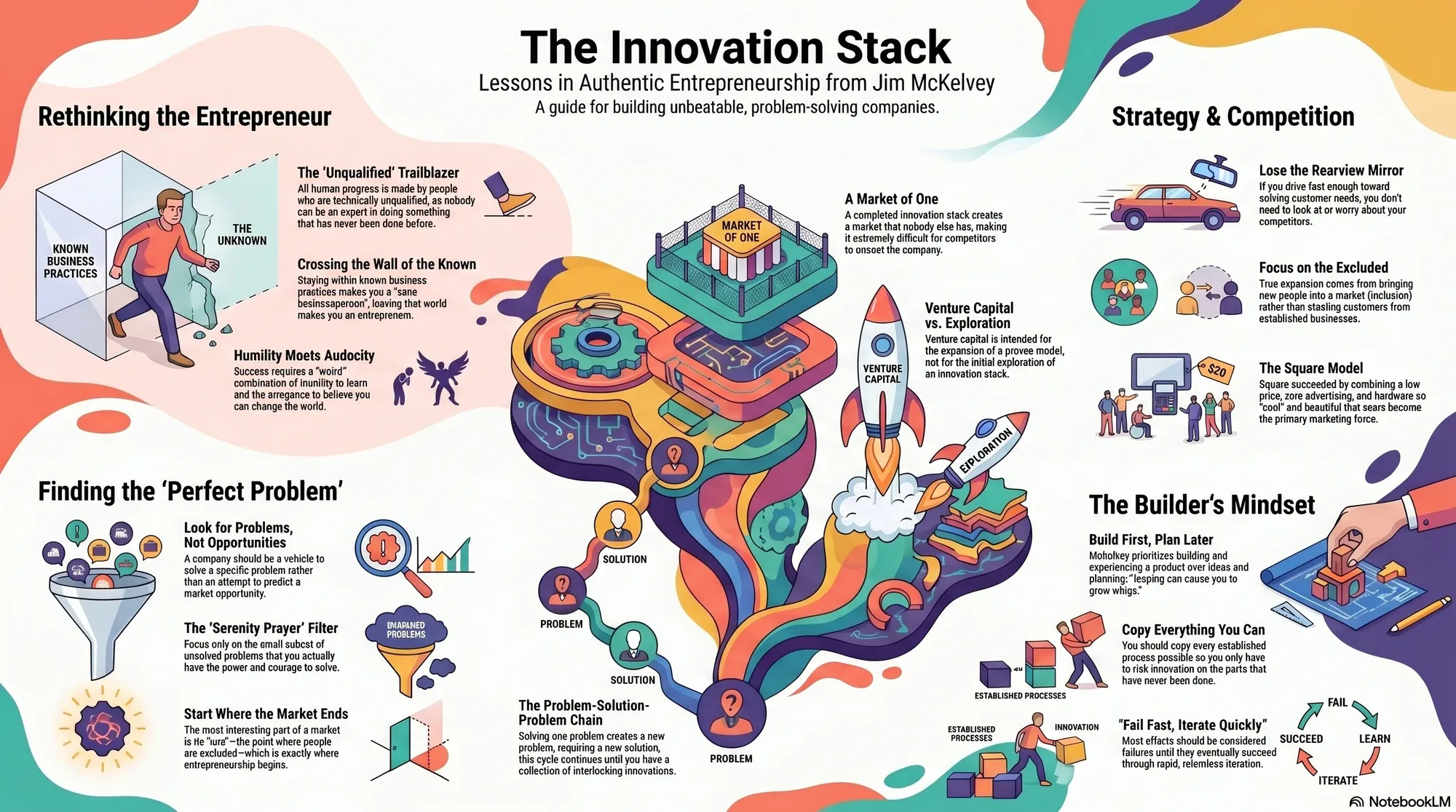
- Expand markets by including people left out: McKelvey argues that many important entrepreneurial ventures create access for people established providers have not served, rather than merely taking incumbent customers. — The Invisible Market.
- Step beyond the established playbook: McKelvey uses a city-wall metaphor to distinguish established business practice from the uncertainty of creating something genuinely new. — Entrepreneurs and Perfect Problems.
- Entrepreneurship once implied a novel undertaking: In McKelvey’s historical framing, an entrepreneur attempted a kind of business that had not previously been proved workable. — Washington University Interview.
- New work has no established expert credential: If a problem has never been solved, no one can be qualified by prior experience with that exact solution; McKelvey treats this as a reason to try, not to ignore useful expertise. — HBR IdeaCast Interview.
- Combine confidence with humility: McKelvey describes continuing through uncertainty and building teams with varied expertise, rather than assuming one person already has every answer. — Diane Hamilton Interview.
- Know when copying is the wrong tool: McKelvey advises copying a working solution when one exists, but says an unsolved problem requires invention rather than pretending a precedent applies. — Thought Economics Interview.
- Notice the pull of familiar examples: McKelvey says copying is normally sensible, yet relying only on prior models can keep capable people from attempting new problems. — Diane Hamilton Interview.
The Innovation Stack
- Interlocking changes can defend a new market: McKelvey describes an innovation stack as several mutually reinforcing changes that are hard for a competitor to copy all at once. — HBR IdeaCast Interview.
- One solution exposes the next problem: Building Square required a sequence of fixes in which solving one obstacle revealed another; McKelvey calls the resulting collection an innovation stack. — HBR IdeaCast Interview.
Problem Solving
- Begin with a real problem: McKelvey urges founders to start with a problem worth solving rather than an abstract opportunity story. — HBR IdeaCast Interview.
- Look for solvable, unsolved problems: His “perfect problems” are problems that have no satisfactory existing solution but that a team can plausibly tackle. — Entrepreneurs and Perfect Problems.
- Let frustration reveal a problem: McKelvey’s inability to accept a credit-card payment for his glasswork gave him and Jack Dorsey a concrete problem to address with Square. — HBR IdeaCast Interview.
- Inspect where a market stops: McKelvey looks for customers excluded by current products and asks why the market has not reached them. — The Invisible Market.
- Caring about the problem sustains effort: McKelvey says personal investment in an unsolved problem can help a founder persist through criticism and uncertainty. — Science of Success Interview.
- Copy when the problem is already solved: Before inventing, McKelvey recommends checking whether a working solution can simply be copied or adapted. — Thought Economics Interview.
Competition and Strategy
- Competitor avoidance is conditional: For a business with a defensible innovation stack, McKelvey argues that attending to customers can matter more than reacting to every competitor move. — Thought Economics Interview.
- Serve customers rather than mimic rivals: McKelvey contrasts creating value for overlooked customers with chasing an incumbent’s product or price point. — The Invisible Market.
- Do not abandon the plan in a copycat attack: When Amazon launched a competing reader, Square continued its planned improvements rather than making a sudden reactive price or product change. — Washington University Interview.
- Aim to expand, not merely disrupt: McKelvey argues that the more interesting opportunity is often serving people excluded by an existing market, not merely taking customers from incumbents. — The Invisible Market.
On Building and Creating
- Show a working thing: McKelvey emphasizes making a usable product to address a real problem rather than relying on a persuasive idea alone. — Diane Hamilton Interview.
- Build while institutional permission catches up: Square developed its product while working through card-network permissions; McKelvey presents this as a concrete case of starting before every requirement was settled, not a promise that leaps always work. — When Is the Most Important Question.
- Build tools across different fields: McKelvey describes a throughline across art, computing, payments and public service: he repeatedly builds tools for problems he encounters. — Insider Interviews Episode.
Failure and Learning
- Treat early failures as iterations: McKelvey describes much of his work as unsuccessful until repeated adjustment eventually produces a working result. — Washington University Interview.
- Study when, not only how: McKelvey recounts having workable answers at the wrong time and says he became more attentive to timing. — When Is the Most Important Question.
- Persist through fear without romanticizing it: McKelvey rejects the fearless-founder myth: his account of entrepreneurship is continuing to work even while afraid. — Diane Hamilton Interview.
- Choose a problem worth sustained effort: Caring deeply about a problem can provide the motivation to keep working through setbacks and criticism. — Science of Success Interview.
Mindset and Perspective
- Question what seems impossible: McKelvey observed that people often assume some feasible ideas are impossible before anyone tries them. — CNN The Next List Transcript.
- Rules are obstacles to work through: McKelvey recounts building Square while seeking the permissions and relationships required to move money; this was an obstacle to solve, not a license to disregard rules. — When Is the Most Important Question.
- Admit uncertainty and keep going: McKelvey says founders may be unqualified for a never-before-solved problem yet can still try to solve it; he pairs that humility with persistence under fear. — Diane Hamilton Interview.
- Expect fear outside familiar practice: McKelvey says pioneering work can be frightening to the founder and to people who care about them, even when the problem is worth attempting. — Thought Economics Interview.
- Art reaches beyond mathematical proof: McKelvey describes art as involving felt qualities that are not fully settled by mathematical demonstration. — CNN The Next List Transcript.
- Glassmaking rewards well-judged risk: McKelvey says the medium gives an artist brief, sometimes irreversible chances to make a move. — CNN The Next List Transcript.
- Turn a weakness into a useful strength: In a later direct conversation, McKelvey suggests that improving one of your weakest qualities can produce an unusually high personal return. — Fast Forward STL Interview.
On Customers and Products
- Know the people you serve: McKelvey’s Square account begins with merchants unable to accept cards and follows the product choices made to serve them. — The Invisible Market.
- Look for excluded customers: People who cannot use the current market’s products can reveal a new customer group and a problem worth solving. — The Invisible Market.
- Make the product explain itself: For Square’s small merchants, McKelvey describes pairing a low-cost offering with an intuitive, distinctive reader and software experience that people could demonstrate to others. — Young and Profiting Interview.
- Design can carry the message: McKelvey says Square’s distinctive reader design helped attract attention and explain a product without a large advertising budget. — Young and Profiting Interview.
Leadership and Advice
- Build teams with unlike strengths: McKelvey says he seeks heterogeneous teams and is comfortable working alongside people whose expertise exceeds his own. — Diane Hamilton Interview.
- Partner with operators: McKelvey distinguishes his early-stage builder role from continuing management and says he relies on managers who are stronger at operating. — Diane Hamilton Interview.
- Hear success stories skeptically: McKelvey cautions aspiring founders to account for luck and context when taking advice from people who have succeeded. — Entrepreneur Conference Report.
Learn more:
- HBR IdeaCast — Square’s Cofounder on Discovering and Defending Innovations
- Jim McKelvey — Entrepreneurs and Perfect Problems (The Innovation Stack excerpt)
- Jim McKelvey — Can You Find the Next Massive Invisible Market? (book excerpt)
- Washington University — The Takeoff Interview with Jim McKelvey
- Science of Success — Jim McKelvey on Innovation Stacks and Perfect Problems
- Diane Hamilton — Entrepreneurship, Risk-Taking, and The Innovation Stack with Jim McKelvey
- Young and Profiting #69 — The Innovation Stack with Jim McKelvey
- Fast Forward STL — Jim McKelvey: From St. Louis to Global Tech Leader
- CNN The Next List — Jim McKelvey Interview Transcript
- Thought Economics — A Conversation with Jim McKelvey
- Jim McKelvey — When Is the Most Important Question for Entrepreneurs?
- Insider Interviews — Jim McKelvey: Disruptive by Design
- Entrepreneur — Jim McKelvey on Skepticism Toward Success Advice
- Jim McKelvey — Official Biography