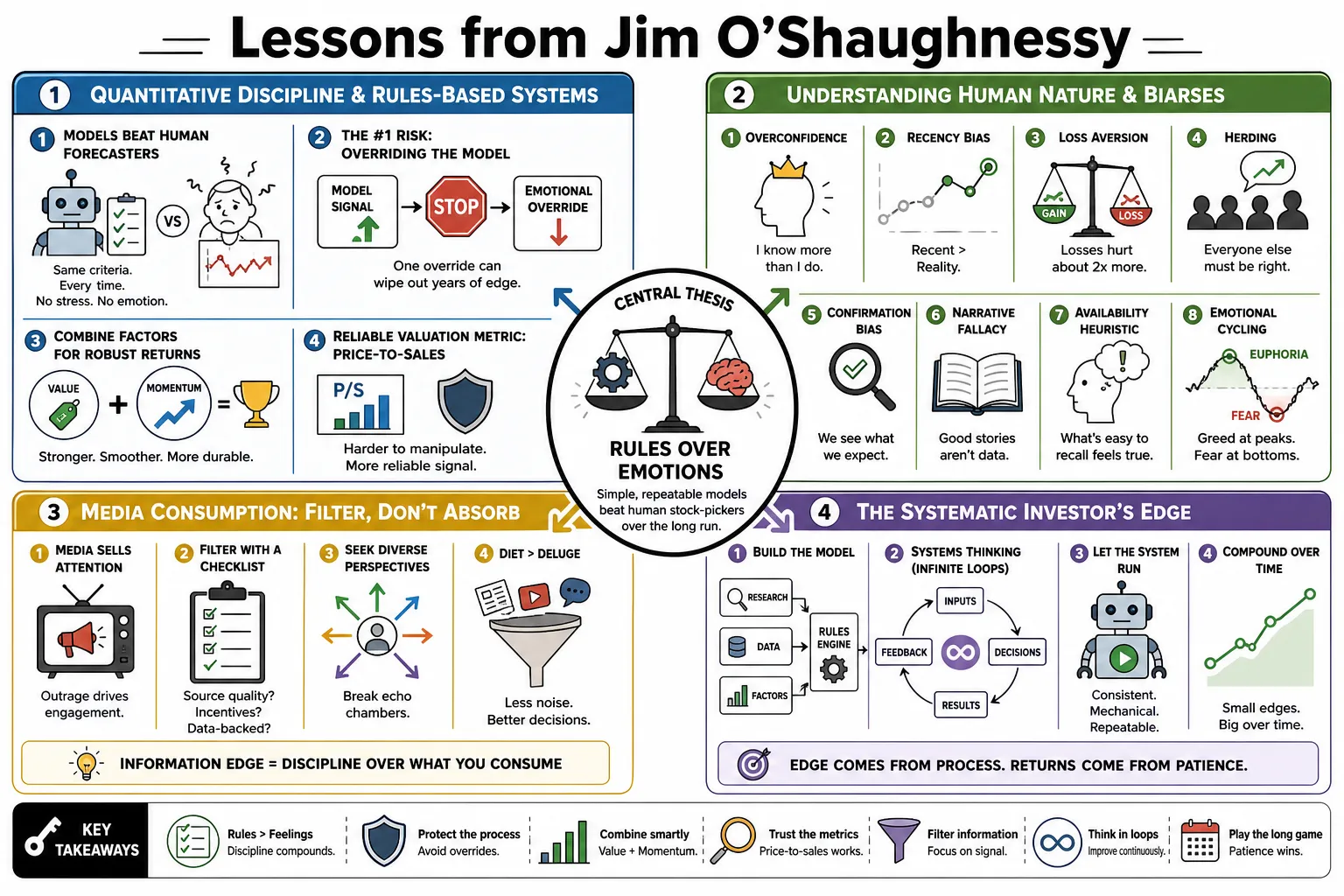
Lessons from Jim O'Shaughnessy
Jim O'Shaughnessy made a career proving that simple, rules-based investment models beat human stock-pickers. From his book What Works on Wall Street to the Infinite Loops podcast, he tracks how cognitive biases warp markets and everyday decisions alike. This collection brings together his arguments on quantitative discipline and media consumption, all rooted in a pragmatic view of human nature.
Part 1: Quantitative Discipline and Rules-Based Systems
- On the superiority of models: "Models beat human forecasters because they reliably apply the same criteria to every decision without getting stressed or emotional." — Source: What Works on Wall Street
- On the primary risk for quants: "I know that as a systematic, rules-based quantitative investor, I can negate my entire track record by just once emotionally overriding my investment models." — Source: Medium
- On factor combinations: "Combining value and momentum factors provides a far more robust return profile than relying on any single metric alone." — Source: What Works on Wall Street
- On valuation metrics: "Price-to-sales is consistently one of the most reliable valuation metrics because it is far harder for management to manipulate top-line revenue than bottom-line earnings." — Source: What Works on Wall Street
- On process over prediction: "Successful investing is not about trying to predict an unknowable future, but about executing a repeatable process with a known statistical edge." — Source: Infinite Loops
- On base rates: "Investors habitually ignore base rates in favor of compelling specific details, a math error that guarantees long-term underperformance." — Source: Twitter / @jposhaughnessy
- On tracking outcomes: "We remember our winners and conveniently forget our losers. The only way to combat this is to rigorously document every trade and the reason for making it." — Source: 25iq Interview
- On complex markets: "The market is a complex adaptive system. Treating it like a predictable machine leads to fragility; treating it probabilistically leads to resilience." — Source: Infinite Loops
- On avoiding interference: "Algorithms don't get hungover, they don't get divorced, and they don't panic when the market drops three percent in an hour." — Source: Masters in Business
- On historical data: "You need fifty years of data to truly test an investment strategy. Anything less is just capturing a single market regime." — Source: What Works on Wall Street
Part 2: Arbitraging Human Nature
- On the ultimate edge: "Arbitrage human nature. The markets change minute to minute, but human nature barely budges millennia by millennia." — Source: Johnathan Bi Interview
- On biological wiring: "We are biologically wired to be terrible investors. Our fight-or-flight response forces us to sell at the bottom and our greed forces us to buy at the top." — Source: The Long View
- On the four horsemen: "The four horsemen of the investment apocalypse are fear, greed, hope, and ignorance. They have destroyed more wealth than any bear market." — Source: Twitter / @jposhaughnessy
- On emotional gating: "You cannot eliminate your emotions, but you can build systems that act as a gate, preventing those emotions from affecting your portfolio." — Source: O'Shaughnessy Ventures
- On historical panics: "Read about the South Sea Bubble or the Tulip Mania. The assets change, but the psychological progression of a bubble is permanently identical." — Source: Infinite Loops
- On seeking comfort: "Doing what feels comfortable is usually a terrible investment strategy. High returns are the compensation you receive for bearing discomfort." — Source: Masters in Business
- On overconfidence: "We systematically overestimate our own abilities while underestimating the role of luck in our successes." — Source: 25iq Interview
- On loss aversion: "The pain of losing a dollar is mathematically twice as intense as the joy of making a dollar, which warps our ability to take rational risks." — Source: What Works on Wall Street
- On social proof: "It is incredibly painful for humans to stand apart from the crowd. We would rather fail conventionally than risk succeeding unconventionally." — Source: The Long View
- On self-awareness: "The hardest person to fool is anyone else, and the easiest person to fool is yourself." — Source: Infinite Loops
Part 3: The Danger of Narratives and Stories
- On storytelling vs. math: "Humans are narrative engines. We prefer a good story over cold, hard statistics, and Wall Street exploits this flaw relentlessly." — Source: Masters in Business
- On the illusion of expertise: "Pundits sound incredibly confident explaining why the market moved today, but their narratives are just retrofitted fiction over random noise." — Source: Twitter / @jposhaughnessy
- On chasing trends: "By the time a compelling story about a new paradigm reaches the retail investor, the underlying asset is already massively overpriced." — Source: What Works on Wall Street
- On confirmation bias: "Once we adopt a narrative, we actively filter the world to find data that proves us right, discarding any evidence that contradicts our position." — Source: Infinite Loops
- On charismatic leaders: "Beware the charismatic CEO with a great story. You want to invest in boring businesses generating cash, not a visionary promising a revolution." — Source: 25iq Interview
- On financial media: "The daily financial news is optimized for engagement, not accuracy. Its goal is to make you anxious so you keep watching." — Source: Twitter / @jposhaughnessy
- On simple explanations: "Complex systems rarely have single causes. Beware of anyone offering a simple, clean narrative to explain macroeconomic shifts." — Source: Infinite Loops
- On the danger of 'this time is different': "The four most dangerous words in investing are not 'this time is different,' but rather 'it's a new paradigm.'" — Source: What Works on Wall Street
- On discarding old rules: "People abandon proven strategies the moment a new story arrives, confusing temporary underperformance with permanent irrelevance." — Source: The Long View
- On factual anchoring: "When the narrative gets loud, look at the underlying cash flows. Numbers are a highly effective antidote to hysteria." — Source: Masters in Business
Part 4: Patience and the Long Game
- On waiting for pitches: "If there's nothing to do, do nothing. Our success rests on having the discipline to wait patiently for opportunities to present themselves." — Source: Masters in Business
- On the difficulty of discipline: "Finding a winning strategy is easy; sticking with it when it underperforms the benchmark for three years is almost impossible." — Source: What Works on Wall Street
- On compounding: "Time is the only true arbitrage left. If your time horizon is decades rather than months, you are playing an entirely different game than Wall Street." — Source: Infinite Loops
- On surviving drawdowns: "You must design your portfolio not just for optimal returns, but for your personal capacity to endure a fifty percent drawdown without selling." — Source: The Long View
- On short-term noise: "Measuring your portfolio's performance daily is the financial equivalent of pulling up a plant by its roots every day to see if it's growing." — Source: Twitter / @jposhaughnessy
- On contrarian action: "It requires immense courage to run towards the fire when everyone else is running away, but that is where the premium returns are hidden." — Source: Masters Invest
- On market cycles: "The market is a pendulum that swings between irrational exuberance and unjustified despair. The patient investor waits at the extremes." — Source: 25iq Interview
- On evaluating managers: "Judging an investment strategy over a one-year period is statistically meaningless. You are measuring noise, not skill." — Source: What Works on Wall Street
- On eventual vindication: "Value investing will always work eventually, because cash flows matter. The problem is that 'eventually' can outlast your career or your clients' patience." — Source: Masters in Business
Part 5: Upgrading the Human Operating System
- On continuous evolution: "Stasis is death. The moment you decide you have it all figured out is the moment the world passes you by." — Source: Infinite Loops
- On mental models: "We operate on a biological software program shaped by the Pleistocene era. Upgrading your 'HumanOS' requires consciously installing new mental models." — Source: The Long View
- On adaptability: "The most important skill for the 21st century is the ability to rapidly unlearn outdated information and adapt to new paradigms." — Source: O'Shaughnessy Ventures
- On the great filter: "The internet is a great filter. If you have a specific, quirky interest, you can now find the ten thousand other people in the world who share it." — Source: Infinite Loops
- On intellectual humility: "Strong opinions, weakly held. You must be willing to abandon your most cherished beliefs the moment the data proves them wrong." — Source: Twitter / @jposhaughnessy
- On reading broadly: "Do not just read within your discipline. The best insights come from applying the frameworks of biology or history to financial markets." — Source: 25iq Interview
- On confronting errors: "Write down your predictions. When you are wrong, conduct a post-mortem to figure out where your thinking broke down." — Source: Masters in Business
- On agency: "Optimism is a choice, and agency is a muscle. You have significantly more control over your trajectory than default societal narratives suggest." — Source: Infinite Loops
- On the power of the internet: "We are living through a Gutenberg-level event. The friction to access the world's best minds has dropped to zero." — Source: O'Shaughnessy Ventures
Part 6: Navigating Information and Media
- On media consumption: "Guard your attention fiercely. The media ecosystem is designed to exploit your amygdala, keeping you in a state of perpetual outrage." — Source: Twitter / @jposhaughnessy
- On filtering noise: "Ninety-nine percent of financial news is noise meant to provoke a transaction. True signal is rare and usually found in historical data." — Source: What Works on Wall Street
- On the Lindy Effect: "Read old books. If a piece of wisdom has survived for two thousand years, it has Lindy properties and is likely to be true tomorrow." — Source: Two Thoughts
- On information diets: "Treat your information diet the same way you treat your food diet. Consuming junk information will make your mind sluggish and reactive." — Source: Infinite Loops
- On algorithms: "Social media algorithms optimize for engagement, which correlates highly with tribalism and anger. You have to curate your feed aggressively to find the signal." — Source: O'Shaughnessy Ventures
- On historical perspective: "When you read history, you realize that the 'unprecedented' crises we face today have all happened before in slightly different clothing." — Source: The Long View
- On expert predictions: "The track record of geopolitical and economic forecasters is worse than a coin flip. Stop paying attention to predictions and focus on process." — Source: Masters in Business
- On independent thought: "To think independently, you must first disconnect from the real-time stream of consensus opinion." — Source: Twitter / @jposhaughnessy
- On the value of fiction: "Fiction often contains more profound truths about human behavior and motivation than non-fiction." — Source: Infinite Loops
Part 7: Wealth Creation and Risk
- On the nature of risk: "Risk is not volatility. Risk is the permanent loss of capital, usually caused by buying a bad business at an inflated price during a mania." — Source: What Works on Wall Street
- On downside protection: "The math of investing is brutal. If you lose fifty percent of your capital, you need a one hundred percent return just to get back to even." — Source: Masters in Business
- On index funds vs. stock picking: "For the vast majority of people, low-cost index funds are the best solution. Only those with a proven, disciplined edge should attempt active management." — Source: 25iq Interview
- On survival: "In order to compound your wealth over decades, you must first ensure you survive the short-term shocks. Survival is the prerequisite for success." — Source: The Long View
- On the definition of wealth: "Wealth is not just a number on a balance sheet; it is the freedom to control your own time and associate with people you respect." — Source: Infinite Loops
- On saving vs. investing: "You cannot invest your way out of a bad savings rate. Wealth creation starts with spending less than you earn." — Source: Twitter / @jposhaughnessy
- On asymmetric bets: "Look for opportunities where the downside is strictly capped, but the upside is virtually unlimited. That is how fortunes are made." — Source: O'Shaughnessy Ventures
- On concentration vs. diversification: "Diversification preserves wealth, but concentration builds it. However, concentration without a mathematical edge is just gambling." — Source: What Works on Wall Street
- On market efficiency: "The market is highly efficient most of the time. It only becomes wildly inefficient at the extremes of fear and greed." — Source: Masters in Business
Part 8: Lifelong Learning and Evolution
- On changing your mind: "The measure of your intelligence is how quickly you can update your priors when presented with undeniable contrary evidence." — Source: Infinite Loops
- On curiosity: "Curiosity is the ultimate compounding asset. A relentless desire to understand how the world works pays dividends across your entire life." — Source: The Long View
- On mentoring: "The best way to solidify your own knowledge is to teach it to someone else. Mentorship is a two-way street of learning." — Source: O'Shaughnessy Ventures
- On learning from failure: "Success teaches you almost nothing. It is your failures, properly analyzed without ego, that provide the roadmap for improvement." — Source: Twitter / @jposhaughnessy
- On exploring the frontier: "All the interesting developments are happening at the edges of disciplines, where different fields intersect and cross-pollinate." — Source: Infinite Loops
- On intellectual honest: "Admitting 'I don't know' is a superpower. It frees you from the burden of defending a position and allows you to start learning." — Source: Masters in Business
- On surrounding yourself with talent: "If you are the smartest person in the room, you are in the wrong room. Seek out people who challenge your baseline assumptions." — Source: 25iq Interview
- On timeless wisdom: "The technology we use changes constantly, but the philosophical frameworks required to live a good life were figured out by the Stoics millennia ago." — Source: Two Thoughts
- On the future: "Despite the constant drumbeat of pessimism in the media, betting against human ingenuity over the long term has always been a losing trade." — Source: The Long View