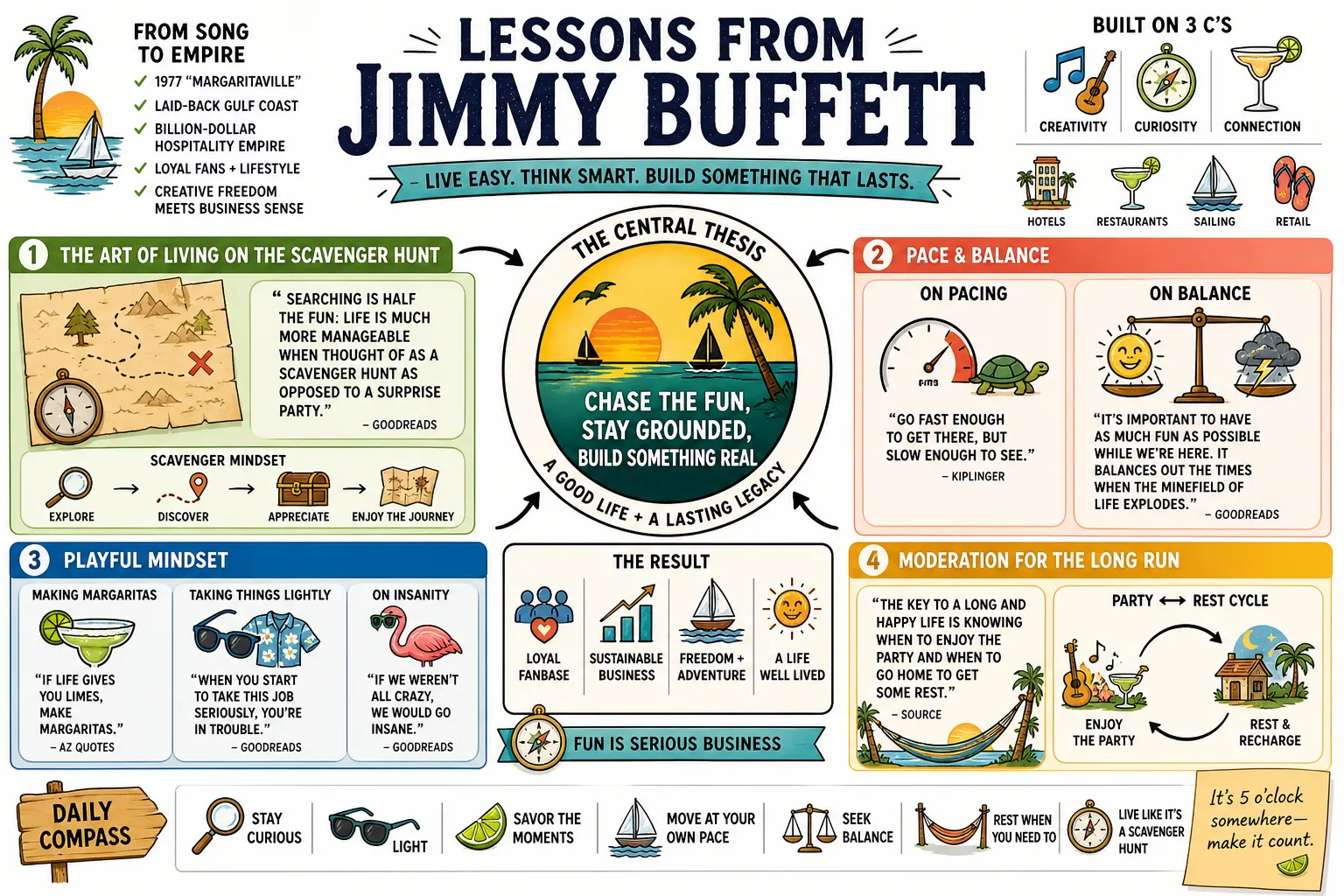
Lessons from Jimmy Buffett
Jimmy Buffett turned his 1977 hit “Margaritaville” into a long-running musical career and, later, a hospitality and lifestyle business. His songs drew on Gulf Coast upbringing, Key West, sailing and travel, while his concerts cultivated a devoted Parrothead audience. These lessons separate his own words and songs from the many maxims later attributed to him online. — Jimmy Buffett Official Biography.
Part 1: The Art of Living
- On Pacing: In his co-written song “Barometer Soup,” Buffett contrasts reaching a destination with moving slowly enough to notice the journey. — Barometer Soup — Official Lyrics.
- On Balance: Buffett said that even amid serious events, people need occasional fun and a rest from what is happening around them. — CBS Sunday Morning Interview.
- On Taking Things Lightly: Buffett said his small acting roles were fun and that he did not take that sideline as seriously as his music career. — Vice Interview.
- On Happiness: In the co-written song “Happily Ever After (Now and Then),” Buffett treats happiness as something found in moments rather than a permanent state. — Banana Wind — Official Lyrics.
Part 2: Business and the Margaritaville Empire
- On Selling Emotion: Margaritaville co-founder John Cohlan said the brand's transferable product was the feeling associated with Buffett's music, not just a restaurant or shirt. — Economic Club of Florida Podcast.
- On Warren Buffett's Advice: Buffett recalled Warren Buffett asking whether a proposed deal would actually change his life; he then walked away from a Disney arrangement that demanded too much of him. — Men’s Journal Interview.
- On Protecting Your Ideas: Buffett said counterfeit shirts and disputes over song-title rights pushed him to control merchandise and protect names associated with his work. — Washington Post Interview.
- On Strategic Partnerships: When a large restaurant opportunity emerged, Buffett brought in John Cohlan to help turn Margaritaville from a few venues into a company rather than simply licensing the name. — Economic Club of Florida Podcast.
- On Reading the Room: When record sales flattened while concert attendance grew, Buffett responded by developing merchandise and brand partnerships rather than assuming the album market would recover. — Washington Post Interview.
- On The Illusion of Laziness: Buffett credited the work ethic his parents instilled in him and described success as mostly sustained effort, with some talent and luck. — Vice Interview.
- On Attention to Detail: For the Broadway musical, Buffett said he paid attention to the lobby bars as well as the performance because the whole audience experience mattered. — Hollywood Reporter Interview.
- On Knowing Your Customer: Buffett attributed much of his career to a live connection with audiences built during years of playing small venues, not to a string of chart hits. — Pollstar Interview.
- On Willingness to Fail: Buffett said early performers must handle rejection and failure before they can handle success; he remembered continuing to perform even to very small audiences. — Pollstar Interview.
- On Professional Evolution: Buffett said he learned to run his own band and business because no one else would, while still trying to preserve his independent artistic identity. — Washington Post Interview.
Part 3: Resilience and Moving On
- On Acceptance: The co-written song “Breathe In, Breathe Out, Move On” uses a present-focused refrain in the aftermath of Hurricane Katrina. — Take the Weather With You — Official Lyrics.
- On Adventure and Risk: In his memoir of travel at fifty, Buffett presents adventurous life as including genuine danger as well as pleasure; the legacy quotation should not be presented without a checked book passage. — A Pirate Looks at Fifty — Author Excerpt.
- On Dealing with Fear: Buffett said that when stage fright arrived, he acknowledged it and went on rather than pretending it was absent. — Men’s Journal Interview.
- On Letting Go of the Past: In “Changes in Latitudes, Changes in Attitudes,” Buffett's narrator turns from looking backward toward places and experiences still ahead. — Changes in Latitudes — Official Lyrics.
- On Unpredictability: The fictional older traveler in Buffett's song “He Went to Paris” looks back on a life containing both tragic and rewarding episodes; this is songwriting, not Buffett's autobiography. — He Went to Paris — Official Lyrics.
- On Enduring Hardship: When the pandemic disrupted touring, Buffett urged patience and waiting for a safe return rather than forcing the schedule. — Official Tour Postponement Statement.
Part 4: Aging and Time
- On Staying Young: Buffett's song “Growing Older But Not Up” treats aging as compatible with curiosity and playfulness. — Coconut Telegraph — Official Lyrics.
- On Maturity: At 73, Buffett looked to older entertainers still working and saw continuing creative work as a reason to keep going. — CBS Sunday Morning Interview.
- On Time Management: Buffett argued that the leisure pictured in his music depended on taking care of business first, not on abandoning business for the beach. — Washington Post Interview.
- On Pivoting in Mid-Life: By fifty, Buffett wrote that he had quit drugs and tried to slow down, even as he continued touring, flying and writing. — A Pirate Looks at Fifty — Author Excerpt.
- On Navigating the Decades: Buffett used a Caribbean journey for his fiftieth birthday as the framework for a travelogue that mixed travel observations with memories. — A Pirate Looks at Fifty — Author Excerpt.
Part 5: Escapism and Imagination
- On The Need for Fantasy: Buffett explicitly described his performances as escapism that people need, especially in difficult periods. — Pollstar Interview.
- On Reading and Dreaming: Buffett recommended being a good reader, saying books let him learn even though he considered himself shy. — Men’s Journal Interview.
- On Storytelling: Buffett described himself as an embellisher and said songwriters and prose writers sometimes expand the literal truth when telling stories. — Men’s Journal Interview.
- Listen to find stories: Buffett said that finding stories for songs required listening to other people and recognizing that his own view was fallible. Storytelling, in his account, started with attention to others rather than only personal invention. — Jimmy Buffett — Copley News Service Interview
- On Music as a Vehicle: Buffett said healthcare workers had used his music to calm themselves and described songs as giving listeners a short respite from serious events. — CBS Sunday Morning Interview.
Part 6: The Ocean and Adventure
- On Exploration: Buffett said his seafaring family inspired him to see the world, and he kept touring partly because he loved travel. — Pollstar Interview.
- On The Value of the Ocean: Buffett said daily time in the water, through surfing or swimming, was his own way of staying active as he aged. — Men’s Journal Interview.
- On Aviation: Buffett's flying, especially in seaplanes, was a long-standing pursuit alongside music and writing; the source does not establish an “absolute freedom” motive. — Florida Artists Hall of Fame Biography.
- On Local Culture: Buffett said time on boats and in Caribbean places supplied material for songs and deepened his interest in those cultures. — WTOP Interview on JimmyBuffett.com.
- On Sailing: Buffett likened managing a touring crew to running a boat: people matter, destinations may change, and a captain must adapt. — Pollstar Interview.
Part 7: Authenticity and Identity
- On Being Genuine: Buffett insisted that writers of his stage musical know the songs and the Parrothead culture, not merely take a writing assignment. — WTOP Interview on JimmyBuffett.com.
- On Defining Your Own Success: Buffett valued his loyal fan base over industry prizes and continued to build shows around what his audience enjoyed. — Hollywood Reporter Interview.
- On Coastal Roots: Buffett's Gulf Coast upbringing and his grandfather's sea stories shaped the places and characters that later appeared in his music. — Jimmy Buffett Official Biography.
- On Unapologetic Living: Buffett said he would not apologize for being a capable businessman even as he retained the independent spirit associated with his music. — Washington Post Interview.
- On Trusting Your Gut: In “Cowboy in the Jungle,” Buffett's narrator favors intuition and adjusting to events over blind ambition; the song does not claim that business decisions should be effortless. — Son of a Son of a Sailor — Official Lyrics.
Part 8: Perspective and Optimism
- On Finding the Good: During the pandemic, Buffett looked for modest silver linings while acknowledging the tragedy rather than denying it. — CBS Sunday Morning Interview.
- On Laughter as Medicine: In “Changes in Latitudes, Changes in Attitudes,” humor is the narrator's response to uncertainty and relentless change. — Changes in Latitudes — Official Lyrics.
- On Environmental Stewardship: After the Gulf oil spill, Buffett asked who could clean the damage and how he could help, rather than only dwelling on what had been lost. — CNN Gulf Spill Interview.