Joe Dispenza teaches meditation and habit-change practices that combine mental rehearsal, attention, and emotion. He has coauthored exploratory research on a retreat combining meditation and other activities; that small observational study does not establish that his method cures disease. — Communications Biology — 2025 Retreat Study.
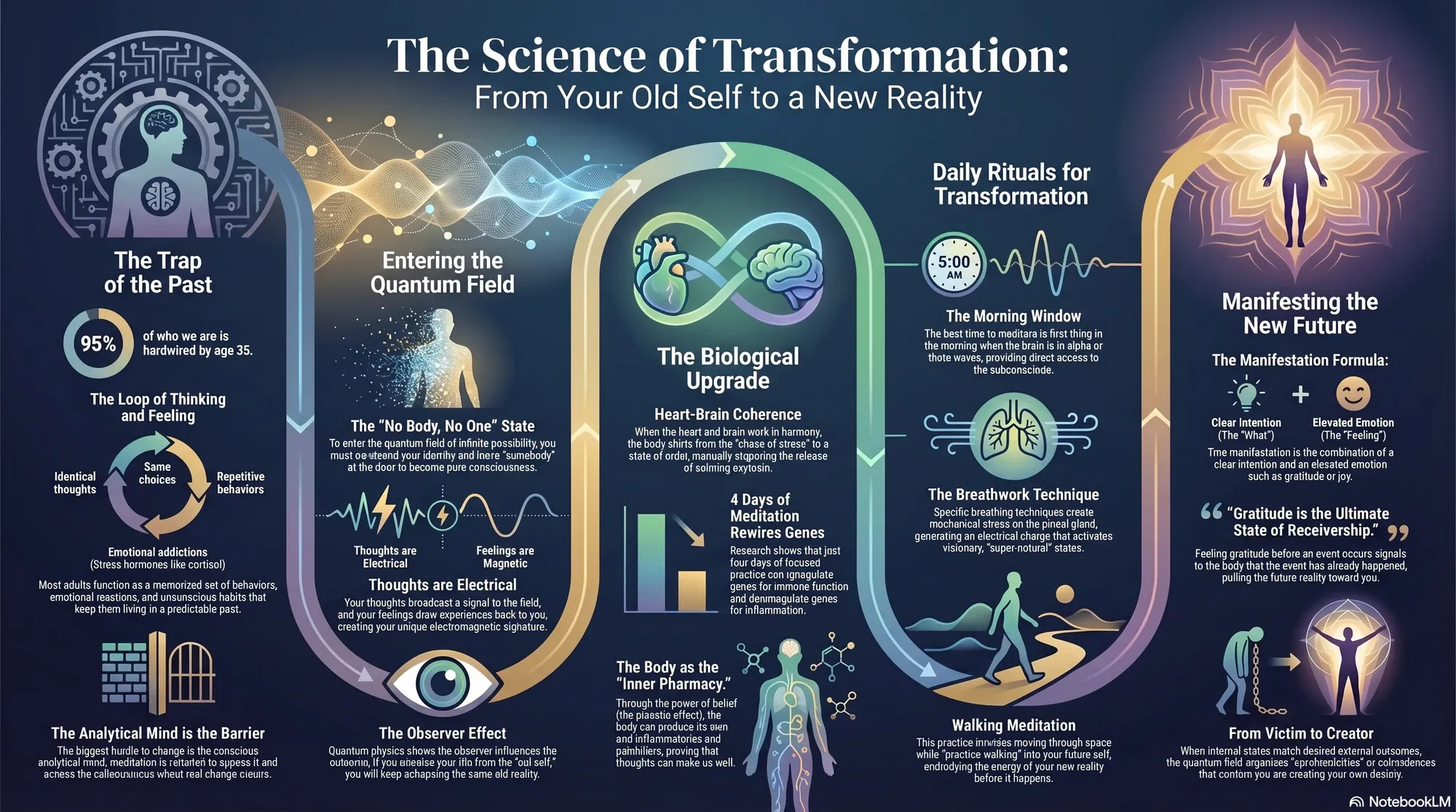
Part 1: The Neuroscience of Habit and the Past
- On Neuroplasticity: Dispenza describes neuroplasticity as the brain’s capacity to reorganize connections through learning and experience; he urges practice rather than treating new information alone as change. — Evolve Your Brain — Dispenza Interview.
- On Repeated Patterns: Dispenza asks students to notice recurring thoughts, behaviors, and emotional reactions, then deliberately rehearse alternatives during meditation. — Back to Basics.
- On Automatic Habits: Dispenza teaches that repeated thoughts and behaviors can become automatic, and that noticing them is a first step toward changing a habit. The old 95-percent-by-age-35 figure is not retained. — Back to Basics.
- On Stress Patterns: Dispenza describes a recurring cycle of thought and emotion that can keep a person reacting in familiar ways; he recommends noticing the pattern during meditation. This is his practice framework, not a clinical diagnosis of hormone addiction. — Back to Basics.
- On Personal Reality: A central premise of Dispenza’s teaching is that personality includes patterns of thinking, acting, and feeling; he asks students to change those patterns when seeking a different life. — Back to Basics.
- On Practicing Beyond Familiar Feelings: Dispenza encourages people to identify familiar emotional reactions and rehearse how they would rather respond, instead of automatically repeating past patterns. — Back to Basics.
- On Observing the Analytical Mind: Dispenza uses meditation to notice habitual thoughts before they pass unchecked; he describes this as becoming conscious of automatic mental programs, not as bypassing a scientifically defined barrier. — Back to Basics.
- On Changing Routines: Dispenza describes learning new skills and having novel experiences as ways to move beyond habitual routines; he emphasizes applying knowledge rather than only acquiring it. — Evolve Your Brain — Dispenza Interview.
- On Unused Neural Circuits: Dispenza uses neural pruning to explain why repeatedly practicing new responses may matter more than merely deciding to think differently; the original quote is not independently verified. — The Four Pillars of Healing.
Part 2: The Quantum Field and Energy
- On the Quantum Field in His Teaching: Dispenza calls an imagined realm beyond ordinary sensory awareness the “quantum field” in his meditation teaching. This describes his spiritual framework, not an established route to influence external events. — The Quantum Field — Dispenza.
- On Combining Thought and Feeling: Dispenza’s exercise pairs a clear intention with an elevated emotion. He describes the pairing in electrical and magnetic language, but the page does not demonstrate that thoughts broadcast a reality-changing signal. — Tuning In With Your Heart.
- On Stepping Back From Identity: Dispenza asks meditators to set aside attention to their body, surroundings, and familiar roles—his “no body, no one” practice—to focus on an imagined new possibility. — Changing Boxes Walking Meditation.
- On Imagining Alternatives: In Dispenza’s walking-meditation exercise, participants imagine a different future and then practice moving through daily life as the person they hope to become. It does not establish that alternate lives physically pre-exist. — Changing Boxes Walking Meditation.
- On Interpreting Coincidences: Dispenza interprets coincidences as encouraging signs during his future-focused practice. This is his interpretation, not evidence that a quantum field arranged the events. — For Those Feeling Stuck.
Part 3: Heart-Brain Coherence and Emotional Regulation
- On Heart-Focused Attention: Dispenza asks meditators to slow their breathing, place attention around the heart, and cultivate emotions such as gratitude and compassion. This describes his practice, not a verified claim about the direction of nerve signals. — Accessing the Heart’s Intelligence.
- On Coherence as Practice: In Dispenza’s teaching, coherence refers to practicing self-regulation and generating a chosen emotional state rather than waiting for circumstances to dictate it. — Emotions as Tools of Creation.
- On Practicing Elevated Emotions: Dispenza suggests deliberately practicing gratitude, joy, love, and compassion rather than waiting for an external event to evoke them. His advice does not establish that an imagined future event has already occurred. — Accessing the Heart’s Intelligence.
- On Noticing Stress Patterns: Dispenza describes prolonged alertness as a stress pattern and encourages readers to notice when they are reacting from it. The original high-beta brainwave metaphor is not verified here. — The Power of Gratitude.
- On Heart-Centered Meditation: His practical instruction is to find a quiet moment, slow the breath, attend to the heart area, and cultivate an emotion such as gratitude. The source does not establish that this manually triggers oxytocin release. — Accessing the Heart’s Intelligence.
- On Emotional Regulation: Dispenza frames emotional regulation as a skill: practice generating a chosen feeling and, when a difficult mood returns, aim to recover more quickly rather than expecting constant calm. — Emotions as Tools of Creation.
- On Appreciation: Dispenza includes appreciation among the emotions he asks people to cultivate during heart-focused practice. His uncontrolled workshop report is not sufficient to establish that appreciation strengthens immunity or lowers cortisol. — Accessing the Heart’s Intelligence.
- On Letting Go of Resentment: In a meditation instruction, Dispenza suggests noticing resentment and practicing a shift toward gratitude. The original poison aphorism is not presented as his quote. — Feeling Into Your Future.
- Turn Inner Work Into Care for Others: Dispenza urges his community to reach out, check on one another, and offer practical support and connection—not to limit its practice to private or remote meditation. This is his advice about conduct, not evidence that group intention heals others at a distance. — Community, Culture, and Care — Part II
Part 4: The Power of Belief and the Placebo Effect
- On the Inner Pharmacy Metaphor: Expectation can influence some bodily experiences, including pain: controlled placebo experiments found changes in reported pain and pain-related brain activity. That narrow finding does not mean belief can replace antidepressants, anti-inflammatories, or other prescribed treatment. — Wager et al. — Placebo Pain Study.
- On Chronic Stress and Health: Long-term stress can contribute to or worsen some health problems. The original claim that 75–90 percent of illness is stress-related, or that changing thoughts alone reverses illness, is not established by this evidence. — NCCIH — Stress.
- On Conditioning and Expectation: Dispenza distinguishes two contributors to placebo responses: conditioning from past associations and expectation about what may happen next. This is a framework for understanding responses, not a promise that belief can recondition disease away. — The Band-Aid and Placebo Response.
- On Practicing a New Belief: Dispenza asks students to identify a habitual thought or belief, choose an alternative, and mentally rehearse the behavior that would express it. The exercise targets habits of response, not guaranteed changes to external events. — Back to Basics.
- On Mental Rehearsal: In a five-finger motor-skill experiment, mental practice changed measured motor-cortex responses. That is a specific learning result, not proof that the brain treats every imagined event exactly like a real one. — Pascual-Leone et al. — Motor Practice Study.
- On Rehearsing a Future Response: Dispenza’s meditation exercise asks people to imagine how they want to act and feel in future situations, then rehearse that response. The exercise is documented; a claim that it biologically makes a future event real is not. — Back to Basics.
- On the Placebo Effect: The placebo effect describes a beneficial response associated with expecting an intervention to help. It is a reason to study expectations carefully, not evidence that a person can reliably treat any illness by becoming their own placebo. — NCCIH — Placebo Effect.
- On Studying Remission Stories: Dispenza says he investigated hundreds of case histories of spontaneous remission as part of his interest in mind–body change. Those histories do not establish that changing personality caused the remissions. — Becoming Divine.
Part 5: Becoming Supernatural and Advanced States
- On Pineal-Focused Meditation: Dispenza includes attention to the pineal gland in a meditation aimed at vivid inner experience. The practice is documented, but the claim that the gland converts signals from a unified field into imagery is not established. — A Practical Guide to Chasing the Mystical.
- On Measured Brainwave Changes: In a coauthored study of novice meditators at a three-day workshop, EEG gamma-band power rose from pre- to end-meditation measurements. This preliminary brainwave finding does not establish mystical experience or clinical healing. — Stapleton et al. — Meditation EEG Study.
- On Stepping Beyond the Familiar Self: Dispenza describes a contemplative exercise of loosening attention to familiar roles and self-concepts so that an inner experience feels less constrained by the usual identity. This is a description of his practice, not evidence of becoming a disembodied consciousness. — A Practical Guide to Chasing the Mystical.
- On Blessing the Energy Centers: His guided practice directs attention to eight named energy centers, one at a time. The center map belongs to his meditation framework; the cited description does not establish that the exercise restores autonomic balance or treats disease. — Blessing the Energy Centers.
- On Mystical Experience as an Inner Event: Dispenza describes mystical experience as a vivid inner event rather than an action a meditator can simply force. That account concerns subjective experience; it does not demonstrate entry into a physical field beyond ordinary space. — A Practical Guide to Chasing the Mystical.
Part 6: Epigenetics and Biological Rewiring
- On Genes and Environment: Genes matter, but health is also shaped by behavior and environment, and epigenetic processes can alter how genes are expressed. This does not mean thought alone can override inherited risks or treat disease. — CDC — Epigenetics and Health.
- On Measured Gene-Expression Changes: A small, non-preregistered twin pilot at Dispenza’s seven-day retreat measured changes in blood gene expression and related markers. It did not establish that four days of meditation selectively strengthen immunity or suppress inflammation. — Twin Retreat Pilot Study.
- On Telomere Research: Across small meditation studies, a meta-analysis found tentative evidence that meditation groups had longer telomeres than comparison groups; the effect shrank when an outlier was removed. This is not evidence that Dispenza’s retreats reverse aging. — Meditation and Telomere Meta-analysis.
- On a Preliminary IgA Observation: Dispenza reports that 120 retreat attendees practiced gratitude and other emotions while his team measured immunoglobulin A and cortisol before and after the event. Without a controlled, isolated intervention, those measurements cannot show that ten minutes of gratitude alone boosts immunity. — The Transformational Power of Gratitude.
- On Studying Bloodborne Factors: A coauthored lab study found that plasma from experienced retreat meditators affected entry of a SARS-CoV-2 pseudovirus into cultured lung cells. That result concerns a cell assay; it does not establish that thoughts direct tissue repair or prevent human infection. — Meditator Plasma Cell-Assay Study.
Part 7: Practical Meditation and Daily Rituals
- Morning Intention: Dispenza recommends starting the day by setting an intention for how to think and act. This documents his routine, not a uniquely effective alpha/theta window. — Morning and Evening Meditations.
- Walking Meditation: His walking meditation moves from eyes-closed contemplation to practicing intended behavior while walking with eyes open. It is an exercise in carrying intention into daily action. — You’re Worth the Walk.
- His Breath Practice: Dispenza includes a named breath practice intended to help participants remain alert while relaxing. The claimed transfer of energy from lower centers into the brain is his model, not an established physiological effect. — Inspire, Volume 2.
- Sitting With Distraction: Dispenza advises sitting, relaxing the body, and noticing the urge to analyze whether meditation is working. His guidance is to return to the exercise, not treat ordinary distraction as failure. — Demystifying the Meditation Process.
- Closing the Eyes: His guidance uses closed eyes to reduce attention to immediate surroundings and turn attention inward. The specific claim that this removes 80 percent of sensory input is not verified. — You’re Worth the Walk.
- Noticing Resistance: Dispenza describes noticing excuses that arise before a planned practice, then deciding whether to keep the commitment. The dog-training analogy and old-self claim are not retained. — You’re Worth the Walk.
- Open Attention: One of his meditation instructions is to broaden attention beyond one object and rest awareness on space or absence. The source documents the exercise, not a measured stress-to-coherence shift. — Demystifying the Meditation Process.
- Evening Reflection: His evening exercise asks people to review their responses during the day and decide what to practice differently tomorrow. That is reflective practice, not proof of neural rewiring from a single review. — Morning and Evening Meditations.
- Repeating the Practice: Dispenza treats meditation as a practice developed by repeatedly showing up, including when it is tempting to postpone. He does not establish that a fixed number of hours guarantees a particular outcome. — You’re Worth the Walk.
- Track the Actions That Matter: Dispenza suggests keeping a visible chart or daily ledger of the actions tied to a chosen change, then returning to the routine after a missed day rather than treating the lapse as failure. — Making Change Stick
- Place Reminders in Your Environment: He also recommends placing notes, images, or other reminders where they will be seen during the day, so the intended behavior remains salient outside meditation. — Making Change Stick
Part 8: Manifestation and the New Future
- Releasing Control of the Outcome: Dispenza distinguishes forming an intention from dictating how and when it will happen. This describes his surrender practice; it does not establish that a quantum field arranges external events. — The Balance Between Intention and Surrender.
- Practicing an Answered-Prayer Feeling: In his prayer practice, Dispenza asks people to imagine the feelings they would have if a hoped-for outcome had occurred. This is a visualization exercise, not evidence the prayer has been answered. — Prayer Changes Everything, Part II.
- Openness to the Unknown: Dispenza contrasts a tightly predicted outcome with remaining open to a result one cannot specify in advance. This is his approach to uncertainty, not a literal rule about quantum novelty. — Investing in the Unknown, Part II.