Joe Hudson is the founder of Art of Accomplishment and an executive coach whose work blends contemplative traditions, neuroscience, and psychology. After thirteen years in venture capital and managing a philanthropic foundation, he began treating business itself as a practice of self-discovery. Art of Accomplishment distills that approach into coaching, courses, podcasts, and practical tools designed to make ambition and inner work reinforce each other. — Joe Hudson: About.
Emotional Acceptance and Fluidity
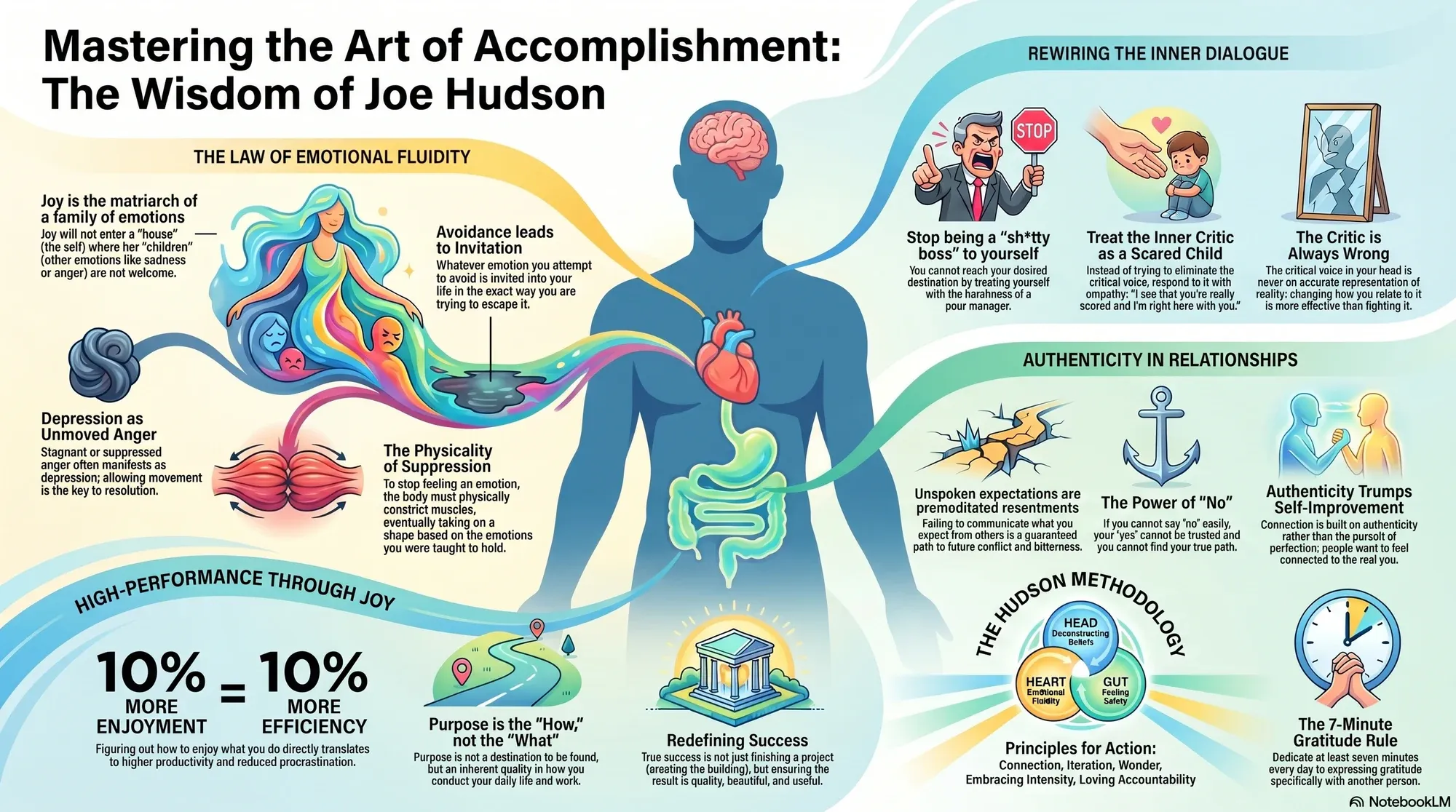
- Joy Welcomes Every Emotion: Joe describes joy as the matriarch of an emotional family: when the other feelings are unwelcome, joy does not settle in either. — Art of Accomplishment: Joy.
- Avoidance Can Recreate the Feeling: Joe argues that efforts to avoid an unwanted emotion can reproduce the very experience one hopes to escape; he offers this as a coaching observation. — Embracing Your Emotions Interview Video.
- Let Emotions Move: In Joe’s account, emotional fluidity means allowing feelings to arise and pass without suppressing or acting them out. He allows that urgent situations may call for temporary compartmentalization. — Art of Accomplishment: Emotional Fluidity.
- Notice the Body’s Response: Joe describes bodily constriction as one way people may hold back feelings; this is his experiential model, not a universal physiological rule. — Embracing Your Emotions Interview Video.
- Widen the Possible Responses: Joe suggests that becoming more willing to feel difficult emotions can make additional responses to a situation visible. — Embracing Your Emotions Interview Video.
- Explore What Overwhelm Conceals: Joe observes that some people feel overwhelmed not only by their workload but by emotions they have not paused to experience or express. — Embracing Your Emotions Interview Video.
- Examine Anger Without Reducing Depression to It: In his coaching discussions, Joe invites some people who feel depressed to examine anger they have not expressed. He also mentions grief and sadness; this is his perspective, not a diagnosis or a claim that anger explains depression generally. — Art of Accomplishment: Exploring Depression.
- Recognize Old Defensive Patterns: Joe recalls learning to fight when he felt scared or sad as a child, a response he later came to see as protective rather than inevitable. — Pathless Path Interview.
- Letting Go Cannot Be Forced: Joe says letting go is not accomplished by commanding oneself to do it; seeing the pain of holding on can make release possible when one is ready. — Art of Accomplishment: The Opposite of Trying.
- End the Internal Fight: Joe describes peace as dropping a war with oneself, an undoing rather than another task to perform. He presents the image as something he heard, not his own coinage. — Art of Accomplishment: The Opposite of Trying.
- Welcome the Resistance: When a feeling is difficult to accept, Joe suggests beginning by welcoming the resistance to that feeling. — Art of Accomplishment: Love the Resistance.
Self-Compassion, Authenticity, and Identity
- Question the Critical Voice: Joe challenges the apparent authority of harsh self-talk and encourages examining its claims rather than accepting them as truth. — Embracing Your Emotions Interview Video.
- Do Not Manage Yourself Like a Harsh Boss: Joe likens severe self-criticism to being a bad boss to oneself and argues that this is a poor route to the change one wants. — Modern Wisdom #813.
- Experiment With Your Response to Self-Criticism: Rather than only trying to silence the critical voice, Joe suggests experimenting with how to respond, including acknowledging fear and offering reassurance. — Embracing Your Emotions Interview Video.
- Treat the Critical Voice as a Frightened Part: Joe compares the harsh inner voice to a young child having a tantrum; in his example, reassurance may be more useful than letting that voice act as the boss. — Embracing Your Emotions Interview Video.
- Growth Does Not Prove Defect: In discussing authenticity versus self-improvement, Joe uses an oak tree’s growth to question the idea that a person must be defective now in order to keep developing. — Embracing Your Emotions Interview Video.
- Notice Self-Rejection in a Spiritual Project: Joe observes that a spiritual or self-improvement path can become another way to tell oneself that one is not good enough yet. — Modern Wisdom #813.
- Examine the Need to Be Special: Joe connects the desire to be special with uncertainty about one’s own identity; this is his reflection, not a universal psychological law. — Modern Wisdom #813.
- Recognize Conflicting Childhood Stories: Joe recalls feeling loved while also carrying a story that something was wrong with him, a tension he later connected with seeking outside validation. — Pathless Path Interview.
- Distinguish Inner Freedom From Its Consequences: Joe says people can choose to be themselves even when doing so may bring consequences they do not want; the choice and its costs should not be conflated. — Art of Accomplishment: What We’re Afraid to Lose.
Joy, Ambition, and Meaningful Work
- How You Work Matters: Joe argues that accomplishment is not only a finished result: the quality of the process can shape how fulfilling the work feels. — Art of Accomplishment Master Class.
- Experiment With Enjoyment at Work: Joe invites people to look for ways to enjoy their work more; his 10% illustration is a coaching prompt, not evidence of a measured efficiency gain. — Embracing Your Emotions Interview Video.
- Make Work More Inviting: In a coaching session, Joe asks a client to consider how the work itself could become more enjoyable before assuming that procrastination requires more force. — Art of Accomplishment: Overcoming Procrastination.
- Define Success by the Result’s Quality: Joe’s building example distinguishes merely finishing a project from making something useful, beautiful, and well made. — Art of Accomplishment Master Class.
- Bring Ambition and Inner Work Together: Joe presents business and ambition as settings for self-discovery rather than pursuits that must be abandoned for inner work. — Joe Hudson: About.
- Pursue Accomplishment With Enjoyment: Joe’s approach asks how a person can pursue meaningful results while also attending to connection and ease in the process; it does not promise constant joy. — Art of Accomplishment Master Class.
Relationships, Boundaries, and Connection
- Prioritize Connection Over Perfection: Joe says people in a relationship generally want to feel connected more than they want a flawless performance from the other person. — Art of Accomplishment: Connection over Perfection.
- Make No a Real Option: Joe argues that a person whose no cannot be expressed easily may not be able to give a trustworthy yes. — Modern Wisdom #813.
- Find the Yes Behind a Boundary: In Joe’s account, being able to say no helps a person recognize and communicate an authentic yes. — Modern Wisdom #813.
- Make Expectations Explicit: Joe invokes a saying he attributes to Neil Strauss about unspoken expectations becoming resentment. The useful practice is to voice expectations rather than silently rely on them. — Modern Wisdom #813.
- Keep Care Present During Conflict: Joe argues that drawing a boundary or confronting someone need not require withdrawing love or denying the other person’s humanity. — Art of Accomplishment: Love over Defense.
- Let Self-Acceptance Inform Relationships: Joe connects his growing acceptance of disowned parts of himself with a greater capacity to accept those parts in his partner. — Art of Accomplishment: How Relationships Reveal Us.
- Do Not Make a Partner Your Project: Joe suggests treating a close relationship as an opportunity for each person’s own growth rather than a campaign to change the other person. — Art of Accomplishment: How Relationships Reveal Us.
- Make Room for Disapproval: Joe says that if a person cannot tolerate the possibility of being disliked, it becomes harder to speak candidly. — Embracing Your Emotions Interview Video.
- Practice Gratitude Together: Joe recommends a daily period of expressing gratitude with another person while genuinely feeling it, rather than merely listing items. — Embracing Your Emotions Interview Video.
- Repair Parenting Mistakes: Joe says that when a parent shames a child, apologizing and repairing the connection can model how to own a mistake; he does not frame perfect parenting as the goal. — Art of Accomplishment: Parenting and Repair.
Curiosity, Decisions, and Experimentation
- Test Advice as an Experiment: Joe asks listeners to test his advice in their own experience instead of accepting it solely on his authority. — Embracing Your Emotions Interview Video.
- Notice the Feeling You Are Forecasting: Joe argues that analyses such as pro-and-con lists often help people predict how each outcome will feel; treating that emotional forecast explicitly can clarify a decision. — Art of Accomplishment: Better Decisions.
- Make Principles Actionable: Joe distinguishes a vague values statement from a principle that helps someone choose what to do in a concrete situation. — Art of Accomplishment: Wrestle With Your Principles.
- Let Principles Evolve Through Use: Joe names connection, iteration, wonder, intensity, and loving accountability among his current principles, and says a useful principle should be tested and refined rather than treated as fixed. — Art of Accomplishment: Wrestle With Your Principles.
- Rate the Energy of Meetings: Joe asks leaders to rate meetings from one to five stars and examine what leaves them energized or depleted, using the exercise to surface team dysfunction. — Art of Accomplishment: Building a Dysfunctional Team.
- Stay in Wonder Before Seeking an Answer: Joe describes wonder as curiosity without pressure to resolve the question immediately, combined with awe about what remains beyond one's control. — Art of Accomplishment: Wonder.
Self-Discovery, Purpose, and Transformation
- Let Setbacks Prompt Self-Examination: Joe recalls being expelled from college as a painful event that pushed him to look at parts of his life he had avoided; the lesson is his personal account, not a general rule about failure. — Pathless Path Interview.
- Practice Humility Without Self-Diminishment: Joe discusses a humility formulation he learned from someone else: attending less to oneself need not mean thinking poorly of oneself. — Good Life Project Interview.
- Question the Search for Purpose: Joe says his own search for purpose assumed it was missing, which made it harder to notice purpose in present action. — Art of Accomplishment: How To Find Your Purpose.
- Consider How You Do the Work: For Joe, purpose concerns how one engages in an activity as well as the activity one chooses. — Art of Accomplishment: How To Find Your Purpose.
- Let Ambition Change Its Motive: Joe says ambition remained in his life even as his relationship to it shifted; his account contrasts open-hearted drive with proving himself. — Pathless Path Interview.
- Revisit Inherited Beliefs: Joe uses un-brainwashing as a metaphor for examining beliefs learned in childhood about money, love, marriage, and success. — Practice of the Practice Interview.
- Engage Head, Heart, and Gut: Joe describes his coaching approach as engaging beliefs, emotional experience, and a felt sense of safety; these are his working categories, not established neuroanatomical divisions. — Practice of the Practice Interview.
Appendix: Sources and Links
- Art of Accomplishment: Joe Hudson — About Art of Accomplishment
- Art of Accomplishment: How To Find Your Purpose — Joe Hudson podcast transcript
- Good Life Project: Authenticity, Self-Discovery and Emotional Fluidity with Joe Hudson
- Art of Accomplishment: How Relationships Reveal Us — Joe Hudson transcript
- Art of Accomplishment: If You Can’t Love the Feeling, Love the Resistance — podcast transcript
- Lenny’s Podcast: How Embracing Your Emotions Will Accelerate Your Career — Joe Hudson (original video)
- Art of Accomplishment: Overcoming Procrastination — Joe Hudson coaching-session transcript
- Art of Accomplishment: How Can I Make Better Decisions? — Joe Hudson transcript
- Pathless Path: Joe Hudson on the Pathless Path — direct interview transcript
- Practice of the Practice: Overcome Your Limiting Beliefs with Joe Hudson (#691)
- Art of Accomplishment: Wonder — Joe Hudson podcast transcript
- Art of Accomplishment: How to Be a Parent (Without Messing Everything Up) — Joe Hudson and Nathan Baschez
- Art of Accomplishment: The Art of Accomplishment — Master Class, Part 1
- Art of Accomplishment: Emotional Fluidity — Joe Hudson podcast transcript
- Art of Accomplishment: Wrestle With Your Principles — Joe Hudson podcast transcript
- Modern Wisdom: The Art of Mastering Your Emotions with Joe Hudson (#813, original video)
- Art of Accomplishment: Love over Defense — Joe Hudson podcast transcript
- Art of Accomplishment: What We’re Afraid to Lose — Joe Hudson podcast transcript
Additional original transcripts:
- Joy — Joe Hudson and Brett Kistler podcast transcript
- Exploring Depression in the Head, Heart, and Gut — Joe Hudson transcript
- The Opposite of Trying — Joe Hudson podcast transcript
- Connection over Perfection — Joe Hudson Master Class transcript
- Building a Dysfunctional Team — Joe Hudson podcast transcript