Lessons from Joe Studwell
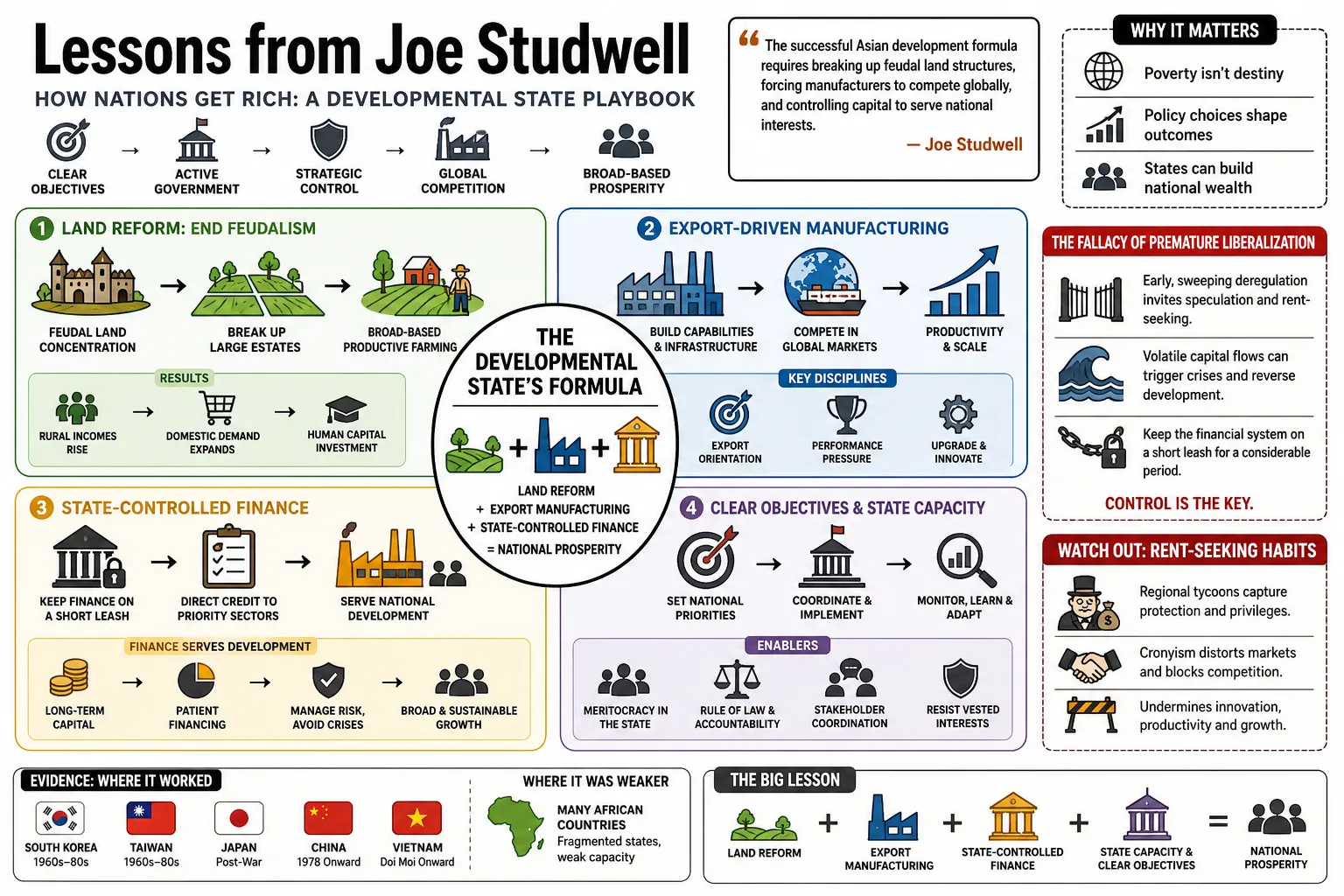
British journalist Joe Studwell documents how developing nations actually get rich, bypassing the assumptions of Western economists. He argues that successful development relies on a strict formula: land reform, export-driven manufacturing, and state-controlled finance. This profile covers his reporting on the economic history of emerging markets in Asia and Africa, the structural challenges they face, and the rent-seeking habits of regional tycoons.
Part 1: The Developmental State's Formula
- On the basic recipe for wealth: "The successful Asian development formula requires breaking up feudal land structures, forcing manufacturers to compete globally, and controlling capital to serve national interests." — Source: [Gates Notes]
- On the fallacy of premature deregulation: "Studwell deems it appropriate to keep the financial system on a short leash for a considerable period of time and make it serve developmental purposes rather than resorting to a premature deregulation." — Source: [Quora]
- On clear developmental objectives: "It falls to governments to shape that environment and to decide what objectives finance will have. Control is the key." — Source: [WordPress]
- On resisting early liberalization: "It is the job of governments to resist entrepreneurs' lobbying until basic developmental objectives have been achieved." — Source: [Goodreads]
- On independent central banks: "Equally, independent central banks are not appropriate to developing countries until considerable economic progress has been made." — Source: [Goodreads]
- On clear policy differentiation: "The secret to the region's success turned on a small number of policy differences, the most important being the presence or absence of export discipline." — Source: [Andrew Batson]
- On straightforward answers: "Studwell delivers direct explanations for national success or failure, avoiding the heavily hedged answers typical of academic economics." — Source: [Gates Notes]
- On working with market discipline: "Industrial policy has to work with the market and rely on market discipline, not try to circumvent such constraints." — Source: [Marginal Revolution]
- On the role of political power: "In a functioning society markets are shaped and reshaped by political power." — Source: [WordPress]
- On policy over destiny: "The divergence in economic outcomes between nations is ultimately a matter of structural policy choices, not geographic destiny." — Source: [L'Express]
Part 2: Land Reform and Household Farming
- On the foundation of growth: "Without the dispossession of landlords in Japan, Korea, Taiwan and China there would have been no increased agricultural surplus to prime industrialisation." — Source: [WordPress]
- On the efficiency of small plots: "When you give farmers ownership of modest plots and allow them to profit from the fruits of their labor, farm yields are much higher per hectare." — Source: [Gates Notes]
- On generating industrial fuel: "Rising yields help countries generate the surpluses and savings they need to power up their manufacturing engine." — Source: [Gates Notes]
- On rural income distribution: "Creating a productive agricultural surplus ensures broadly distributed gains across society, giving the bulk of the population the purchasing power to participate in the economy." — Source: [The Wire China]
- On the feudal trap: "Countries that failed to enact meaningful land redistribution left their economies controlled by landed elites, stunting the transition to high-productivity manufacturing." — Source: [Gates Notes]
- On agricultural labor: "Poor countries possess massive reserves of farm labor that must be utilized intensively on small plots before the population can shift to urban factories." — Source: [Gates Notes]
- On market creation: "Agricultural markets do not naturally optimize for national development; they must be aggressively structured by the state to maximize yields over landlord profits." — Source: [WordPress]
- On sequence: "Land reform must come first; it is the necessary precursor to industrial policy, as it builds the capital base and domestic market required for factories to survive." — Source: [Blinkist]
- On the failure of large estates: "Large, feudal agricultural estates in developing nations historically underperform household farming in terms of sheer yield per hectare." — Source: [Gates Notes]
- On the necessity of dispossession: "The political act of stripping land from traditional elites was the painful but essential catalyst for Northeast Asia's economic takeoff." — Source: [WordPress]
Part 3: Export Discipline and Manufacturing
- On conditional support: "Export discipline requires the conditioning of subsidy in all its myriad forms on a significant level of exports at the firm level." — Source: [WordPress]
- On unconditional subsidies: "If you give subsidy to entrepreneurs they are amazingly good at taking the money and pretending to do what you want, but not actually doing so." — Source: [WordPress]
- On avoiding lazy monopolists: "Absent such discipline, businesses can easily turn into lazy monopolists, rent-seekers, or property speculators." — Source: [Andrew Batson]
- On the objective metric of exports: "Forcing companies to sell goods internationally provides the state with an undeniable measure of whether a firm is actually productive." — Source: [WordPress]
- On creating global competitors: "What created the Canons, the Samsungs, the Acers and so on in Japan, Korea and Taiwan was the marriage of infant industry protection and market forces." — Source: [Goodreads]
- On state-sponsored competition: "The most successful economies featured subsidized exports combined with fierce internal competition between manufacturers vying for state support." — Source: [Goodreads]
- On culling the losers: "Governments must possess the political will to withdraw funding and allow protected firms to go bankrupt if they fail to hit export targets." — Source: [Noahpinion]
- On the necessity of manufacturing: "Manufacturing is essential because its products are easily traded and standardized, providing a clear yardstick for international competitiveness." — Source: [WordPress]
- On bypassing services: "Entrepreneurs prefer concentrating on domestic services because they can extract rents without facing the harsh reality of global competition." — Source: [WordPress]
- On the failure of Southeast Asian industry: "Unlike in northeast Asian states, the Thai bureaucracy never brought export discipline to bear because the Thai generals and politicians who ran the country did not prioritise it." — Source: [Marginal Revolution]
Part 4: Financial Repression and Banking Control
- On directing capital: "The easiest way to run developmentally efficient finance continues to be through a banking system, because it is banks that can most easily be pointed by governments at the projects necessary to agricultural and industrial development." — Source: [Goodreads]
- On the mechanism of control: "Banks can be tightly managed via rediscounting loans for exports and policing the system through requirements for export letters of credit." — Source: [Goodreads]
- On the bluntness of the banking tool: "The simplicity and bluntness of this mechanism makes it highly effective." — Source: [Goodreads]
- On trapping domestic money: "Developing states must implement financial repression to keep domestic capital trapped within the country, ensuring it funds local industry rather than seeking higher returns abroad." — Source: [The Wire China]
- On the real motive for stock markets: "It is, tellingly, the capacity of bank-based systems for enforcing development policies that makes entrepreneurs in developing countries lobby so hard for bond, and especially stock, markets to be expanded." — Source: [Goodreads]
- On escaping oversight: "Stock and bond markets are aggressively pushed by local elites precisely because they serve as a means to escape state direction and capital controls." — Source: [Goodreads]
- On financial structures: "All sorts of monetary policies have been tried in East Asia; what matters is what the finance is actually directed to achieve, rather than the architecture of the financial system itself." — Source: [WordPress]
- On early-stage capital allocation: "In the early stages of national development, free-flowing capital naturally gravitates toward real estate speculation and consumption rather than the arduous work of building factories." — Source: [Quora]
- On the danger of outsize banking: "South-east Asia's high savings rates lent themselves to outsize banking systems, which invited godfather abuse." — Source: [Goodreads]
- On the root of financial crises: "There is a pretty direct line from the insider manipulation of regional banks to the Asian financial crisis." — Source: [Goodreads]
Part 5: The Asian Godfathers and Elites
- On the lack of national commitment: "We are poor because our élites have no sense of nation." — Source: [Everand]
- On the true source of blame: "The blame for the resultant situation, in as much as it needs to be attributed, belongs with politicians not with businessmen." — Source: [Goodreads]
- On the nature of the tycoon: "The term godfather reflects a specific regional business culture steeped in traditions of paternalism, male power, aloofness and mystique." — Source: [Justin Calderon]
- On succession and gender: "Very, very occasionally a girl might be chosen over a boy if that boy is particularly incompetent. So it is a best-male-gets-it deal." — Source: [Luxuo]
- On the psychology of oligarchs: "The behavior of regional tycoons often mirrors the manipulative social dynamics described in Eric Berne's The Games People Play, requiring psychological rather than purely economic analysis." — Source: [Everand]
- On rent-seeking over innovation: "Southeast Asian tycoons generated immense personal wealth primarily through licenses, monopolies, and property development rather than globally competitive technological innovation." — Source: [Goodreads]
- On the illusion of business genius: "Many celebrated regional billionaires were simply political operators who successfully secured state concessions, rather than capable visionaries who built efficient enterprises." — Source: [Goodreads]
- On political complicity: "The godfather structure relies entirely on political leaders who choose personal patronage over the difficult work of implementing national industrial policy." — Source: [Goodreads]
- On the cost of elite capture: "When elites dominate the banking sector, domestic savings are funneled into speculative insider projects, starving productive manufacturing of necessary capital." — Source: [Goodreads]
Part 6: The China Dream and Western Delusions
- On the recurring fantasy: "Western business culture has historically been bewitched by the promise of a massive consumer base, repeatedly falling for a market mirage." — Source: [Barnes & Noble]
- On the reality of the market: "For the majority of investors, the China market remains little more than a chimera." — Source: [The Guardian]
- On corporate amnesia: "Foreign executives consistently display amnesia and lack of critical sense, ignoring centuries of previous failures to capture the Chinese consumer base." — Source: [Grove Atlantic]
- On swallowing propaganda: "Western businessmen have frequently been guilty of accepting official economic statistics and government hype at face value without adequate skepticism." — Source: [The Guardian]
- On the margin squeeze: "The actual operating environment for foreign firms is defined by intense local competition, copycatting, and surprisingly low profit margins." — Source: [The China Project]
- On being a myth-buster: "Studwell's early work served as a deliberate antidote to the extreme corporate optimism of the 1990s and 2000s regarding immediate Asian expansion." — Source: [OpenEdition]
- On historical repetition: "The obsession with unlocking a massive, untapped Eastern market is a cyclical delusion that has bankrupted foreign capital multiple times over the past seven hundred years." — Source: [Grove Atlantic]
- On the nature of the market: "The true nature of the Chinese economy is heavily managed and protectionist, structurally designed to prevent foreign capital from dominating domestic consumption." — Source: [The China Project]
- On redefining the debate: "Recognizing the nonsense surrounding the China dream forces corporations to evaluate investments based on hard economic realities rather than demographic scale." — Source: [Grove Atlantic]
Part 7: Africa's Growth Frontier
- On the density constraint: "Chronically low population density was a primary historical barrier in Africa, making per-capita infrastructure costs prohibitive and preventing the formation of deep local markets." — Source: [JoeStudwell.com]
- On the turning point: "Africa is currently crossing the population density threshold necessary to support the accelerated, labor-intensive economic growth previously seen in East Asia." — Source: [Policy Center for the New South]
- On low-budget colonialism: "The European colonial legacy left Africa with arbitrary borders and a tiny educated elite because powers focused purely on cheap commodity extraction." — Source: [1914 Reader]
- On misdiagnosing the problem: "Factors commonly blamed for African poverty, such as political instability and corruption, are actually symptoms of underdevelopment rather than the root causes." — Source: [1914 Reader]
- On the folly of leapfrogging: "Attempts to skip labor-intensive manufacturing and jump directly to a service economy deny the bulk of the population an entry point into the formal economy." — Source: [Policy Center for the New South]
- On the universal mechanics of growth: "The states in Africa that are developing rapidly are doing so by applying the exact same fundamental policy mix used by the Asian Tigers." — Source: [JoeStudwell.com]
- On agricultural sequence in Africa: "Just as in Asia, African nations must prioritize household farming yields to create the broad purchasing power needed to sustain domestic industry." — Source: [The Wire China]
- On state capacity: "The successful deployment of industrial policy in emerging African nations requires a deliberate, focused expansion of basic bureaucratic capacity to track firm-level performance." — Source: [L'Express]
- On optimistic demographics: "The combination of rising literacy, urban growth, and increasing density positions Africa as the world's last great developmental frontier." — Source: [JoeStudwell.com]
Part 8: The Architecture of Success and Failure
- On the limits of free-market orthodoxy: "Standard neoliberal economic prescriptions often fail developing nations because they recommend policies appropriate for mature economies, not emerging ones." — Source: [Blinkist]
- On the necessity of state intervention: "Rapid economic modernization is not a natural market phenomenon; it requires an aggressively interventionist state directing resources." — Source: [WordPress]
- On premature deindustrialization: "Shifting capital away from factory floors too early strands a massive, unskilled workforce in low-productivity informal labor." — Source: [Andrew Batson]
- On measuring true progress: "A nation's development is measured not by gross domestic product spikes from commodity exports, but by the technological upgrading of its domestic firms." — Source: [WordPress]
- On the illusion of the service economy: "Services cannot pull a poor country out of poverty because they generally lack the high-scale productivity gains and export potential inherent to manufacturing." — Source: [WordPress]
- On the cost of elite consensus: "Development inherently requires disrupting the existing economic consensus and forcibly directing capital away from the traditional, comfortable investments of the wealthy." — Source: [Gates Notes]
- On bureaucratic focus: "Successful developmental states do not need perfect, corruption-free bureaucracies; they only require agencies capable of strictly enforcing export discipline and loan terms." — Source: [Marginal Revolution]
- On the structural reality of wealth: "Ultimately, nations become wealthy by mastering the unglamorous mechanics of crop yields, factory output, and strict banking rules." — Source: [Gates Notes]