Joelle Pineau directed Meta's Fundamental AI Research lab during the development of Llama and currently leads applied AI strategy at Cohere. She is best known for forcing the machine learning field to adopt rigorous reproducibility standards through her work at NeurIPS, shifting the discipline from experimental alchemy toward formal science. This profile catalogs her pragmatic views on open-source weights, reinforcement learning under uncertainty, and why enterprise utility matters more than the pursuit of artificial general intelligence.
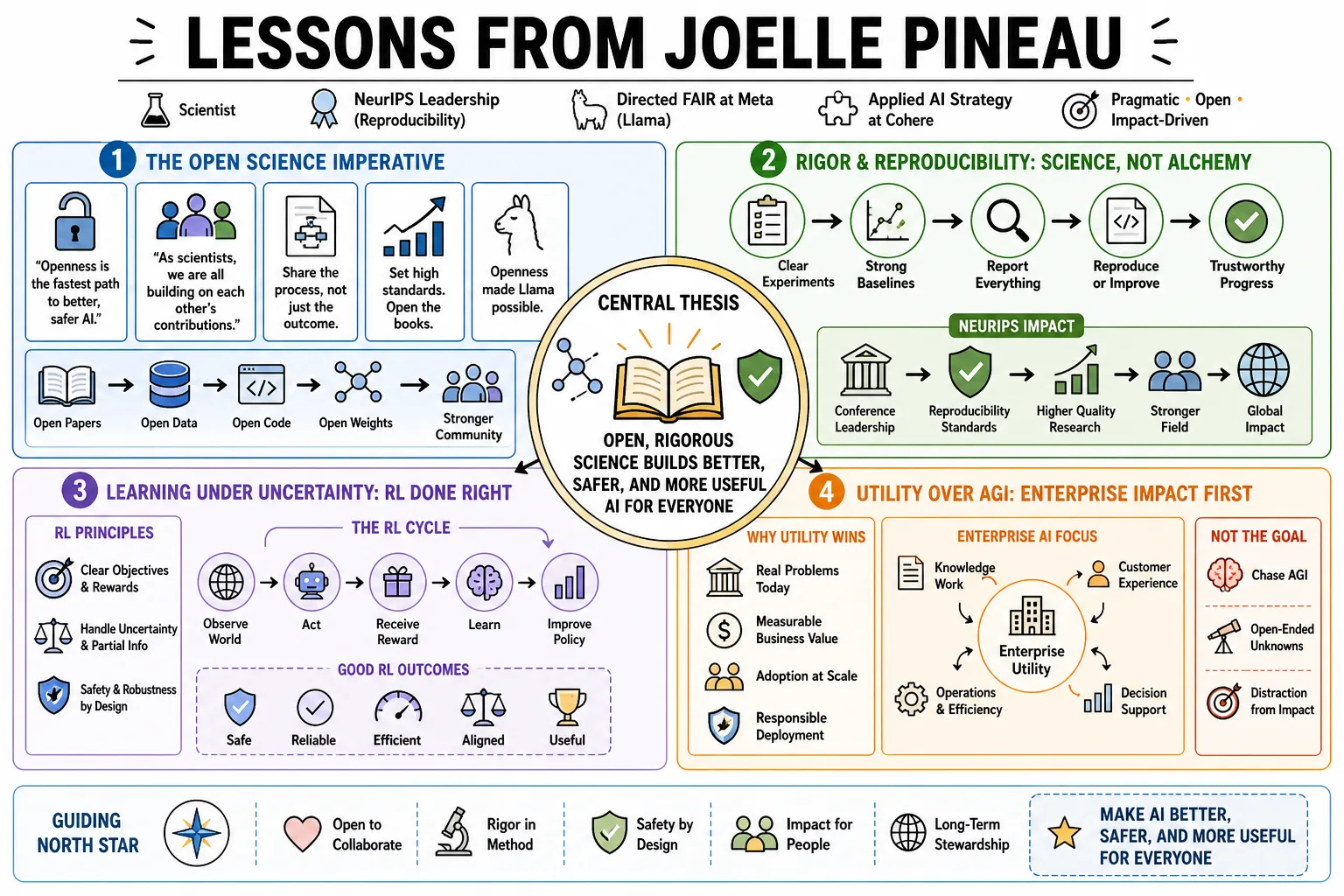
Part 1: The Open Science Imperative
- On the necessity of openness: "Openness is the fastest path to better, safer AI." — Source: [Approximately Correct Podcast]
- On collaborative science: "As scientists, we are all building on each other's contributions. None of us is an island." — Source: [Mila - Quebec AI Institute]
- On sharing the process: "The more we can share in terms of not just the outcome but the process of our work, the more we can empower others to contribute." — Source: [Approximately Correct Podcast]
- On setting high standards: "When you've set out as a goal to share the result of your work—whether it's a paper or a model—it sets a pretty high bar. You're opening up the books on the work that you've done." — Source: [Approximately Correct Podcast]
- On the Llama release strategy: Open-weight models allow the global community to identify flaws and mitigate risks that closed, proprietary models might hide behind a firewall. — Source: [Meta AI Research]
- On safety through transparency: Security in artificial intelligence is better achieved by allowing researchers worldwide to probe systems for vulnerabilities rather than relying on internal red-teaming alone. — Source: [Observer]
- On the limits of closed systems: "There is no point in publishing the paper in the public domain if others cannot build off of it." — Source: [TechTalks]
- On reference implementations: There should be at least one publicly available reference implementation for every published algorithmic claim so that others can use it as a baseline. — Source: [TechTalks]
- On shifting research velocity: Open science accelerates the field because it prevents parallel teams from wasting compute and time repeating the exact same failed experiments in secret. — Source: [Mila - Quebec AI Institute]
- On licensing evolution: The AI industry needs a new approach to open-source licensing that addresses the unprecedented scale of training data while maintaining the collaborative spirit of the software community. — Source: [Financial Times]
Part 2: Confronting the Reproducibility Crisis
- On the baseline of science: "Reproducibility is the minimum necessary condition for a finding to be believable and informative." — Source: [NeurIPS 2018 Keynote]
- On the origins of her advocacy: "I fell into reproducibility by accident. Over and over again my students would say 'I can't get these results,' or they found that, to get the results, they had to do things that I didn't think were correct." — Source: [Nature Interview]
- On stopping bad norms: It was critical to intervene and establish reproducibility standards before methodological shortcuts became the accepted norm in machine learning. — Source: [Nature Interview]
- On ambition versus methodology: "Our dedication to sound methodology is lagging behind the ambition of our experiments." — Source: [Nature Interview]
- On evaluating research with FRESCO: True scientific progress in AI should be measured by Focus, Rigor, Elegance, Scale, Compactness, and Openness. — Source: [How AI Happens Podcast]
- On the difficulty of verification: "It's getting harder and harder to tell which are reliable results and which are not." — Source: [Healthcare Reimagined]
- On scientific competition: "Science is not a competitive sport! We really need to have some reusable material—whether they be software, datasets, or experimental platforms." — Source: [Institute for Advanced Study]
- On the complexity of the real world: Ensuring reproducibility in simulation is straightforward, but transferring that rigor to real-world applications exposes how much complexity simulators strip away. — Source: [Future of Life Institute]
- On incentive structures: "Replication is essential, but it isn't rewarded. One solution is to get students to do the work." — Source: [Nature Interview]
- On code sharing expectations: The machine learning community must operate with exceptionally high expectations for sharing code alongside published papers. — Source: [TechTalks]
Part 3: Reinforcement Learning and Robotics
- On mathematical elegance: "I was delighted by the elegance of the mathematical formulation [of reinforcement learning]... it was also useful for decision-making." — Source: [McGill University]
- On deep RL that matters: Reinforcement learning research often suffers from severe variance, where hyperparameter choices and random seeds can drastically alter the apparent success of an algorithm. — Source: [Deep RL That Matters Paper]
- On POMDPs: Partially Observable Markov Decision Processes provide the necessary mathematical framework for robots to act effectively even when their sensor data is incomplete or noisy. — Source: [Point-based value iteration Paper]
- On acting under uncertainty: Real-world robotics requires moving beyond clean simulated environments to address the fundamental uncertainty of physical spaces. — Source: [Reasoning and Learning Lab]
- On the SmartWheeler initiative: The goal of applying AI to wheelchair mobility is not full autonomy, but shared control that handles low-level navigation while respecting the user's high-level commands. — Source: [SmartWheeler Project]
- On physical constraints: Building algorithms for physical robots forces researchers to confront sample efficiency and safety constraints that digital-only systems can ignore. — Source: [Me, Myself, and AI Podcast]
- On multi-turn dialogue: Generative hierarchical neural networks are necessary to handle the complexity and state-tracking required for natural, multi-turn conversational agents. — Source: [Building End-To-End Dialogue Systems Paper]
- On asking the right questions: "Perhaps, the most important thing in research is asking the right question." — Source: [Mila - Quebec AI Institute]
- On avoiding pre-selected tools: "Don't walk in with your own hammer, and expect to find a problem to show-off your techniques. Genuine curiosity about the other field is very valuable." — Source: [Mila - Quebec AI Institute]
Part 4: The Shift to Enterprise AI
- On practical priorities: The industry must focus on "ROI over AGI," shifting away from existential theorizing toward building tools that actually provide a return on investment. — Source: [Agence France-Presse Interview]
- On AGI as a distraction: Debating the timeline for artificial general intelligence often distracts from the immediate, concrete challenges of deploying machine learning in enterprise environments. — Source: [The Star]
- On the capability overhang: There is a significant gap between the theoretical capabilities of frontier models and what enterprises are currently able to deploy effectively in production. — Source: [Big Technology Podcast]
- On efficiency over raw power: Businesses frequently prefer "good enough" intelligence that runs cost-effectively and securely over massive, general-purpose models. — Source: [Big Technology Podcast]
- On moving past demos: The enterprise AI market requires a transition from impressive laboratory demonstrations to reliable agents that consistently complete specific business workflows. — Source: [Big Technology Podcast]
- On low drama culture: Successful enterprise AI companies benefit from a "low drama" culture that avoids public feuding and focuses strictly on product execution and customer privacy. — Source: [Agence France-Presse Interview]
- On real-world signal: Selling artificial intelligence to established businesses provides a much stronger signal of a model's true utility than academic benchmarks. — Source: [20VC Podcast]
- On capital efficiency: As the cost of data and compute rises, AI companies must demonstrate clear predictability in returns to justify their capital expenditures. — Source: [20VC Podcast]
- On data sovereignty: Offering models that run on-premise or within Virtual Private Clouds is a critical requirement for sectors like finance and healthcare that cannot compromise on data security. — Source: [Radical Talks]
Part 5: Building World Models and Memory
- On the limits of text prediction: AI must evolve beyond "word models" that predict text toward "world models" that understand causality and physical laws. — Source: [Big Technology Podcast]
- On physical vs digital worlds: While robots require physical world models to understand gravity, web agents require digital world models to predict the cascading effects of actions like sending an email or executing a trade. — Source: [Big Technology Podcast]
- On the necessity of simulation: World models are strictly essential for autonomous agents because an agent must simulate possible futures before committing to an irreversible action. — Source: [Big Technology Podcast]
- On the retrieval challenge: The real hurdle in AI memory is not storage capacity, but selectivity—knowing exactly which specific piece of information from the past is relevant to the current task. — Source: [Big Technology Podcast]
- On context window limitations: Simply expanding the context window of a language model is the easiest approach, but it is less efficient than developing models that can effectively summarize and retrieve history. — Source: [Big Technology Podcast]
- On temporal granularity: A true planning agent must operate at multiple levels of temporal granularity, handling high-level objectives before computing low-level details. — Source: [Me, Myself, and AI Podcast]
- On biological benchmarks: A squirrel possesses a tiny brain yet can remember food caches across months of visual data, demonstrating a level of long-term planning efficiency that current transformer architectures lack. — Source: [Hunch.net Interview]
- On positional embeddings: How transformers handle word order is heavily reliant on relative positioning rather than absolute position, which affects how models perceive sequential planning. — Source: [McGill University Research]
- On continual learning: Future architectures must master continual learning, acquiring new skills in dynamic environments without catastrophically forgetting previously learned information. — Source: [McGill University Research]
Part 6: AI in Healthcare and Assistive Tech
- On the Nursebot project: Early assistive robotics like "Pearl" demonstrated that mobile robots could successfully navigate assisted-living facilities while prompting users about daily routines. — Source: [Carnegie Mellon University]
- On optimizing neurostimulation: Reinforcement learning algorithms can learn the optimal time and intensity to deliver electrical pulses to an epileptic patient's brain, outperforming fixed-interval medical treatments. — Source: [Montreal Neurological Institute]
- On clinical decision support: Machine learning models can synthesize clinical notes, lab reports, and imaging to help doctors tailor disease prediction and treatment strategies to the individual. — Source: [Substack Profile]
- On the stakes of medical AI: For artificial intelligence to be trusted in high-stakes fields like healthcare, the underlying research must be completely transparent, rigorous, and verifiable. — Source: [Substack Profile]
- On representation in datasets: There is a critical social responsibility to ensure medical imaging datasets, such as those used in dermatology, contain adequate representation of darker skin tones. — Source: [CIFAR Talks]
- On personalized medicine: The true value of AI in healthcare is accelerating the discovery of personalized treatment strategies rather than relying on generalized, population-level interventions. — Source: [Radical Ventures Masterclass]
- On robotics as an interface: Assistive robots serve as physical interfaces for algorithmic decision-making, translating abstract reinforcement learning policies into physical support for vulnerable populations. — Source: [AAAI Publications]
- On conflicting values: The development of AI for complex social systems requires explicitly navigating conflicting human values, asking "whose values" are being encoded into the optimization function. — Source: [ICML Keynote]
- On empowering users: Technology applied to legal and healthcare systems must be deliberately engineered to empower individuals while actively preventing systemic abuse. — Source: [ACT International Conference]
Part 7: Leadership, Culture, and Scale
- On the Plus-One principle: Effective leaders take responsibility for a scope one level higher than their actual job description, prioritizing the broader organization over their immediate team. — Source: [Radical Talks]
- On eliminating territorial friction: Shifting focus to a Plus-One scope helps eliminate zero-sum thinking during resource allocation and fosters high-trust collaboration across departments. — Source: [Radical Talks]
- On the true bottleneck of growth: "Culture scales faster than technology." While compute grows exponentially, human coordination is the defining limit of an organization's velocity. — Source: [Radical Talks]
- On culture as infrastructure: A stable organizational culture acts as invisible infrastructure, allowing massive research teams to navigate ambiguity without structural collapse. — Source: [Radical Talks]
- On the manager's role: "My role isn't to set the problems for [the research team], it's to set the conditions for them to be successful." — Source: [Mila - Quebec AI Institute]
- On decision velocity: "A clear decision is better than no decision at all." — Source: [Mila - Quebec AI Institute]
- On seizing momentum: "If it takes off, just be ready to run with it... be ready for that upswing if it comes, otherwise it's a missed opportunity." — Source: [Mila - Quebec AI Institute]
- On rigor versus speed: Rigor and speed are not opposites; in fact, scientific rigor is exactly what makes speed meaningful by preventing wasted time on false starts. — Source: [Radical Talks]
- On leadership judgment: The hardest part of managing a large-scale AI lab is exercising judgment to make definitive calls when the empirical data is still imperfect or incomplete. — Source: [Radical Talks]
- On building regional ecosystems: Establishing AI labs in diverse geographic locations, like Montreal, is crucial for tapping into localized talent pools and preventing a brain drain to single tech hubs. — Source: [Ask AI Podcast]
Part 8: Navigating Monoculture and Ethics
- On algorithmic monoculture: "I worry about the fact that... we are sort of on a curve of progress... and if we build on very few of these [algorithms and models] there are some things about our technology, and our culture, that get encoded in these artifacts." — Source: [Approximately Correct Podcast]
- On the danger of homogeneity: It becomes increasingly difficult to deviate from established AI architectures when the entire industry coalesces around a single method or base model. — Source: [Approximately Correct Podcast]
- On shared digital vulnerabilities: Relying on a tiny handful of foundational models means a single prompt-injection technique or security flaw could compromise the entire ecosystem simultaneously. — Source: [Approximately Correct Podcast]
- On cultural encoding: Models trained primarily on homogeneous datasets inherently encode specific, English-centric cultural biases that narrow the space of hypotheses the AI can explore. — Source: [Approximately Correct Podcast]
- On foundational diversity: "Diversity in foundational models is essential." Without it, the industry risks stagnation because every application inherits the exact same underlying limitations. — Source: [YouTube - Mila]
- On social responsibility in engineering: "If we're going to push for state-of-the-art on the scientific and engineering aspects, we must push for state-of-the-art in terms of social responsibility." — Source: [How AI Happens Podcast]
- On carbon footprints: Researchers have a responsibility to systematically report and attempt to mitigate the energy and carbon costs associated with training massive machine learning models. — Source: [Research.com Profile]
- On sovereign alternatives: International clients increasingly require sovereign AI alternatives to avoid being locked into tools controlled entirely by a few US-based tech conglomerates. — Source: [Les Inguliers]
- On tracking real risk: The field must shift its ethical focus from hypothetical science-fiction scenarios to the immediate, tangible risks of data privacy violations and workforce disruption. — Source: [Agence France-Presse Interview]