John Gruber has written and published Daring Fireball since 2002, focusing on Apple, technology and design. The independent site became his full-time work in 2006. — iPure John Gruber Interview.
On Design and Taste
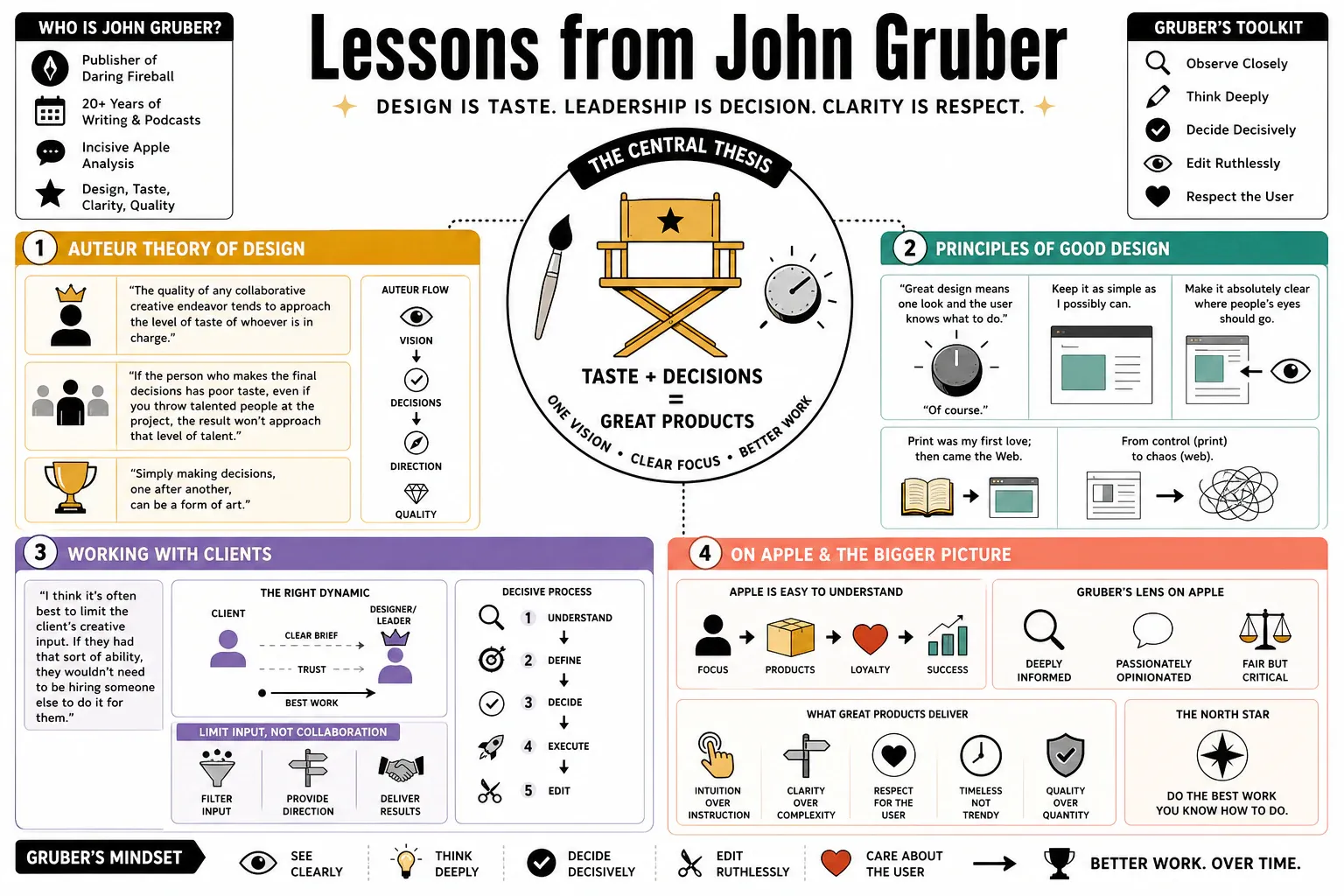
Gruber’s auteur theory argues that the person guiding final creative decisions strongly shapes the quality of a collaborative design project. — Creative Bloq Interview.
- Taste sets the ceiling for collaborative design: Gruber argues that the quality of collaborative creative work tends toward the taste of the person controlling the final decisions. — Creative Bloq Interview.
- Strong talent cannot compensate for poor final judgment: In Gruber’s account, a team of talented people can still deliver weaker work when the person making final decisions has poor taste. — Creative Bloq Interview.
- Make the main action discoverable: Gruber favored an always-visible camera shortcut on the iPhone lock screen over a hidden gesture, even though it reduced visual simplicity; users should be able to see how to perform the important action. — Apple’s Highest Priority Is Obviousness.
- Design constraints change with the medium: Gruber said moving from print to web design meant giving up control over canvas size, fonts and rendering; designing the iPhone app Vesper restored some of the fidelity he had valued in print. — Macworld Vesper Interview.
- Give readers a clear visual path: For Daring Fireball, Gruber said his design priorities were keeping the page simple and making clear where readers’ eyes should go. — Creative Bloq Interview.
- Creative control is a sequence of decisions: Gruber argued that a project manager in design should bring artistic vision to the finished site, not merely administer deadlines; the final decisions shape the work. — Creative Bloq Interview.
- Do not manufacture choices you cannot endorse: Gruber cautioned designers against presenting clients with multiple concepts merely to offer choice when they already know which direction best serves the work. — Creative Bloq Interview.
On Apple
Gruber has spent much of Daring Fireball analyzing Apple’s products, business decisions and developer relationships, sometimes criticizing the company directly. — Sub Club Podcast with John Gruber.
- Understand Apple through its product priorities: Gruber described Apple’s devices as unusually easy to understand in use and said that their design helped him understand computers more generally. — iPure John Gruber Interview.
- Make the product before the campaign: Gruber’s account of Apple’s marketing starts with making a great product and only then communicating its merits; promotion cannot substitute for the product itself. — Seeing It.
- See the iPhone as a pocket computer: Writing five years after its launch, Gruber argued that the iPhone disrupted phones because it was a pocket-sized computer with phone connectivity, not merely a better handset. — The iPhone and Disruption.
- Admiration does not require uncritical coverage: In his 2025 Siri essay, Gruber acknowledged that Apple’s record had made him complacent and publicly criticized the company for promises it could not demonstrate. — Something Is Rotten in the State of Cupertino.
- Distinguish a concept video from a working demo: In March 2025, Gruber criticized Apple for depicting personalized Siri features in a polished WWDC video without demonstrating the features running live. — Something Is Rotten in the State of Cupertino.
- Public promises need accountability: Gruber used the delayed personalized-Siri announcement to argue that Apple’s culture of excellence requires candid accountability for what it can actually demonstrate and deliver. — Something Is Rotten in the State of Cupertino.
- Earn developer commitment by making a better platform: Gruber argued that Apple would benefit from making its platforms attractive enough that developers choose to build for them, rather than relying only on the App Store’s existing power. — Sub Club Podcast with John Gruber.
- Cover technology and design, not just a single company: Gruber described Daring Fireball as a site primarily about Apple, technology and design, explaining that his interest in the latter two subjects naturally leads him to write extensively about Apple. — iPure John Gruber Interview.
On Technology and the Web
Gruber’s writing also examines software, design, web publishing and how technology choices affect users. — Software as the Product of Obsession Times Voice.
- Implementation gives an app idea its value: While describing how Vesper came together, Gruber said he had held the idea for years but valued the team’s execution more than the idea alone. — Macworld Vesper Interview.
- Native and web apps need not be enemies: Gruber argued in 2007 that web apps and native apps often serve different purposes, so the arrival of a native iPhone SDK would not make web development irrelevant. — The iPhone and Web Apps.
- Distinguish compelling technology from a usable product: In a 2013 response to Google Glass, Gruber accepted the concern that phones can distract from conversation but doubted that wearing a display on one’s face would solve it. — Gruber on Google Glass.
- Page-view incentives can distort journalism: Gruber warned that paying publishers for page views can reward viral reach over accuracy, creating a corrupting incentive for newsrooms. — If a Story Is Viral, Truth May Be Taking a Beating.
- Keep plain-text writing readable: Gruber created Markdown so source text would remain readable and easy to write; his original documentation credits Aaron Swartz with feedback, testing and syntax ideas. — Markdown Documentation.
- Blogging’s ecosystem changed: In 2018 Gruber observed that although strong blogs remained, fewer new ones seemed to replace the older sites that disappeared. — Kottke on the State of Blogging.
On Writing and Blogging
Gruber built Daring Fireball from a hobby into an independent writing career and has described how he developed its voice over time. — Shawn Blanc Interview.
- A real audience changes the writing process: Gruber said writing became easier once Daring Fireball had regular readers; at the beginning, publishing felt to him like speaking to an empty auditorium. — Shawn Blanc Interview.
- Build an independent readership over time: Gruber described writing Daring Fireball persistently as a hobby while experimenting with revenue before it became his full-time work in 2006. — The Deck, Adieu.
- Write a continuing column, not isolated posts: Gruber said he wanted to be a columnist because regular readers can get something greater than the sum of individual pieces; Daring Fireball gave him that outlet. — Shawn Blanc Interview.
- Writing remains the enduring work: Gruber said writing was the one kind of work in which he remained endlessly engaged, even as he was unsure whether he would write a book. — Shawn Blanc Interview.
- Keep comments from displacing the article: Gruber explained that he kept on-site comments off Daring Fireball because they would distract from the article and encourage a skimming mode of reading. — Creative Bloq Interview.
- A consistent authorial voice rewards regular readers: Gruber valued the way a good columnist’s individual pieces build into something larger for regular readers and used his own weblog to write in a voice he controlled. — Shawn Blanc Interview.
Learnings and General Wisdom
The lessons below draw on Gruber’s own essays and interviews about product quality, design judgment and independent publishing. — The Deck, Adieu.
- Hold strong ideas provisionally: Gruber endorsed holding strong ideas loosely when linking to a discussion of the backfire effect, a compact reminder to stay open to changing a position. — The Backfire Effect.
- Judge quality by the experience of use: Gruber argues that a product’s quality is measured by the experience of buying, setting up and using it, rather than by a list of technical specifications. — Seeing It.
- Simplicity should serve the task: Gruber said Vesper was built to do a few things well, with organization and prioritization that made quick note-taking efficient without a large feature set. — Macworld Vesper Interview.
- Start with the desired experience: Gruber’s analysis of Apple argues for deciding what experience a product should create and then working backward to the necessary technology, rather than leading with a novel technical prototype. — Working Backwards to the Technology.
- Give new platforms time to mature: Discussing Vision Pro in 2025, Gruber compared its early limitations to the original Macintosh and argued that building a platform before mass-market hardware arrives can be a rational long-term bet. — Sub Club Podcast with John Gruber.
- Control the outlet you depend on: Gruber chose to build Daring Fireball as his own publication, writing it for years before sponsorships and memberships made full-time independence possible. — The Deck, Adieu.
- Write in a voice you control: Gruber said a self-owned weblog let him write whatever and however he wanted, giving him the columnist-style outlet he had sought. — Shawn Blanc Interview.
- Correct the record when primary evidence changes it: Gruber acknowledged that a widely repeated Ed Colligan quotation he had used was inaccurately transcribed, then pointed readers to the original recording and the more precise wording. — Gruber on Correcting the Colligan Quote.
- Examine the obvious in detail: Gruber described his product-review method as examining overlooked ordinary interactions in detail and trying to convey how a device feels in use. — Shawn Blanc Interview.
- Test the popular analogy against the facts: In a 2004 essay, Gruber challenged the familiar claim that the iPod would repeat the Macintosh’s licensing mistake by comparing their actual compatibility and market positions. — Why 2004 Won’t Be Like 1984.
- Treat software as a craft: Gruber argued that independent developers can still make software around quality and artistic vision, and criticized interfaces that ignore established interaction-design principles. — Software as the Product of Obsession Times Voice.
- Focus requires saying no: Gruber used Apple’s post-1997 product focus to argue that interesting technologies can be cut when they do not serve the company’s fundamental product directions. — Working Backwards to the Technology.
- Choose revenue that respects readers: Gruber recounted rejecting poorly fitting display ads and building Daring Fireball with sponsorship formats that avoided tracking, animation and crowded pages. — The Deck, Adieu.
- Keep the public work accessible: When he asked readers to support Daring Fireball in 2004, Gruber chose to keep the main site freely readable while testing memberships and other ways to fund it. — Something Daring.
- Resist fashionable sameness across platforms: Gruber criticized interface designs that impose a uniform look across platforms while ignoring long-established, platform-specific interaction conventions. — Software as the Product of Obsession Times Voice.
Learn more:
- John Gruber — Seeing It
- John Gruber — The Auteur Theory of Design (dConstruct Audio Archive)
- John Gruber on the Auteur Theory of Design — Creative Bloq Interview
- John Gruber — Apple’s Highest Priority Is Obviousness
- Jason Snell — Meet Vesper: An Interview With John Gruber and Q Branch (Macworld)
- Jan Pražák — Interview: John Gruber (iPure)
- John Gruber — Something Is Rotten in the State of Cupertino
- John Gruber — Working Backwards to the Technology
- Shawn Blanc — John Gruber: A Mix of the Technical, the Artful, the Thoughtful, and the Absurd
- John Gruber — Markdown: Syntax, Rationale and Acknowledgments
- John Gruber — Kottke on the State of Blogging
- John Gruber — The Deck, Adieu
- John Gruber — Something Daring
- The Past, Present, and Future of Building on Apple — Sub Club Podcast With John Gruber
- John Gruber — Software as the Product of Obsession Times Voice
- John Gruber — The iPhone and Web Apps