John Hennessy is a computer scientist and academic who co-developed the RISC microprocessor architecture, changing the foundational design of modern computing hardware. He served as the president of Stanford University for 16 years, shaping its ties to Silicon Valley, before becoming the chairman of Alphabet Inc. This profile collects his insights on processor design, leading complex academic institutions, and building organizations grounded in empirical research.
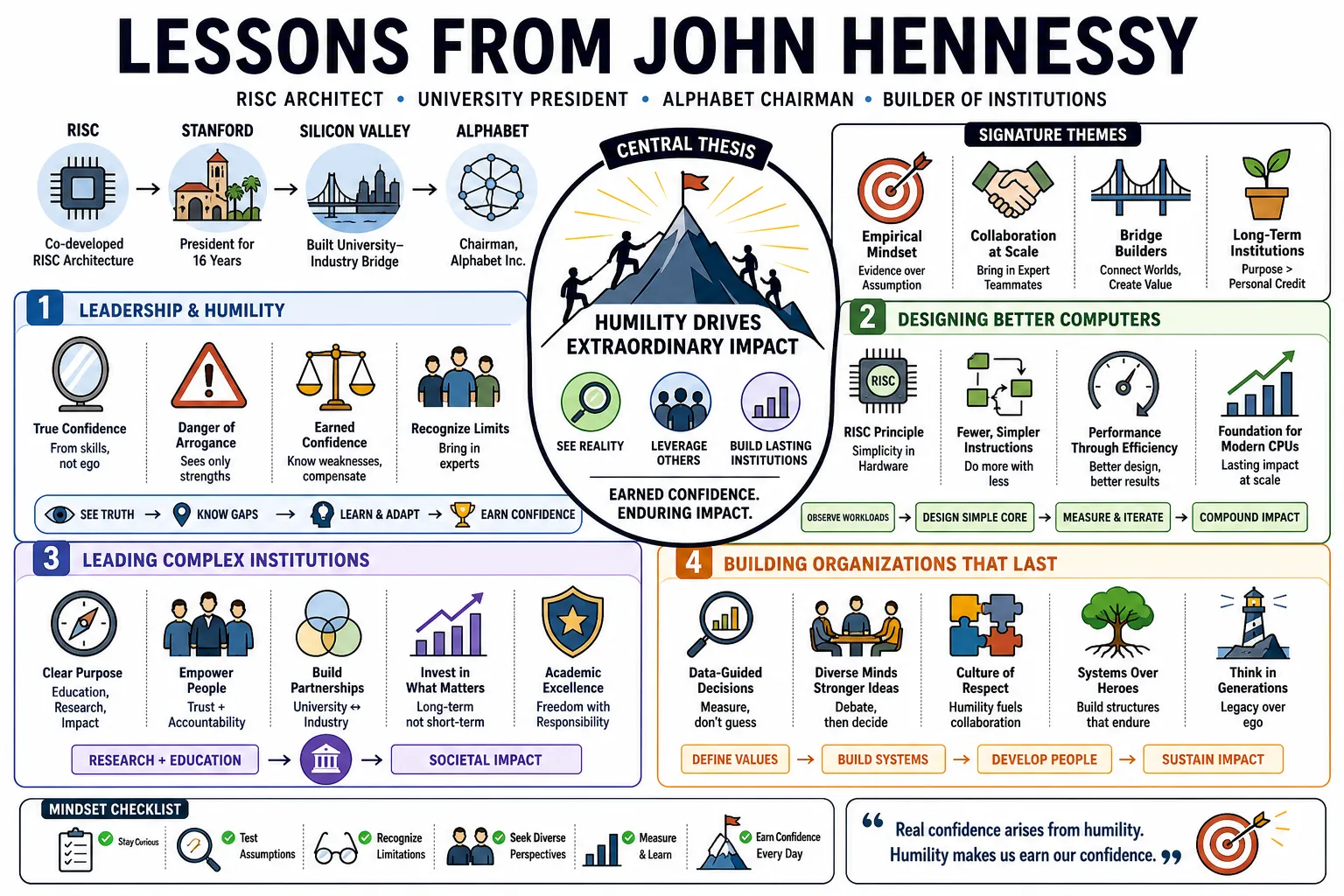
Part 1: Leadership and Humility
- On true confidence: "Real confidence—that is, not a mask of confidence, or phone bravado, or worst of all, misplaced confidence, but a true sense of one's own skills and character—arises not from ego, but from humility." — Source: [Leading Matters]
- On the danger of arrogance: "Arrogance... sees only our strengths, ignores our weaknesses, and overlooks the strengths of others, therefore leaving us vulnerable to catastrophic mistakes." — Source: [Forbes]
- On earning confidence: "Humility shows us where our weaknesses lie so we can compensate for them. Humility makes us earn our confidence." — Source: [Leading Matters]
- On recognizing limits: "Humility was about... recognizing that you're not the expert on everything and bringing in experts, people who know the field is crucial to building a team that can be successful." — Source: [unSILOed Podcast]
- On standing on shoulders: "I was able to be successful because I stood on the shoulders of many other people who had contributed along the way." — Source: [unSILOed Podcast]
- On righteous ambition: "Perhaps the only way to be both humble and ambitious is to be ambitious for the good of others." — Source: [Forbes]
- On leadership as service: "True leadership is fundamentally about service—being ambitious for the sake of an institution or a mission rather than for personal gain." — Source: [Strategy+Business]
- On confronting hard problems: "We face challenging problems: denying them, belittling them, or minimizing them, delays the implementation of solutions and increases the long-term negative impacts for our successors." — Source: [Forbes]
- On authenticity: "Leaders must align their actions with their core values to build trust that endures through institutional crises." — Source: [Leading Matters]
- On admitting mistakes: "A leader’s willingness to clearly say 'I was wrong' is not a sign of weakness, but a profound demonstration of intellectual honesty to the team." — Source: [Leading Matters]
Part 2: The Foundation of Computer Architecture
- On historical context: "Those who cannot remember the past are condemned to repeat it." — Source: [2017 ACM Turing Award Lecture]
- On processor efficiency: "The driving philosophy behind RISC architecture was that simpler instructions executed rapidly are fundamentally more efficient than complex, slower instructions." — Source: [Frontiers of Knowledge Awards]
- On the 1980s microprocessor market: "Microcomputers were competing on crazy things... rather than saying here's a set of standard benchmarks, and my machine is faster than your machine." — Source: [Communications of the ACM]
- On the quantitative approach: "Computer architecture must be evaluated based on empirical measurement and quantitative analysis rather than intuition alone." — Source: [Computer Architecture: A Quantitative Approach]
- On anticipating the future: "Hardware architects must anticipate technological advancements, like the capacity doubling of Moore's Law, rather than designing for the status quo." — Source: [Computer Architecture: A Quantitative Approach]
- On abstraction: "Implementing clean layers of abstraction allows both hardware engineers and software developers to increase their productivity without understanding the full stack." — Source: [Computer Architecture: A Quantitative Approach]
- On performance priorities: "Engineers should always focus on making the common case fast, as improving frequent tasks yields much higher returns than optimizing rare edge-cases." — Source: [Computer Architecture: A Quantitative Approach]
- On market validation: "The marketplace ultimately settles architecture debates." — Source: [2017 ACM Turing Award Lecture]
- On software's influence: "Software advances can inspire architecture innovation by creating new bottlenecks that hardware must resolve." — Source: [2017 ACM Turing Award Lecture]
Part 3: The Next Era of Computing
- On hardware and software co-design: "Elevating the hardware/software interface creates opportunities for architecture innovation." — Source: [2017 ACM Turing Award Lecture]
- On the current shift: "We are entering a new golden age for computer architecture driven by the demand for domain-specific hardware and open instruction sets." — Source: [2017 ACM Turing Award Lecture]
- On the end of Moore's Law: "As transistor scaling slows, future performance gains will rely almost entirely on specialized silicon architectures." — Source: [Communications of the ACM]
- On open source hardware: "Open instruction sets like RISC-V democratize processor design, lowering the barrier to entry and enabling agile chip development." — Source: [2017 ACM Turing Award Lecture]
- On domain-specific architectures: "The future belongs to hardware tailored tightly to specific workloads like machine learning, abandoning the overhead of general-purpose processors." — Source: [2017 ACM Turing Award Lecture]
- On the 90/10 locality rule: "A program typically spends 90% of its execution time in just 10% of its code, dictating where hardware optimization should be focused." — Source: [Computer Architecture: A Quantitative Approach]
- On redundancy and dependability: "Systems must be designed with redundancy to avoid single points of failure, ensuring dependability at scale." — Source: [Computer Architecture: A Quantitative Approach]
- On the Amdahl/Case Rule: "A balanced system requires roughly 1 megabyte of memory and 1 megabit per second of I/O bandwidth for every MIPS of CPU performance." — Source: [Computer Architecture: A Quantitative Approach]
- On security in hardware: "Enhanced security must be addressed at the architectural level, as software patches cannot outrun fundamental hardware vulnerabilities." — Source: [2017 ACM Turing Award Lecture]
- On the AI transition: "As artificial intelligence workloads dominate, the hardware industry must shift from logic-centric design to memory-centric design." — Source: [Not Alone Podcast]
Part 4: The Reality of Entrepreneurship
- On naive business plans: "The original MIPS business plan had no financial projections, operating on the pure assumption that if we build it, they will buy it." — Source: [Mayfield]
- On the myth of products selling themselves: "At the time I didn’t think you needed sales and marketing because I thought great products would sell themselves …. If you believe that, you should go do cold call sales for a month." — Source: [Mayfield]
- On recognizing knowledge gaps: "What I didn’t know about business could have filled a book." — Source: [The Villanovan]
- On respecting salesmanship: "Building a commercial company gave me a tremendous respect for good salesmen and the grueling reality of moving product in a competitive market." — Source: [The Villanovan]
- On transitioning from academia to business: "The leap from a working laboratory prototype to a reliable commercial product requires an entirely different, rigorous discipline of engineering." — Source: [Stanford Historical Society]
- On defining MIPS: "The acronym MIPS was chosen to mean 'Microprocessor without interlocked pipeline stages' specifically to subvert the meaningless marketing metric of 'Million Instructions Per Second'." — Source: [Substack]
- On the value of sabbaticals: "Taking time away from the university to found MIPS fundamentally changed my perspective on how academic research impacts the real world." — Source: [Frontiers of Knowledge Awards]
- On commercializing research: "Academic breakthroughs only represent the first 10% of the journey; the rest is painstaking engineering and finding market fit." — Source: [Strategy+Business]
- On balancing roles: "Managing the demands of a startup while maintaining an academic identity requires strict boundaries and trusting your co-founders through deep delegation." — Source: [unSILOed Podcast]
Part 5: Higher Education and Institutional Evolution
- On university focus: "A great university must balance the deep, foundational work of graduate research with the transformative, broadening experience of undergraduate education." — Source: [unSILOed Podcast]
- On interdisciplinary research: "The most complex global problems cannot be solved within a single academic department; they require radically interdisciplinary collaboration." — Source: [Stanford Video]
- On the rights of education: "Education is both a personal right and a profound responsibility to give back to the society that makes such institutions possible." — Source: [Stanford Convocation]
- On the true test of free speech: "A university must defend free speech most fiercely when the ideas being expressed are uncomfortable, deeply unpopular, or controversial." — Source: [Stanford Review]
- On financial aid: "Ensuring that tuition cost is never a barrier for the most talented students is the moral imperative of elite educational institutions." — Source: [Stanford Report]
- On building an elite institution: "Excellence is not an accident; it requires deliberately recruiting faculty who are not just great researchers, but dedicated institution-builders." — Source: [Stanford Historical Society]
- On the Knight-Hennessy Scholars: "The goal is to prepare a new generation of global leaders who possess both deep domain expertise and broad leadership skills to tackle systemic issues." — Source: [Strategy+Business]
- On university leadership: "Leading a university is less like being a corporate CEO and more like being the mayor of a highly opinionated, incredibly smart town." — Source: [Leading Matters]
- On enduring impact: "The true measure of a university president's success is seen decades later in the alumni who go out and change the world." — Source: [Stanford Commencement]
Part 6: Innovation and the Silicon Valley Ethos
- On taking risks: "The ecosystem of Silicon Valley is built on the premise that failing at a hard, ambitious problem is far better than succeeding at a trivial one." — Source: [Stanford Historical Society]
- On measuring success: "True technical innovation requires clear, quantifiable benchmarks rather than relying on qualitative marketing claims." — Source: [Computer Architecture: A Quantitative Approach]
- On academic versus industrial research: "The best outcomes happen when academia focuses on high-risk 5-to-10 year horizons while industry scales immediate, practical solutions." — Source: [unSILOed Podcast]
- On the Silicon Valley formula: "The unique blend of risk capital, academic excellence, and entrepreneurial ambition cannot be easily replicated by top-down government mandate." — Source: [Stanford Video]
- On ethical frameworks: "Decisions in technology must always be tethered to a core ethical framework that prioritizes human well-being over raw technical capability." — Source: [Veritas Forum]
- On decisive pivots: "When empirical data shows a project is failing, the brave choice is to shut it down and redirect resources, rather than succumb to sunk cost fallacy." — Source: [Computer Architecture: A Quantitative Approach]
- On crossing boundaries: "Innovation frequently happens at the boundaries of disciplines, where the assumptions of one field can disrupt the stagnation of another." — Source: [Stanford Video]
- On the value of setbacks: "Failures in startups are just extremely expensive data points; the key is to extract the lesson without letting the ego get bruised." — Source: [Stanford Historical Society]
- On crisis management: "In a crisis, leaders must gather the best data quickly, act decisively without waiting for perfect information, and communicate transparently." — Source: [Leading Matters]
Part 7: Team Building and Mentorship
- On finding the right role: "People do their best work when they find a role perfectly tuned to their specific strengths—an 'easy job' that feels challenging yet natural to them." — Source: [Stanford News]
- On empowering others: "Great leaders don't just solve problems; they build the infrastructure and culture that allows others to solve them autonomously." — Source: [Alphabet Inc.]
- On the role of a mentor: "A mentor's job is not to give the answers, but to ask the right, probing questions that help mentees discover their own potential." — Source: [Not Alone Podcast]
- On selecting talent: "When building a team, look for individuals who demonstrate both high intellectual capacity and a notably low ego." — Source: [Leading Matters]
- On collaboration over isolation: "The era of the lone genius is over; the most significant scientific breakthroughs now come from highly collaborative, diverse teams." — Source: [Stanford Historical Society]
- On creating trust: "Trust is built in drops and lost in buckets; it requires consistent, daily demonstrations of integrity over years." — Source: [Leading Matters]
- On empathy in management: "Understanding the personal and professional pressures your team faces is essential to guiding them effectively through high-stress periods." — Source: [Leading Matters]
- On succession planning: "A leader’s ultimate responsibility is to prepare their successors and ensure the institution thrives long after they depart." — Source: [Strategy+Business]
- On diversity of thought: "Teams that look at a problem from completely different academic and personal backgrounds are the ones that generate true conceptual breakthroughs." — Source: [Imagine A World Podcast]
Part 8: Lifelong Learning and Legacy
- On intellectual curiosity: "A leader must remain an active student of the world, constantly reading and asking questions outside their immediate discipline." — Source: [Leading Matters]
- On storytelling: "The ability to craft a compelling narrative is one of the most powerful and underappreciated tools a leader possesses for rallying a team." — Source: [Leading Matters]
- On reading broadly: "Reading biographies and history provides a necessary perspective on how long-term structural changes actually occur in society." — Source: [Leading Matters]
- On the purpose of legacy: "Legacy is not about having a building named after you; it is about the enduring positive impact you have on the lives of others." — Source: [Leading Matters]
- On adapting to change: "The technology landscape shifts so rapidly that what you learned ten years ago is obsolete; the only durable skill is the ability to learn continuously." — Source: [Not Alone Podcast]
- On avoiding groupthink: "Surrounding yourself with people who think differently and actively challenge your assumptions is the best defense against catastrophic errors." — Source: [Leading Matters]
- On handling criticism: "Constructive criticism from peers is the peer-review process of leadership; it refines good ideas into great ones." — Source: [Leading Matters]
- On staying grounded: "Despite all the accolades, remembering your roots and the mentors who helped you early on is what keeps you grounded in reality." — Source: [unSILOed Podcast]
- On making time for research: "Even in heavy administrative roles, finding time to engage with deep technical research keeps the mind sharp and connected to the mission." — Source: [Stanford Historical Society]
- On the ultimate goal: "The ultimate goal of both technology and education is to leave the world measurably better than we found it." — Source: [Stanford Commencement]