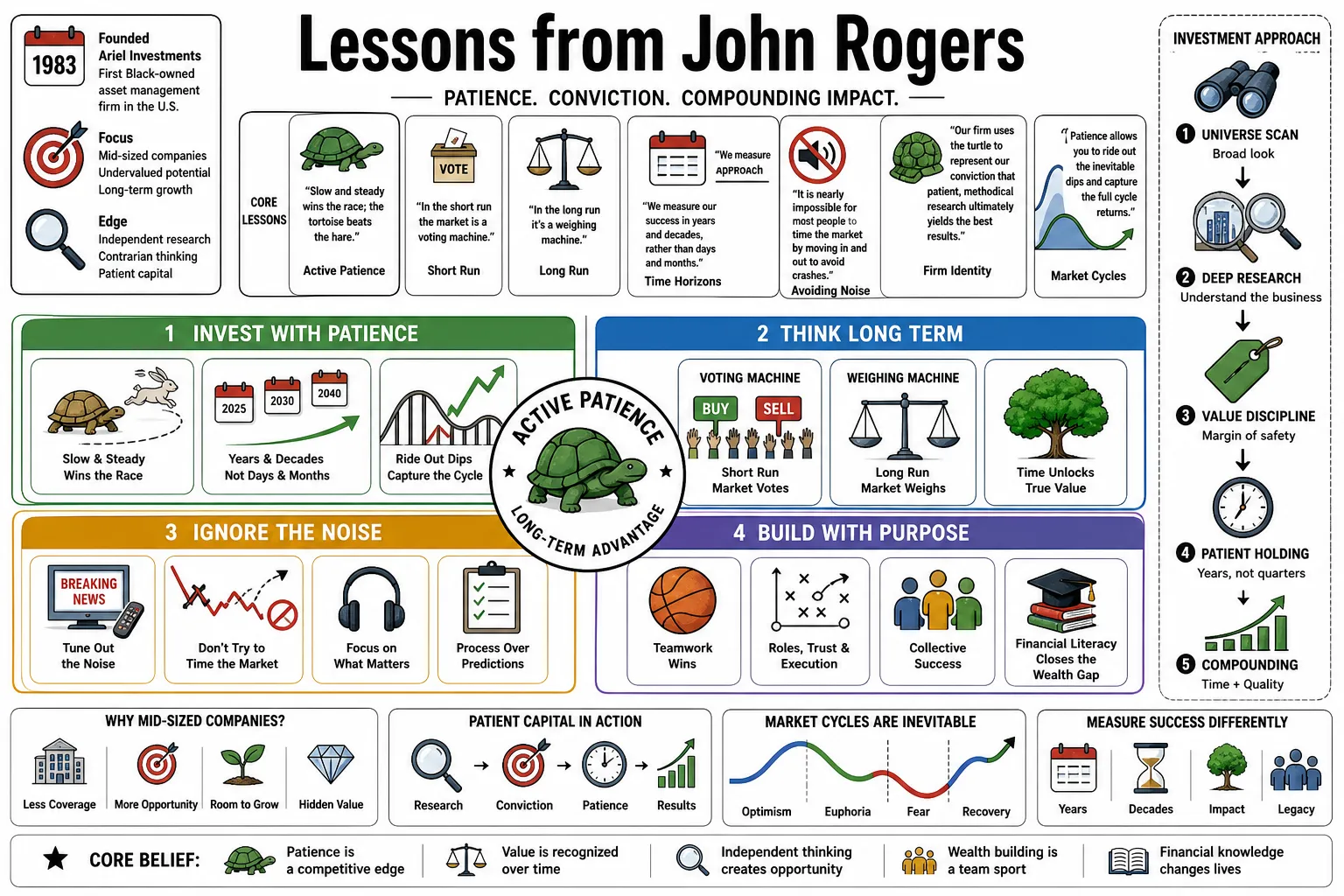
Lessons from John Rogers
John W. Rogers Jr. founded Ariel Investments in 1983, creating the first Black-owned asset management firm in the United States. He built his career on a patient, contrarian approach to value investing by favoring mid-sized companies and holding them through market turbulence. This collection outlines his methods for analyzing businesses, his lessons from basketball on teamwork, and his advocacy for financial literacy to close the wealth gap.
Part 1: Patience and Long-Term Investing
- On Active Patience: "Slow and steady wins the race; the tortoise beats the hare." — Source: [Forbes]
- On Time Horizons: "We measure our success in years and decades, rather than days and months." — Source: [Ariel Investments]
- On Avoiding Noise: "It is nearly impossible for most people to time the market by moving in and out to avoid crashes." — Source: [Chicago Magazine]
- On Firm Identity: "Our firm uses the turtle to represent our conviction that patient, methodical research ultimately yields the best results." — Source: [Ariel Investments]
- On Market Cycles: "Patience allows you to ride out the inevitable dips and capture the long-term compound growth of a quality business." — Source: [Boyar Value Group]
- On Trading Frequency: "High turnover is the enemy of returns; we buy with the intention of holding for the long haul." — Source: [Forbes]
- On Steady Growth: "True wealth is built slowly. Speculation might offer a quick thrill, but it rarely builds lasting capital." — Source: [The Conference Board]
- On Panic: "The most costly mistakes investors make occur when they lose their patience during a market panic." — Source: [Ariel Investments]
- On Conviction: "If you have done the deep research, time becomes your greatest ally." — Source: [Bloomberg]
Part 2: Contrarian Strategy and Market Volatility
- On Finding Value: "We look for high-quality companies that have temporarily fallen out of favor with the broader market." — Source: [Ariel Investments]
- On Market Drops: "Volatility is not a danger to be avoided, but an opportunity to find undervalued stocks." — Source: [Bloomberg]
- On Contrarianism: "It pays to be a contrarian. The best bargains are found in the sectors everyone else is running away from." — Source: [Forbes]
- On Market Consensus: "When the crowd is in agreement, they are usually wrong about the future price of an asset." — Source: [Boyar Value Group]
- On Setbacks: "We look for businesses facing solvable problems, where the market has overreacted to short-term bad news." — Source: [Bloomberg]
- On Buying Opportunities: "A market crash is often a sale on the best companies in the world." — Source: [Chicago Magazine]
- On Independent Thinking: "You cannot outperform the market if you are hugging the index and thinking like everyone else." — Source: [Ariel Investments]
- On Fear: "Fear creates mispricing, and our job is to capitalize on that mispricing methodically." — Source: [Bloomberg]
- On Staying the Course: "During economic uncertainty, the most important advice is to stay the course and avoid being shaken out." — Source: [Chicago Magazine]
Part 3: The Power of Teamwork
- On Basketball Lessons: "Princeton basketball taught me that a team working together selflessly can defeat much more talented opponents." — Source: [Princeton University]
- On Diverse Perspectives: "A business thrives when it embraces diverse talent, leading to better, more rounded decision-making." — Source: [The Conference Board]
- On Firm Culture: "Like a successful basketball team, an investment firm needs people who know their roles and execute them flawlessly." — Source: [The Conference Board]
- On Ego: "Leave your ego at the door. The market will humble you if your colleagues fail to do it first." — Source: [Ariel Investments]
- On Collaboration: "The best investment ideas are usually forged in the fire of vigorous, respectful team debate." — Source: [Ariel Investments]
- On Leadership: "A good leader acts like a point guard, making sure everyone else on the floor is in a position to score." — Source: [Princeton University]
- On Hiring: "We look for people who are passionate, competitive, but ultimately team-oriented." — Source: [Forbes]
- On Shared Goals: "Alignment of interests between our team and our clients is the foundation of our business model." — Source: [Ariel Investments]
- On Resilience: "A strong team absorbs losses together, learns from the mistakes, and comes back stronger the next season." — Source: [Bloomberg]
- On Diverse Talent: "You miss out on a massive competitive advantage if you fail to build a team with different backgrounds and viewpoints." — Source: [Black Economic Alliance]
Part 4: Financial Literacy and Early Education
- On Early Gifts: "My father giving me stock certificates instead of toys for my 12th birthday changed the trajectory of my life." — Source: [Ariel Investments]
- On Financial Education: "We need to teach our children the language of finance as early as we teach them to read." — Source: [Ariel Investments]
- On Generational Wealth: "Understanding the stock market is the most reliable engine for building wealth across generations." — Source: [The Conference Board]
- On Compound Interest: "Kids need to see the magic of compounding with their own eyes to truly understand its power." — Source: [Chicago Magazine]
- On Dinner Table Talk: "Conversations about money, stocks, and business should be normal topics at the family dinner table." — Source: [Ariel Investments]
- On Youth Programs: "Sponsoring financial literacy programs in schools acts as a direct investment in the economy's future, rather than simple charity." — Source: [The Conference Board]
- On Tangible Ownership: "Owning a share of a company you know and love makes the abstract concept of investing incredibly real for a young person." — Source: [Forbes]
- On Starting Early: "The biggest advantage young investors have is time. The earlier they start, the less heavy lifting they have to do later." — Source: [Ariel Investments]
- On Breaking Cycles: "Financial literacy is a necessary tool for breaking the cycle of poverty and building community resilience." — Source: [Black Economic Alliance]
Part 5: Leadership and Character
- On Reliability: "Become that rare person where people know your word is your bond and you will do exactly what you say." — Source: [Business Insider]
- On Networking: "Choose friends and professional connections based on the quality of their character rather than their status or wealth." — Source: [Business Insider]
- On Accountability: "Being a good teammate means delivering on commitments, showing up on time, and avoiding excuses." — Source: [Business Insider]
- On Integrity: "In the financial industry, your reputation is your most valuable asset. Guard it fiercely." — Source: [Forbes]
- On Humility: "Admitting when you are wrong is a prerequisite for long-term survival in the stock market." — Source: [Ariel Investments]
- On Consistency: "Consistency and dependability are the surest paths to gaining responsibility and opportunity in any career." — Source: [Business Insider]
- On Ethical Leadership: "We want to invest in management teams that treat their shareholders as true partners, rather than mere sources of capital." — Source: [Boyar Value Group]
- On Giving Back: "Success in business comes with an obligation to serve the community and open doors for others." — Source: [Princeton University]
- On Character Tests: "How a management team behaves during a severe downturn tells you everything you need to know about their character." — Source: [Bloomberg]
Part 6: Business Diversity and the Wealth Gap
- On Minority Enterprise: "If we care about the wealth gap, we have to have a stronger minority business community." — Source: [University of Chicago]
- On Economic Inclusion: "Diversity in asset management is a fiduciary imperative, not simply a social good." — Source: [Forbes]
- On Capital Access: "Providing access to capital for Black entrepreneurs is essential for building sustainable wealth in underserved communities." — Source: [Black Economic Alliance]
- On Corporate Boards: "We push the companies we invest in to have diverse boards because it prevents groupthink and drives better results." — Source: [Ariel Investments]
- On Supplier Diversity: "Real corporate commitment to diversity means spending money with minority-owned businesses, rather than simply releasing statements." — Source: [The Conference Board]
- On Systemic Barriers: "Overcoming historical wealth disparities requires intentional, structural investment in Black-owned financial institutions." — Source: [Bloomberg]
- On Civil Rights: "The next phase of the civil rights movement is rooted in economic empowerment and financial equity." — Source: [Forbes]
- On Mentoring: "Successful minority executives have a duty to pull up the next generation and show them the path to the boardroom." — Source: [University of Chicago]
- On Institutional Allocators: "Endowments and pension funds must actively seek out diverse fund managers to truly capture the market's best ideas." — Source: [Bloomberg]
Part 7: Analyzing Companies and Value
- On Economic Moats: "We look for businesses with strong competitive advantages that can protect their profit margins over a decade or more." — Source: [Ariel Investments]
- On Consumer Brands: "Companies with deep customer loyalty possess a pricing power that provides a margin of safety during inflation." — Source: [Bloomberg]
- On Niche Markets: "We often find the best value in mid-sized companies that dominate a specific, unglamorous niche." — Source: [Boyar Value Group]
- On Balance Sheets: "A pristine balance sheet is a company's best defense against unforeseen macroeconomic shocks." — Source: [Forbes]
- On Free Cash Flow: "Earnings can be manipulated, but consistent free cash flow generation is the hallmark of a healthy enterprise." — Source: [Ariel Investments]
- On Management Alignment: "We prefer to invest alongside CEOs who have a significant portion of their own net worth tied up in the company's stock." — Source: [Chicago Magazine]
- On Simple Businesses: "If a business model is too complex to explain to a teenager, it is usually too complex to invest in safely." — Source: [The Conference Board]
- On Judging Success: "Our private clients can judge us by just one thing: growth." — Source: [Forbes]
- On Intrinsic Value: "Our job is to calculate a company's private market value and buy the stock only when it trades at a steep discount to that figure." — Source: [Bloomberg]
Part 8: The Psychological Game of Investing
- On Poker Analogies: "Investing is like poker, where a good player can lose if he gets dealt a bad hand, but skill wins out over time." — Source: [Forbes]
- On Emotional Discipline: "The market is designed to test your convictions. Emotional discipline is just as important as analytical skill." — Source: [Ariel Investments]
- On Overconfidence: "A string of early successes can be dangerous. It breeds an overconfidence that the market will eventually punish." — Source: [Boyar Value Group]
- On Information Overload: "More data does not necessarily equal better decisions. You have to filter the noise to find the actual signal." — Source: [Bloomberg]
- On Patience as Action: "Sometimes the hardest, but most profitable, action to take in a turbulent market is doing absolutely nothing." — Source: [Chicago Magazine]
- On Self-Awareness: "You must know your own psychological biases to prevent them from sabotizing your portfolio." — Source: [The Conference Board]
- On the Pain of Losing: "The pain of a loss always feels sharper than the joy of a gain, which is why investors often sell at the exact wrong time." — Source: [Forbes]
- On Contrarian Discomfort: "Buying a stock when everyone else is selling it feels incredibly uncomfortable, but that discomfort is where the premium lies." — Source: [Ariel Investments]
- On Intellectual Honesty: "You have to be willing to change your mind when the facts change, regardless of how publicly you stated your original thesis." — Source: [Bloomberg]