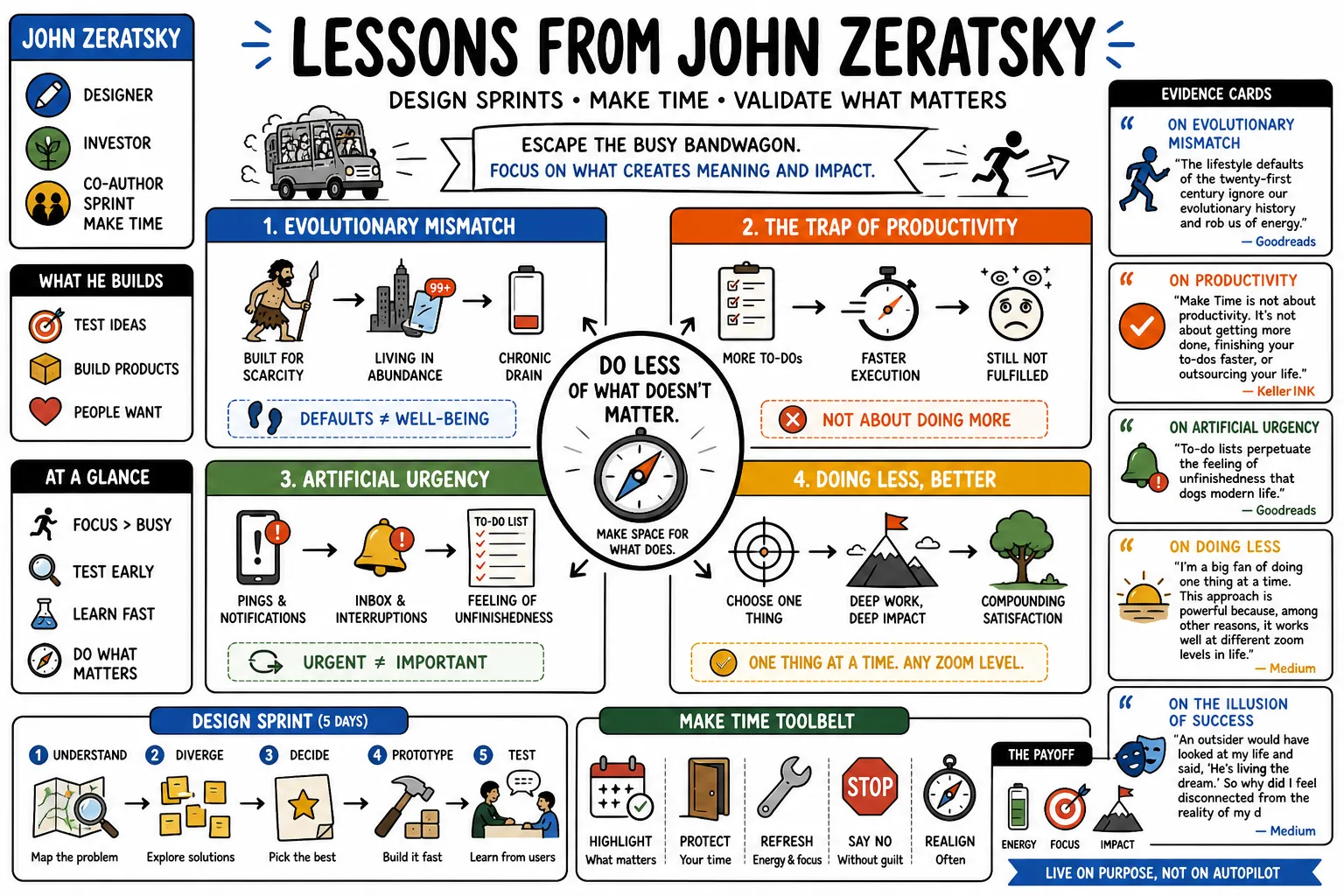
Lessons from John Zeratsky
John Zeratsky is a designer, investor, and co-author of Sprint and Make Time. At Google Ventures and Character Capital, he developed practical methods to help teams test ideas and build products people actually want. This collection gathers his exact tactics for running design sprints, reclaiming your attention, and validating early-stage startups.
Part 1: The Trap of the Busy Bandwagon
- On Evolutionary Mismatch: "The lifestyle defaults of the twenty-first century ignore our evolutionary history and rob us of energy." — Source: Goodreads
- On Productivity: "Make Time is not about productivity. It's not about getting more done, finishing your to-dos faster, or outsourcing your life." — Source: KellerINK
- On Artificial Urgency: "To-do lists perpetuate the feeling of unfinishedness that dogs modern life." — Source: Goodreads
- On Doing Less: "I'm a big fan of doing one thing at a time. This approach is powerful because, among other reasons, it works well at different zoom levels in life." — Source: Medium
- On The Illusion of Success: "An outsider would have looked at my life and said, 'He's living the dream.' So why did I feel disconnected from the reality of my dreamlike life?" — Source: Goodreads
- On False Priorities: "Reacting to the constant influx of emails and messages means you lose the entire day reacting to other people's priorities." — Source: Make Time
- On Modern Defaults: "We default to constant motion because stopping feels like we are falling behind, even when motion does not equal progress." — Source: Lenny's Podcast
- On Reclaiming Control: "Even if you don't completely control your own schedule, and few of us do, you absolutely can control your attention." — Source: Make Time
- On Being Overwhelmed: "The feeling of being overwhelmed isn't necessarily a failure of time management, but a failure of boundary management." — Source: Productivity Paradox
- On Doing Nothing: "Taking a break shouldn't feel like a luxury; it is a structural requirement for doing meaningful work." — Source: The Art of Manliness
Part 2: Escaping Infinity Pools
- On Infinity Pools: "Focusing on a daily Highlight stops the tug-of-war between Infinity Pool distractions and the demands of the Busy Bandwagon." — Source: Make Time
- On Intentionality: "You only waste time when you're not intentional about it." — Source: Freedom.to
- On App Design: "Consumer software is designed to pull you in and never let you go, which is why willpower alone isn't enough to resist it." — Source: Medium
- On Default Behaviors: "We check our phones not because we need to, but because we haven't given ourselves a better default behavior." — Source: Innovators on Tap
- On Notification Friction: "Adding friction to how you access your devices is one of the most effective ways to break the cycle of unconscious phone use." — Source: Time Dorks
- On Social Media: "The endless scroll is a trap that trades your finite attention for a brief, unsatisfying dopamine hit." — Source: Make Time
- On Email Boundaries: "Inbox zero is a myth that encourages you to treat other people's requests as your primary job." — Source: Lenny's Podcast
- On Digital Sabbaths: "Disconnecting from the internet periodically isn't about rejecting technology, but remembering how to exist without it." — Source: Productivity Paradox
- On Reclaiming Attention: "The third path between being constantly busy and constantly distracted is choosing to be intentional with your time." — Source: Make Time
Part 3: The Power of the Daily Highlight
- On Highlights: "Asking yourself 'What's going to be the highlight of my day?' ensures that you spend time on things that matter to you." — Source: Goodreads
- On Daily Priorities: "A highlight can be based on urgency, satisfaction, or joy; it does not have to be strictly work-related." — Source: Make Time
- On Choosing Wisely: "If everything is a priority, then nothing is; picking one highlight forces clarity." — Source: Time Dorks
- On Protecting Time: "Once you identify your highlight, you must ruthlessly defend the calendar blocks required to achieve it." — Source: The Art of Manliness
- On Satisfaction: "Ending the day knowing you accomplished your highlight is the antidote to the feeling of wondering what you actually did today." — Source: Lenny's Podcast
- On Joy As A Metric: "Productivity frameworks often ignore joy, but dedicating your highlight to something simply because you enjoy it is a highly effective use of time." — Source: Make Time
- On Flexibility: "Your highlight isn't a rigid rule; it's a flexible focal point that anchors your day amid chaos." — Source: Medium
- On Creating Time: "It's a framework designed to help you actually create more time in your day for the things you care about." — Source: KellerINK
- On Daily Resets: "Each morning is a clean slate to decide what will make today meaningful, rather than inheriting yesterday's baggage." — Source: Time Dorks
Part 4: Finding Your Laser Focus
- On Deep Work: "Laser focus requires specific, intentional tactics to eliminate the environmental triggers of distraction." — Source: Make Time
- On Friction: "Creating physical distance between you and your phone is the easiest way to jumpstart deep focus." — Source: Productivity Paradox
- On Multitasking: "The human brain isn't built to switch contexts constantly; doing one thing at a time actually gets things done faster." — Source: Medium
- On Willpower: "Relying on willpower to stay focused is a losing strategy against billion-dollar tech companies designed to distract you." — Source: Innovators on Tap
- On Workspace Design: "Curate your physical workspace to signal to your brain that it is time to work, not time to browse." — Source: Make Time
- On Timers: "Using visible timers can create a helpful sense of artificial urgency that keeps you locked into your task." — Source: Time Dorks
- On Distraction-Free Devices: "Removing email and social media from your phone entirely is a dramatic but effective way to ensure laser focus." — Source: Make Time
- On Sustained Attention: "The ability to focus deeply is a muscle that atrophies with disuse but can be rebuilt with deliberate practice." — Source: Lenny's Podcast
- On Saying No: "Laser focus means getting comfortable with letting smaller, less important things slide." — Source: The Art of Manliness
Part 5: Managing Physical and Mental Energy
- On Resilience: "I try to take a natural and low-tech approach to sleep, food, exercise, and other human basics. This keeps life simple, saves money, and makes me more resilient." — Source: My Morning Routine
- On Biological Defaults: "The twenty-first century robs us of energy because it ignores the basic evolutionary needs of the human body." — Source: Goodreads
- On Movement: "Exercise is more than a fitness routine; it is a mechanical tool for generating the cognitive energy required for focus." — Source: Time Dorks
- On Rest: "Sleep is not an obstacle to productivity; it is the absolute foundation of it." — Source: Make Time
- On Caffeine: "Strategic use of caffeine is better than constant consumption; time your coffee for when you actually need a boost." — Source: Productivity Paradox
- On Real Food: "Eating whole, unprocessed foods prevents the energy crashes that destroy afternoon productivity." — Source: Make Time
- On Connection: "Spending time with people you care about isn't a distraction; it is a profound source of restorative energy." — Source: The Art of Manliness
- On Quiet: "Giving your brain moments of complete silence without inputs is essential for processing information and reducing stress." — Source: Innovators on Tap
- On Nature: "Stepping outside, even for just a few minutes, resets our baseline and provides an immediate energy shift." — Source: Make Time
- On Boundaries: "Protecting your energy means knowing when to shut down your computer and explicitly end the workday." — Source: Medium
Part 6: Reflecting and Adapting
- On Data Points: "Every mistake is just a data point." — Source: Goodreads
- On Daily Review: "Taking time at the end of the day to review what worked and adjust for the next day is necessary for long-term change." — Source: Make Time
- On Self-Forgiveness: "If a day goes off the rails, don't dwell on it; just use the information to plan a better tomorrow." — Source: Time Dorks
- On Iteration: "Personal productivity isn't a fixed system; it is an ongoing experiment of testing and tweaking tactics." — Source: Lenny's Podcast
- On Tracking: "Keeping a simple log of your energy levels and focus can reveal patterns you would otherwise miss." — Source: Make Time
- On Honesty: "You have to be honest with yourself about which distractions are actually bringing you value and which are just habits." — Source: Medium
- On Micro-Adjustments: "Massive overhauls rarely stick; it is the tiny, daily adjustments that lead to sustainable habits." — Source: Productivity Paradox
- On Gratitude: "Ending the day by reflecting on what went right helps rewire the brain away from a default state of anxiety." — Source: The Art of Manliness
- On Customization: "No single framework works perfectly for everyone; you must adapt the rules to fit your specific life and brain." — Source: Innovators on Tap
Part 7: Design Sprints and Rapid Prototyping
- On Prototyping: "The ideal prototype should be Goldilocks quality. If the quality is too low, people won't believe the prototype is a real product." — Source: Sprint
- On Sprints: "A sprint gives you an excuse to work the way you want to work, with a clear calendar and one important goal to address." — Source: Sprint
- On Group Dynamics: "The Sprint methodology replaces traditional office defaults, like endless debate, with focused, respectful execution." — Source: Simon & Schuster
- On Learning Fast: In his Sprint Week Thursday guide, Zeratsky explains that a team can test with customers by building a realistic facade, focusing on the customer-facing surface, and making the prototype just realistic enough to evoke honest reactions. — Reference: John Zeratsky Sprint Week Thursday guide on realistic facades and customer reactions
- On Deadlines: "An artificial, constrained timeframe forces teams to make decisions instead of kicking the can down the road." — Source: GV
- On Validation: "The primary goal of a design sprint is to test a specific hypothesis, saving teams from investing months in the wrong direction." — Source: Sprint
- On Experts: "Getting the right people in the room for five days is expensive, but building the wrong product is far more costly." — Source: Medium
- On Solo Ideation: "Group brainstorming often fails; the best ideas come when individuals sketch solutions alone and then evaluate them together." — Source: Lenny's Podcast
- On Failure: "A sprint that reveals a flawed idea is a massive success because it prevents a long, expensive failure later." — Source: Sprint
- On Momentum: "The intense focus of a five-day sprint creates a sense of momentum that can revitalize a stagnant team." — Source: Innovators on Tap
Part 8: Startup Validation and Character Capital
- On Continuous Validation: "A startup never stops caring about growth. The questions never go away, so validation continues to be an essential function." — Source: Medium
- On Complacency: "Even startups can get complacent, so you have to reinvest in discovery of new opportunities." — Source: Medium
- On The Startup Stage: "It's sort of like a spotlight on stage: The focus may change as the company evolves, but the rest of the stage never goes completely dark." — Source: Medium
- On Building the Right Thing: "Startups rarely fail because they can't write code; they fail because they build something nobody actually wants." — Source: Lenny's Podcast
- On Differentiation: "For a startup to break out, being slightly better isn't enough; you must be fundamentally different." — Source: Character.vc
- On Foundation Sprints: "Validating the core narrative and customer need must happen before any significant capital is deployed into engineering." — Source: Lenny's Podcast
- On Venture Capital: "Modern venture capital must provide more than raw capital; founders need structured operational support to find product-market fit faster." — Source: Character.vc
- On Avoiding Assumptions: In an Exploring Product interview, Zeratsky frames the early-stage startup risk as a product-market question: whether the product will work, whether anyone will care, and whether the team can find those people repeatably. — Reference: Exploring Product interview with Zeratsky on early-stage product-market risk and validation
- On The Early Stage: "The earliest days of a startup should look less like a software factory and more like a series of rapid, low-fidelity experiments." — Source: Character.vc