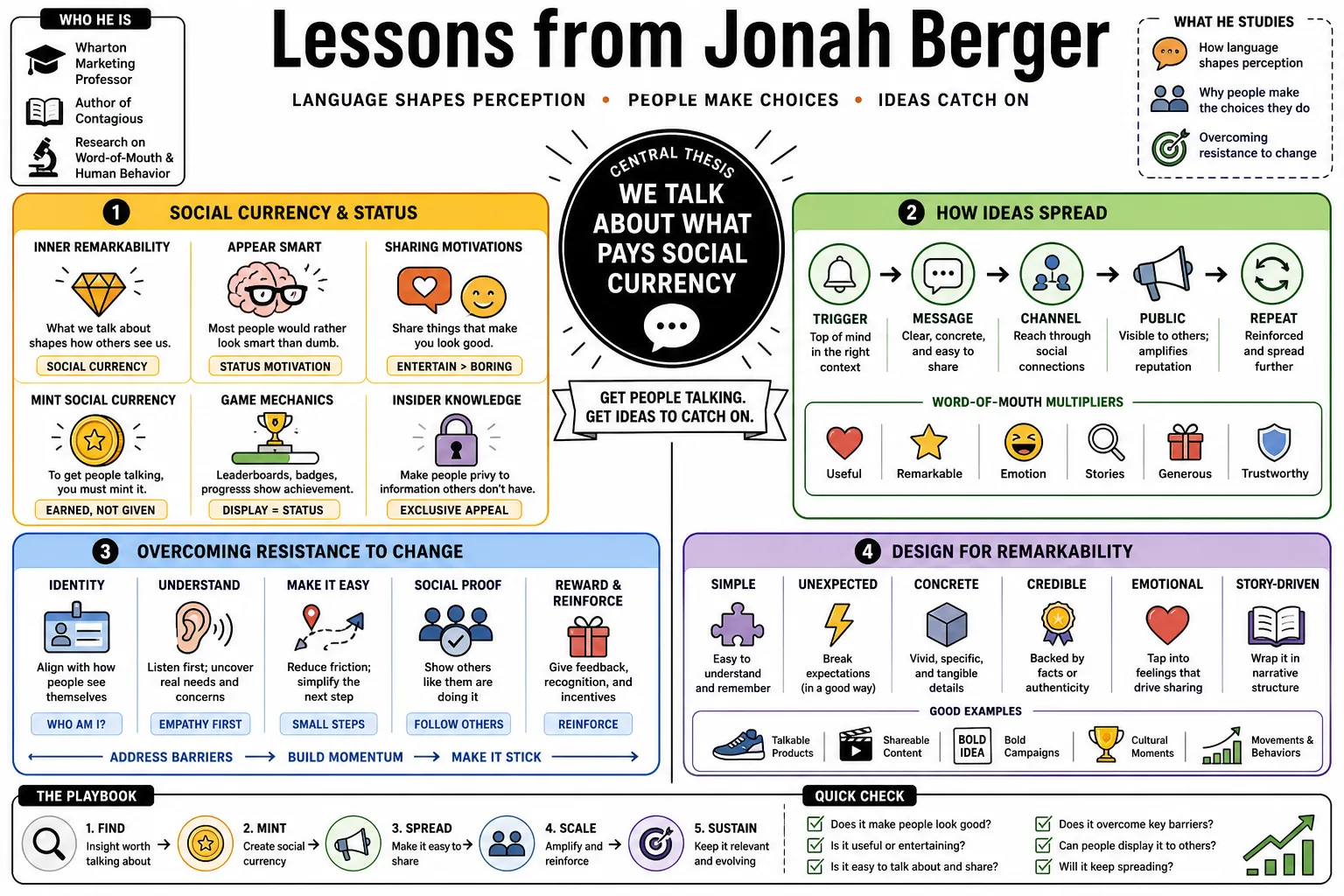
Lessons from Jonah Berger
Wharton marketing professor Jonah Berger studies how language shapes perception and why people make the choices they do. He is best known for examining the psychology of word-of-mouth in his book Contagious and for developing frameworks to overcome resistance to change. This profile compiles his research on human behavior and persuasion to explain the forces that dictate what catches on.
Part 1: Social Currency and Status
- On inner remarkability: "Just like the clothes we wear and the cars we drive, what we talk about influences how others see us. It’s social currency." — Source: [Goodreads]
- On appearing smart: "Most people would rather look smart than dumb, rich than poor, and cool than geeky." — Source: [Goodreads]
- On sharing motivations: "People share things that make them look good to others… people prefer sharing things that make them seem entertaining rather than boring." — Source: [Substack]
- On minting currency: "To get people talking, companies and organizations need to mint social currency." — Source: [SuperSummary]
- On game mechanics: Game mechanics like leaderboards and progress bars give people a tangible way to display their achievements and gain status. — Source: [Sobrief]
- On insider knowledge: Making people feel like insiders through scarcity and exclusivity encourages them to share to show how well-connected they are. — Source: [InformaConnect]
- On social influence: "Everything you talk about affects how people see you and impacts your level of social influence." — Source: [Shortform]
- On positive impressions: People use social currency just like real money to buy desired positive impressions from their peers. — Source: [SuperSummary]
- On self-promotion: "Give people a way to make themselves look good while promoting their products and ideas along the way." — Source: [Book Blabber]
Part 2: Triggers and Top-of-Mind
- On top-of-mind awareness: "Top of mind leads to tip of tongue." — Source: [Goodreads]
- On environmental cues: Triggers in the environment serve as subtle reminders that keep a product or idea active in our thoughts. — Source: [Plain Sight Ventures]
- On habitual talking: We talk about things that are triggered by our immediate surroundings, simply because they are easily recalled. — Source: [Unruly]
- On context: Context plays a massive role in whether a product is remembered and discussed after the initial interaction. — Source: [Unruly]
- On consistent reminders: For word of mouth to be sustained, products need frequent triggers in the daily lives of consumers. — Source: [Medium]
- On linking ideas: You can create triggers by linking your product or idea to an existing, frequently occurring environmental cue. — Source: [Goodreads]
- On natural associations: The strongest marketing creates a natural association where an everyday event automatically brings the product to mind. — Source: [Business Explained]
- On continuous sharing: While social currency gets people talking initially, triggers keep them talking continuously. — Source: [Book Blabber]
- On word-of-mouth marketing: "Word-of-mouth marketing is effective only if people actually talk." — Source: [15 Minute Business Books]
Part 3: Emotion and Arousal
- On caring and sharing: "When we care, we share." — Source: [Goodreads]
- On high-arousal emotions: Emotions like awe, excitement, and anger drive people to action much more than low-arousal emotions like sadness. — Source: [ReferralCandy]
- On motivation: "People don't need to be paid to be motivated." — Source: [Goodreads]
- On viral content: Content that evokes a strong emotional reaction naturally compels the viewer to pass it along to others. — Source: [CKGSB]
- On avoiding sadness: Sadness decreases arousal, making it less likely that people will share content associated with that emotion. — Source: [Medium]
- On anger: Anger is a high-arousal emotion; content that makes people mad often spreads incredibly fast. — Source: [ReferralCandy]
- On awe: Experiencing awe expands our sense of the world and creates a strong urge to share that feeling with peers. — Source: [Unruly]
- On emotional design: Virality is engineered by designing messages that specifically target and activate physiological arousal. — Source: [Devang Gaur]
- On physiological activation: Sharing is fundamentally linked to a state of physiological activation caused by our emotional reactions. — Source: [Book Blabber]
Part 4: Public Visibility and Imitation
- On visibility: "If something is built to show, it's built to grow." — Source: [QuoteFancy]
- On imitation: Making things observable makes them much easier for others to imitate and adopt. — Source: [Plain Sight Ventures]
- On behavioral residue: Products that leave a physical or visible trace after they are used continue to advertise themselves. — Source: [Medium]
- On observable actions: We are heavily influenced by the actions of others, but only when those actions are public enough to be seen. — Source: [Goodreads]
- On social proof: People assume that if others are doing something, it must be the right thing to do. — Source: [Sobrief]
- On private versus public: Behaviors that occur in private are much harder to turn into social movements or viral trends. — Source: [Business Explained]
- On making the private public: A key strategy for spreading ideas is finding ways to make private choices publicly visible. — Source: [Devang Gaur]
- On the power of observability: The more public a product is, the less marketing is required, because the product markets itself. — Source: [Goodreads]
- On the psychology of crowds: Our tendency to conform to the crowd is driven by the visible cues the crowd provides. — Source: [Unruly]
Part 5: Practical Value and Sharing
- On helping others: People inherently like to help others, and sharing useful information is a simple way to do that. — Source: [SuperSummary]
- On filtering information: Because there is so much information available, content that is highly practical and easy to apply cuts through the noise. — Source: [Plain Sight Ventures]
- On reinforcing bonds: Sharing practical value strengthens social bonds between the sender and the receiver. — Source: [ReferralCandy]
- On packaging value: The way useful information is packaged determines how far it will travel; lists and tips are highly shareable. — Source: [Medium]
- On altruism in sharing: While social currency is about making oneself look good, sharing practical value is often driven by altruism. — Source: [Book Blabber]
- On relevance: Information must be relevant to the specific problems of the receiver to be considered practically valuable. — Source: [Unruly]
- On expertise: Sharing useful tips is a way for people to establish themselves as helpful experts within their networks. — Source: [Business Explained]
- On actionable advice: Content that can be immediately acted upon is shared far more frequently than theoretical concepts. — Source: [Sobrief]
- On saving time and money: The most universally shared practical value usually revolves around saving the recipient either time or money. — Source: [Devang Gaur]
Part 6: Storytelling and Narratives
- On how people think: "People don't think in terms of information. They think in terms of narratives." — Source: [Goodreads]
- On information transmission: "While people focus on the story itself, information comes along for the ride." — Source: [Goodreads]
- On idle chatter: Information often travels under the guise of casual, idle chatter wrapped in a narrative format. — Source: [Dropkick Copy]
- On memorable formats: People are vastly more likely to share a memorable story than they are a dry list of facts. — Source: [Sobrief]
- On the Trojan Horse: A good story acts as a Trojan Horse, carrying your core message inside an engaging exterior. — Source: [Medium]
- On brand integration: For a story to be effective marketing, the brand or product must be integral to the narrative, not just a side note. — Source: [Plain Sight Ventures]
- On natural conversation: We share stories because they fit naturally into conversations without feeling like an advertisement. — Source: [Unruly]
- On connecting facts: Narratives help us connect disparate facts in a way that makes logical and emotional sense. — Source: [Business Explained]
- On persuasion: A compelling story is far more persuasive than statistics, because it bypasses analytical skepticism. — Source: [Book Blabber]
- On virality as a process: "Virality isn't born; it's made." — Source: [Book Blabber]
Part 7: Overcoming Inertia and Catalyzing Change
- On the catalyst approach: "Rather than taking a predetermined plan and pushing it on people, catalysts do the opposite." — Source: [Goodreads]
- On the five roadblocks: "Reactance, Endowment, Distance, Uncertainty, and Corroborating Evidence can be called the five horsemen of inertia." — Source: [Goodreads]
- On loss aversion: "Because, as loss aversion shows, losses loom larger than gains... Seeing how much time or money is being lost is more motivating than seeing how much could have been gained." — Source: [Goodreads]
- On settling for good: "Few people attain great lives, in large part because it is just so easy to settle for a good life." — Source: [Goodreads]
- On corroborating evidence: "Some things need more proof. Catalysts find corroborating evidence, using multiple sources to help overcome the translation problem." — Source: [Goodreads]
- On reactance: Allowing people a sense of agency prevents them from pushing back when they feel they are being pushed. — Source: [Goodreads]
- On endowment: To move people past the status quo, you must clearly surface the hidden costs of their inaction. — Source: [Goodreads]
- On distance: When a target is too far away, catalysts shrink the distance by asking for less or shifting the field of play. — Source: [Goodreads]
- On uncertainty: "So, while uncertainty is great for the status quo... it's terrible for changing minds." — Source: [Goodreads]
- On removing barriers: Instead of trying to persuade harder, effective change agents focus on identifying and removing the barriers to change. — Source: [Goodreads]
Part 8: The Science of Language and Invisible Influence
- On framing questions: "Swapping that out for 'What questions do you have?' will encourage more people to follow up if they don't understand." — Source: [Goodreads]
- On identities vs. actions: Using nouns (like "being a runner") is more persuasive and identity-shaping than using verbs (like "going running"). — Source: [Goodreads]
- On avoiding blame: "Dropping the 'you' and switching to something like 'I wanted to talk, but now didn't seem like the best time,' avoids any finger-pointing." — Source: [Goodreads]
- On invisible forces: "When it comes to hiring, raising money, or even conserving energy, people aren't rational robots. Where they stand in relation to others affects motivation." — Source: [Goodreads]
- On familiarity and novelty: "The right blend of familiarity and novelty also drives what becomes popular." — Source: [Goodreads]
- On perceived credibility: "Appearing on the best-seller list provides an air of credibility." — Source: [Goodreads]
- On communication habits: Small shifts in language, such as removing hedges, can dramatically change how confidently you are perceived. — Source: [Awesome At Your Job]
- On language and bias: The specific words we use subtly reveal societal biases and deeply held assumptions to those listening. — Source: [Goodreads]
- On active listening: Asking the right questions doesn't just extract information; it actively shapes the dynamic of the conversation. — Source: [Jennifer Van Gennip]
- On the psychology of influence: Harnessing influence requires understanding why people talk, how they process language, and the hidden psychological forces driving their decisions. — Source: [Goodreads]