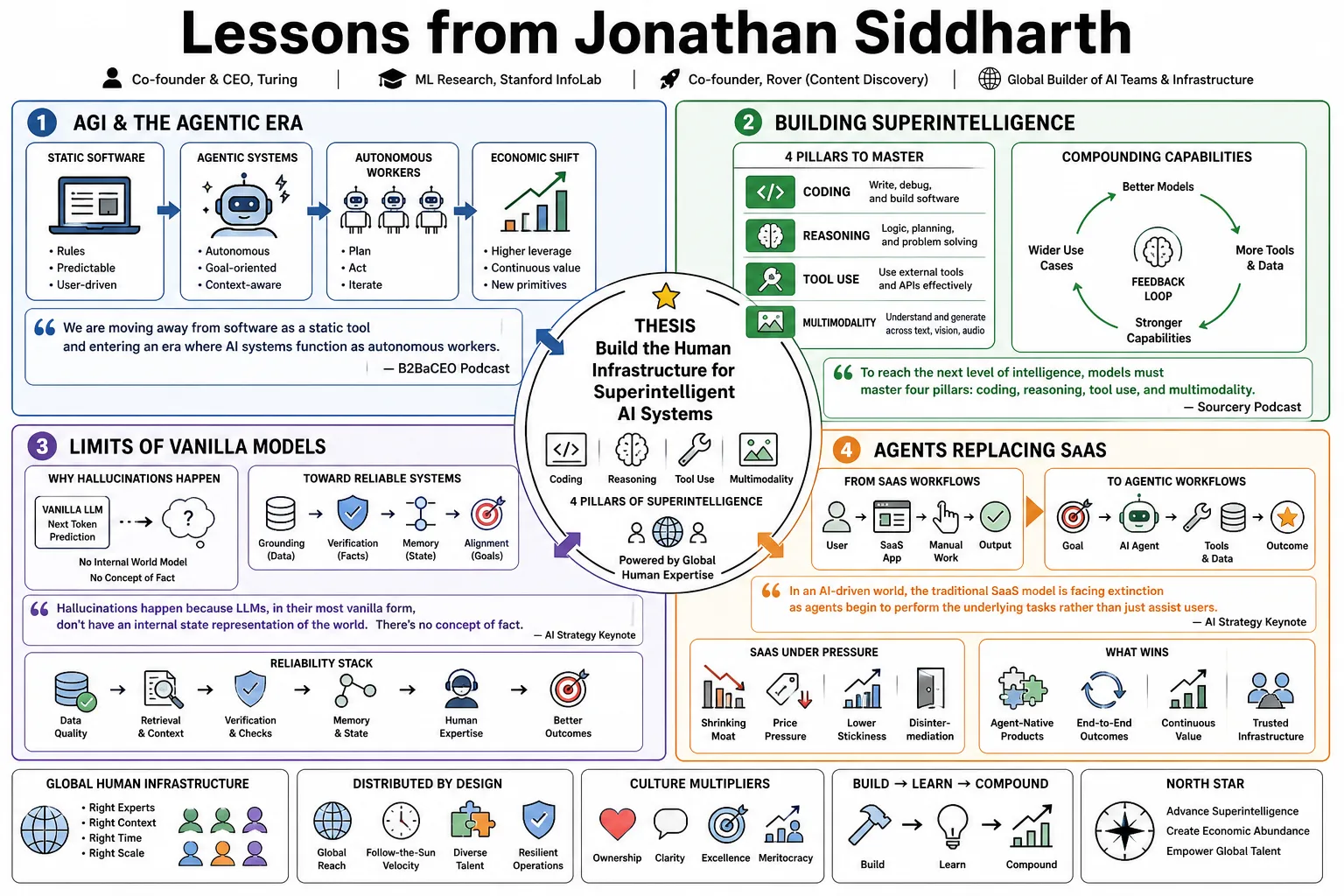
Lessons from Jonathan Siddharth
Jonathan Siddharth is the co-founder and CEO of Turing, which provides frontier AI labs with the human experts needed to train advanced models. He previously researched machine learning at the Stanford InfoLab and co-founded the content discovery app Rover. This profile covers his views on AGI infrastructure, agentic AI, and building globally distributed engineering teams.
Part 1: Artificial General Intelligence (AGI) & The Agentic Era
- On the agentic transition: "We are moving away from software as a static tool and entering an era where AI systems function as autonomous workers." — Source: B2BaCEO Podcast
- On the pillars of superintelligence: Siddharth treats coding, tool use, reasoning, and multimodality as linked capabilities: solving them together is central to the path toward superintelligent systems. — Reference: The Neon Show transcript on coding, tool use, reasoning, and multimodality
- On the limits of vanilla models: "Hallucinations happen because LLMs, in their most vanilla form, don't have an internal state representation of the world. There's no concept of fact." — Source: AI Strategy Keynote
- On software replacement: Siddharth argues that AI agents will move digital knowledge work away from static software interfaces and toward systems that use tools directly on behalf of users. — Reference: 20VC episode on agents and knowledge work
- On human-AI symbiosis: Siddharth wants agent-first, human-second workflows: agents create the first version, while humans steer the task, provide context, verify results, and iterate. — Reference: The Neon Show transcript on agent-first, human-second work
- On continuous improvement: Siddharth sees model improvement as a feedback loop: identify where the agent fails, collect or generate better data for that gap, and feed the lesson back into the system. — Reference: 20VC episode on data-driven feedback loops
- On reasoning vs. recalling: "We are training models not just to retrieve facts, but to break down complex problems into step-by-step logical deductions." — Source: RAISE Summit 2025
- On the speed of transition: "The timeline to highly capable autonomous agents is shorter than most enterprises realize; the bottleneck is no longer compute, but reasoning data." — Source: Summation with Auren Hoffman
- On multimodal understanding: Siddharth puts multimodality in the same capability stack as coding, reasoning, and tool use, because useful agents need to operate across more than plain text. — Reference: The Neon Show transcript on multimodality and agent capabilities
- On defining AGI: Siddharth frames AGI pragmatically: a system approaches AGI when it can match humans across nearly all kinds of digital knowledge work. — Reference: 20VC episode on defining AGI through knowledge work
Part 2: Data Quality & Model Training
- On the power shift in data: Siddharth says the data layer has moved beyond commodity labeling: frontier models now need expert humans, hard tasks, and research-grade data that exposes model limits. — Reference: Sourcery interview on research-first data acceleration
- On human expertise: "To make models smarter, you need training data generated by humans who are currently smarter than the models in specific domains." — Source: B2BaCEO Podcast
- On synthetic data limits: "Synthetic data alone isn't enough; you eventually hit a ceiling where you need human-in-the-loop insights to correct the model's blind spots." — Source: RAISE Summit 2025
- On domain-specific training: Siddharth argues that enterprise AI value comes from distilling proprietary data, tools, and human knowledge into workflows the model can actually use. — Reference: 20VC episode on proprietary enterprise data
- On evaluating model outputs: "The hardest part of training frontier models isn't generating the answer, it's rigorously evaluating whether the logic used to reach that answer is sound." — Source: Summation with Auren Hoffman
- On the cost of bad data: Siddharth emphasizes that frontier models need increasingly sophisticated, expert-generated data; simple labeling work is not enough for complex reasoning and agentic tasks. — Reference: 20VC episode on expert data for frontier models
- On breaking models: Siddharth sees a core part of data work as deliberately finding tasks that stump current models, then turning those failures into training signal. — Reference: Sourcery interview on making models and agents break
- On the developer cloud: Siddharth describes Turing as a developer cloud: vetted engineers supply high-quality coding, STEM, and evaluation data that helps train frontier models. — Reference: Gradient Dissent conversation on Turing developer cloud
- On scaling human feedback: "You can't just crowdsource frontier model training; you need vetted experts who understand the nuances of software architecture and advanced mathematics." — Source: B2BaCEO Podcast
- On data infrastructure: "The infrastructure to train AGI requires managing millions of interactions between human experts and models in a highly secure environment." — Source: RAISE Summit 2025
Part 3: The Future of Software Engineering
- On coding as language: Siddharth treats code as unusually valuable training material because it connects natural-language goals to execution, data analysis, and verifiable reasoning chains. — Reference: Gradient Dissent conversation on coding tokens and reasoning
- On the evolving role of developers: Siddharth expects engineers to spend more time steering agents, giving them sources and prompts, and verifying outputs than writing every first draft themselves. — Reference: The Neon Show transcript on agent-first engineering work
- On programming languages: Siddharth sees natural-language prompts, context, and tool access becoming a core interface for agents, even as code remains important for execution. — Reference: 20VC episode on prompts, tools, and natural-language interaction
- On debugging AI: "As models write more of our software, the primary skill for engineers will be debugging and verifying the logic of AI outputs." — Source: Summation with Auren Hoffman
- On specialized coding tasks: "AI is great at writing individual functions, but humans are still required to understand how those functions fit into a massive legacy codebase." — Source: B2BaCEO Podcast
- On 10x engineers: Siddharth’s version of leverage is an engineer managing multiple agents: the agent creates, the human steers, and the system multiplies execution capacity. — Reference: The Neon Show transcript on humans managing multiple agents
- On software maintenance: Siddharth points to coding-agent work that can inspect tasks, run tests, and handle pull-request-style software changes under human supervision. — Reference: The Neon Show transcript on coding agents and pull requests
- On the barrier to entry: Siddharth sees software creation becoming much more accessible: more people can build custom tools, so judgment about what to build matters more. — Reference: The Neon Show transcript on custom software becoming easier to create
- On human intuition in engineering: Siddharth still puts humans in the steering role: agents can create and execute, but people provide context, judgment, sources, and verification. — Reference: The Neon Show transcript on humans steering agent work
- On the AI-native stack: "We are moving away from traditional IDEs toward AI-native environments where the model acts as an active pair programmer with deep context." — Source: RAISE Summit 2025
Part 4: The Knowledge Work Economy
- On the $30 trillion market: "Knowledge work is a $30 trillion global market, and AI will fundamentally restructure how every single one of those dollars is spent." — Source: Summation with Auren Hoffman
- On automating white-collar tasks: Siddharth believes digital knowledge work is moving toward broad automation, with society needing time to adapt workflows, education, and jobs. — Reference: 20VC episode on digital knowledge work automation
- On the new firm structure: "The company of the future will consist of a small core team of human operators managing a massive fleet of specialized AI agents." — Source: B2BaCEO Podcast
- On skill commoditization: As models handle more routine work, Siddharth shifts the human premium toward judgment, workflow design, and knowing how to direct agent systems. — Reference: The Neon Show transcript on human judgment and agent workflows
- On enterprise adoption: "Enterprises that fail to integrate agentic workflows won't just be slower; their unit economics will simply not be able to compete." — Source: RAISE Summit 2025
- On human capital: "The definition of human capital is shifting from 'what can you do?' to 'what AI systems can you orchestrate?'" — Source: Summation with Auren Hoffman
- On economic displacement: Siddharth expects automation to change jobs materially, which is why he argues companies and society need time to redesign workflows and education around AI. — Reference: 20VC episode on job transition and workflow preparation
- On the speed of business: Siddharth sees AI lowering the friction from idea to execution, especially when agents can help create software and coordinate work quickly. — Reference: The Neon Show transcript on lower-friction execution
- On competitive moats: Siddharth’s clearest moat is proprietary data: companies win when they distill their own knowledge, workflows, and data into useful AI systems. — Reference: Sourcery interview on proprietary data as moat
Part 5: Remote Work & Global Talent
- On the remote-first shift: "The talent pool is global, but until recently, the opportunity was restricted by geography. Remote work breaks that arbitrary barrier." — Source: The Chad & Cheese Podcast
- On vetting talent: "Traditional resumes are terrible predictors of success. We had to build AI systems to evaluate developers based on actual code output and problem-solving speed." — Source: Clay.com Profile
- On geographic arbitrage: "You can find elite engineering talent in emerging markets that rivals Silicon Valley, provided you have the right infrastructure to assess and integrate them." — Source: Foundersuite Blog
- On remote culture: "Building culture in a distributed team requires over-communication, written documentation, and intentional structures for serendipity." — Source: Summation with Auren Hoffman
- On pay transparency: "Global talent markets demand transparency; engineers everywhere are aware of their market value, and companies must adapt their compensation models accordingly." — Source: The Chad & Cheese Podcast
- On the death of the office: Siddharth’s operating model is global by default: Turing built around remote engineering talent and a developer cloud rather than one local office-bound labor pool. — Reference: Gradient Dissent conversation on global developer cloud
- On asynchronous work: "To scale globally, you have to move away from meeting-heavy cultures and embrace asynchronous, document-driven workflows." — Source: B2BaCEO Podcast
- On sourcing bottlenecks: "The hardest part of building a tech company isn't raising capital anymore; it's sourcing and retaining top-tier engineering talent." — Source: Foundersuite Blog
- On equalizing opportunity: Siddharth sees global talent access as a structural advantage: companies can find strong engineers outside traditional hubs and route them into high-value work. — Reference: Gradient Dissent conversation on global software engineering talent
Part 6: Founder Focus & Execution
- On updating insights: "Founders must frequently challenge their core insights; an idea that was brilliant before ChatGPT might be entirely obsolete today." — Source: SVIcons Interview
- On extreme intensity: "Building a category-defining company requires an uncomfortable level of intensity and a willingness to focus exclusively on the hardest problems." — Source: B2BaCEO Podcast
- On early product iteration: "Your first product will likely be wrong. The goal is to build a fast feedback loop with users so you can pivot before you run out of money." — Source: Foundersuite Blog
- On the founder journey: "The transition from founder to CEO is about moving from doing the work to building the machine that does the work." — Source: Summation with Auren Hoffman
- On overcoming failure: "My time at Rover taught me that having great technology isn't enough; if the distribution model is flawed, the company will struggle." — Source: Clay.com Profile
- On market timing: Siddharth watches market structure closely, especially how frontier-model needs shift over months; strategy has to track where the data and workflow market is actually moving. — Reference: 20VC episode on market composition and timing
- On avoiding distractions: "There are a thousand things you could do as a startup, but usually only one or two things that actually move the needle. Ignore the rest." — Source: B2BaCEO Podcast
- On hiring executives: "When hiring leaders, you aren't just looking for experience; you're looking for adaptability and the ability to unlearn outdated playbooks." — Source: Summation with Auren Hoffman
- On managing psychology: Siddharth’s founder advice is more practical than motivational: pick a big market, understand the competitive structure, and stay close to where real value is being unlocked. — Reference: The Neon Show transcript with founder market advice
Part 7: Scaling & Capital Efficiency
- On pivoting business models: "Turing evolved from a talent marketplace to an AGI infrastructure company because we realized our developer network was the perfect engine for model training." — Source: RAISE Summit 2025
- On unit economics: Siddharth’s own positioning for Turing stresses a large market, strong funding, and profitability, so growth has to connect back to a durable operating engine. — Reference: Sourcery interview intro on Turing funding, valuation, and profitability
- On leveraging AI internally: Turing used AI inside its own operating system to source talent, vet talent, match talent, and manage talent before expanding that machinery into broader AI data work. — Reference: The Neon Show transcript on Turing using AI for talent operations
- On the B2B sales cycle: "Selling AI infrastructure to enterprises requires moving past the hype and proving concrete, measurable ROI in their specific domain." — Source: B2BaCEO Podcast
- On network effects: Siddharth’s flywheel is feedback-driven: deploy agents, observe where they fail, collect better data for those gaps, and use that data to improve the next version. — Reference: 20VC episode on data-driven feedback loops
- On the value of partnerships: "Collaborating with frontier labs like OpenAI and Anthropic gave us the precise signal we needed to tailor our supply side to their exact data requirements." — Source: RAISE Summit 2025
- On measuring success: "Vanity metrics will kill a startup. Focus obsessively on retention and engagement, because those dictate true product-market fit." — Source: Foundersuite Blog
- On operational drag: "As you scale, processes naturally ossify. You have to aggressively prune bureaucracy to maintain startup speed." — Source: Summation with Auren Hoffman
- On strategic positioning: "Don't compete where the giants are strong. Find the pick-and-shovel opportunities that the major players need to succeed." — Source: B2BaCEO Podcast
Part 8: Learning & Adaptability
- On continuous education: "The half-life of technical knowledge is shrinking rapidly; the only sustainable advantage is the speed at which you can learn new paradigms." — Source: Stanford Alumni Network
- On the Stanford environment: "Being at Stanford InfoLab taught me how to approach massive, unstructured data problems from first principles." — Source: Medium Profile
- On algorithmic thinking: "Machine learning isn't just a technical skill; it's a framework for probabilistic thinking that applies directly to business decisions." — Source: Clay.com Profile
- On intellectual honesty: Siddharth grounds ambitious AGI claims in workflow evidence: the test is whether models can perform useful work in real enterprise contexts, not whether the narrative sounds exciting. — Reference: Gradient Dissent conversation on enterprise workflow evidence
- On cross-disciplinary insights: Turing’s talent system reused search-style thinking: build deep representations of developers, then match the right people to the right projects. — Reference: Gradient Dissent conversation on developer representation and matching
- On reading the market: Siddharth makes market reading a recurring habit, spending weekend time studying what is changing so strategy stays aligned with the next shift. — Reference: 20VC episode on Siddharth weekend market review
- On letting go of code: "Transitioning from an engineer to a CEO required me to stop writing code and start optimizing the organizational architecture." — Source: Summation with Auren Hoffman
- On navigating hype cycles: Siddharth acknowledges AI hype, but he keeps returning to practical value: better workflows, real enterprise use cases, and the ability to unlock work that was previously too hard or costly. — Reference: The Neon Show transcript on AI hype and practical value
- On the long game: "True technological revolutions don't happen in a single funding cycle. You have to build with a decadal time horizon." — Source: B2BaCEO Podcast