Jony Ive is an industrial designer who shaped the physical form and function of Apple's defining hardware, including the iMac, iPod, and iPhone. His approach relies on removing unnecessary elements so that the manufacturing process and the material itself dictate a product's final shape. This collection gathers his stated perspectives on the discipline of focus, the realities of prototyping, and the careful effort required to build something useful.
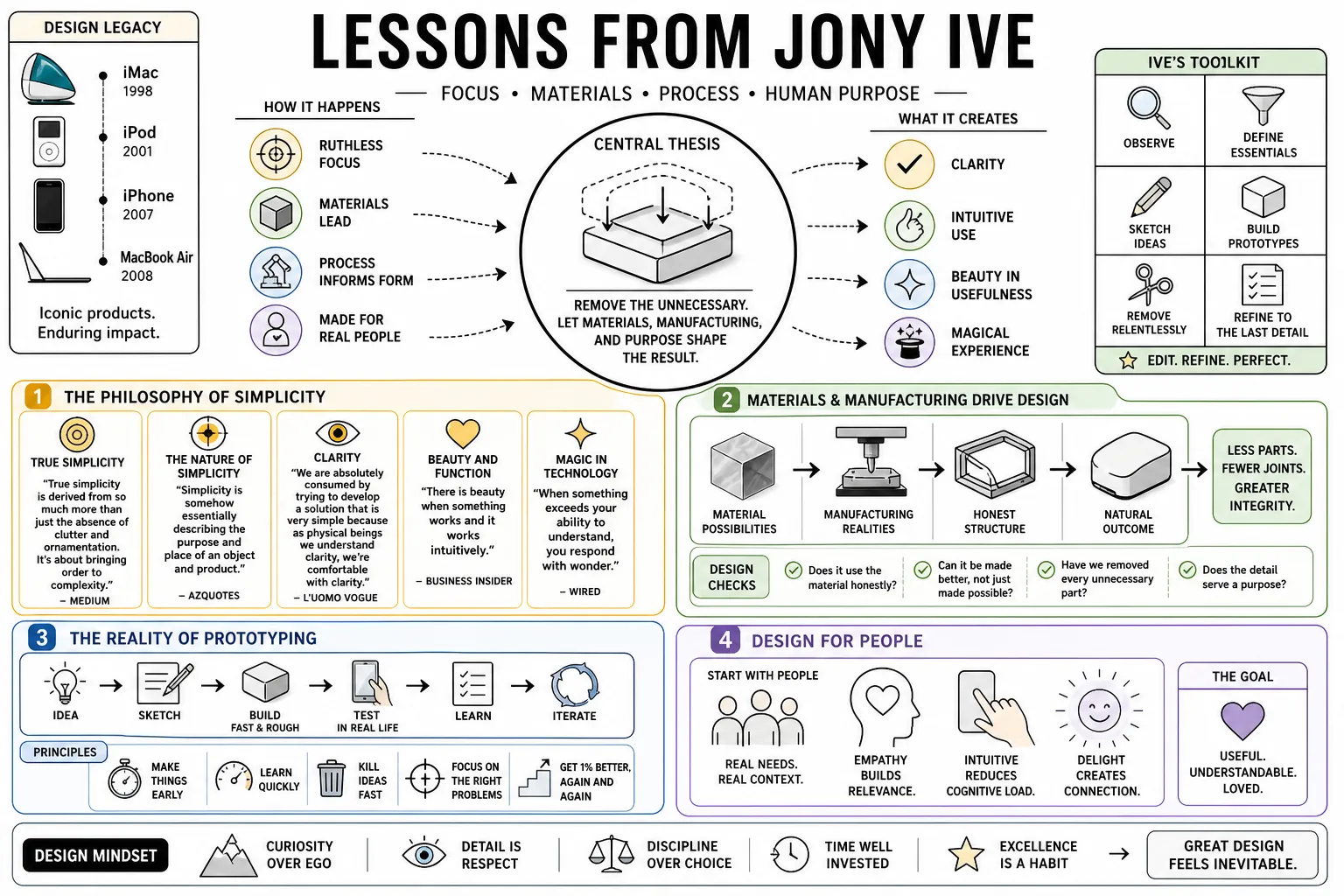
Part 1: The Philosophy of Simplicity
- On True Simplicity: "True simplicity is derived from so much more than just the absence of clutter and ornamentation. It's about bringing order to complexity." — Source: Medium
- On the Nature of Simplicity: "Simplicity is somehow essentially describing the purpose and place of an object and product." — Source: AZQuotes
- On Clarity: "We are absolutely consumed by trying to develop a solution that is very simple because as physical beings we understand clarity, we're comfortable with clarity." — Source: L'uomo Vogue
- On Beauty and Function: "There is beauty when something works and it works intuitively." — Source: Business Insider
- On Magic in Technology: "When something exceeds your ability to understand how it works, it sort of becomes magical." — Source: TechRadar
- On Minimalism's Trap: "True minimalism is not merely stripping things away; it is a deep understanding of the object's purpose and the removal of anything that distracts from that goal." — Source: Objectified
- On the Burden of Design: "The designer must solve the profound complexities of a product internally so the user experiences only a seamless interface." — Source: Objectified
- On Striving for the Essential: "The design team's approach relies on attempting to achieve the most function with the fewest possible elements." — Source: L'uomo Vogue
- On Enduring Beauty: "I think there is a profound and enduring beauty in simplicity; in clarity, in efficiency." — Source: Goodreads
Part 2: The Discipline of Focus
- On True Focus: "What Focus means… is saying NO to something that—with every bone in your body—you think is a phenomenal idea... but you say NO to it because you're focusing on something else." — Source: The Little Almanack
- On Problem Solving: "If something is going to be better, it is new, and if it's new you are confronting problems and challenges you don't have references for. To solve and address those requires a remarkable focus." — Source: Alvin Alexander
- On the Enemy of Greatness: "Really great design is hard. Good is the enemy of great." — Source: QuoteFancy
- On Saying No: "Steve Jobs repeatedly taught that true focus is measured by the number of good ideas you are willing to discard to protect your main objective." — Source: Business Insider
- On Rejecting Reason: "To do something innovative means that you reject reason." — Source: AZQuotes
- On Maintaining High Standards: "We shouldn't be afraid to fail—if we are not failing we are not pushing. 80% of the stuff in the studio is not going to work. If something is not good enough, stop doing it." — Source: Jacob Tyler
- On Avoiding Compromise: "Ideas begin as fragile thoughts that are incredibly easy to compromise or destroy before they can be fully realized." — Source: Y Combinator
- On Unapologetic Passion: "It's actually a rare and precious thing to discover what it is you love to do, and I encourage you to remain unapologetically consumed by it. Be faithful to your gift and very confident in its value." — Source: AZQuotes
- On Protecting the Idea: "The chaos of opinion and the rush to judgment are the greatest threats to a fragile new concept, and focus provides the clarity to defeat them." — Source: WSJ. Magazine
- On Being Different vs. Better: "The thing is, it's very easy to be different, but very difficult to be better." — Source: Goodreads
Part 3: The Nature of Materials and Making
- On Form and Material: "You cannot disconnect the form from the material — the material informs the form." — Source: Engadget
- On the Value of Hands-On Work: "With a father who is a fabulous craftsman, I was raised with the fundamental belief that it is only when you personally work with a material with your hands, that you come to understand its true nature..." — Source: Dezeen
- On Discussing Design: "We seldom talk about shapes. We talk about processes and materials and how they work." — Source: AppleInsider
- On Manufacturing as Design: "The manufacturing process itself is a design material. You cannot design an object and then figure out how to make it later because the process dictates what is possible." — Source: Blake Crosley
- On Making and Designing: "Designing and making are inseparable." — Source: Blake Crosley
- On Understanding Material Constraints: "Until you physically manipulate a material like metal, you cannot truly understand its characteristics or know how to honor it in the final shape." — Source: Dezeen
- On the Transition to Reality: "When you see the most dramatic shift is when you transition from an abstract idea to a slightly more material conversation." — Source: Alvin Alexander
- On Preoccupation with Process: "That understanding, that preoccupation with the materials and processes, is essential to the way we work." — Source: Engadget
- On the Art of Miniaturization: "Viewing complex mechanical objects like traditional watches provides a profound appreciation for the distillation of craft and the art of making." — Source: Hodinkee
- On Tactile Ideas: "Good design allows the user to feel the physical connections, creating a pure and tactile relationship with the object." — Source: Vogue
Part 4: Care, Intention, and Quality
- On Subconscious Discernment: "I think subconsciously people are remarkably discerning. I think that they can sense care." — Source: Medium
- On Fanatical Attention: "We are both fanatical in terms of care and attention to things people don't see immediately. It's like finishing the back of a drawer. Nobody's going to see it, but you do it anyway." — Source: AppleInsider
- On Products as Communication: "Products are a form of communication—they demonstrate your value system, what you care about." — Source: AppleInsider
- On the Primary Motivation: "Our job isn't to make money for Apple. Our job is to try and make the very best products we can." — Source: YouTube
- On Expressing Gratitude: "Making something with deep care, even for people you will never meet, is a direct way of expressing gratitude to humanity." — Source: MacDailyNews
- On the Decisive Factor: "The decisive factor is fanatical care beyond the obvious stuff. The obsessive attention to details that are often overlooked." — Source: Founders Podcast
- On the Test of Character: "What we make stands testament to who we are." — Source: Substack
- On True Care: "The most important thing is that you actually care. When you do, and you spend an enormous amount of time and energy to try to get something right, it's a funny thing – your intent is felt." — Source: Blake Crosley
- On Authentic Excellence: "The connection between great engineers and designers is rooted in an authentic pursuit of excellence and a shared desire to make something remarkably well." — Source: The New Yorker
Part 5: Navigating the Creative Process
- On the Unpredictability of Ideas: "The creative process is fabulously unpredictable. A great idea cannot be predicted." — Source: McKinsey
- On the Genesis of Ideas: "What I love about the creative process, and this may sound naive, but it is this idea that one day there is no idea, and no solution, but the next day there is an idea. I find that incredibly exciting..." — Source: Jacob Tyler
- On Opinions vs. Ideas: "What kills most ideas? I think people desperate to express an opinion and it's really, let’s be very clear, opinions aren’t [as valuable as] ideas." — Source: Substack
- On the Importance of Prototyping: "We struggle with the right words to describe the design process at Apple, but it is very much about designing and prototyping and making. When you separate those, I think the final result suffers." — Source: Alvin Alexander
- On Historical Context: "Paying attention to what's happened historically actually helps give you some faith that you are going to find a solution. Faith isn't a surrogate for engineering competence, but it can certainly help fuel the belief that you're going to find a solution." — Source: Time Magazine
- On the Transition to a Product: "The difference between an idea and a product is that you've solved the problems... If they can be solved, the idea transitions into becoming a thing. If they can't, it remains an idea." — Source: McKinsey
- On Respecting Your Own Work: "If we make it our habit to respect our ideas and our process, we increase the probability that they will actually be good and worthy of that respect." — Source: California College of the Arts
- On True Innovation: "Innovation is rarely about a big idea; more usually it's about a series of small ideas brought together in a new and better way." — Source: Goodreads
- On Nurturing Curiosity: "Being curious fuels our appetite to learn. And wanting to learn is far more important than being right." — Source: Daniel Scrivner
- On Developing Creativity: "Our professional skills develop with repetition. Our creativity develops with deep care and intention." — Source: Daniel Scrivner
Part 6: Failure, Iteration, and Prototyping
- On the Necessity of Failure: "There’s no learning without trying lots of ideas and failing lots of times." — Source: Business Insider
- On Making Mistakes Together: "A fundamental part of that is making mistakes together." — Source: Business Insider
- On Brutal Self-Criticism: "I'm much more concerned about how we can make them as good as possible than how many we'll sell. We're brutally self-critical and go through countless iterations of each product." — Source: The Guardian
- On Pushing Boundaries: "We should not be afraid to fail because a lack of failure indicates a lack of pushing the boundaries of what is possible." — Source: Jacob Tyler
- On Recognizing Bad Design: "Let's say we're talking about something that I've done that's ugly and ill-proportioned—because, believe you me, I can pull some beauties out of the old hat." — Source: The New Yorker
- On Knowing When to Stop: "If a prototype or a project clearly is not meeting the rigorous standards required, the best course of action is to simply stop doing it." — Source: Jacob Tyler
- On Holding Onto the Past: "I actually think the path of holding onto features that have been effective, the path of holding onto those whatever the cost, is a path that leads to failure." — Source: Time Magazine
- On the Sanctity of Creating: "Experiencing difficult and physically uncomfortable creative challenges can permanently alter how you view the sanctity of bringing something new into the world." — Source: California College of the Arts
- On Authentic Effort: "Creating a product must begin with a sincere effort because poorly made objects testify to mere convenience and a fundamental lack of ambition." — Source: The New Yorker
Part 7: Lessons from Steve Jobs
- On Shared Vision: "It was literally the meeting showing him what we'd worked on, and we just clicked... I think that we both perceived the world in the same way." — Source: Vogue
- On "Dopey" Ideas: "Steve used to say to me — and he used to say this a lot — 'Hey Jony, here's a dopey idea.' And sometimes they were... But sometimes they took the air from the room and they left us both completely silent." — Source: Y Combinator
- On Ego and Validation: "Jobs once challenged Ive by telling him he was being vain and just wanted people to like him, which taught him to focus entirely on the work rather than external approval." — Source: The Little Almanack
- On Clarity in Chaos: "Jobs possessed a singular and beautiful clarity that was necessary for defeating the roar of competing opinions and the rush to judgment in the design studio." — Source: Wallpaper
- On Driving Ideas Forward: "The ideas that come from me and my team would have been completely irrelevant, nowhere, if Steve hadn't been here to push us, work with us, and drive through all the resistance to turn our ideas into products." — Source: CNET
- On Spiritual Partnership: "Steve Jobs viewed their relationship not merely as a working arrangement, but as a deeply aligned spiritual partnership." — Source: CNET
- On Protecting Autonomy: "Jobs deliberately set up the company structure so that the design team had unprecedented operational power, which ensured no one could force them to compromise their vision." — Source: Business Insider
- On Frustrations with Credit: "Despite their close bond, Ive admitted to paying maniacal attention to where ideas originated and feeling hurt when Jobs occasionally presented collaborative designs as his own independent thoughts." — Source: CNET
- On Loving the Species: "Jobs instilled the belief that making something empowering and beautiful is the ultimate expression of love and appreciation for our species." — Source: Reddit
Part 8: The Future, Technology, and Humanity
- On the Limitless Future: "When you think about technology and what it has enabled us to do so far, and what it will enable us to do in future, we're not even close to any kind of limit. It's still so, so new." — Source: Time Magazine
- On Personal Technology: "As products become more personal, something that is worn on the wrist put us in the space of fashion... Our understanding will temper and define future products we're working on. We're only starting." — Source: 9to5Mac
- On Humanizing Power: "I think it's part of the human condition that when we see something huge and powerful, that we aspire to make it smaller, and personal." — Source: Business Insider
- On Effortless Interaction: "The most successful wearable technology allows for casual interactions, enabling users to glance carefully rather than requiring the heavy investment of attention demanded by a phone." — Source: The Guardian
- On Building the New: "This is not the time to seek the comfortable familiarity of the past, but rather to build and make something new." — Source: Wallpaper
- On the Role of AI and Tools: "AI is an incredible technology, but great tools require work at the intersection of technology, design, and understanding people and the world." — Source: OpenAI
- On Moving the Species Forward: "At the highest level, the goal of design is to attempt to create something that genuinely moves the entire human species forward." — Source: Substack
- On Typographical Craft: "Designing a bespoke typeface makes no traditional economic sense, but it is pursued obsessively because it serves as an important contribution to culture." — Source: Fast Company
- On Caring for the Self: "My encouragement is to be committed and proactive in caring for that deep, creative part of yourself that is easily overlooked." — Source: Daniel Scrivner