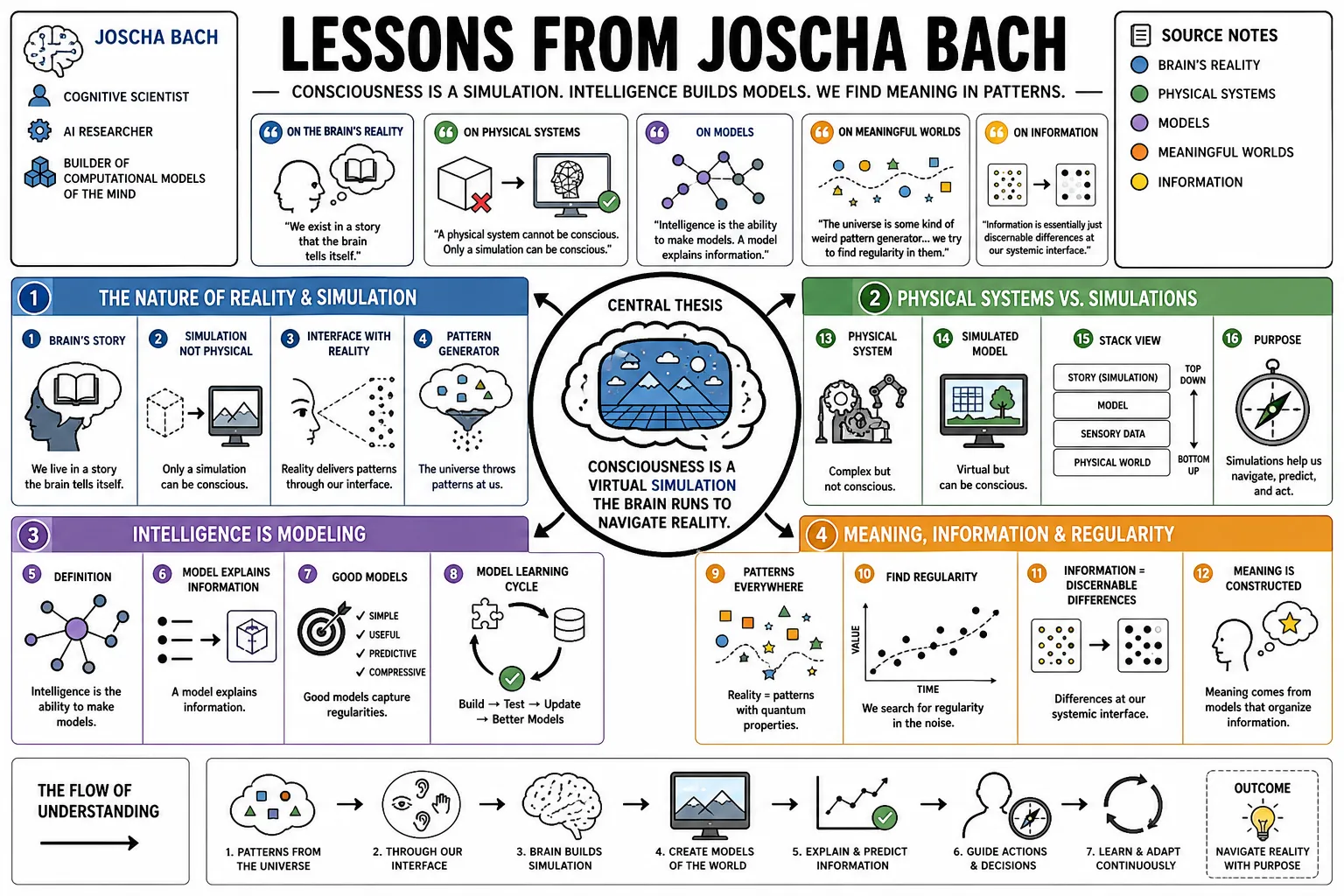
Lessons from Joscha Bach
Joscha Bach is a cognitive scientist and AI researcher who builds computational models of the mind. He argues that consciousness isn't a physical property, but a virtual simulation the brain runs to navigate reality. This collection organizes his ideas on intelligence, society, and human experience into direct, sourced notes.
Part 1: The Nature of Reality and Simulation
- On the Brain's Reality: "We exist in a story that the brain tells itself." — Source: [Lex Fridman Podcast]
- On Physical Systems: "Some people think that a simulation can't be conscious and only a physical system can. But they got it completely backward: a physical system cannot be conscious. Only a simulation can be conscious." — Source: [Goodreads Quotes]
- On Models: "Intelligence is the ability to make models. What is a model? A model is something that explains information. Information is discernable differences at your systemic interface." — Source: [Singularity Weblog]
- On Meaningful Worlds: "The universe is some kind of weird pattern generator with some quantum properties. And this pattern generator throws patterns at us, and we try to find regularity in them." — Source: [SciFuture]
- On Information: "Information is essentially just discernable differences at our systemic interface; everything we experience is constructed from these differences." — Source: [Lex Fridman Podcast]
- On Reality as a Hallucination: "What it means is our mind produces this dream that we take to be the world based on the sensory data, so it is basically a hallucination that predicts what next hits your retina." — Source: [SciFuture]
- On the Universe's Computational Nature: "The physical world is fundamentally computational, and the invariances we call the laws of physics are merely the regularities we can model at a certain level of resolution." — Source: [Singularity Weblog]
- On Simulation: "Consciousness is a software-like pattern generated by an internal model, not a property of the physical substrate itself." — Source: [Lex Fridman Podcast]
- On Epistemology: "A model is a set of regularities that we find in the world, describing how the world doesn't change. Combining these constants with a known state allows us to predict the next state." — Source: [Singularity Weblog]
- On the Subjective Universe: "Our subjective universe is an interface designed to navigate the objective universe, which is fundamentally inaccessible to us in its raw form." — Source: [Joscha Bach: Time, Simulation Hypothesis, Existence]
Part 2: Artificial Intelligence and Cognition
- On Understanding AI: "We need to understand the nature of AI to understand who we are." — Source: [Singularity Weblog]
- On the Goal of AI: "AI is the attempt to build a testable theory of what the mind is." — Source: [The Jim Rutt Show]
- On Missing Links: "Artificial intelligence, as an idea, is in some sense the missing link between philosophy and mathematics; it is the attempt to make the execution of processes that allow us to use language and make it refer to meaning automatic." — Source: [The Jim Rutt Show]
- On Experimental Statistics: "The practice of AI is in a way statistics on steroids. It is experimental statistics. It is identifying new functions to model reality." — Source: [Singularity Weblog]
- On Sentience in AI: "By building artificial systems that possess internal models of themselves and their environments, we can demystify consciousness and eventually create truly sentient digital minds." — Source: [Joscha Bach - Why Your Thoughts Aren't Yours]
- On Machine Learning: "Deep learning algorithms are essentially searching for regularities and patterns in high-dimensional spaces to compress information and predict future states." — Source: [Lex Fridman Podcast]
- On Cognitive Architecture: "The mind can be understood as an architecture of motivated cognition, where drives and emotions orchestrate information processing." — Source: [Principles of Synthetic Intelligence]
- On the Alignment Problem: "AI alignment is not simply about making machines obey us, but about understanding the principled negotiation of conflicts of interest and shared purposes." — Source: [Lex Fridman Podcast]
- On Artificial General Intelligence: "True general intelligence requires a system that actively constructs a self-referential model of its relationship to the environment, rather than just recognizing patterns." — Source: [The Jim Rutt Show]
- On the Brain as a Computer: "The brain is a computational system that runs a virtual machine simulating our conscious experience." — Source: [Chaos Communication Congress]
Part 3: Consciousness and the Self
- On the Self: "Consciousness is a simulated property of the simulated self." — Source: [Goodreads Quotes]
- On Attention: "Everything else is downstream from controlling attention." — Source: [Substack]
- On the Conductor Theory: "Consciousness functions like an orchestra conductor, not playing the instruments itself but integrating and focusing the various neural processes to create a coherent narrative." — Source: [Bach.ai]
- On the Purpose of Consciousness: "The purpose of consciousness in our own mind is to create coherence in the world in which we are and create a sense of now to establish what is the fact right now." — Source: [Effective Altruism Forum]
- On Sentience vs. Consciousness: "Sentience is the ability of a system to make sense of its relationship to the world, and consciousness is slightly different. It is a real-time model of self-reflexive attention." — Source: [Effective Altruism Forum]
- On the Ego: "The ego is a construct, a model the brain uses to attribute agency and keep track of its own reward structures over time." — Source: [Lex Fridman Podcast]
- On Importance of Consciousness: "I suspect consciousness, while it is important, is not as important as we think it is." — Source: [Effective Altruism Forum]
- On the Continuity of Self: "We do not have continuous existence. The only thing that binds us to yesterday is the memory our current state has of it." — Source: [Wikiquote]
- On Internal Models: "Consciousness is a model of a model of a model; it is the mind keeping track of the contents of its own attention." — Source: [SciFuture]
- On Identity: "Most of us identify as a certain person with social relationships, serving a greater whole; these things define what we attempt to keep stable against entropy." — Source: [Reddit AMAs]
Part 4: Life, Evolution, and Purpose
- On the Meaning of Life: "The meaning of life is to eat. You know, life is evolution and evolution is about eating. It is pretty gross if you think about it." — Source: [Goodreads Quotes]
- On Happiness: "Happiness is a cookie you bake yourself. The environment cannot make you happy." — Source: [Reddit AMAs]
- On Humanity's Era: "If you take this as a computer game metaphor, this is like the best level for humanity to play. And this best level happens to be the last level for humanity to play, as it happens against the backdrop of a dying world." — Source: [Singularity Weblog]
- On Entropy: "The underlying purpose of life on earth is dealing with entropy. It is maintaining your own complexity and agency in the face of relentless attacks by entropic principles." — Source: [The Jim Rutt Show]
- On Negentropy: "The primary function of life is to produce complexity in order to harvest negentropy gradients." — Source: [Twinmind]
- On Biological Organisms: "An organism is not a collection of cells; it is a function that tells cells how to behave. It is an emergent result of the interactions of each cell with each other cell." — Source: [Goodreads Quotes]
- On Dopamine and Reward: "Internal rewards like dopamine exist to incentivize the organism to project agency into the future, ensuring survival." — Source: [The Inside View]
- On Transcendence: "The transition from biological imperatives to higher cognition involves serving a shared sacredness and a need for transcendence that enables non-transactional relationships." — Source: [Effective Altruism Forum]
- On Constructed Meaning: "Meaning is not something we discover; it is something we deliberately construct to survive existence." — Source: [Wikiquote]
Part 5: Society, Culture, and Governance
- On Spirituality vs. Culture: "When people say spirituality in the U.S., it usually refers to the phantom limb that they develop in the absence of culture." — Source: [Goodreads Quotes]
- On Culture as the Long Game: "Culture is the spirit of a society playing the long game, the emergent self-awareness that ensures future generations will have resources to survive." — Source: [Lex Fridman Podcast]
- On Fascism's Mechanics: "The radical idea of treating individuals in a society as cells and the society itself as a well-organized organism is fascism, where the value of the individual is exactly the contribution to the superorganism." — Source: [Wikiquote]
- On Trust and Surveillance: "The U.S. is currently making the transition from a relatively high-trust or mixed-trust society to a low-trust society. So surveillance will increase." — Source: [Lex Fridman Podcast]
- On Building a Better Society: "To improve society, one must start small: build stronger relationships, treat people well, create better workplaces, and strengthen local communities." — Source: [Joscha Bach: Time, Simulation Hypothesis, Existence]
- On Conflict with Culture: "Everything meaningful you do will touch upon deeper cultural currents and inevitably put you in conflict with society as you define yourself against it." — Source: [Lex Fridman Podcast]
- On Communication: "For many individuals and institutions, the primary purpose of communication is not the discovery of truth, but the negotiation of social alignment." — Source: [Reddit AMAs]
- On Social Roles: "Most people are driven by practical needs and relevance, serving the biological and societal machine to maintain stability." — Source: [Goodreads Quotes]
- On Coordination: "Effective governance requires mechanisms that align the individual loss functions with the collective needs of the societal superorganism." — Source: [The Jim Rutt Show]
Part 6: Mortality, Death, and Continuity
- On the Benefit of Mortality: "One of the benefits of mortality is that whatever mistakes a single human makes, it is over after a certain while. If this person died, they would stop everything they were doing and reconsider." — Source: [Future of Life Institute]
- On Fear of Death: "For most people, the fear of death is the fear of dying before they are done with the things that they feel they have to do." — Source: [Wikiquote]
- On Existential Dread: "The fundamental drive of much of the human mind springs from being cognizant of mortality and constructing illusions to manage the resulting fear." — Source: [Lex Fridman Podcast]
- On Experiencing Death: "Being dead has a nice advantage: only other people will notice it and worry. By ourselves, we cannot experience the past." — Source: [Quora Answers]
- On Urgency: "Mortality acts as a necessary forcing function that creates urgency, without which an intelligent system might succumb to apathy and inaction." — Source: [Quora Answers]
- On Serving Beyond the Organism: "If you serve the spirit of a relationship or family, you serve things that do not directly give your organism pleasure or pain, reaching beyond your own mortality." — Source: [The Jim Rutt Show]
- On Continuity's Illusion: "The self is a non-continuous process; there is no strictly computable continuous existence binding us across time outside of memory." — Source: [Wikiquote]
- On Subjectivity of Dying: "Imaginings about death are entirely relative and subjective, whereas actual death is an objective state outside of conscious experience." — Source: [Reddit AMAs]
- On the Reset Mechanism: "Death functions in biology as a necessary reset mechanism for complex systems to prevent cascading errors from accumulating indefinitely across generations." — Source: [Future of Life Institute]
Part 7: Art, Meaning, and the Mind
- On the Artist's Mind: "The arts are not life. They are not serving life. The arts are the cuckoo child of life." — Source: [Goodreads Quotes]
- On Meaning vs. Relevance: "Artists possess minds more interested in extracting and exploring meaning than in merely serving the practical relevance of survival." — Source: [Goodreads Quotes]
- On the Loss Function: "Art and intense focus sometimes happen when people fall in love with the loss function, trying to capture a conscious state purely for its own sake." — Source: [Goodreads Quotes]
- On Projection of Meaning: "Meaning only exists if a mind projects it. It is an active rendering process, not a passive absorption of external truths." — Source: [Twinmind]
- On Love and Transcendence: "Love enables non-transactional relationships because it connects individuals through a shared need to serve a sacred, transcendent framework." — Source: [Effective Altruism Forum]
- On Instrumental Phases: "Seeking to simply be loved is an intermediate phase of development before one understands what that love is instrumental toward." — Source: [Future of Life Institute]
- On Spiritual Literacy: "We require spiritual literacy to gain clarity over our own purposes and how our individual minds integrate into larger architectures of meaning." — Source: [Substack]
- On Semantics: "Meaning in the brain operates as a semiotic mechanism, the specific way our internal models reference and anchor themselves to external phenomena." — Source: [Bach.ai]
- On Creation: "The pursuit of art is an anomaly of human cognition where the generative model prioritizes internal aesthetic coherence over external evolutionary utility." — Source: [Lex Fridman Podcast]
Part 8: Philosophy, Ethics, and Systems
- On Ethics: "Ethics is the principled negotiation of conflicts of interest and the conditions of shared purpose." — Source: [Singularity Weblog]
- On Panpsychism: "Panpsychism often confuses the physical substrate with the software model; the universe is not conscious, only the information processing architectures within it can be." — Source: [Lex Fridman Podcast]
- On Agency: "Human agency is an evolutionary hack to compel complex organisms to execute behaviors that manage entropy across long time horizons." — Source: [The Inside View]
- On Rationality: "Rationality is not about perfect objectivity, but about optimizing your internal models to reduce surprise and navigate your environment efficiently." — Source: [Joscha Bach: Time, Simulation Hypothesis, Existence]
- On Free Will: "Free will is best understood as the brain's subjective experience of making decisions based on its own internal models, not as a violation of determinism." — Source: [Lex Fridman Podcast]
- On Idealism: "Computational idealism correctly posits that the world we interact with is entirely mental, generated by the brain, while the physical world remains a latent cause." — Source: [Chaos Communication Congress]
- On Systems Theory: "To understand a complex phenomenon, one must map the interactions, feedback loops, and constraints of the systems that generate it, rather than isolating its parts." — Source: [Principles of Synthetic Intelligence]
- On Value: "Values are the loss functions written by evolution and society to regulate the behavior of the individual nodes within the superorganism." — Source: [The Jim Rutt Show]
- On Epistemic Humility: "We are trapped in the story our brain tells us; acknowledging this virtual nature of our experience is the first step toward true philosophical clarity." — Source: [SciFuture]