Joseph Campbell (1904–1987) was an American writer and teacher of comparative mythology. In The Hero with a Thousand Faces and his later conversations with Bill Moyers, he explored how mythic patterns can illuminate human experience. — Joseph Campbell Foundation Biography.
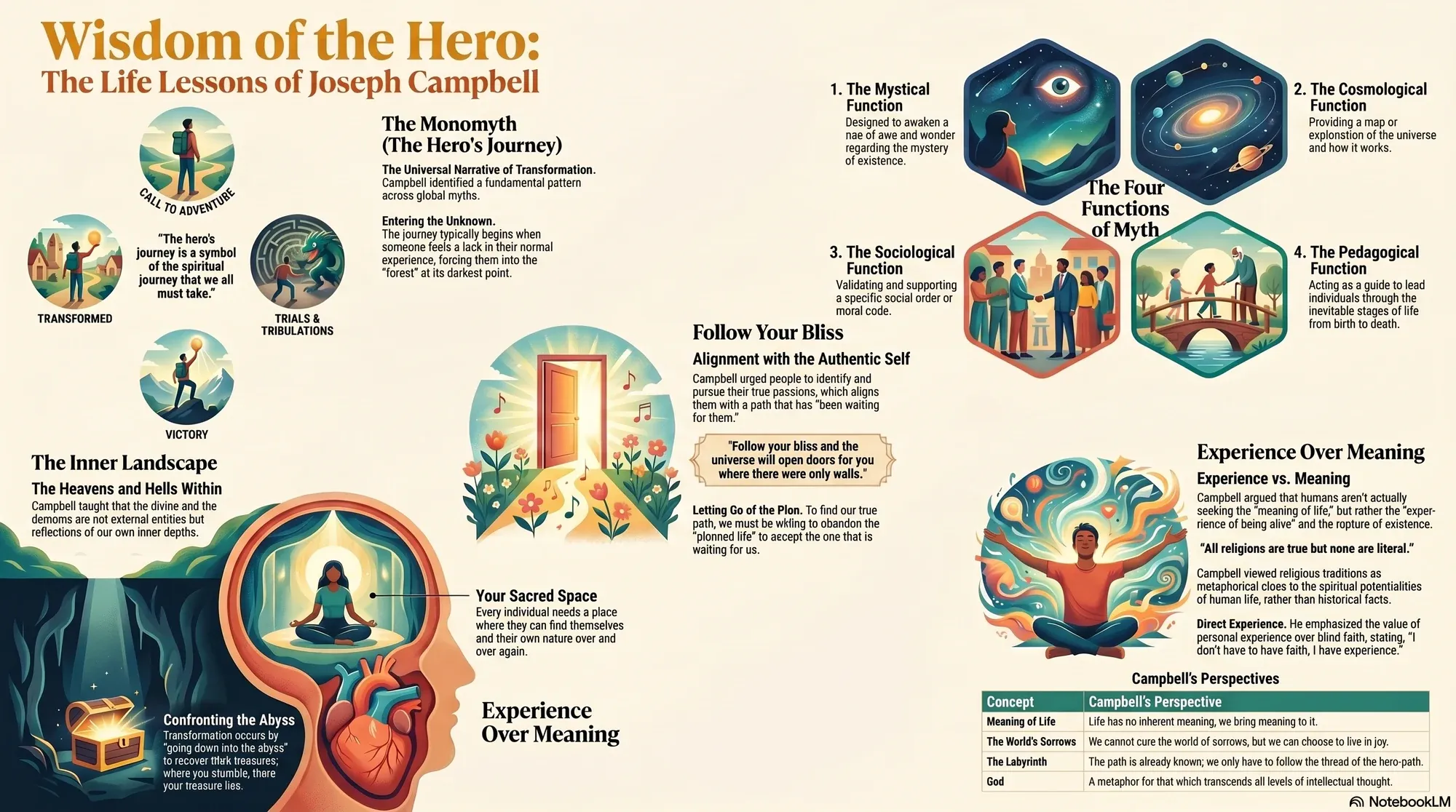
Key Learnings from Joseph Campbell
Campbell described mythology as serving several functions, including helping people navigate stages of life. The following lessons distinguish his own words from later interpretations. — Joseph Campbell Foundation — Four Functions of Myth.
- The Hero's Journey: In The Hero with a Thousand Faces, Campbell proposed a recurring pattern of separation, initiation and return, with many possible variations. He also treated the journey as a metaphor for transitions in a person's life. — Joseph Campbell Foundation — Hero's Journey.
- Follow Your Bliss: Campbell advised finding the deep enthusiasm that fits one's life and following it with commitment. He distinguished bliss from quick pleasure and said judgment and existing responsibilities still matter. — Joseph Campbell Foundation — Follow Your Bliss.
- Four Functions of Myth: Campbell described four functions of a living mythology: awakening awe, presenting a cosmology, supporting a social order and guiding people through life's stages. He did not claim that every individual myth performs all four. — Joseph Campbell Foundation — Four Functions of Myth.
- The Inner World: Campbell read gods, heavens and hells as symbolic of dimensions of inner life, and argued that mythic images can point beyond literal description toward human experience. — Joseph Campbell Foundation — Quotations.
- Experience of Being Alive: In his conversation with Bill Moyers, Campbell said that people may seek not an abstract meaning of life but the felt experience of being alive. — Joseph Campbell Foundation — Quotations.
- At the Threshold: Campbell's hero-cycle describes a threshold guardian that the hero must confront, conciliate or pass; the monster is one possible mythic image of the trials that begin an adventure. — Joseph Campbell Foundation — Hero's Journey.
- Beyond Opposites: Campbell argued that religious and mythic symbols can point toward a plane of experience beyond the oppositions through which people ordinarily think. — Joseph Campbell Foundation — Power of Myth Excerpt.
- Commitment to Work: Campbell warned that following one's bliss is not merely doing what is fun: it takes instruction, perseverance and the willingness to continue work even when recognition does not come quickly. — Joseph Campbell Foundation — Follow Your Bliss.
Further Lessons from Joseph Campbell
- Let the Planned Life Change: Campbell urged willingness to release a planned life to make room for the life that arrives; the familiar 'let go' wording is a softened variant of the wording printed in A Joseph Campbell Companion. — Joseph Campbell Foundation — Companion Excerpt.
- Become Who You Are: Campbell called being who you are the privilege of a lifetime, in the posthumously edited A Joseph Campbell Companion. — Joseph Campbell Foundation — Companion Excerpt.
- Myth and Dream: Campbell compared myths with public dreams and dreams with private myths; the Foundation attributes this formulation to Myths to Live By, not The Hero with a Thousand Faces. — Joseph Campbell Foundation — Myths to Live By Excerpt.
- Heavens and Hells Within: Campbell treated the realms of gods and demons as dreamlike, inner symbolic realities, rather than literal places; the Foundation's direct excerpt comes from Myths of Light. — Joseph Campbell Foundation — Myths of Light Excerpt.
- Find Your Own Way: Campbell said a teacher can offer clues and warn of hazards, but another person cannot hand you your own way through fear or change. Treat the path as yours to discover rather than following a borrowed formula. — PBS — The Hero's Adventure.
- Match Nature's Rhythm: In A Joseph Campbell Companion, Campbell pictured a life in harmony with nature through the metaphor of bringing one's heartbeat into rhythm with the universe. — Joseph Campbell Foundation — Companion Excerpt.
- Find Sacred Space: Campbell described sacred space as somewhere a person can find themselves again and again; the Foundation attributes this line to A Joseph Campbell Companion. — Joseph Campbell Foundation — Companion Excerpt.
- Vitality Can Be Contagious: When Bill Moyers framed a personal journey as saving oneself rather than the world, Campbell replied that a vital person can vitalize others. Campbell's point was about the influence of living fully, not a guarantee that self-work alone solves public problems. — PBS — The Hero's Adventure.
- Meaning Through Being Alive: Campbell challenged the idea that life needs an abstract answer supplied from outside. In his conversation with Moyers, he urged attention to the felt experience of being alive and the meaning a person brings to life. — Bill Moyers — The Message of the Myth.
- Break Through Limitations: Campbell associated breaking through personal limitations with spiritual growth in The Hero with a Thousand Faces; the lesson is a mythic metaphor, not a clinical claim. — Joseph Campbell Foundation — Hero Excerpt.
- Find Treasure in the Abyss: In A Joseph Campbell Companion, Campbell linked descent into the abyss and stumbling with the discovery of life's treasures. This is the longer documented thought behind the popular shortened cave aphorism. — Joseph Campbell Foundation — Companion Excerpt.
- Regret Arrives Late: Campbell's line about regrets as late illuminations appears in The Hero with a Thousand Faces, according to the Foundation's book-attributed excerpt. — Joseph Campbell Foundation — Hero Excerpt.
- Distinguish a Mythic Metaphor from Clinical Reality: In Myths to Live By, Campbell compared a guided mystical inward journey with an unguided psychotic experience using a swimming metaphor. This reflects his historical interpretation of myth and psyche; it is not a clinical description or mental-health advice. — Myths to Live By — JCF Edition.
- Affirm Life Without Denying Suffering: Campbell argued that saying yes to life does not mean denying its pain or withdrawing from action. In his conversation with Moyers, he describes sorrow and loss as part of living while still urging participation in the world. — Bill Moyers — The Message of the Myth.
- Joy Amid Sorrow: In the Sukhavati recording, Campbell urged joyful participation amid the world's sorrows. The thought acknowledges suffering; it does not promise that sorrow disappears or that joy is always a choice. — Sukhavati: Place of Bliss — JCF excerpt.
- The Hero Can Become the Tyrant: Campbell warned that the hero who defeats a tyrant can later become a tyrant by holding fast to a past victory or position. His mythic warning is about continual renewal, not a claim that every real-world hero inevitably turns oppressive. — The Hero with a Thousand Faces — JCF excerpt.
- Serve Something Beyond Yourself: In his conversation with Bill Moyers, Campbell defined a hero as someone who gives themselves to something beyond their own interests. He distinguished physical acts, such as saving a life, from a spiritual journey that returns with something to communicate. — Bill Moyers — The Hero's Adventure.
- Read Myth as Metaphor: Campbell warned against treating a myth only as a literal historical account. In his interview with Moyers, he said its symbolic reading can point toward human and cosmic mystery that a purely factual reading misses. — Bill Moyers — The Message of the Myth.
- Religion as Metaphor: Campbell said religious traditions can be true as metaphors for human and cosmic mystery, while warning that treating a metaphor as literal fact misses its reference. This was his interpretive view, not a claim that all doctrinal statements are factually true. — Bill Moyers — Masks of Eternity.
- God as a Name for Mystery: Campbell described God as a name pointing toward a mystery beyond categories of thought. He treated mythic language as metaphorical reference rather than a literal description that could exhaust that mystery. — Bill Moyers — The Message of the Myth.
- Integrate the Unrecognized Power: Campbell used the image of swallowing a demon to describe gaining power by facing what one has not recognized in oneself. This is a symbolic claim about inner conflict, not a literal prescription. — The Power of Myth — JCF excerpt.
- Artists Renew Mythic Language: Campbell argued that artists can present enduring mythic mysteries in the setting and language of contemporary life. The old themes persist, but their expression must change with the times. — The Hero's Journey — JCF excerpt.
- Say Yes to the Adventure of Living: For Campbell, mythic adventure can describe ordinary life as well as legendary quests. In The Hero’s Adventure, he urges openness to the adventure of being alive rather than treating a call as a guaranteed heroic outcome. — Bill Moyers — The Hero’s Adventure.
- Sacrifice to the Relationship: Campbell described marriage as a relationship to which both people contribute; in his account, the sacrifice is to the shared relationship rather than merely to the other person. He also warned against defining a union only through its children. — Bill Moyers — Sacrifice and Bliss.
- Tame the Demons Within: Bill Moyers recalled Campbell reading Maurice Sendak's Where the Wild Things Are as an image of confronting one's own inner demons. Campbell's observation was about Max's story, not a line from The Hero with a Thousand Faces. — Bill Moyers — Conversation with Maurice Sendak.
- Many Ways an Adventure Begins: Campbell described hero adventures that begin by chance, by a deliberate decision to seek something, or because circumstances force a person into change. There is no single required kind of call. — PBS — The Hero's Adventure.
- Enter the Pathless Forest: In Pathways to Bliss, Campbell pictured the search for one's own way as entering a forest where no path is marked. The image emphasizes an individual route rather than a prescribed path from someone else. — Pathways to Bliss — JCF excerpt.
- Knowing What We Do Not Know: In his final Moyers conversation, Campbell repeated a traditional saying that real knowledge includes awareness of what one does not know. Present it as a saying he invoked, not an aphorism he originated. — Bill Moyers — Masks of Eternity.
- Experience Before Assent: Asked by Bill Moyers whether he was a man of faith, Campbell answered by pointing to his own experiences of wonder, love and the conflicting energies of life. He was describing his personal way of approaching religious imagery, not disproving others' faith. — Bill Moyers — Masks of Eternity.
- Shed the Old Skin: In A Joseph Campbell Companion, Campbell paired the image of shedding an old skin with relinquishing a life plan that no longer fits. Transformation requires making room for what comes next, not simply clinging to the former shape. — A Joseph Campbell Companion — JCF excerpt.
- Myths Open Spiritual Awareness: Campbell said myths and their symbols can bring people into a spiritual level of awareness. In his Moyers conversation, he illustrated this with the shift he experienced upon entering a cathedral from a busy city street. — PBS — The Hero's Adventure.
- Follow the Thread of Earlier Heroes: In The Hero with a Thousand Faces, Campbell suggested that earlier hero stories offer a thread through the mythic labyrinth. Their patterns can orient a new journey without prescribing every person's exact route. — The Hero with a Thousand Faces — JCF excerpt.
- Return with a Boon, Then Face New Calls: In Campbell's pattern, the hero returns from the unfamiliar realm with a boon that can renew the ordinary world. He also described a good life as successive journeys, each with a new call and no guarantee of success. — Joseph Campbell Foundation — The Hero’s Journey.
- Begin with Mystery and Awe: Campbell associated experiences of wonder and awe with recognition of a dimension beyond what the senses ordinarily grasp. This describes his interpretation of such experiences, not a universal definition of the sacred. — Bill Moyers — Masks of Eternity.
- A Computer as a Mythic Image: In a Moyers interview, Campbell joked that his new IBM computer resembled a rule-bound Old Testament god. He then used the machine's software as a metaphor for how distinct religious systems operate, showing both frustration with and wonder at the technology. — Bill Moyers — The Message of the Myth.
- Use an Unstructured Period to Read Deeply: Campbell recalled spending five years in Woodstock reading extensively while he had no job or money. His account offers a concrete example of sustained self-education, without the unverified prescription about choosing only the 'right' books or people. — Joseph Campbell Foundation — The Hanged Man.
- Begin with One's Own Life Without Withdrawing: In A Joseph Campbell Companion, Campbell stresses putting one's own life in order amid a world that has always been troubled. In his conversation with Moyers, he also makes clear that affirming the world does not rule out reforming laws or taking part in public struggles. — A Joseph Campbell Companion — JCF Edition.
- The Dark Moment in Myth: Campbell used a mythic descent into darkness as an image for the possibility of transformation. This is a feature of the story pattern, not a guarantee that every hardship will resolve in light. — Joseph Campbell Foundation — Power of Myth Excerpt.
- Renewal Requires Something New: In The Hero with a Thousand Faces, Campbell used repeated birth as a metaphor for renewal in the soul and in society: surviving change requires the emergence of something new, not simply the return of the old. — The Hero with a Thousand Faces — JCF excerpt.
- Cross the Familiar Threshold: In The Hero with a Thousand Faces, Campbell describes the hero leaving familiar ground for a realm of unknown and sometimes dangerous forces. The threshold marks a change in the story, not a universal prescription to disregard ordinary caution. — The Hero with a Thousand Faces — JCF Excerpt.
Learn more:
- Joseph Campbell Foundation — The Hero with a Thousand Faces
- Bill Moyers — The Hero's Adventure
- Joseph Campbell Foundation — Book-Attributed Quotes
- Joseph Campbell Foundation — Four Functions of Myth
- Joseph Campbell Foundation — Follow Your Bliss
- Joseph Campbell Foundation — A Joseph Campbell Companion
- The Collected Works of Joseph Campbell