Joseph Jacks founded OSS Capital to invest in companies built around open-source projects. His writing and interviews focus on the business models, governance, and investor judgment involved in commercial open source. — Changelog Interviews #602.
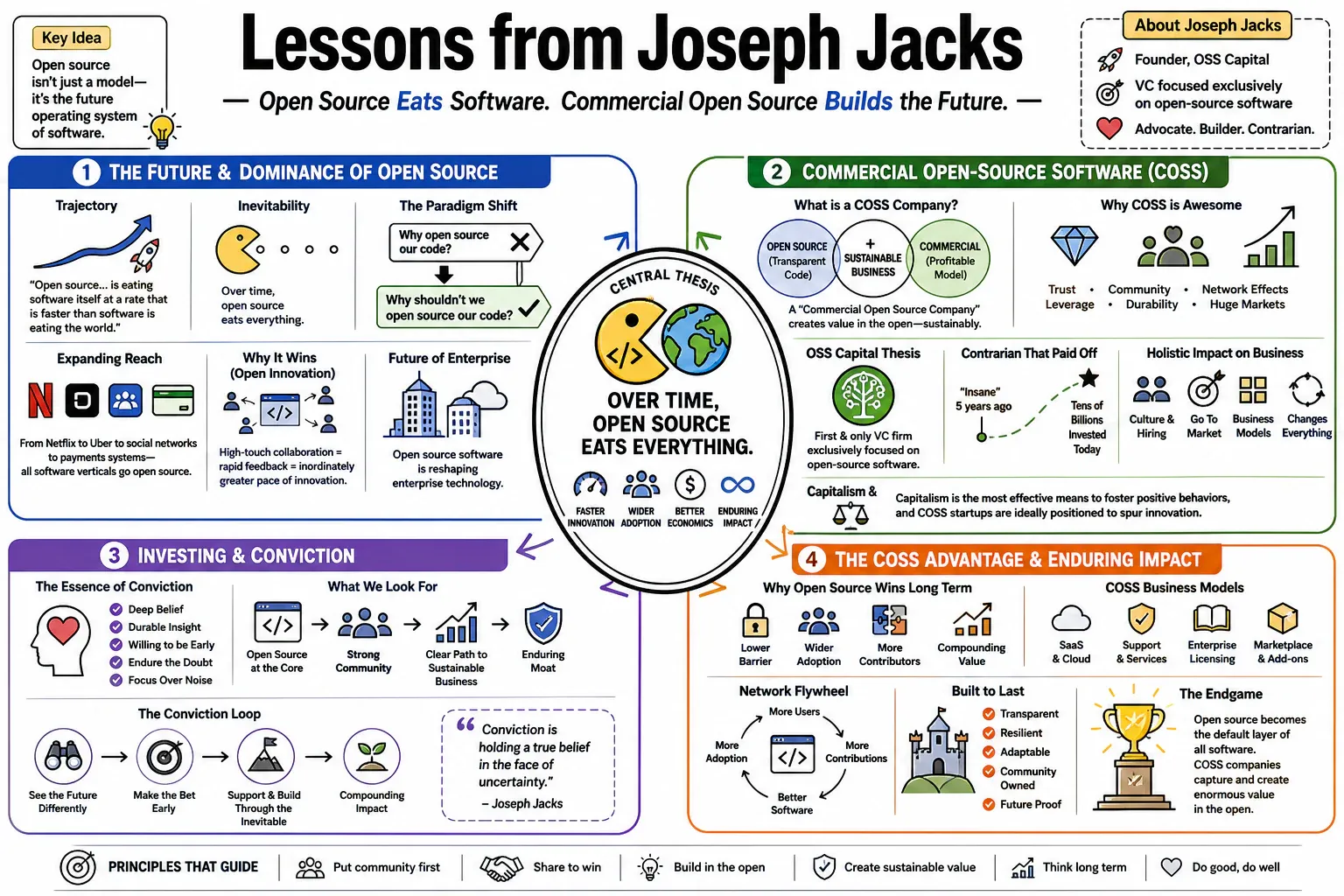
On the Future and Dominance of Open Source
- On the Open-Source Thesis: Jacks's investing thesis is that open source is increasingly replacing proprietary software as the foundation of new products and companies. — Changelog Interviews #602.
- On User Control: Jacks argues that an open alternative can appeal to users who want control, extensibility, and a product they can inspect and trust. — Changelog Interviews #602.
- On the Sequence of Adoption: In a 2018 interview, Jacks expected infrastructure software to move toward open source before enterprise applications, while saying consumer apps could take longer. — Software Engineering Daily — OSS Capital.
- On Open Feedback Loops: Jacks argued that public development can shorten feedback loops by letting a wider group of users test and improve software. — The $70B Open Source Software Paradox.
- On Enterprise Viability: Jacks saw commercial support and the ability to build a business around open projects as reasons open-source infrastructure had become more viable for enterprises. — The $70B Open Source Software Paradox.
On Commercial Open-Source Software (COSS)
- On Defining COSS: Jacks uses “commercial open-source software company” for a business whose product depends on developing a core open-source technology, not for every company that merely uses open-source tools. — Console DevTools — OSS & Investing.
- On an Exclusive Investment Focus: OSS Capital says it has focused on early-stage commercial open-source companies since 2018; Jacks describes that exclusive focus as the firm's defining investment thesis. — OSS Capital — Team.
- On Contrarian Conviction: Jacks recalls that when he launched OSS Capital in 2018, many investors considered a dedicated commercial-open-source fund contrarian; his earlier Kubernetes experience gave him conviction in the category. — Changelog Interviews #602.
- On Company Versus Project: Jacks distinguishes funding a company built around an open-source project from funding the project itself; the company must develop a commercial model alongside the open technology. — Changelog Interviews #602.
- On Open-Source Value Capture: Jacks argues that commercial businesses can capture a portion of the value open source creates while continuing to make the underlying technology widely available. — Software Engineering Daily — OSS Capital.
On Investing and Conviction
- On Investment Conviction: Jacks says investment conviction is qualitative and personal, drawing on judgment of the founder, the market, and unproven hypotheses. — On Reaching Conviction.
- On Founder and Idea: Jacks says he needs conviction in both the founder and the idea, rather than investing in a person alone. — On Reaching Conviction.
- On Founder Obsession: Jacks looks for founders who are deeply compelled by the problem they are pursuing, alongside the judgment and abilities needed to build a company. — On Reaching Conviction.
- On the Investor's Own Interest: Jacks tests his own conviction by whether a founder's idea keeps drawing his attention and makes him want the product to exist. — On Reaching Conviction.
- On Decisive Learning: Jacks values founders who decide quickly while continually incorporating new evidence and improving their execution. — On Reaching Conviction.
- On a Long Investment Horizon: In his January 2024 Bittensor announcement, Jacks described an investment and network-building horizon of more than ten years, rather than a quick trade. — $25 Million Commitment to Bittensor.
- On the Opportunity Set: In his 2024 essay, Jacks says he seeks ideas with a potential opportunity set hundreds of times larger than his entry price; this is his conviction criterion, not a forecast of realized returns. — On Reaching Conviction.
On Technology and Innovation
- On Open-Source Principles: Jacks stresses that open-source licenses should not discriminate against users or uses, and credits Richard Stallman's early free-software work as a foundation for today's open-source ecosystem. — Console DevTools — OSS & Investing.
- On AI and Source Code: Jacks argues that model weights are a different artifact from software source code, complicating how traditional open-source terminology applies to AI releases such as Llama. — Changelog Interviews #602.
- On the Bittensor Commitment: In January 2024, Jacks announced that OSS Capital was committing $25 million to the Bittensor ecosystem across grants, startups, validators, subnets, and long-term holdings. — $25 Million Commitment to Bittensor.
- On Kubernetes Governance: When Kubernetes was still young, Jacks argued that independent community governance was important for its growth rather than leaving the project under Google's control. — Why CNCF? Why Now?.
Learnings from Joseph Jacks' Journey and Experience
- On Blogging to Build Conviction: Before OSS Capital had much capital, Jacks used writing to test his ideas about commercial open source and gather feedback on the fund's thesis. — Changelog Interviews #602.
- On Starting KubeCon: Jacks says he named and helped organize KubeCon's first two events with others; Kismatic later donated the event to the CNCF. — Changelog Interviews #602.
- On Kismatic: Jacks helped build Kismatic, an early company commercializing Kubernetes for enterprises; Apprenda acquired it in 2016. — Apprenda — Kismatic Acquisition.
- On Market Timing: Jacks credits timing as well as conviction: after a difficult early fundraise, most of OSS Capital's first fund came together in the 2021 bull market. — Changelog Interviews #602.
- On Users and Customers: For a commercial open-source company, a broad project community is not a substitute for a product customers will pay for; founders still need revenue and a go-to-market motion. — The Craft of Open Source — OSS Capital's Vision.
- On Community Contributions: Jacks distinguishes choosing to encourage outside contributions from the separate question of whether a project's license is open source; community dynamics alone do not define it. — The Craft of Open Source — OSS Capital's Vision.
- On Open Core Summit: Jacks built Open Core Summit as a gathering for commercial open-source founders, while crediting Marco Palladino with seeding the original idea. — InfoQ — Open Core Summit Interview.
- On Preserving the Core License: Jacks says OSS Capital seeks consent rights over changes to a portfolio company's core open-source license because a later relicensing can breach community trust. — Changelog Interviews #602.
- On Building a Business Around Open Source: Jacks warns that open-source adoption does not remove the ordinary work of building a product, generating revenue, hiring, and going to market. — The Craft of Open Source — OSS Capital's Vision.
- On Open Core Versus Freemium: Jacks favors a useful, unrestricted open core over a narrowly limited free trial; paid features may be added around a core that users can still extend themselves. — Changelog Interviews #602.
- On Learning from Talend: Jacks says working at Talend early in his career exposed him to a type of company built around open-source technology before he developed the COSS investment thesis. — The Craft of Open Source — OSS Capital's Vision.
- On Acquisition Signals: During OSS Capital's early fundraise, Jacks viewed the MuleSoft and Red Hat acquisition announcements as signs that commercial open source was attracting larger-market attention. — Changelog Interviews #602.
- On Continuous Learning: In judging founders, Jacks looks for people who keep learning and grow their capacity as the company faces more complex problems. — On Reaching Conviction.
- On a Three-Year Fundraise: OSS Capital's first $52 million fund took Jacks nearly three years to raise; he says almost all of it arrived in 2021 after a difficult 2019 and 2020. — Changelog Interviews #602.
- On Licensing Expertise: Jacks describes Heather Meeker as an OSS Capital partner whose licensing work informed the firm's thinking about open-source and source-available approaches. — The Craft of Open Source — OSS Capital's Vision.
- On Balancing Multiple Stakeholders: Jacks says commercial open-source founders must balance the project's community with paying customers and company investors, a tension unlike a purely proprietary product. — The Craft of Open Source — OSS Capital's Vision.
Learn more:
- Changelog Interviews #602: Open Is the Way with Joseph Jacks
- Software Engineering Daily: OSS Capital with Joseph Jacks — Interview Transcript
- Console DevTools: OSS & Investing with Joseph Jacks
- The Craft of Open Source: OSS Capital’s Vision for Open Source Software
- InfoQ: Open Core Summit Preview — Interview with Joseph Jacks
- CNCF: CloudNativeCon and the Future of KubeCon — 2016 Announcement
- Apprenda: Enterprise Kubernetes with the Acquisition of Kismatic
- Joseph Jacks: On Reaching Conviction
- Joseph Jacks: $25 Million Commitment to Bittensor
- OSS Capital: Team and Investment Focus
- Joseph Jacks: Why CNCF? Why Now?
- Joseph Jacks: The $70B Open Source Software Paradox