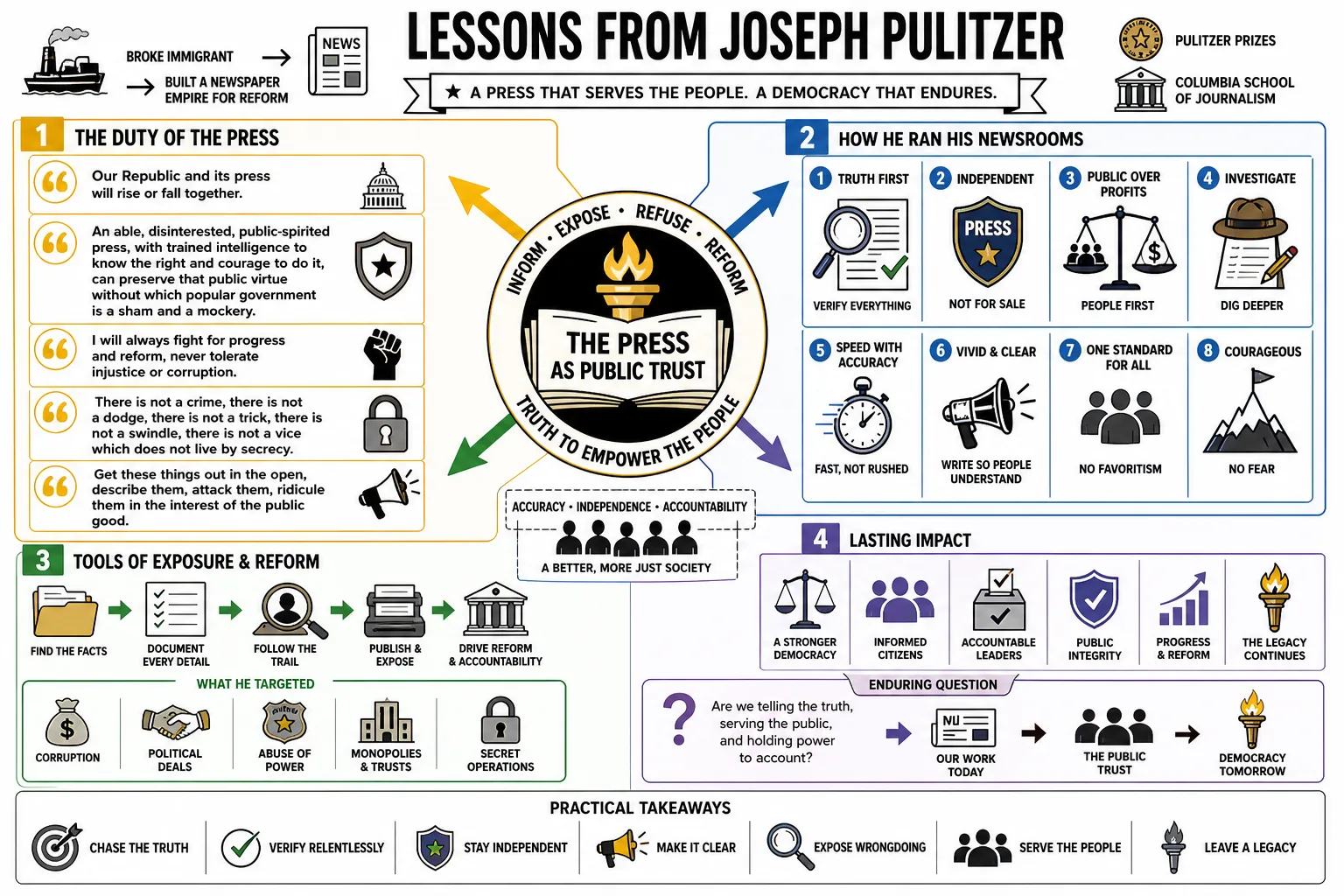
Lessons from Joseph Pulitzer
Joseph Pulitzer arrived in the United States broke and built a newspaper business that defended the working class and investigated political corruption. He is best known today for funding the Pulitzer Prizes and the Columbia School of Journalism, but his practical legacy is the way he ran his newsrooms. This profile details the methods he used to force accuracy, independence, and accountability into daily reporting.
Part 1: The Duty of the Press
- On the press and democracy: "Our Republic and its press will rise or fall together." — Source: [North American Review, 1904]
- On journalistic courage: "An able, disinterested, public-spirited press, with trained intelligence to know the right and courage to do it, can preserve that public virtue without which popular government is a sham and a mockery." — Source: [North American Review, 1904]
- On fighting for reform: "I will always fight for progress and reform, never tolerate injustice or corruption." — Source: [The New York World Platform, 1883]
- On the dangers of secrecy: "There is not a crime, there is not a dodge, there is not a trick, there is not a swindle, there is not a vice which does not live by secrecy." — Source: [The World Archives]
- On the power of exposure: "Get these things out in the open, describe them, attack them, ridicule them in the press, and sooner or later public opinion will sweep them away." — Source: [The World Archives]
- On public service: "A newspaper’s highest calling involves actively working toward the betterment of the community it serves, far beyond simply reporting events." — Source: [Pulitzer.org Biography]
- On continuous vigilance: "The press must consistently maintain its independence and stay devoted to the public welfare." — Source: [The New York World Platform, 1883]
- On protecting the vulnerable: "A journalist must maintain sympathy with the poor and consistently oppose privileged classes and public plunderers." — Source: [The New York World Platform, 1883]
- On moral purpose: "A cynical press will eventually create a cynical and corrupt society; the newspaper must act as an instrument of moral clarity." — Source: [North American Review, 1904]
- On the true measure of success: "Circulation and revenue mean nothing if a newspaper fails to improve the civic life of its readers." — Source: [St. Louis Post-Dispatch History]
Part 2: Journalistic Independence
- On political affiliation: "Always fight demagogues of all parties, never belong to any party." — Source: [The New York World Platform, 1883]
- On financial independence: "A newspaper must achieve high profitability to ensure editorial independence from advertisers and politicians." — Source: [Pulitzer.org Biography]
- On resisting influence: "A true editor serves only the reader and resists the temptations of high society and the pressures of corporate interests." — Source: [The New York World Archives]
- On equal opportunity criticism: "The press must willingly attack wrong wherever it exists, whether perpetrated by predatory plutocracy or predatory poverty." — Source: [The New York World Platform, 1883]
- On avoiding complacency: "An editor should never grow so comfortable with the ruling class that they hesitate to expose elite failures." — Source: [The World Archives]
- On fearless publishing: "The decision to publish should never bend to threats of legal action or personal retaliation." — Source: [Pulitzer.org Biography]
- On the nature of independence: "True independence means being willing to alienate your own subscribers if they demand you compromise your principles." — Source: [St. Louis Post-Dispatch History]
- On advertising revenue: "Advertisers buy space rather than the editorial voice of the newspaper; the two must remain firmly separated." — Source: [The New York World Archives]
- On partisanship: "A newspaper that operates as a mouthpiece for a political party ceases to be a newspaper and becomes a mere pamphlet." — Source: [North American Review, 1904]
- On editorial sovereignty: "The editorial page must act as the soul of the paper and speak with an undivided, uncompromised voice." — Source: [St. Louis Post-Dispatch History]
Part 3: The Craft of Writing and Editing
- On readability: "Put it before them briefly so they will read it, clearly so they will appreciate it." — Source: [Journalism Standards Project]
- On memorability: "Picturesquely so they will remember it, and above all, accurately so they will be guided by its light." — Source: [Journalism Standards Project]
- On editing priorities: "What a newspaper needs in its news, in its headlines, and on its editorial page is terseness, humor, descriptive power, satire, originality, good literary style, clever condensation." — Source: [The New York World Archives]
- On accuracy: "Accuracy, accuracy, accuracy." — Source: [The New York World Archives]
- On visual storytelling: "Headlines and illustrations function as essential tools for grabbing the attention of a busy public, rather than serving as mere decoration." — Source: [Pulitzer.org Biography]
- On clear prose: "Avoid academic jargon and write in the language of the people so that the newest immigrant and the oldest citizen can both understand." — Source: [The World Archives]
- On the power of condensation: "A great editor knows how to reduce a sprawling thousand-word report into a punchy, impactful two-hundred-word story without losing the facts." — Source: [North American Review, 1904]
- On engaging the senses: "A well-written news story should transport the reader to the scene and make them feel the heat of the fire or the tension of the courtroom." — Source: [The New York World Archives]
- On revision: "Never accept the first draft; ruthless editing remains the only path to clear communication." — Source: [St. Louis Post-Dispatch History]
- On human interest: "Facts alone are dry; tie every political or economic story directly to the real human beings it affects." — Source: [Pulitzer.org Biography]
Part 4: Holding Power Accountable
- On crusading journalism: "A newspaper must actively lead the crusade to remove corrupt officials from office rather than simply reporting on their misdeeds." — Source: [St. Louis Post-Dispatch History]
- On confronting monopolies: "Corporate trusts that exploit the working class must be dragged into the sunlight of public scrutiny." — Source: [The New York World Archives]
- On investigative reporting: "Deep, sustained investigations are required to break through the defensive walls of entrenched political machines." — Source: [Pulitzer.org Biography]
- On legal threats: "When powerful men threaten to sue the paper, it usually proves that the reporters are digging in exactly the right place." — Source: [The World Archives]
- On tax evasion: "Exposing the wealthy elites who refuse to pay their fair share of taxes serves as a primary duty of a democratic press." — Source: [St. Louis Post-Dispatch History]
- On systemic corruption: "Catching a single bribe-taker is insufficient; the paper must expose the entire system that made the bribe possible." — Source: [The New York World Archives]
- On the role of the editorial: "The news columns expose the facts while the editorial columns act as the prosecutor demanding justice from the public." — Source: [North American Review, 1904]
- On political appointments: "Scrutinize the appointments of every mayor and governor; incompetence in office acts as a theft of the public's trust." — Source: [St. Louis Post-Dispatch History]
- On speaking truth: "The most patriotic act a newspaper can perform is telling the unvarnished truth about the nation's leaders." — Source: [The World Archives]
- On unrelenting pressure: "Once a newspaper begins a campaign against corruption, it must not stop until the issue is resolved or the public has rendered a verdict." — Source: [Pulitzer.org Biography]
Part 5: Empathy and the Public Interest
- On defending immigrants: "Having arrived in America with nothing, a publisher must ensure the paper defends the rights and dignity of new immigrants." — Source: [Pulitzer.org Biography]
- On the working class: "The true audience of the newspaper is the working person who relies on the press to be their voice in the halls of power." — Source: [The New York World Archives]
- On mass appeals: "When the government refuses to fund a public good, the press must rally working-class citizens to step up and finish the job." — Source: [Statue of Liberty Campaigns]
- On civic pride: "A great newspaper builds a sense of shared civic destiny among its readers and unites them across class lines." — Source: [The World Archives]
- On accessible pricing: "Keeping the cost of the newspaper at a single penny ensures that information remains accessible to the poorest citizens." — Source: [The New York World Archives]
- On public works: "The press should campaign endlessly for better roads, cleaner water, and safer streets for the general public." — Source: [St. Louis Post-Dispatch History]
- On disaster relief: "In times of tragedy, a newspaper must actively organize relief funds for the victims." — Source: [The New York World Archives]
- On labor rights: "The press must give a fair hearing to striking workers rather than reflexively siding with the factory owners." — Source: [Pulitzer.org Biography]
- On housing reform: "Exposing the dangerous and squalid conditions of tenement housing is necessary to force legislative reform." — Source: [The World Archives]
- On the definition of news: "News encompasses how the powerless survive alongside the actions of the powerful." — Source: [North American Review, 1904]
Part 6: Elevating the Profession
- On journalism as a calling: "Journalism is a noble profession that requires the same rigorous training as law or medicine." — Source: [Pulitzer.org Biography]
- On intellectual training: "A journalist must be educated in history, economics, and law to properly contextualize the events of the day." — Source: [Columbia Journalism School History]
- On moral education: "Technical writing skills are useless without a deep moral foundation to guide the journalist’s judgment." — Source: [North American Review, 1904]
- On institutional backing: "Endowing a university school of journalism is necessary to elevate the standards and respectability of the entire field." — Source: [Columbia Journalism School History]
- On the future of the craft: "The quality of tomorrow's democracy depends entirely on the quality of the journalists being trained today." — Source: [Pulitzer.org Biography]
- On specialized knowledge: "A reporter cannot accurately cover the courts or the legislature without understanding the mechanics of how those institutions operate." — Source: [North American Review, 1904]
- On professional ethics: "A formal code of ethics and rigorous peer review are necessary to separate true journalists from propagandists." — Source: [Columbia Journalism School History]
- On self-education: "The best journalists are relentless self-educators who spend their free time reading history and literature." — Source: [The World Archives]
- On the duty to improve: "Every generation of editors has an obligation to leave the profession better and more principled than they found it." — Source: [St. Louis Post-Dispatch History]
Part 7: The Business of News
- On competition: "Fierce competition between newspapers drives innovation, but it can also lead to the dangerous temptation of sensationalism." — Source: [The World Archives]
- On circulation: "High circulation gives the paper the influence needed to enact real political change." — Source: [The New York World Archives]
- On visual appeal: "Utilizing bold illustrations, large headlines, and distinct layouts makes the paper stand out on a crowded newsstand." — Source: [The World Archives]
- On entertainment vs. news: "A paper must include humor, sports, and entertainment to draw in the masses, so they will stay to read the serious political editorials." — Source: [The New York World Archives]
- On sensationalism: "While dramatic storytelling attracts readers, crossing the line into fabricated news ultimately destroys the paper's credibility." — Source: [Pulitzer.org Biography]
- On understanding the audience: "An editor must intimately know the desires, fears, and daily struggles of the people buying the paper." — Source: [St. Louis Post-Dispatch History]
- On the necessity of profit: "A bankrupt paper cannot fight for anyone; fiscal discipline is required to sustain journalistic independence." — Source: [The New York World Archives]
- On adapting to technology: "Investing in the latest printing presses and telegraph networks is essential to getting the news to the public faster than the competition." — Source: [The World Archives]
Part 8: Legacy and Institutional Vision
- On lasting impact: "The establishment of formal prizes is designed to continually incentivize and reward excellence long after the founder's death." — Source: [Pulitzer.org Biography]
- On recognizing greatness: "Society must formally celebrate outstanding achievements in journalism, literature, and music to encourage cultural progress." — Source: [The Pulitzer Prizes]
- On the longevity of institutions: "A well-endowed school or prize committee outlives the individual and ensures the perpetuation of their highest ideals." — Source: [Columbia Journalism School History]
- On self-correction: "A healthy press ecosystem must have mechanisms to recognize its own failures and reward its best practitioners." — Source: [The Pulitzer Prizes]
- On the defense of truth: "The true legacy of a great publisher rests entirely upon the lies they exposed and the truths they defended." — Source: [North American Review, 1904]
- On the burden of leadership: "The responsibility of steering public opinion is a heavy burden that requires a lifetime of dedication and sacrifice." — Source: [Pulitzer.org Biography]
- On continuous evolution: "The methods of journalism will inevitably change, but the core mission of public service must remain rigid." — Source: [St. Louis Post-Dispatch History]
- On final judgments: "History judges a newspaper by the courage it showed when the public needed a champion." — Source: [The World Archives]