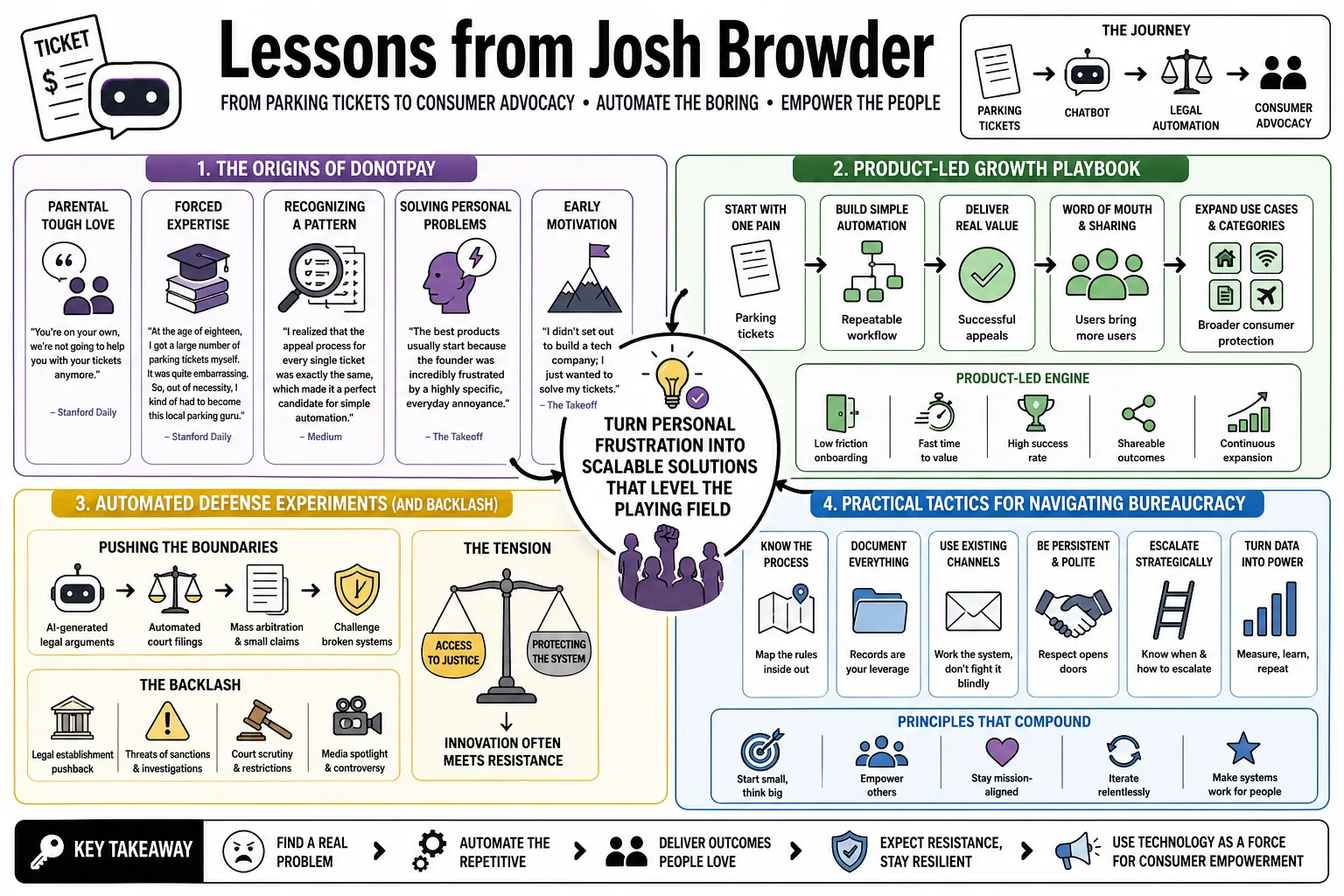
Lessons from Josh Browder
Josh Browder founded DoNotPay, turning a simple parking-ticket chatbot into a consumer advocacy platform. His push to automate routine legal services won over users but drew heavy scrutiny from the legal establishment. This profile covers his product-led growth strategy, his controversial automated defense experiments, and his practical tactics for navigating bureaucracy.
Part 1: The Origins of DoNotPay
- On parental tough love: "You're on your own, we're not going to help you with your tickets anymore." — Source: Stanford Daily
- On forced expertise: "At the age of eighteen, I got a large number of parking tickets myself. It was quite embarrassing. So, out of necessity, I kind of had to become this local parking guru." — Source: Stanford Daily
- On recognizing a pattern: "I realized that the appeal process for every single ticket was exactly the same, which made it a perfect candidate for simple automation." — Source: Medium
- On solving personal problems: "The best products usually start because the founder was incredibly frustrated by a highly specific, everyday annoyance." — Source: The Takeoff
- On early motivation: Browder started with a personal, embarrassing pain point: after repeated parking tickets, he learned the appeal process well enough to turn it into a useful chatbot for himself and friends. — Reference: Stanford Daily Q&A on the parking-ticket origin of DoNotPay
- On accidental scaling: "What started as a tool for myself and a few friends quickly spread because everyone hates getting parking tickets." — Source: Stanford Daily
- On the first version: "The initial prototype was incredibly basic, just a few rules and templates, but it worked because the bureaucracy it was fighting was equally rigid." — Source: Medium
- On geographical expansion: Browder used the move from England to Stanford as proof that bureaucratic pain travels: parking tickets were only the first example of a broader consumer-rights problem. — Reference: Cognitive Revolution interview on moving from parking tickets to consumer rights
- On finding inspiration: "I don't look to business books for career advice; I prefer reading historical accounts of entrepreneurship, like The Wonga Coup." — Source: The Takeoff
Part 2: Democratizing Legal Access
- On the primary mission: Browder frames DoNotPay as a power-shifting tool: AI should help ordinary consumers fight big companies and government systems that otherwise have more leverage. — Reference: LawDroid Manifesto episode notes on DoNotPay giving power back to consumers
- On avoiding lawyers for everyday issues: Browder focuses on disputes too small for traditional legal help: the product is meant for everyday issues where hiring a lawyer would make no economic sense. — Reference: Artificial Lawyer interview on small legal issues not worth hiring a lawyer over
- On the absurdity of legal fees: Browder saw access-to-justice friction in the economics of small claims: if contesting a ticket costs a large fraction of the ticket itself, many people are priced out before they begin. — Reference: Stanford Daily Q&A on the cost of challenging parking tickets
- On replacing routine legal work: Browder targets repetitive document work where legal fees come from process friction rather than deep expertise, especially copy-and-paste style consumer claims. — Reference: Artificial Lawyer interview on automating routine legal documents
- On fighting institutions: Browder sees AI as consumer leverage against institutions: the software handles the bureaucratic hoops that individuals usually face alone. — Reference: LawDroid Manifesto episode on consumers standing up to corporations and bureaucracies
- On passive savings: Browder wants consumer AI to become proactive: instead of waiting for users to complain, it should keep looking for refunds, bill reductions, and bureaucratic wins in the background. — Reference: LawDroid Manifesto quote on DoNotPay saving money while users sleep
- On universal access: Browder links adoption to free access: if a product exists to fight unfair fines and routine legal friction, charging users up front undermines the mission. — Reference: Artificial Lawyer interview on keeping DoNotPay free for users
- On the cost of justice: "The current legal system prices out the middle class entirely; you have to be either very poor or very rich to get representation." — Source: CBS News
- On corporate advantage: "Corporations have entire teams of lawyers on retainer to fight small claims; consumers need an equivalent tool to fight back." — Source: The Takeoff
- On legal gatekeeping: "The legal profession often relies on intentional complexity to justify its fees." — Source: Medium
Part 3: The Role of Artificial Intelligence
- On the concept of a robot lawyer: "I would like to hopefully replace lawyers with technology." — Source: CBS News
- On AI versus AI: "Companies use AI to power chatbots and customer support, so consumers need to be armed with their own AI to level the playing field." — Source: Newcomer Podcast
- On technical breakthroughs: "Multimodal is the most unappreciated AI breakthrough." — Source: Hugging Face
- On outsourcing personal finance: "I used GPT-4 to negotiate my bills, cancel my subscriptions, and handle my financial statements." — Source: Twitter / X
- On matching corporate resources: "If a bank uses an automated system to deny your refund, you should use an automated system to demand it back." — Source: Newcomer Podcast
- On the limits of early chatbots: "Before large language models, our tools were mostly decision trees. AI allows us to handle unstructured responses from companies." — Source: LawNext Podcast
- On generating documents: "An AI can draft a cease-and-desist letter in seconds that would take a human lawyer an hour to bill for." — Source: Artificial Lawyer
- On continuous learning: Browder moved beyond static templates because companies learn to ignore repeated letters; AI lets DoNotPay vary, negotiate, and improve the dispute process over time. — Reference: Cognitive Revolution interview on replacing brittle templates with AI-driven disputes
- On AI accessibility: "The technology itself isn't the product; the product is making that technology accessible to someone who just wants their money back." — Source: LawNext Podcast
Part 4: Product and Growth Strategy
- On app fatigue: "I would build a chatbot, because nobody downloads apps anymore." — Source: Medium
- On viral utility: "We never had to spend much on marketing because fighting a parking ticket is something people naturally want to share with their friends." — Source: The Takeoff
- On product-led growth: "If your tool actually solves a painful problem and gets someone their money back, the press will write about it for free." — Source: Business Insider
- On expanding features: "We started with parking tickets, but quickly realized the same logic applied to airline refunds, hidden fees, and canceled subscriptions." — Source: The Takeoff
- On seizing current events: "When the pandemic hit, we immediately built tools to help people get refunds for canceled flights and events." — Source: Business Insider
- On user retention: "To keep users, you have to offer more than just a one-off solution. You have to become the default place they go when they feel cheated." — Source: The Takeoff
- On interface design: "The interface needs to be as simple as a messaging thread. If it looks like a legal document, people will get intimidated and leave." — Source: Medium
- On early product risks: "I'm confident that this is at least going to go on for a few months. I hope we don't get shut down. We'll see." — Source: Business Insider
- On identifying new use cases: Browder expands by looking for repeated consumer pain: parking tickets, subscriptions, refunds, bills, and other areas where people lose money through friction. — Reference: LawDroid Manifesto notes on DoNotPay expanding across consumer-rights use cases
- On the subscription model: "A low monthly fee aligns our incentives with the consumer, unlike lawyers who charge by the hour." — Source: The Takeoff
Part 5: Navigating Entrepreneurship
- On assessing founders: Browder judges young founders by problem connection: he looks for evidence that they care enough about the work to keep going when the company becomes painful. — Reference: CNBC Make It interview on Browder assessing founder-market fit
- On handling rejection: Browder treats resilience as downstream of obsession: founders who lack a real connection to the problem are less likely to survive the grind. — Reference: CNBC Make It interview on founder resilience and connection to the problem
- On pitching investors: Browder now looks for conviction strong enough to be obvious even before a company has much data; the story has to show why this founder must build this thing. — Reference: CNBC Make It interview on Browder investing in young founders
- On framing the market: "Investors didn't care about a parking ticket app. They cared about a platform that could automate all consumer legal disputes." — Source: The Takeoff
- On building credibility: "Putting the logos of major companies we had successfully fought on our pitch deck changed the tone of investor conversations." — Source: Business Insider
- On staying lean: "You don't need a massive team to start. The earliest versions of our most popular features were built by just a few people." — Source: The Takeoff
- On direct communication: "I've done entire press interviews via Twitter Direct Messages because it's faster and removes the friction of scheduling." — Source: Artificial Lawyer
- On public building: "Sharing your milestones and failures publicly builds an audience that is invested in your success." — Source: Twitter / X
- On the reality of startups: Browder is wary of resume-driven company building; the founders he wants to back are the ones who care about the problem beyond status or optics. — Reference: CNBC Make It interview on founders caring deeply about the problem
Part 6: Strategy and Technical Execution
- On focus: "I think it's very important for companies to stay focused. Unlike courtroom drama, these types of cases can be handled online, are simple and are underserved." — Source: Above the Law
- On leveraging APIs: Browder keeps the product focused by outsourcing hard infrastructure when possible, such as using IBM Watson for classification so DoNotPay can concentrate on legal workflows. — Reference: Artificial Lawyer interview on using IBM Watson for classification
- On the fax machine problem: "Many government offices still require faxes. We didn't try to change their behavior; we just built a digital-to-fax bridge." — Source: Medium
- On avoiding massive R&D: Browder scales legal automation by turning document and process creation into internal tooling, so more legal workflows can be built without every task becoming a custom engineering project. — Reference: Artificial Lawyer interview and job ad on internal tools for legal automation
- On shipping fast: "It is better to release a highly specific tool that works for one type of dispute than a general tool that fails at everything." — Source: The Takeoff
- On data extraction: Browder learned that legal automation depends on mapping the messy user problem into structured claims, defenses, laws, and documents that institutions will process. — Reference: Cognitive Revolution interview on rules-based templates and legal dispute workflows
- On scaling operations: "Automating the physical mail and printing process was a huge bottleneck that we had to solve to scale." — Source: Medium
- On prioritizing features: "We prioritize new features based on the volume of complaints we see people tweeting about." — Source: The Takeoff
- On technical debt: Browder treats brittle templates as a temporary bridge: they can prove demand, but they age quickly and eventually need a more adaptive AI layer. — Reference: Cognitive Revolution interview on the limits of template-based automation
- On execution over ideas: "The idea for a robot lawyer isn't new. What matters is doing the tedious work of mapping out the specific forms for thousands of different jurisdictions." — Source: Medium
Part 7: Handling Controversy and Scrutiny
- On attempting courtroom automation: "On February 22nd at 1.30PM, history will be made. For the first time ever, a robot will represent someone in a US courtroom." — Source: CBS News
- On the threat of prosecution: "After receiving threats from State Bar prosecutors, it seems likely they will put me in jail for 6 months if I follow through with bringing a robot lawyer into a physical courtroom." — Source: CBS News
- On retreating from physical courts: "DoNotPay is postponing our court case and sticking to consumer rights." — Source: CBS News
- On dismissing critics: "A bit of a nothingburger." — Source: LawNext Podcast
- On public challenges: "We offered $1 million to any lawyer who would wear AirPods and let our AI argue their case in the Supreme Court." — Source: ABA Journal
- On facing investigative threads: "When you make bold claims on Twitter, you have to expect that paralegals and lawyers will try to dismantle them publicly." — Source: ABA Journal
- On regulatory pushback: "The legal establishment is inherently protective of its monopoly, so any attempt to automate their work will face aggressive resistance." — Source: LawNext Podcast
- On correcting mistakes: "When a public demonstration failed or was scrutinized, we had to pull it down and rethink our approach to compliance." — Source: ABA Journal
- On the cost of ambition: "Pushing the boundaries of what is legally permissible generates great press, but it also paints a target on your back." — Source: LawNext Podcast
Part 8: Long-term Vision and Future of Law
- On the ultimate goal: "My vision is that you'll never need a trained, human lawyer again." — Source: CBS News
- On the end of paperwork: Browder wants the consumer experience to move away from forms and hold queues toward AI agents that handle the administrative fight in the background. — Reference: LawDroid Manifesto notes on AI automating bureaucratic hoops for consumers
- On leveling the scales: "Technology is the only way to make the justice system blind to wealth." — Source: Medium
- On redefining legal services: "Law shouldn't be treated as a luxury good; it should be treated as a basic public utility." — Source: CBS News
- On consumer expectations: "People expect to manage their banking and healthcare from their phones; they will soon expect the same from their legal disputes." — Source: The Takeoff
- On the future of the legal profession: Browder does not need to replace every lawyer to change legal access; automating routine consumer issues is already enough to pull a large class of problems out of hourly-billing economics. — Reference: Artificial Lawyer interview on simple legal issues and consumer automation
- On automation outlasting hype: "Long after the initial AI hype cycle ends, the tools that actually fill out forms and save people time will remain." — Source: LawNext Podcast
- On societal impact: "If we can automate the defense against predatory fines, we can put billions of dollars back into the pockets of ordinary people." — Source: Medium
- On continuous evolution: "As bureaucracy adapts and invents new fees, our AI will adapt to fight them. It is a permanent arms race on behalf of the consumer." — Source: Newcomer Podcast