Josh Buckley is an entrepreneur and investor who co-founded Mino Games, served as CEO of Product Hunt, and leads Buckley Ventures. He is known for applying mechanics from the mobile gaming industry directly to enterprise software investing. This profile catalogs his approaches to capital allocation, user retention, and identifying founders capable of surviving market downturns.
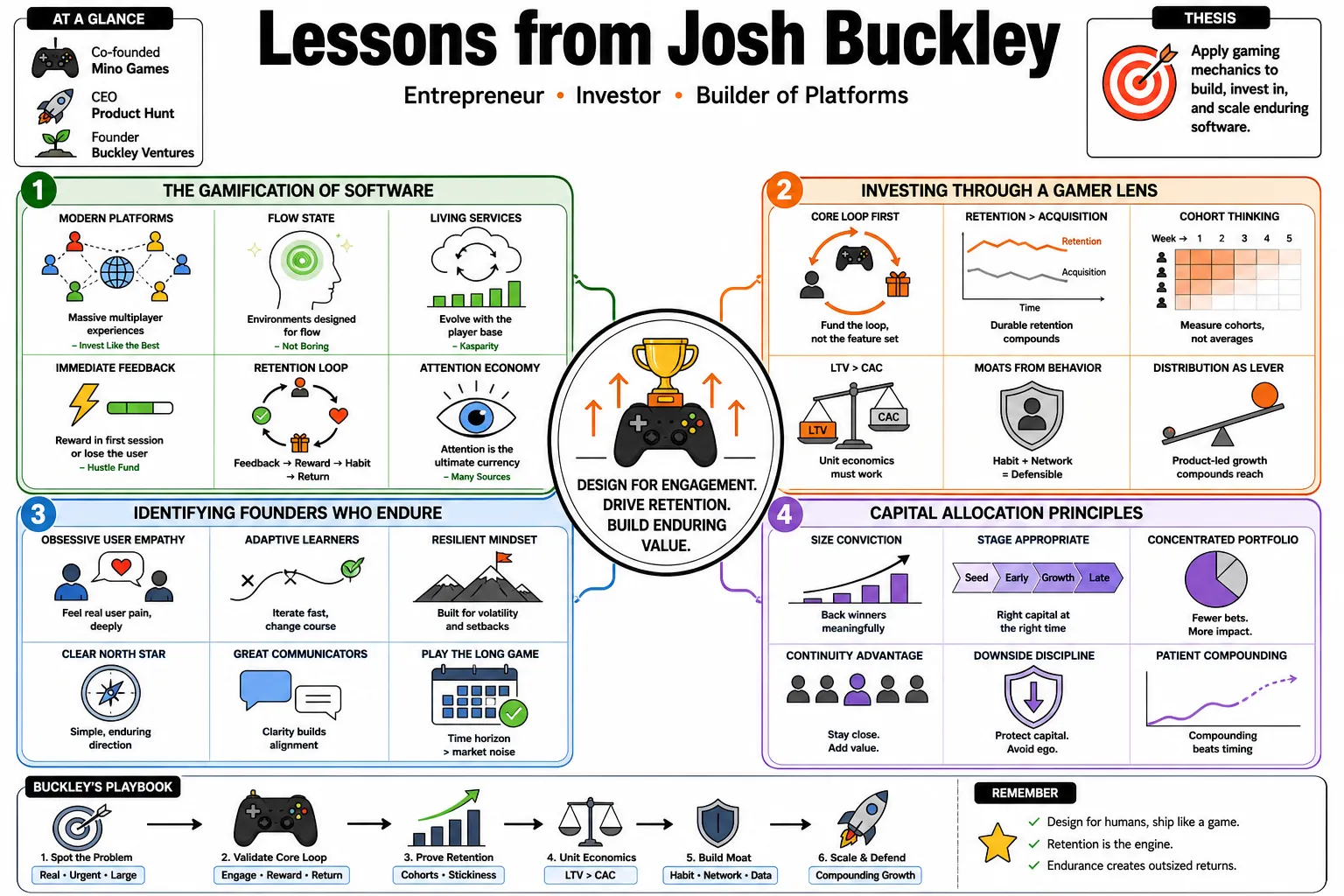
Part 1: The Gamification of Software
- On the nature of modern platforms: "The biggest games in the world don't look like games. Twitter, Facebook, and Instagram are massive multiplayer games played by billions." — Source: Invest Like the Best
- On flow state in software: "The best games and the best software are environments designed entirely to bring you into a state of flow." — Source: Not Boring
- On the shift in product delivery: "These games are no longer static products sitting on a shelf. They are living services that evolve with the player base." — Source: Kasparity
- On immediate feedback loops: "Gaming teaches you that users need dopamine hits quickly; if a consumer app doesn't reward a user in the first session, they are gone." — Source: Hustle Fund
- On retaining attention: "Attention is the ultimate currency, and games have spent decades perfecting the exact mechanics required to harvest and keep it." — Source: Invest Like the Best
- On infinite gameplay: "Software companies should aim to build infinite games where the rules constantly update to keep the user engaged indefinitely." — Source: The 20VC Podcast
- On emotional design: "You have to design for emotion. A spreadsheet that makes you feel powerful is using the same psychological hooks as a strategy game." — Source: Product Hunt
- On multiplayer dynamics: "Single-player utility gets you in the door, but multiplayer status games keep you coming back for years." — Source: Invest Like the Best
- On status as a driver: "Every successful social platform eventually monetizes the human desire for status and hierarchy." — Source: Not Boring
- On crossing the chasm: "When game mechanics cross over into productivity tools, you don't just get better software, you get religious adoption." — Source: Buckley Ventures
Part 2: Founder Psychology and the Cockroach Mindset
- On defining the cockroach: "I love 'cockroach' entrepreneurs, the ones who are entirely unfazed by nuclear winters in the market and just keep marching forward." — Source: The 20VC Podcast
- On enduring pain: "Through darkness comes light, through fear comes love, through pain comes triumph. This is the triumph of the human spirit." — Source: Humans of NYMC
- On deserving success: "To get what you want, you have to deserve what you want. The world is not yet a crazy enough place to reward a whole bunch of undeserving people." — Source: Josh Buckley's Blog
- On resourcefulness: "A cockroach founder doesn't need a massive seed round to figure out if their core loop works; they build it with whatever is lying around." — Source: Hustle Fund
- On market cycles: "Founders who survive the bear markets are the ones who ultimately define the bull markets." — Source: Buckley Ventures
- On obsessive focus: "The best founders I back share a borderline unhealthy obsession with their product's micro-interactions." — Source: Invest Like the Best
- On adapting to failure: "Survival in early-stage startups is less about avoiding mistakes and more about how quickly you can mutate after making one." — Source: The 20VC Podcast
- On unglamorous work: "The reality of building a billion-dollar company looks much more like grinding out unit economics than giving visionary speeches." — Source: Product Hunt
- On founder market fit: "I look for founders who would be building their specific product even if venture capital didn't exist." — Source: Buckley Ventures
- On maintaining morale: "The primary job of a CEO during a downturn is to absorb the panic so the team can focus on execution." — Source: The 20VC Podcast
Part 3: Enterprise and Consumer Convergence
- On consumerized B2B: "Enterprise software must feel exactly like a consumer app. The end user expects the same fluidity they get from their phone." — Source: Hustle Fund
- On immediate value: "Focus on instant value delivery. In B2B, just like in gaming, if you don't hook them in the first five minutes, the churn is inevitable." — Source: Hustle Fund
- On bottom-up adoption: "The best enterprise tools today are adopted by individual contributors trying to escape bad software, not by CIOs making top-down mandates." — Source: Invest Like the Best
- On UI as a moat: "A deeply intuitive user interface isn't just a nice-to-have in SaaS; it is a defensive moat against incumbents." — Source: Product Hunt
- On emotional switching costs: "When an enterprise tool makes an employee look good in front of their boss, the switching costs become highly emotional." — Source: Buckley Ventures
- On viral B2B mechanics: "Founders must obsess over a simple question: How does this product inherently create viral loops within an organization?" — Source: Hustle Fund
- On the death of training manuals: "If your enterprise software requires a three-day training seminar, you are vulnerable to a competitor with a better onboarding flow." — Source: The 20VC Podcast
- On borrowing from gaming: "SaaS metrics are just a delayed version of mobile gaming metrics. The gaming industry figured out cohorts and retention curves years before Silicon Valley." — Source: Invest Like the Best
- On consumer expectations: "The line between work and play is blurring, meaning the software we use for work must be as engaging as the software we use for play." — Source: Not Boring
Part 4: The Physics of User Engagement
- On core loops: "Every great product has a core loop that takes seconds to complete but provides enough satisfaction to repeat endlessly." — Source: Invest Like the Best
- On onboarding friction: "Removing a single unnecessary click from an onboarding flow can dramatically alter the long-term trajectory of a company." — Source: Product Hunt
- On habit formation: "You aren't just building a feature set; you are attempting to wire a new habit into a human brain." — Source: Hustle Fund
- On the first session: "The first session is everything. You have roughly thirty seconds to convince a user that their life is better with your product." — Source: The 20VC Podcast
- On dopamine scheduling: "The cadence of rewards within a product dictates the frequency of the user's return visits." — Source: Kasparity
- On perceived performance: "Speed is a feature. If an app feels fast, users will forgive a lack of features, but they will never forgive lag." — Source: Product Hunt
- On churn analysis: "Don't just ask why users leave; obsess over the exact moment their engagement began to decay." — Source: Invest Like the Best
- On organic growth: "If your product doesn't naturally prompt users to invite their peers, your engagement loop is broken at a fundamental level." — Source: Buckley Ventures
- On community as retention: "A strong community around a product creates a social barrier to exit that features alone can never replicate." — Source: Product Hunt
Part 5: Capital Allocation and Venture Strategy
- On early-stage concentration: "The best returns come from highly concentrated bets on deeply misunderstood founders." — Source: Buckley Ventures
- On evaluating risk: "Venture capital shouldn't be about minimizing risk; it should be about pricing the risk of a monumental outcome." — Source: Invest Like the Best
- On solo capitalism: "Operating as a solo capitalist allows for a speed of conviction that partnership models simply cannot match." — Source: The 20VC Podcast
- On frontier technology: "The most interesting investments are often at the absolute frontier of technology, where the market hasn't yet agreed on a consensus valuation." — Source: SuperScout
- On signaling: "If you only invest when the rest of the market agrees with you, your returns will exactly match the market average." — Source: Buckley Ventures
- On founder support: "Capital is a commodity. The real value an investor provides is helping a founder see around corners they didn't know existed." — Source: The 20VC Podcast
- On capital efficiency: "Too much early capital can mask fundamental product flaws; constraint often breeds the most elegant solutions." — Source: Hustle Fund
- On long-term holding: "The hardest thing to do in venture is to hold onto your winners long after the math suggests you should sell." — Source: Invest Like the Best
- On spotting outliers: "Outliers don't look like slightly better versions of existing companies; they look strange, flawed, and easily dismissible." — Source: Buckley Ventures
Part 6: Systems, Loops, and Product-Led Growth
- On product-led growth: "Product-led growth isn't a marketing strategy; it's a fundamental architectural decision made on day one." — Source: Hustle Fund
- On structural advantages: "Companies that win build compounding structural advantages where every new user makes the product better for existing users." — Source: Invest Like the Best
- On data moats: "A true data moat isn't just having data; it's having a product that automatically refines its own algorithms based on user behavior." — Source: Not Boring
- On system design: "You have to view your startup as a complex system of interconnected feedback loops, not a linear progression of milestones." — Source: The 20VC Podcast
- On removing friction: "Growth is often less about adding new acquisition channels and more about ruthlessly eliminating friction in the existing ones." — Source: Product Hunt
- On the limits of paid acquisition: "If you rely entirely on paid ads to grow, you are renting your users. Product-led growth means you own the distribution." — Source: Hustle Fund
- On compounding improvements: "A one percent improvement in your core retention loop compounds into massive enterprise value over a five-year horizon." — Source: Invest Like the Best
- On aligning incentives: "The most powerful systems perfectly align the user's selfish desires with the platform's overarching goals." — Source: Not Boring
- On network effects: "True network effects are rare; most companies just have viral growth that eventually decays. Building real network density is the ultimate prize." — Source: Buckley Ventures
Part 7: Unit Economics as Survival
- On the religion of metrics: "Gaming companies live and die by their unit economics. Enterprise founders must treat their CAC to LTV ratio with the same religious fervor." — Source: Hustle Fund
- On gross margins: "High gross margins are the oxygen of software companies. They give you the breathing room to make mistakes and still survive." — Source: The 20VC Podcast
- On payback periods: "A short payback period on customer acquisition is the ultimate cheat code for scaling a business without endless dilution." — Source: Invest Like the Best
- On hidden costs: "Founders often lie to themselves about their true customer acquisition cost by ignoring the massive hidden costs of sales and onboarding." — Source: Buckley Ventures
- On pricing power: "The ability to raise prices without losing your core customer base is the most definitive sign that you have built something valuable." — Source: Product Hunt
- On lifetime value: "LTV is a lagging indicator. You need to find proxy metrics in the first seven days that accurately predict multi-year retention." — Source: Hustle Fund
- On scaling prematurely: "Scaling a company before the unit economics are definitively positive is the fastest way to burn capital." — Source: The 20VC Podcast
- On margin compression: "In competitive markets, margins inevitably compress. Your unit economics need to be strong enough to withstand a price war." — Source: Invest Like the Best
- On the math of survival: "At the end of the day, a startup is just a very complex math equation. If the inputs don't generate positive outputs, the company dies." — Source: Buckley Ventures
Part 8: Building Enduring Organizations
- On company culture: "Culture is not what you write on the wall; it is the absolute lowest standard of behavior you are willing to tolerate in the office." — Source: The 20VC Podcast
- On hiring early: "Your first ten hires determine the DNA of the company. You cannot compromise on talent in the early days, no matter how desperate you are." — Source: Buckley Ventures
- On operational cadence: "A fast operational cadence is a competitive advantage. If your team ships twice as fast, you get twice as many iterations to find the truth." — Source: Product Hunt
- On founder growth: "The founder who starts the company is rarely equipped to run it at scale. Rapid, continuous self-improvement is mandatory." — Source: Invest Like the Best
- On delegation: "You have to learn to let fires burn. If you try to extinguish every small problem, you will never have the time to solve the existential ones." — Source: The 20VC Podcast
- On clear communication: "Complexity is the enemy of execution. The best leaders can distill a complex strategy into a single, understandable sentence." — Source: Product Hunt
- On long-term vision: "You need a ten-year vision to inspire the team, but you need a ruthless thirty-day execution plan to ensure the company survives the month." — Source: Buckley Ventures
- On firing fast: "Keeping a bad fit on the team out of empathy is actually cruel to the rest of the company that has to carry the burden." — Source: The 20VC Podcast
- On building density: "Talent density is everything. A small team of exceptional people will easily outmaneuver a massive team of average performers." — Source: Invest Like the Best
- On the ultimate goal: "The goal isn't just to build a product; it's to build a machine that consistently builds great products long after the founder is gone." — Source: Buckley Ventures