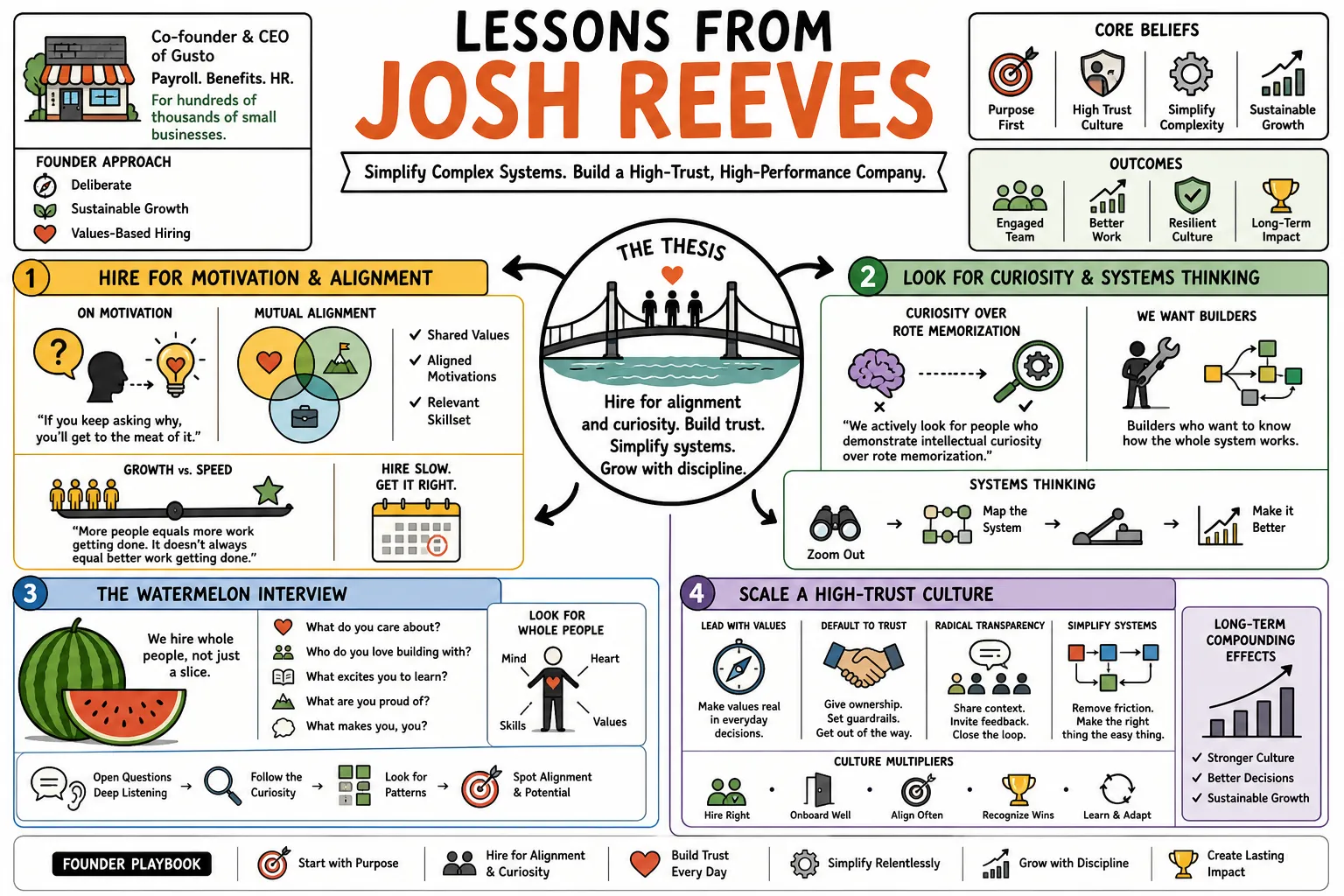
Lessons from Josh Reeves
Josh Reeves is the co-founder and CEO of Gusto, which handles payroll, benefits, and HR for hundreds of thousands of small businesses. He takes a deliberate approach to company building that prioritizes sustainable growth and values-based hiring. This profile collects his advice on simplifying complex systems and scaling a high-trust culture as a founder.
Part 1: Hiring and Interviewing
- On Motivation: "If you keep asking why, you'll get to the meat of it, which is when someone leaves behind trying to think about the right answer, and you get to questions about purpose, and what motivates you." — Source: Business Insider
- On Mutual Alignment: "An interview is about finding alignment with someone... Shared Values, Aligned Motivations, Relevant Skillset." — Source: SaaStr
- On Growth vs. Speed: "More people equals more work getting done. It doesn't always equal better work getting done." — Source: SaaStr
- On Curiosity in Candidates: "We actively look for people who demonstrate intellectual curiosity over rote memorization. We want builders who want to know how the whole system works." — Source: Y Combinator
- On The Watermelon Interview: "Our Watermelon Interview is a structured way of assessing culture add rather than culture fit—we want to know what unique perspectives you bring to the table." — Source: SaaStr
- On Channeling a Toddler: "I try to channel my inner three-year-old during interviews. Asking 'why' repeatedly strips away rehearsed answers and reveals the person's underlying operating system." — Source: The New York Times
- On Rejecting Sales Pitches: "An interview shouldn't feel like a sales pitch from either side. It should feel like a working session to see if we're meant to build together." — Source: Business Insider
- On Assessing Resilience: "I always ask candidates about a time they failed spectacularly. I'm not looking for a neatly wrapped lesson; I'm looking for intellectual honesty." — Source: HR Brew
- On Hiring for Values: "Skills can be taught. Motivation and values alignment are ingrained. You have to index heavily on the latter in the early days." — Source: Y Combinator
- On Avoiding False Positives: "A bad hire in the early days is significantly more destructive than taking an extra three months to find the right person." — Source: SaaStr
Part 2: Company Culture and Values
- On Living the Values: "Values can't just be words on a wall; they have to be verbs. They are the things you actually do when things get hard." — Source: Mark MacLeod
- On Ownership: "We don't call our team members employees; we call them owners. Language dictates mindset, and mindset dictates behavior." — Source: SaaStr
- On Transparency: "Defaulting to transparency is painful in the short term but builds the ultimate competitive advantage: deep internal trust." — Source: HR Brew
- On Building a Community: "A company isn't a family—you can't fire your family. It's a community of high-performing individuals aligned around a specific mission." — Source: Y Combinator
- On Office Environment: "We take our shoes off in the office not as a gimmick, but to enforce a feeling of being grounded and treating the workspace like a home." — Source: Gusto Blog
- On Celebrating Mistakes: "If we aren't making mistakes, we aren't moving fast enough. The key is to celebrate the learning, not just the success." — Source: SaaStr
- On Internal Feedback: "Feedback is a gift, but it has to be delivered with context and care. Ruthless candor without empathy is just being a jerk." — Source: The New York Times
- On Culture as a Product: "Culture is the internal product of the company. You have to iterate on it, fix its bugs, and scale it just like you do with your software." — Source: Mark MacLeod
- On Rituals: "Rituals are the heartbeat of culture. Whether it's our all-hands or how we celebrate anniversaries, consistency in rituals creates belonging." — Source: Gusto Blog
- On Diversity of Thought: "True culture add means hiring people who challenge the founders' assumptions and make the room smarter, not just more harmonious." — Source: Business Insider
Part 3: Leadership and Management
- On Founder Transitions: "The hardest part of scaling is firing yourself from the jobs you used to do, to make room for the jobs the company needs you to do now." — Source: Fintech Blueprint
- On Decision Making: "As a CEO, your job transitions from making the best decisions to designing the best system for decisions to be made." — Source: Y Combinator
- On Delegating: "You have to give away your legos. If you hold onto everything, you become the bottleneck to your own company's success." — Source: SaaStr
- On Managing Energy: "Time management is a myth; energy management is reality. You have to protect the hours where you do your deepest thinking." — Source: Y Combinator
- On Vulnerability: "Leaders who admit they don't know the answer build more credibility than those who pretend they do." — Source: Business Insider
- On Alignment: "If you have to micromanage, you failed at the alignment phase. Clear context eliminates the need for constant control." — Source: Y Combinator
- On Evolving the Org Chart: "We transitioned from a founder-led setup to a matrix organization because complex problems require cross-functional ownership, not top-down dictates." — Source: Fintech Blueprint
- On Patience in Leadership: "Sometimes the best action a leader can take is to do nothing and let the team wrestle with the ambiguity until they find the solution." — Source: HR Brew
- On Setting the Standard: "Your team will not listen to what you say; they will mimic what you tolerate. The lowest standard you walk past is the new standard." — Source: SaaStr
Part 4: Customer Empathy and Dogfooding
- On Dogfooding: "If we're going to go prove that it can be that intuitive, that easy, that simple, we have to dog food it ourselves. We didn't pay ourselves until the product worked." — Source: HR Brew
- On Meeting Customers: "I drove a Winnebago 4,000 miles across the country just to sit in the back rooms of bakeries and auto shops to see how small businesses actually operate." — Source: Norwest Venture Partners
- On Building for Small Businesses: "Small businesses are the lifeblood of the economy and they deserve technology that works as hard as they do." — Source: Morningstar
- On Solving Pain: Reeves frames Gusto around a hair-on-fire small-business problem: payroll and HR paperwork were manual, error-prone, and tied directly to whether employees were paid correctly. — Reference: Y Combinator interview
- On Hidden Friction: "The biggest insights come from watching a customer use your product and observing the invisible friction—the sighs, the pauses, the workarounds." — Source: Y Combinator
- On Customer Support as a Feature: "Support isn't a cost center; it is part of the product. The way you handle a customer in a panic defines your brand forever." — Source: Gusto Blog
- On Empathy as a Strategy: "Empathy is not a soft skill. It is a hard, strategic requirement for building a product that people actually want to use." — Source: Entrepreneur
- On First-hand Knowledge: "You cannot outsource customer discovery. The founders have to feel the customer's pain intuitively before writing a single line of code." — Source: Y Combinator
- On Designing for Humans: "Payroll isn't about moving money; it's about peace of mind. We design for the emotional state of the business owner running it." — Source: Fintech Blueprint
Part 5: Scaling and Sustainable Growth
- On Sustainable Growth: Reeves warns against growth at all costs: if scaling damages the business model, customer experience, or employee experience, the healthier move is to slow down. — Reference: SaaStr customer-value discussion
- On Unit Economics: Reeves says Gusto needed good unit economics from day one because the company was built for a decades-long mission, not for rushing toward revenue for its own sake. — Reference: Logan Bartlett Show interview
- On Focused Expansion: "We started with a payroll-centric ecosystem before expanding into HR and benefits. You have to earn the right to solve the next problem." — Source: Fintech Blueprint
- On Saying No: "Strategy is deciding what not to do. In the early days, you are defined entirely by the feature requests you decline." — Source: Y Combinator
- On Doing Things That Don't Scale: "I was the first salesperson at Gusto. We did things manually for a long time to understand the exact mechanics before we automated them." — Source: Fintech Blueprint
- On Building Moats: "The best moat isn't just technology; it's a deeply integrated customer experience that makes leaving feel like a downgrade." — Source: SaaStr
- On Process as a Tool: "Process should serve the people, not the other way around. If a process slows down decision-making without adding clarity, it needs to be killed." — Source: Mark MacLeod
- On Capital Efficiency: "Raising money is not a milestone; it's a tool. The real milestone is what you build with that capital." — Source: Y Combinator
- On Scaling Culture: "When you double in size, you don't just have more people—you have an entirely new communication network that has to be re-architected." — Source: Business Insider
- On Long-Term Thinking: "We don't build for the next quarter. We build for the next decade. That timescale changes every operational decision you make." — Source: Gusto Blog
Part 6: Entrepreneurship and the Founder Mindset
- On the Definition of Entrepreneurship: "It's not necessarily about building a company. It's about not accepting the way that things work now, and instead thinking of how it could work." — Source: Y Combinator
- On Solving Unsexy Problems: "I actively sought out an unsexy space because that's where the most structural neglect happens, and where the most value can be created." — Source: Y Combinator
- On Founder Resilience: "The founder journey is a continuous exercise in managing your own psychology while the world is seemingly burning around you." — Source: Y Combinator
- On the Idea Maze: Reeves describes Gusto's early path as deliberate sequencing: start with a narrow California new-employer niche, prove people loved the product, then expand geography, product depth, and breadth. — Reference: Logan Bartlett Show interview
- On Engineering Background: "Coming from an electrical engineering background taught me to think in systems. A startup is just a very complex, human-based system." — Source: Y Combinator
- On Taking the Plunge: "There is never a perfect time to start a company. At some point, the pain of not doing it has to outweigh the fear of failing." — Source: Entrepreneur
- On Co-founders: "Your relationship with your co-founders is the bedrock of the company. If there are cracks in the foundation, the whole house will eventually fall." — Source: Y Combinator
- On Ignoring the Hype: After an earlier startup that optimized mainly for revenue, Reeves wanted Gusto to be a 20- or 30-year mission around fixing a real problem, not a company built around startup optics. — Reference: Y Combinator interview
- On Embracing Naivete: "Sometimes, not knowing how hard an industry is to disrupt is your biggest asset. If we knew how complex payroll was, we might not have started." — Source: Fintech Blueprint
Part 7: Product and System Design
- On Core Infrastructure: "Payroll is a mission-critical system. You don't move fast and break things when people's mortgages depend on your code." — Source: Y Combinator
- On Simplicity: "Simplicity on the front-end usually requires massive complexity on the back-end. Our job is to absorb that complexity for the user." — Source: Gusto Blog
- On Design as Differentiator: Gusto treated design as a way to bring clarity and delight to payroll and benefits, using the rebrand to make a technical back-office product feel more human, trustworthy, and memorable. — Reference: First Round Review on Gusto's rebrand
- On Iterative Development: "Launch when the product is slightly embarrassing, but make sure the core utility—the main reason someone is paying you—is rock solid." — Source: Y Combinator
- On Technical Debt: "Technical debt is like financial debt. A little bit helps you grow faster, but if you don't pay down the principal, the interest will bankrupt your roadmap." — Source: Y Combinator
- On Product Expansion: "We viewed payroll as the wedge. Once you become the system of record for compensation, you have the trust to offer health benefits and HR tools." — Source: Fintech Blueprint
- On Data Accuracy: "When dealing with the IRS and state tax agencies, 'mostly correct' is a critical failure. Accuracy is the highest priority feature." — Source: HR Brew
- On User Onboarding: "The time-to-value has to be ruthlessly short. If a user can't see the magic of your product in the first ten minutes, they are gone." — Source: SaaStr
- On Automating the Mundane: "Technology is best used to automate the mundane so that humans can focus on the meaningful parts of running their business." — Source: Morningstar
Part 8: Mission and Long-Term Thinking
- On Building a Legacy: "We don't just want to build a big company; we want to build an enduring institution that changes how the economy supports small businesses." — Source: Gusto Blog
- On Social Impact: "Helping a small business provide health insurance to their team for the first time is why we do this. The software is just the mechanism." — Source: Norwest Venture Partners
- On Staying Grounded: "Silicon Valley can be an echo chamber. To build for Main Street, you have to spend time on Main Street, away from the venture capital bubble." — Source: Entrepreneur
- On Navigating Crises: Reeves ties resilience to customer utility: a company should keep making a customer's pain point go away, and it should slow down when growth threatens product quality or long-term survival. — Reference: SaaStr customer-value discussion
- On Redefining Work: "Our ultimate vision is to create a world where work empowers a better life, not just for founders, but for the millions of people they employ." — Source: Gusto Blog
- On Avoiding Distractions: "There will always be a new trend or technology. If it doesn't serve the core mission of helping small businesses, it is a distraction." — Source: Y Combinator
- On Measuring Success: "Our true North Star isn't revenue; it's the number of small businesses that survive and thrive because they used our platform." — Source: Morningstar
- On Continuous Learning: "The day you stop learning as a founder is the day you cap the potential of your company. Intellectual humility is a survival trait." — Source: Y Combinator
- On the Journey: "Building a company is a marathon run at a sprint pace. You have to find joy in the daily grind, because the finish line is always moving." — Source: Fintech Blueprint