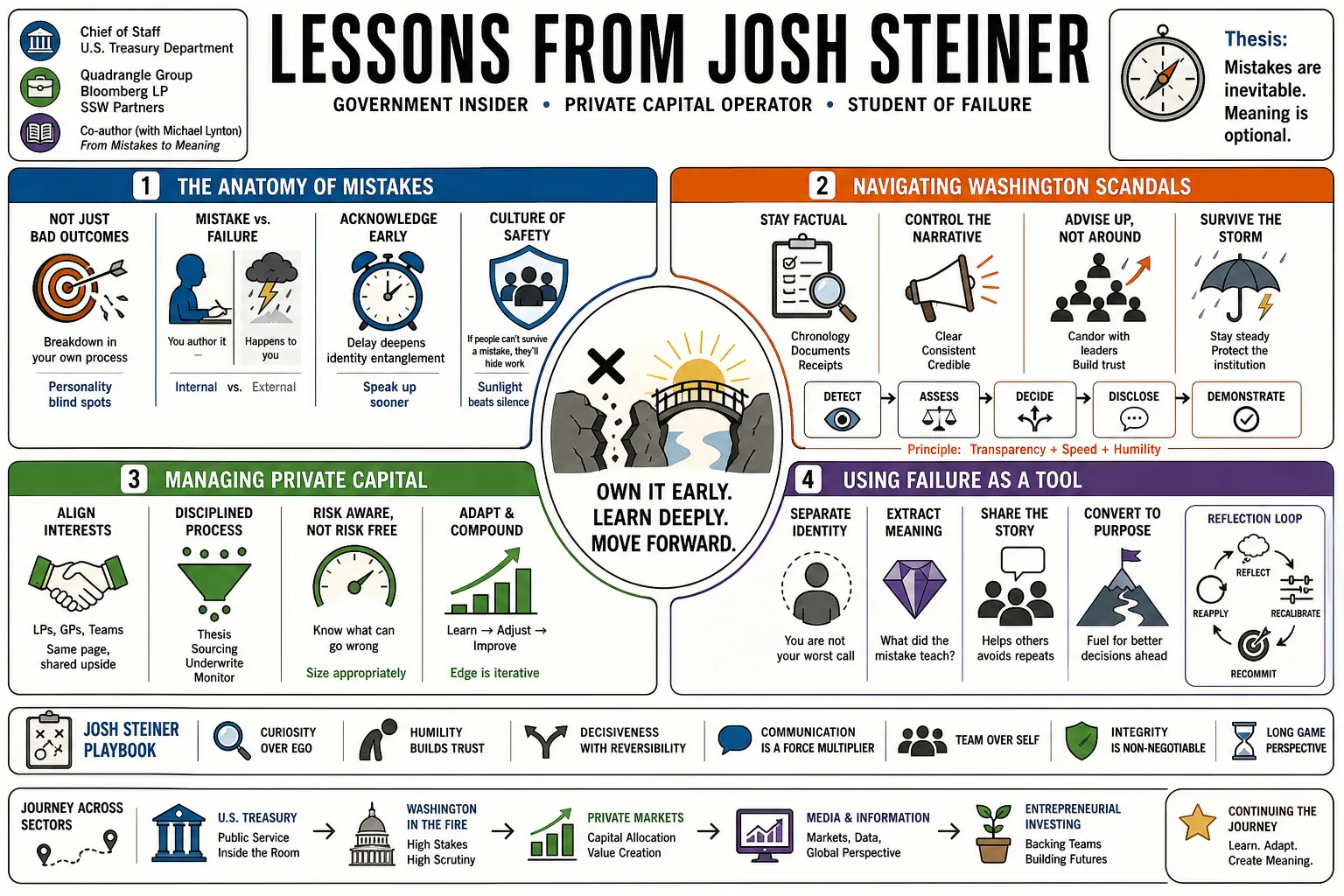
Lessons from Josh Steiner
Joshua L. Steiner is a financier and former government official who served as Chief of Staff at the U.S. Treasury Department before moving to the private sector with Quadrangle Group, Bloomberg LP, and SSW Partners. Alongside Michael Lynton, he co-authored From Mistakes to Meaning, exploring the psychological mechanics of professional blunders and how to survive them. This profile catalogs his insights on navigating Washington scandals, managing private capital, and using failure as a tool for personal clarity.
Part 1: The Anatomy of Mistakes
- On the nature of errors: "A mistake is more than a bad outcome; it is a breakdown in your own process, often driven by personality blind spots rather than a lack of information." — Source: [Capital Allocators]
- On defining mistakes versus failures: On PBS, Steiner separates the act of making a mistake from the longer work of getting over it; the book treats the aftermath as part of the mistake's full life cycle. — Reference: PBS Amanpour interview with Joshua Steiner and Michael Lynton
- On early recognition: "The longer you wait to acknowledge you made the wrong call, the more you conflate your identity with the error itself." — Source: [Hell & High Water Podcast]
- On organizational tolerance: "If people feel they cannot survive a mistake at your company, they will hide their work until the damage is irreversible." — Source: [Capital Allocators]
- On the isolation of blundering: "When you screw up in a highly visible way, the first instinct is to assume nobody has ever felt this specific type of shame before." — Source: [Fast Company]
- On post-mortem clarity: "You learn the most about your operating system in the hours immediately following a disastrous decision." — Source: [Capital Allocators]
- On repetitive patterns: Johns Hopkins describes the book as a guide to uncovering the hidden roots of mistakes, which makes repeated errors something to investigate rather than simply regret. — Reference: Johns Hopkins book-launch description
- On discussing failure: "We lack a functional vocabulary for professional screwups. We treat them as radioactive anomalies rather than predictable human data." — Source: [Hell & High Water Podcast]
- On assessing risk: "Risk assessment is fundamentally flawed when it only calculates financial downside and ignores the reputational and emotional cost of being wrong." — Source: [Capital Allocators]
- On shared experiences: CNBC frames the book around learning from past mistakes and the benefits of talking about them openly, turning shame into a shared executive-learning problem. — Reference: CNBC Squawk Box interview with Steiner and Lynton
Part 2: The Treasury and the Whitewater Diary
- On early success: "Being the youngest Chief of Staff at the Treasury meant I had an abundance of energy and a dangerous deficit of context." — Source: [Hell & High Water Podcast]
- On the diary scandal: Steiner told Andover students that his personal diary was turned over during the Whitewater investigation, landed on the front page of the New York Times, and left him deeply embarrassed. — Reference: The Phillipian report on Steiner's Andover talk
- On public scrutiny: "There is a profound dissonance between who you are and the caricature of you that appears on the front page of a national newspaper." — Source: [Hell & High Water Podcast]
- On testifying: "Sitting before a congressional committee forces you to defend fragmented thoughts as if they were deliberate policy choices." — Source: [Yale SOM Interview]
- On government pressure: "The intersection of White House politics and Treasury protocol is a place where small miscommunications escalate into constitutional crises." — Source: [Public Archives]
- On the aftermath of scandal: In his Andover talk, Steiner described putting the experience in a psychological box, deflecting questions, and later realizing suppression was the wrong way to handle it. — Reference: The Phillipian report on Steiner's Andover talk
- On maintaining perspective: "It takes years to realize that the worst day of your career is a temporary weather event, not the permanent climate of your life." — Source: [Capital Allocators]
- On institutional loyalty: "You owe your colleagues diligence and honesty, but confusing personal loyalty with institutional compliance is a trap." — Source: [Yale SOM Interview]
- On Washington dynamics: "Power in DC is often an illusion maintained by access; lose the access, and you quickly discover who your actual friends are." — Source: [Hell & High Water Podcast]
- On historical record: Policy Magazine recounts Steiner reading a subpoena that required him to preserve and produce papers, letters, calendars, files, and diaries tied to Whitewater, a hard lesson in how private records can become public evidence. — Reference: Policy Magazine review of From Mistakes to Meaning
Part 3: Private Equity and Quadrangle Group
- On founding Quadrangle: "We saw a gap in the market for a firm that genuinely understood both the financial mechanics and the operational realities of media companies." — Source: [Quadrangle Firm History]
- On media investing: "Content is unpredictable, but distribution networks possess a measurable, hard utility that makes them structurally sound investments." — Source: [Bloomberg Market Analysis]
- On capital allocation: "A good investor knows how to underwrite the numbers; a great investor knows how to underwrite the management team’s capacity to handle stress." — Source: [Capital Allocators]
- On evaluating deals: "When every metric looks flawless, you are probably misunderstanding the competitive threats in the market." — Source: [Yale SOM Interview]
- On firm culture: "Private equity requires a culture of rigorous debate; if the junior partners are afraid to contradict the founders, you will eventually buy a terrible company." — Source: [Capital Allocators]
- On adapting to change: "The telecom sector taught us that technological obsolescence happens slowly, then all at once. You have to exit before the 'all at once' phase." — Source: [Bloomberg Market Analysis]
- On managing limited partners: "LPs require more than financial returns; they want a coherent narrative about how you generated those returns so they can trust it will happen again." — Source: [Capital Allocators]
- On family offices versus institutions: "Family capital often allows for longer-term, more patient structural thinking compared to traditional institutional funds." — Source: [SSW Partners Memo]
- On the role of debt: "Debt is a magnifying glass. It clarifies your successes and violently exposes your operational inefficiencies." — Source: [Yale SOM Interview]
- On exiting investments: "The hardest discipline in investing is selling a good business at a fair price rather than holding on for a perfect price." — Source: [Capital Allocators]
Part 4: Operating at Bloomberg LP
- On transitioning to operations: "Moving from investing to operating requires you to stop asking 'what is this worth?' and start asking 'how do we build this tomorrow?'" — Source: [Bloomberg Executive Profiles]
- On the Bloomberg culture: "The transparency of the open-plan office is a physical manifestation of a culture that demands constant, immediate accountability." — Source: [Fast Company]
- On industry verticals: "Information is a commodity until you structure it for a specific professional workflow; then it becomes an indispensable utility." — Source: [Bloomberg Market Analysis]
- On data products: "Professionals do not pay for data; they pay for the time they save by not having to verify the data themselves." — Source: [Bloomberg Executive Profiles]
- On scaling operations: "You can scale technology overnight, but scaling a sales force requires you to manually replicate human trust a thousand times." — Source: [Yale SOM Interview]
- On managing large teams: "Alignment is more important than raw talent. Ten aligned average performers will beat ten unaligned geniuses every quarter." — Source: [Capital Allocators]
- On product iteration: "If your users are complaining about a feature, they care about the product. Silence is the actual indicator of failure." — Source: [Bloomberg Market Analysis]
- On competitive advantage: "Bloomberg’s moat extended beyond the terminal; it was the habituation of the financial industry to a specific interface and network." — Source: [Fast Company]
- On corporate strategy: "Strategic planning in media technology is about placing calculated bets on human behavior alongside hardware capabilities." — Source: [Bloomberg Executive Profiles]
- On adapting leadership: "An effective operator learns to translate the board's abstract financial targets into daily tactical directives for engineers and salespeople." — Source: [Yale SOM Interview]
Part 5: Leadership and Decision-Making
- On decisive action: "A good decision executed on Monday is vastly superior to a perfect decision executed on Friday." — Source: [Capital Allocators]
- On gathering information: Policy Magazine says the book's advice includes taking a deep breath, balancing instinct with deliberation, and focusing on what not to do before major decisions. — Reference: Policy Magazine review of From Mistakes to Meaning
- On cognitive bias: "We naturally weight recent negative experiences heavier than historical positive data, which leads to overly conservative management." — Source: [Capital Allocators]
- On delegating authority: "If you are making every decision, you are not a leader; you are a bottleneck with a fancy title." — Source: [Yale SOM Interview]
- On admitting fault: "When the boss admits a mistake quickly and plainly, it lowers the blood pressure of the entire organization." — Source: [Hell & High Water Podcast]
- On handling crises: CNBC presents Steiner and Lynton as co-authors using public mistakes to discuss how people learn, talk, and recover when a professional crisis becomes personally defining. — Reference: CNBC Squawk Box interview with Steiner and Lynton
- On long-term thinking: "Quarterly goals force you to look at the ground in front of your feet; leadership requires occasionally looking up at the horizon." — Source: [Bloomberg Executive Profiles]
- On team dynamics: "The most dangerous person on a team is the one who agrees with everything you say but privately doubts the strategy." — Source: [Capital Allocators]
- On the limits of experience: "Experience is useful, but it can also trick you into applying yesterday’s solution to tomorrow’s completely different problem." — Source: [Yale SOM Interview]
Part 6: Confronting Shame and Building Resilience
- On the utility of shame: On PBS, Steiner says regret, embarrassment, and shame lingered long after others had moved on, making the emotional aftermath a problem to work through rather than hide. — Reference: PBS Amanpour interview with Joshua Steiner and Michael Lynton
- On public embarrassment: "The fear of public embarrassment is always worse than the actual experience of it, because the public’s memory is incredibly short." — Source: [Hell & High Water Podcast]
- On moving forward: Johns Hopkins summarizes the book as a process for examining both the roots and consequences of mistakes so they can become material for living more fully. — Reference: Johns Hopkins book-launch description
- On resilience as a skill: "Resilience is not a personality trait; it is a mechanical process of evaluating damage, adjusting course, and returning to work." — Source: [Fast Company]
- On internal narratives: "The story you tell yourself about your failure determines whether it becomes a permanent limitation or a useful reference point." — Source: [Capital Allocators]
- On the role of therapy and psychology: Policy Magazine notes that Steiner and Lynton worked with Johns Hopkins psychology professor Alison Papadakis to ground their exploration in clinical research. — Reference: Policy Magazine review of From Mistakes to Meaning
- On vulnerability: "Professionals equate vulnerability with weakness, yet it is the only tool that actually diffuses tension after a major error." — Source: [Hell & High Water Podcast]
- On processing regret: PBS captures Steiner's point that his biggest problem was not only the diary entry itself but the way regret and shame metastasized internally after the public episode. — Reference: PBS Amanpour interview with Joshua Steiner and Michael Lynton
- On secondary mistakes: "The cover-up or the frantic attempt to fix the error immediately often causes more damage than the original incident." — Source: [Capital Allocators]
Part 7: Advice for High-Stakes Environments
- On maintaining composure: "When the stakes are highest, intentionally slow down your physical movements and your speech; it forces your brain to follow suit." — Source: [Yale SOM Interview]
- On legal and public scrutiny: "Assume everything you put in writing will eventually be read aloud in a deposition by someone who dislikes you." — Source: [Hell & High Water Podcast]
- On managing up: "Your boss does not want to hear about your anxiety; they want a clear assessment of the problem and three viable options to solve it." — Source: [Bloomberg Executive Profiles]
- On the media cycle: "Do not feed the news cycle. The media is a machine that runs on friction; if you provide a smooth surface, it moves on." — Source: [Hell & High Water Podcast]
- On building a support network: Policy Magazine quotes the book's argument that trusting close friends with honesty can deepen friendships because they know mistakes do not define the whole person. — Reference: Policy Magazine review of From Mistakes to Meaning
- On negotiation: "The party that is comfortable with silence usually dictates the terms of the deal." — Source: [Capital Allocators]
- On parsing advice: Policy Magazine describes the book's DUET framework: disclose, unpack, empathize, and trust, making advice useful only when the mistake has first been opened up honestly. — Reference: Policy Magazine review of From Mistakes to Meaning
- On physical endurance: "High-stakes environments drain you physically before they drain you mentally. Sleep is a competitive advantage." — Source: [Fast Company]
- On knowing when to quit: "Persistence is a virtue until it becomes a refusal to accept reality. Quitting a doomed project is an executive skill." — Source: [Yale SOM Interview]
Part 8: Cultivating Meaning and Growth
- On mid-career reflection: CNBC identifies Steiner as an SSW Partners partner and co-author revisiting earlier public mistakes, showing later-career reflection as an active leadership practice. — Reference: CNBC Squawk Box interview with Steiner and Lynton
- On writing a book: "Writing forces you to metabolize your experiences. You realize how much of your own history you have remembered incorrectly." — Source: [Hell & High Water Podcast]
- On the illusion of control: "We spend decades trying to engineer risk out of our lives, only to find that meaning is usually generated by the unexpected shocks." — Source: [Capital Allocators]
- On evaluating success: "If you reach the top of your field and realize you dislike the people you work with, you have failed the most important metric." — Source: [Yale SOM Interview]
- On mentorship: "The best mentors avoid giving you a map; they help you identify which direction is north." — Source: [Bloomberg Executive Profiles]
- On personal history: At Andover, Steiner told students that mistakes become less burdensome when people talk about them more, turning personal history into something processed rather than buried. — Reference: The Phillipian report on Steiner's Andover talk
- On interdisciplinary learning: "Working with psychologists showed me how finance professionals use spreadsheets to hide their emotional responses to risk." — Source: [Capital Allocators]
- On legacy: "You will eventually be forgotten by your industry. Focus on the impact you have on the ten people closest to you." — Source: [Hell & High Water Podcast]