Joshua (Josh) Kushner founded Thrive Capital and co-founded Oscar Health. Thrive’s investing philosophy centers on concentrated commitments to exceptional founders and companies, with an ambition to remain a useful partner over long periods. — Building Thrive Capital.
Part 1: Venture Capital and Investment Philosophy
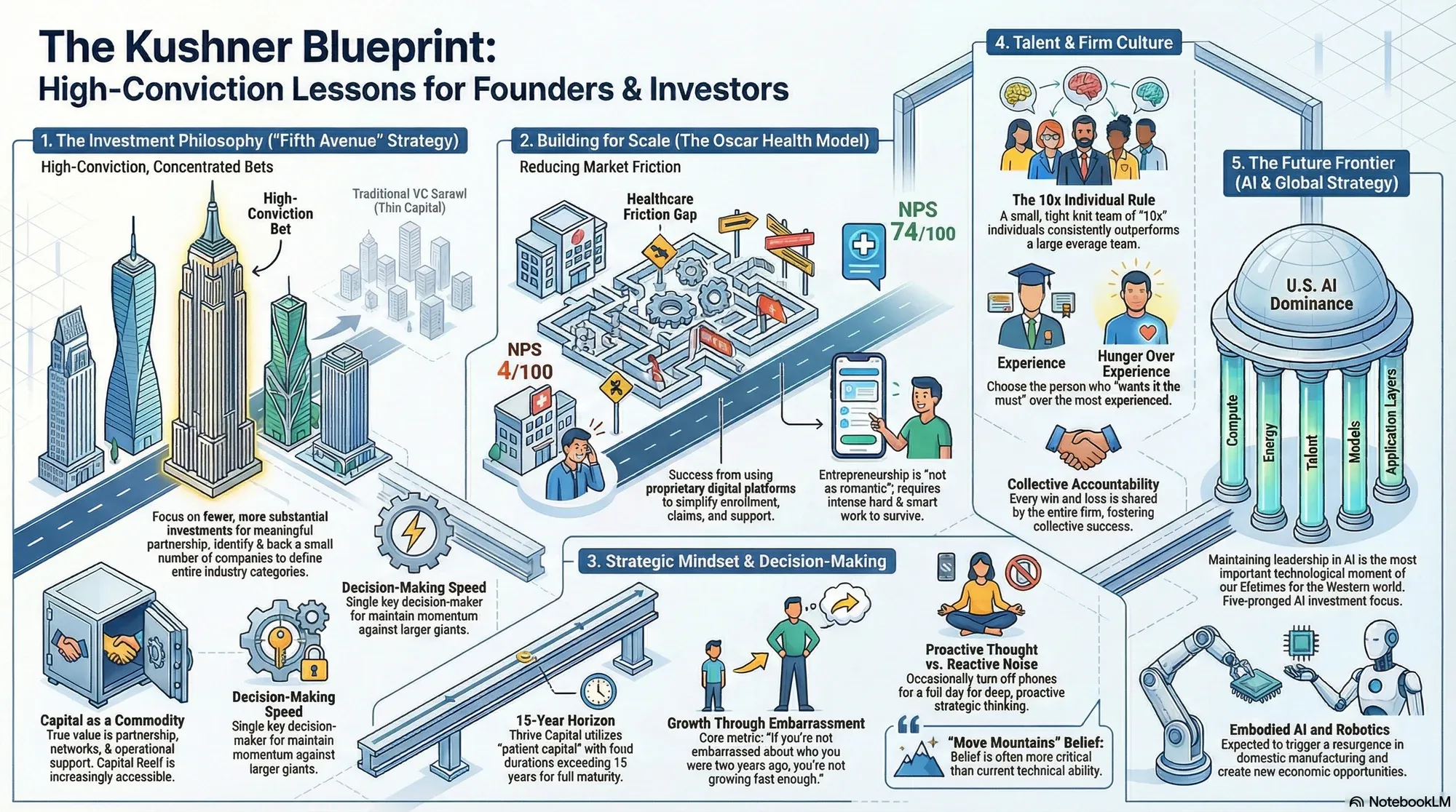
- Concentrated conviction: Thrive aims to concentrate capital in a small number of exceptional companies and stay deeply involved where it can be a meaningful partner. — Building Thrive Capital.
- Notice what others miss: Kushner cites Rick Rubin’s advice to notice what others overlook and says rigid pattern recognition can obscure unfamiliar opportunities. — Building Thrive Capital.
- Ambition in the inputs: Rather than set an assets-under-management target, Kushner says Thrive focuses on ambitious founders, unusually strong people, and being useful to its companies. — Building Thrive Capital.
- Concentrated portfolios: Thrive deliberately keeps a small investment team and concentrates in people and ideas at both early and later stages. — Building Thrive Capital.
- Fifth Avenue investing: Kushner compares later-stage category leaders to Fifth Avenue real estate: quality may look expensive, yet its value can compound over a long holding period. — Building Thrive Capital.
- A company, not just a fund: Kushner describes Thrive as a company whose product includes its strategy, investment process, and partnership as founders define it. — Building Thrive Capital.
- Move when conviction changes: In the Instagram story, Kushner describes acting rapidly to increase Thrive’s investment when his conviction strengthened; speed followed a specific judgment, not a one-person rule. — Concentration and Conviction.
- Invest across stages: Thrive invests at early and later stages, applying conviction in people and ideas rather than confining itself to one funding round. — Building Thrive Capital.
- Founders deserve the credit: Kushner calls founders the heroes and says Thrive should help them quietly rather than claim credit for their successes. — Building Thrive Capital.
- Partnership beyond capital: Kushner says Thrive’s role is to become a meaningful partner on terms the founder defines, including work that goes beyond supplying money. — Building Thrive Capital.
Part 2: Entrepreneurship and Building Oscar Health
- An unloved insurance experience: At DLD, Kushner described widespread frustration with health insurance and presented Oscar as an effort to make the experience simpler and more understandable; the inherited NPS comparison is unverified and removed. — DLD15 Interview.
- The difficulty of building: Kushner cautioned that entrepreneurship is romanticized in the media even though building a business is difficult. — DLD15 Interview.
- A healthcare problem worth solving: Kushner’s own confusion over an insurance bill helped him see a consumer and social opportunity in the hard-to-navigate health-insurance market. — Washington Post Interview.
- Oscar’s mission: In their co-signed letter, Kushner and Mario Schlosser say Oscar was designed to help members navigate healthcare like a doctor in the family, using technology to make complex decisions easier. — Oscar Co-Founders’ Letter.
- Reduce insurance friction: Oscar’s founders describe an end-to-end technology platform intended to simplify finding care, accessing virtual care, and getting help from Care Teams. — Oscar Co-Founders’ Letter.
- Seek category leaders: Kushner says Thrive seeks visionary founders building category-defining companies and holds its best companies long enough for value to compound. — Building Thrive Capital.
- Stay with enduring companies: Kushner says Thrive wants to partner with exceptional founders and hold the strongest companies for long periods rather than optimize for quick exits. — Building Thrive Capital.
Part 3: Decision-Making and Long-Term Strategy
- Keep growing: Kushner says a mentor’s test for growth is whether one can look back two years and recognize how much one has changed; he applies it to himself and his team. — Building Thrive Capital.
- Turn off the phone to think: In the DLD conversation, Kushner acknowledged occasionally turning off his phone for a day and said carving out time to think and write helps counter reactive work. — DLD15 Interview.
- Vision matters: Kushner says a founder’s vision matters because inspiring others is as important as operating, hiring, and building; the inherited mountain-moving aphorism is not verified. — Building Thrive Capital.
- Ignore praise and criticism: At DLD, Kushner said he tries to disregard both positive and negative outside commentary and stay focused on the company’s ultimate goal. — DLD15 Interview.
- Build useful support: Kushner describes Thrive’s portfolio-impact and data teams as ways to give founders tailored information and operational help beyond the investment itself. — Building Thrive Capital.
- Improve the craft: Kushner argues that running an investment firm should not displace hands-on investing: its leaders still need to practice and improve their craft. — Building Thrive Capital.
Part 4: Team Building, Talent, and Culture
- Team wins and losses: Kushner says wins and losses belong to the whole Thrive team, illustrating the point with a Slack investment decision in which his partner changed his mind. — Building Thrive Capital.
- Choose the person who wants it most: Kushner says he prioritizes the candidate who most wants the opportunity over the one with the strongest credentials, emphasizing work ethic. — Building Thrive Capital.
- Independent thought over credentials: Kushner distinguishes intelligence from practical judgment and looks for first-principles thinkers who can imagine new possibilities and analyze businesses. — Building Thrive Capital.
- Hire for partnership potential: Kushner says offers to Thrive’s investment team are made with the expectation that successful hires can become partners, which raises the hiring bar. — Building Thrive Capital.
- Learn from mentors without surrendering judgment: Kushner credits Stan Druckenmiller with teaching attention to both macro conditions and company quality, while describing David Geffen’s advice to resist outside opinion. — Building Thrive Capital.
- Enable the artist: Kushner draws on A24’s approach to artists when describing Thrive’s role as an enabler of founders rather than the creator of their work. — Concentration and Conviction.
- A family lesson in perseverance: Kushner connects his grandparents’ Holocaust survival and immigrant experience with a sense that he is entitled to nothing and must persevere. — Building Thrive Capital.
- Humility in uncertain decisions: Kushner says investment discussions benefit from intellectual honesty and humility because no one at the table can predict the future. — Building Thrive Capital.
- Exceptional small teams: Kushner argues for a small, mutually respectful team of exceptional people and says one extraordinary hire can carry unusually large responsibility. — Building Thrive Capital.
Part 5: Leadership, Personal Growth, and the Future of AI
- What Thrive means: At DLD, Kushner explained Thrive’s name as a belief that people can work toward a better version of themselves; the broader promise that anyone can achieve anything is not retained. — DLD15 Interview.
- American AI leadership: At Hill & Valley, Kushner described AI as a consequential technological moment and argued that the United States needs access to talent, compute, and energy to lead. — Hill & Valley Forum.
- Democratic values in AI: Kushner argued that powerful AI should be developed in line with American democratic values and warned of the consequences if rival systems are not. — Hill & Valley Forum.
- The promise of embodied AI: Kushner said embodied intelligence could improve robotics and might change the economics of manufacturing; he presented this as a possibility, not a guaranteed domestic resurgence. — Hill & Valley Forum.
- Five AI investment areas: Kushner identified five areas in Thrive’s AI investing: leading general models, domain-specific models, applications, infrastructure, and the acquisition and improvement of traditional businesses. These are not the same as the three national inputs he named later. — Hill & Valley Forum.
- Transform existing businesses from inside: Kushner described a holding company buying traditional businesses and applying lessons from technology investing to improve them from within. — Hill & Valley Forum.
- Carry family history forward: Kushner says his grandparents’ survival story informs his values and perspective, while the example he hopes to pass to his children will come through his actions. — Building Thrive Capital.