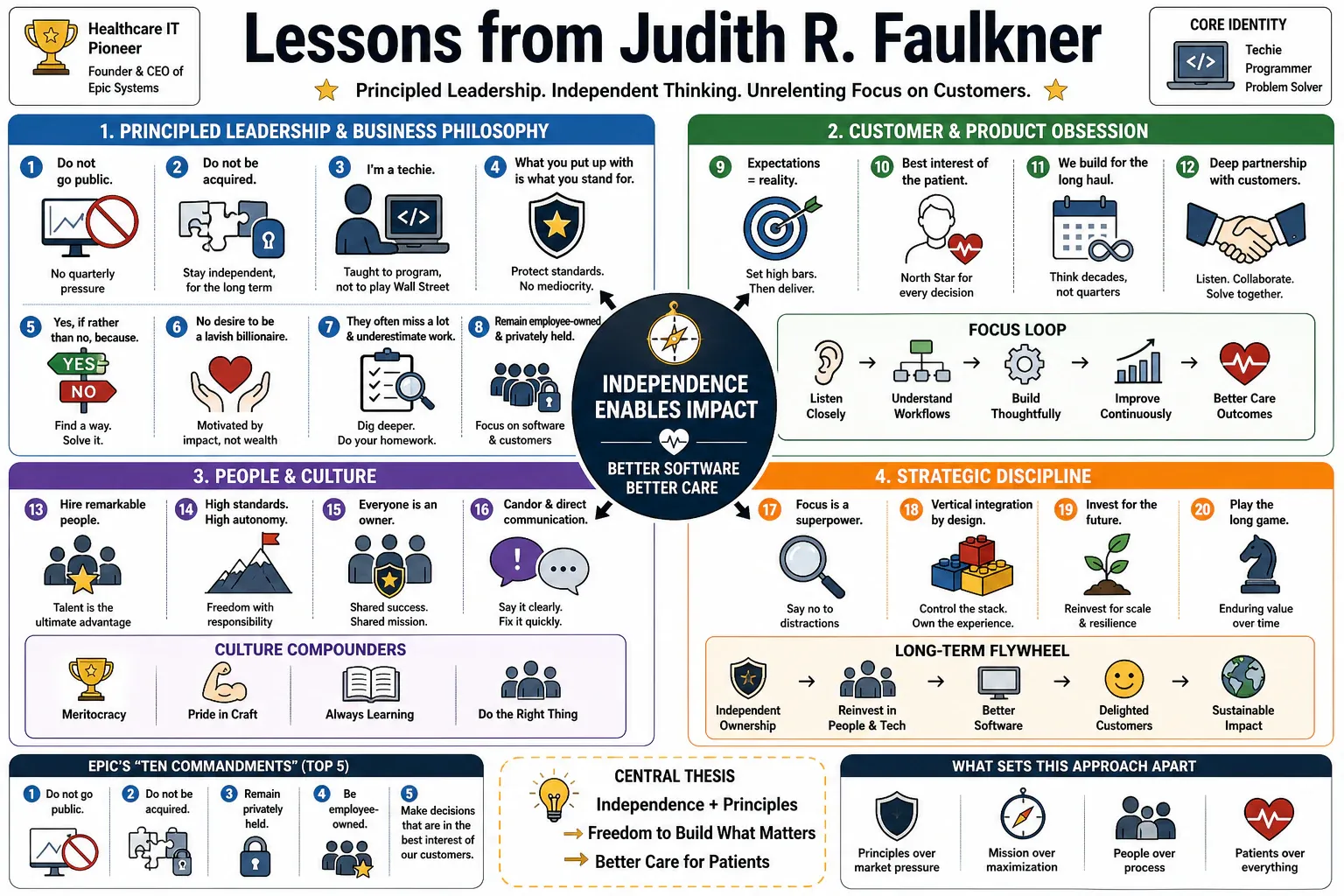
Lessons and Learnings from Judith R. Faulkner
The items below are things Judy Faulkner said in interviews and wrote in the Giving Pledge letter about building Epic, running a private company, philanthropy and healthcare technology. — Freakonomics Radio, “What Makes Judy Faulkner Run?”, transcript.
On Principled Leadership and Business Philosophy
On the podcast A Second Opinion, Faulkner said: "that allows us to avoid the tyranny of the quarter". — Judy Faulkner on A Second Opinion with Bill Frist, auto-generated captions.
On the podcast A Second Opinion, Faulkner said: "let's stay private and let's not be acquired and let's never acquire anyone". — Judy Faulkner on A Second Opinion with Bill Frist, auto-generated captions.
On Freakonomics Radio, Faulkner said: "The shareholders were only interested in return on equity, not what value the company was giving to the world". — Freakonomics Radio, “What Makes Judy Faulkner Run?”, transcript.
On Freakonomics Radio, Faulkner said: "who wants owners who are like that". — Freakonomics Radio, “What Makes Judy Faulkner Run?”, transcript.
On Freakonomics Radio, Faulkner said: "if you tolerate mediocrity, you become a mediocre company". — Freakonomics Radio, “What Makes Judy Faulkner Run?”, transcript.
On Freakonomics Radio, Faulkner said: "you shouldn't concentrate or focus on the revenue side, but you can't be stupid about it". — Freakonomics Radio, “What Makes Judy Faulkner Run?”, transcript.
On Freakonomics Radio, Faulkner said: "Our customers need it more than we do, and so we don't want to misuse them". — Freakonomics Radio, “What Makes Judy Faulkner Run?”, transcript.
On the podcast A Second Opinion, Faulkner said: "the concept of ownership and that is whatever you're working on own it". — Judy Faulkner on A Second Opinion with Bill Frist, auto-generated captions.
On the podcast A Second Opinion, Faulkner said: "we almost never talk about money that's not the focus at all". — Judy Faulkner on A Second Opinion with Bill Frist, auto-generated captions.
On the podcast A Second Opinion, Faulkner said: "the focus is that we've made commitments to our customers to do a good job for them". — Judy Faulkner on A Second Opinion with Bill Frist, auto-generated captions.
On the podcast A Second Opinion, Faulkner said: "why not just say if you need to buy it if you don't need it don't buy it". — Judy Faulkner on A Second Opinion with Bill Frist, auto-generated captions.
On Freakonomics Radio, Faulkner said: "It would have changed us, I think". — Freakonomics Radio, “What Makes Judy Faulkner Run?”, transcript.
On Freakonomics Radio, Faulkner said: "We didn't get private equity, we didn't get venture capital to support us". — Freakonomics Radio, “What Makes Judy Faulkner Run?”, transcript.
On Freakonomics Radio, Faulkner said: "We can feel the focus not on as much helping patients, but much more on making a profit". — Freakonomics Radio, “What Makes Judy Faulkner Run?”, transcript.
On Freakonomics Radio, Faulkner said: "We don't want a client not to be successful". — Freakonomics Radio, “What Makes Judy Faulkner Run?”, transcript.
On Freakonomics Radio, Faulkner said: "my job is not necessarily to know the answer, it's to know who knows the answer". — Freakonomics Radio, “What Makes Judy Faulkner Run?”, transcript.
On Freakonomics Radio, Faulkner said: "you don't want to just leave things a mess". — Freakonomics Radio, “What Makes Judy Faulkner Run?”, transcript.
On Innovation and Customer Focus
On the podcast A Second Opinion, Faulkner said: "the Innovation comes from problems when you see a problem then you try to figure out what can the solution be". — Judy Faulkner on A Second Opinion with Bill Frist, auto-generated captions.
On the podcast A Second Opinion, Faulkner said: "software developers are required to go on what we call immersion trips". — Judy Faulkner on A Second Opinion with Bill Frist, auto-generated captions.
On the podcast A Second Opinion, Faulkner said: "I always feel you have to listen to your customers". — Judy Faulkner on A Second Opinion with Bill Frist, auto-generated captions.
On the podcast A Second Opinion, Faulkner said: "being reactive has worked for us because then people self select and they only call us if they're interested". — Judy Faulkner on A Second Opinion with Bill Frist, auto-generated captions.
On the podcast A Second Opinion, Faulkner said: "I put the patient at the center and all the data around the patient". — Judy Faulkner on A Second Opinion with Bill Frist, auto-generated captions.
On the podcast A Second Opinion, Faulkner said: "you didn't build a different system you just grew that system leaving the patient at the center". — Judy Faulkner on A Second Opinion with Bill Frist, auto-generated captions.
In an Ideas for Tomorrow interview, Faulkner said: "what did i know i didn't know it was hard". — Judy Faulkner, Ideas for Tomorrow (Cleveland Clinic), auto-generated captions.
On Freakonomics Radio, Faulkner said: "I think that our customers should be free to work with any third party they want to work with". — Freakonomics Radio, “What Makes Judy Faulkner Run?”, transcript.
On Freakonomics Radio, Faulkner said: "folks, do you know what you bought". — Freakonomics Radio, “What Makes Judy Faulkner Run?”, transcript.
On Freakonomics Radio, Faulkner said: "We write the code to allow the data to go out to the app, but we don't give the permission". — Freakonomics Radio, “What Makes Judy Faulkner Run?”, transcript.
On Freakonomics Radio, Faulkner said: "it's more complex, because it changes all the time". — Freakonomics Radio, “What Makes Judy Faulkner Run?”, transcript.
In an Ideas for Tomorrow interview, Faulkner said: "we try to stay close with clients". — Judy Faulkner, Ideas for Tomorrow (Cleveland Clinic), auto-generated captions.
In an Ideas for Tomorrow interview, Faulkner said: "we're always watching what's new and working with a lot of the different companies out there who are creating the next new thing". — Judy Faulkner, Ideas for Tomorrow (Cleveland Clinic), auto-generated captions.
On Company Culture and People
On Freakonomics Radio, Faulkner said: "the hold music should be classical". — Freakonomics Radio, “What Makes Judy Faulkner Run?”, transcript.
On Freakonomics Radio, Faulkner said: "why can't their employees have as nice an environment as the customers". — Freakonomics Radio, “What Makes Judy Faulkner Run?”, transcript.
On Freakonomics Radio, Faulkner said: "I think it's nice to come to an environment that is warm and friendly and feels like there's some thought, and whimsical". — Freakonomics Radio, “What Makes Judy Faulkner Run?”, transcript.
On the podcast A Second Opinion, Faulkner said: "our staff will tell you they get so much more work done if they have a private office and they can close the door". — Judy Faulkner on A Second Opinion with Bill Frist, auto-generated captions.
On the podcast A Second Opinion, Faulkner said: "people will walk up and down two flights of stairs but not three". — Judy Faulkner on A Second Opinion with Bill Frist, auto-generated captions.
On the podcast A Second Opinion, Faulkner said: "that works fine when your head's down working on something but it doesn't work fine when you're trying to innovate". — Judy Faulkner on A Second Opinion with Bill Frist, auto-generated captions.
In an Ideas for Tomorrow interview, Faulkner said: "if you're going to work here and spend your time here make it fun". — Judy Faulkner, Ideas for Tomorrow (Cleveland Clinic), auto-generated captions.
On the podcast A Second Opinion, Faulkner said: "we try to really have our staff understand how important what they're doing is". — Judy Faulkner on A Second Opinion with Bill Frist, auto-generated captions.
On Freakonomics Radio, Faulkner said: "we hire bright, capable, hardworking people". — Freakonomics Radio, “What Makes Judy Faulkner Run?”, transcript.
On Philanthropy and Personal Values
On Freakonomics Radio, Faulkner said: "roots so that you grow strong, wings so you can fly". — Freakonomics Radio, “What Makes Judy Faulkner Run?”, transcript.
In the Giving Pledge letter, Faulkner wrote: "The work of my life has been to develop software that would help keep people well and help sick people get better". — Judy Faulkner, Giving Pledge letter (May 7, 2015).
In the Giving Pledge letter, Faulkner wrote: "I never had any personal desire to be a wealthy billionaire living lavishly". — Judy Faulkner, Giving Pledge letter (May 7, 2015).
In the Giving Pledge letter, Faulkner wrote: "Epic needs to be strong, successful, and financially secure so that we can continue to support the healthcare community". — Judy Faulkner, Giving Pledge letter (May 7, 2015).
In the Giving Pledge letter, Faulkner wrote: "reduce the disparity of care, improve education especially for those who don’t have equal opportunities". — Judy Faulkner, Giving Pledge letter (May 7, 2015).
In the Giving Pledge letter, Faulkner wrote: "help others with roots—food, warmth, shelter, healthcare, education—so they too can have wings". — Judy Faulkner, Giving Pledge letter (May 7, 2015).
On Freakonomics Radio, Faulkner said: "Techies, by their nature, are usually introverted". — Freakonomics Radio, “What Makes Judy Faulkner Run?”, transcript.
On Freakonomics Radio, Faulkner said: "I'd rather crawl under the table than be interviewed in most situations". — Freakonomics Radio, “What Makes Judy Faulkner Run?”, transcript.
On Freakonomics Radio, Faulkner said: "I thought computer programming was fun and games". — Freakonomics Radio, “What Makes Judy Faulkner Run?”, transcript.
On the podcast A Second Opinion, Faulkner said: "I get to play games because that's to me what programming was". — Judy Faulkner on A Second Opinion with Bill Frist, auto-generated captions.
On Freakonomics Radio, Faulkner said: "I had no interest in starting a company. I had no idea how to do it". — Freakonomics Radio, “What Makes Judy Faulkner Run?”, transcript.
On Freakonomics Radio, Faulkner said: "the people who work in it — the doctors, the registrars, the administrators — are very, very ethical". — Freakonomics Radio, “What Makes Judy Faulkner Run?”, transcript.
On Freakonomics Radio, Faulkner said: "I hope that I can stay strong physically and mentally". — Freakonomics Radio, “What Makes Judy Faulkner Run?”, transcript.
On the Future of Healthcare and Technology
On Freakonomics Radio, Faulkner said: "I think A.I. is going to help in many ways". — Freakonomics Radio, “What Makes Judy Faulkner Run?”, transcript.
On Freakonomics Radio, Faulkner said: "if you repeat something often enough, people will think it's true. Well, A.I. will think it's true". — Freakonomics Radio, “What Makes Judy Faulkner Run?”, transcript.
On the podcast A Second Opinion, Faulkner said: "where AI really works well is when there's so many things to think about that the human brain isn't as good as the machine". — Judy Faulkner on A Second Opinion with Bill Frist, auto-generated captions.
On Freakonomics Radio, Faulkner said: "giving them the data so it guides them to the right decision rather than waiting till they're all done and then telling them they were wrong is a much better way to do it". — Freakonomics Radio, “What Makes Judy Faulkner Run?”, transcript.
On Freakonomics Radio, Faulkner said: "if the doctor feels that someone else in the room could take good notes, why do you make the doctor do it". — Freakonomics Radio, “What Makes Judy Faulkner Run?”, transcript.
In an Ideas for Tomorrow interview, Faulkner said: "it's better to have good data available quickly than perfect data available too late". — Judy Faulkner, Ideas for Tomorrow (Cleveland Clinic), auto-generated captions.
In an Ideas for Tomorrow interview, Faulkner said: "the knowledgeable patient usually is a healthier patient". — Judy Faulkner, Ideas for Tomorrow (Cleveland Clinic), auto-generated captions.
In an Ideas for Tomorrow interview, Faulkner said: "patients don't want to manage their own information they want you folks to manage it". — Judy Faulkner, Ideas for Tomorrow (Cleveland Clinic), auto-generated captions.
In an Ideas for Tomorrow interview, Faulkner said: "what can you set in the software to match how you work". — Judy Faulkner, Ideas for Tomorrow (Cleveland Clinic), auto-generated captions.
On Freakonomics Radio, Faulkner said: "the physicians do want to make the right decisions". — Freakonomics Radio, “What Makes Judy Faulkner Run?”, transcript.