Lessons from Justin Ishbia
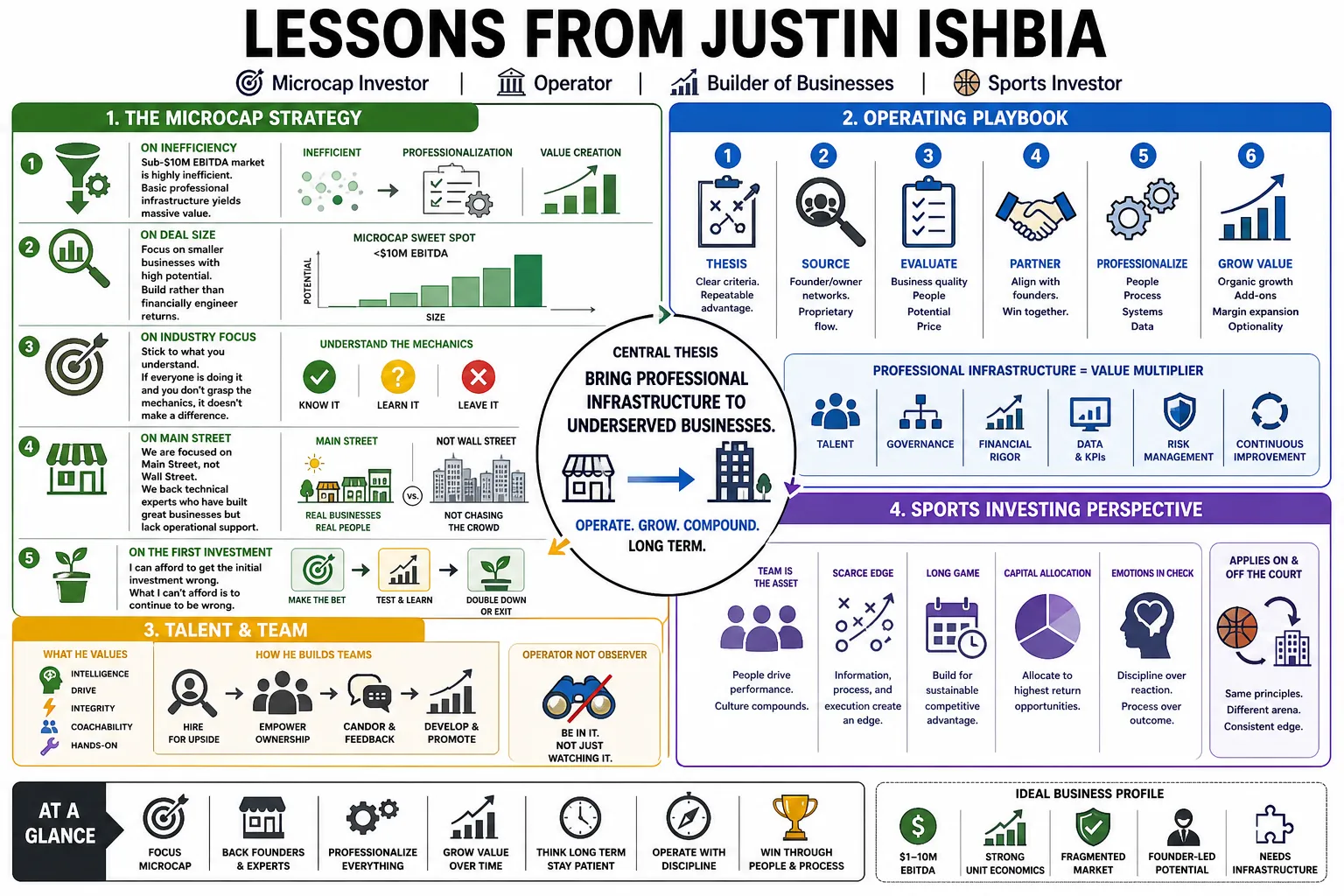
Justin Ishbia is the founding partner of Shore Capital Partners, a private equity firm that buys and grows microcap businesses. He uses strict playbooks to bring professional management to founder-led companies across healthcare, food, and business services. This collection outlines his operating methods, his process for evaluating talent, and his views on sports investing.
Part 1: The Microcap Strategy
- On Inefficiency: "The sub-$10 million EBITDA market is a highly inefficient segment where introducing basic professional infrastructure yields massive value." — Source: Invest Like the Best
- On Deal Size: "Focus on smaller businesses with high potential. The microcap space allows you to build rather than just financially engineer returns." — Source: Shore Capital Partners
- On Industry Focus: "Stick to what you understand. If everyone is doing it and you don't grasp the mechanics, it doesn't make a difference." — Source: 20VC
- On Main Street: "We are focused on Main Street, not Wall Street. We back technical experts who have built great businesses but lack operational support." — Source: Invest Like the Best
- On The First Investment: "I can afford to get the initial platform investment wrong, provided we have capital reserved for add-on acquisitions and the founder is honest." — Source: 20VC
- On Capital Reserves: "Reserve a large portion of your capital for add-on acquisitions rather than deploying it all into the initial platform. This builds in downside protection." — Source: 20VC
- On Unfair Advantages: "Only add new products or verticals when you possess a clear, demonstrable unfair advantage in that area." — Source: Invest Like the Best
- On Niche Dominance: "It is better to be a dominant player in a highly specific regional market than a mediocre player on a national scale." — Source: Bloomberg
- On Value Creation: "Real value creation at the microcap level is about professionalizing the back office, not only expanding the sales team." — Source: Forbes
Part 2: Systems and Processes
- On The Playbook: "The system is the star. Our success is driven by highly replicable operating procedures, not individual brilliance alone." — Source: Invest Like the Best
- On Accountability: "You cannot hold people accountable without clearly written expectations. Treat business processes like a professional athlete studies a playbook." — Source: Invest Like the Best
- On Codifying Knowledge: "Every repeating problem should result in a codified process to ensure it never slows the organization down again." — Source: Shore Capital Partners
- On Process vs. Outcome: "You can promise the process, not the outcome. If the process is sound, the outcomes will eventually align." — Source: Prime Quadrant Conference
- On Predictability: "Investors pay for predictability. A systemized business commands a higher multiple because it relies on processes over personalities." — Source: 20VC
- On Transparency: "Private equity is like shining a flashlight in a dark room. It reveals the good and the bad, and good systems thrive under that light." — Source: 20VC
- On Operating Advantage: "Systems provide operating advantage. A thousand-page playbook means a new hire can be productive on day three, not month three." — Source: Invest Like the Best
- On Removing Ambiguity: "The goal of standard operating procedures is to remove ambiguity from daily tasks so leaders can focus on strategy." — Source: Shore Capital Partners
- On Repeating Success: "If you can't write down how you succeeded, you won't be able to repeat it when market conditions change." — Source: Bloomberg
- On Scaling Systems: "Before you try to scale, you have to get it right from the beginning. Build the foundation first." — Source: Invest Like the Best
Part 3: Talent and Culture
- On Talent Wars: "The current business market, from private equity to sports, is fundamentally a talent war." — Source: Invest Like the Best
- On Top-Grading: "Consistently top-grade your talent. You need to create an environment where high performers are excited to come to work." — Source: Invest Like the Best
- On Vanity Metrics: "Ignore vanity metrics like fancy offices when starting out. Put all your capital and focus into hiring the best analysts and associates." — Source: Invest Like the Best
- On Promoting Youth: "Give young professionals significant responsibility early in their careers. It builds loyalty and accelerates their development." — Source: Invest Like the Best
- On Systemizing Talent: "The best companies are talent systems. Their ability to recruit, train, and retain people is their core competency." — Source: 20VC
- On First-Time CEOs: "About 75 to 80 percent of our portfolio companies are led by first-time CEOs. We look for raw talent over historical titles." — Source: 20VC
- On Cultural Fit: "You can teach a smart person the mechanics of private equity, but you cannot teach them to fit into a culture of radical transparency." — Source: Shore Capital Partners
- On Compensation: "Align compensation directly with the outcomes you want to achieve. If the playbook is executed, the financial rewards should follow predictably." — Source: The Wall Street Journal
- On Developing Leaders: "Our job is to turn clinical experts into business leaders by providing them with a talent infrastructure they could never build alone." — Source: Invest Like the Best
- On Retaining Stars: "The best way to keep top talent is to show them exactly how they can grow within your system. Ambiguity leads to turnover." — Source: 20VC
Part 4: Risk Management
- On Valuation Discipline: "Never be seduced by price. If a deal seems too good to be true, it often is missing fundamental operational stability." — Source: Invest Like the Best
- On Avoiding Trends: "I learned from my father during the 2009 crisis: avoid what you don't understand, even if it feels like everyone else is getting rich." — Source: Invest Like the Best
- On Structuring Deals: "Structure your investments so that you can survive the first deal going wrong. Add-on acquisitions are where the risk is mitigated." — Source: 20VC
- On Evaluating Founders: "The biggest risk is not market dynamics; it is partnering with a founder who lacks integrity. I can fix bad operations, but I can't fix a bad person." — Source: 20VC
- On Market Cycles: "We underwrite our businesses assuming the exit environment will be worse than the current one. If the math still works, it's a good deal." — Source: Bloomberg
- On Downside Protection: "Focus on the downside first. In microcap investing, preserving capital on the bad deals is just as important as maximizing the good ones." — Source: Forbes
- On Regulatory Risk: "In healthcare and regulated industries, compliance is not an administrative task; it is the core of your risk management strategy." — Source: Shore Capital Partners
- On Financing Discipline: "Use debt responsibly. Over-leveraging a small business removes your margin of error when the inevitable operational hiccups occur." — Source: The Wall Street Journal
- On Knowing When to Walk: "The hardest discipline in investing is walking away from a deal after spending months on due diligence when the red flags finally appear." — Source: Invest Like the Best
Part 5: Founder Partnerships
- On Founder Autonomy: "We do not want to run the day-to-day operations. Our goal is to provide the infrastructure so the founder can do what they do best." — Source: Shore Capital Partners
- On Loyalty: "I'm not going to let go of the guys who got me there. If someone helped build the firm and met their goals, they have my loyalty." — Source: 20VC
- On Tapped-Out Leaders: "It is difficult, but if a leader has tapped out and can no longer scale with the business, making a change is necessary for everyone's benefit." — Source: 20VC
- On Alignment: "The best partnerships begin with absolute clarity on the exit horizon. If a founder wants a legacy business and we want a five-year exit, it won't work." — Source: Invest Like the Best
- On Founder Vulnerability: "The strongest founders are the ones who can openly admit they don't know how to scale HR or finance, and ask for help." — Source: Bloomberg
- On Transitioning Roles: "Moving a founder from CEO to a board role or Chief Medical Officer is often the unlock a company needs to reach the next tier of scale." — Source: Shore Capital Partners
- On Communication: "Bad news must travel faster than good news. As a board member, I need to know about the problems immediately, not at the quarterly meeting." — Source: 20VC
- On Building Trust: "Trust with a founder is built in the first 90 days. If you deliver on the small promises during integration, they will trust you with the big decisions later." — Source: Invest Like the Best
- On Shared Economics: "We believe in significant rollover equity. The founder needs to have substantial skin in the game for the second bite of the apple." — Source: Forbes
Part 6: Scaling and Growth
- On Board Composition: "A board should include more than financial sponsors. You need operators who have actually scaled a business from $10 million to $50 million." — Source: Shore Capital Partners
- On The 100-Day Plan: "Execution speed matters most right after closing. A rigorous 100-day plan sets the cadence for the entire investment hold period." — Source: Invest Like the Best
- On M&A Integration: "Buying a company is easy; integrating it is hard. We have a dedicated team just to ensure cultures and IT systems merge seamlessly." — Source: 20VC
- On Organic vs Inorganic Growth: "You cannot rely solely on acquisitions to grow. The underlying platform must demonstrate strong organic growth to justify the roll-up strategy." — Source: Bloomberg
- On Technology Investments: "Upgrading an ERP or CRM in a small business is painful, but it is the prerequisite for scaling operations beyond a regional footprint." — Source: Shore Capital Partners
- On Pricing Power: "In inflationary environments, a business must have the pricing power to pass on costs. If they don't, they are a commodity, not a brand." — Source: The Wall Street Journal
- On Geographic Expansion: "Expand to contiguous markets first. Jumping across the country strains management bandwidth and introduces unnecessary market risk." — Source: Forbes
- On Data Visibility: "You can't manage what you don't measure. Installing clear KPI dashboards is step one in transitioning a business from a mom-and-pop to an enterprise." — Source: Invest Like the Best
- On Exit Preparation: "We start preparing a business for sale the day we buy it. The systems we install are designed specifically to pass the diligence of the next buyer." — Source: 20VC
- On Scaling Culture: "Maintaining culture while doubling headcount is the hardest part of growth. It requires explicit communication of core values during every onboarding." — Source: Shore Capital Partners
Part 7: Sports Ownership
- On The Appeal of Sports: "Beyond the financial aspect, sports ownership is about the relationships, the community, and the unique experiences it creates." — Source: Prime Quadrant Conference
- On Fan Experience: "Our philosophy in sports is the same as in business: improve the underlying product and focus relentlessly on the customer—the fan." — Source: Phoenix Suns Press Conference
- On Partnership: "Owning a team is a partnership with the city. You are a steward of a civic asset, more than a financial asset." — Source: Bloomberg
- On Winning: "In sports, you can promise the process, not the outcome. If we install the right front office and the right culture, the wins will follow." — Source: Prime Quadrant Conference
- On Sports as an Asset Class: "Professional sports franchises have proven to be resilient assets. The scarcity value and media rights dynamics make them unique investments." — Source: Forbes
- On Player Relations: "Treating players and staff with respect and providing them with world-class facilities is how you attract top talent in a competitive league." — Source: Phoenix Suns Press Conference
- On Women's Sports: "Investing in the WNBA and the Phoenix Mercury is not a charity project; it is a massive business opportunity with incredible growth potential." — Source: The Wall Street Journal
- On Community Impact: "The platform a sports team provides allows you to drive meaningful philanthropic and social impact in your local community." — Source: Crain's Chicago Business
- On Long-Term View: "You don't buy a sports team for a quick flip. It is a generational asset that requires a decades-long perspective on value creation." — Source: Bloomberg
Part 8: Personal Philosophy and Balance
- On Work-Life Trade-offs: "There is no one-size-fits-all approach to balance. It is a constant trade-off, and you have to be intentional about being present for your family." — Source: Invest Like the Best
- On Health and Longevity: "I proactively manage my health because the stamina required to run a firm and be a good father demands it. Health is the foundation of performance." — Source: Invest Like the Best
- On Giving Back: "Wealth creation is only part of the equation. Using those resources to support education and community initiatives is the ultimate goal." — Source: Vanderbilt University Interview
- On Continuous Learning: "The moment you think you have the market completely figured out is the moment you are about to lose money. Stay curious." — Source: 20VC
- On Family Lessons: "Watching my father navigate the 2008 crisis taught me more about risk management than any textbook. Real lessons are learned in the downturns." — Source: Invest Like the Best
- On Embracing Failure: "We celebrate the lessons learned from our bad investments. If you hide your failures, the organization never learns from them." — Source: Shore Capital Partners
- On Mentorship: "I dedicate a significant amount of time to mentoring young professionals because someone did the same for me. It is a necessary cycle." — Source: Michigan State University Address
- On Focus: "It is easy to get distracted by shiny objects when you have capital. Discipline is saying no to good deals so you can focus on great ones." — Source: Bloomberg
- On Legacy: "I want to be remembered for more than the returns we generated, but for the careers we launched and the businesses we helped build." — Source: Forbes