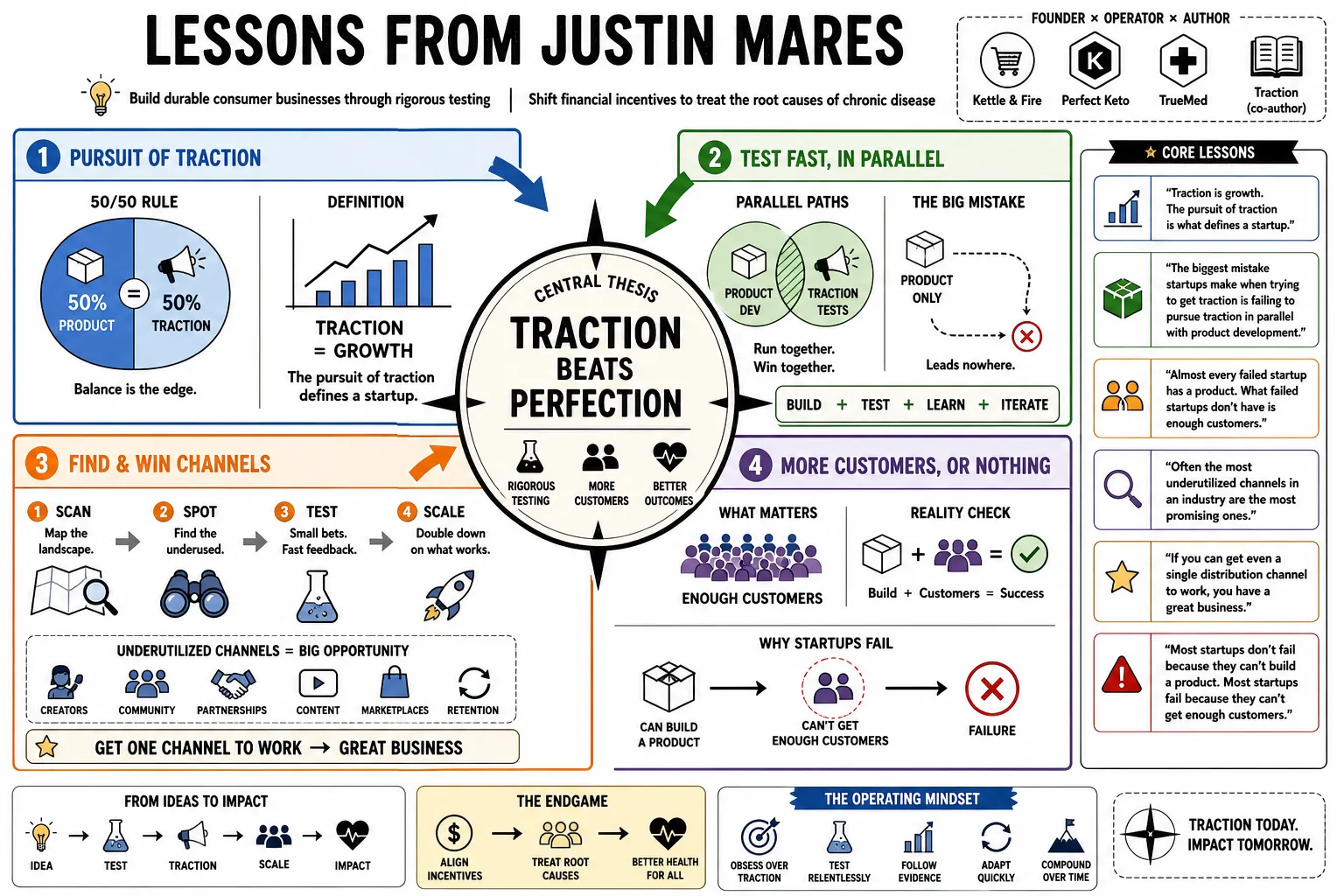
Lessons from Justin Mares
Justin Mares founded Kettle & Fire, Perfect Keto, and TrueMed, and co-authored the startup manual Traction. His writing outlines how to build durable consumer businesses through rigorous testing while shifting financial incentives to treat the root causes of chronic disease.
Part 1: The Pursuit of Traction
- On the 50 Percent Rule: "Spend 50 percent of your time on product and 50 percent on traction." — Source: [Traction Book]
- On Defining Traction: "Traction is growth. The pursuit of traction is what defines a startup." — Source: [Peter J. Thomson]
- On Product Development: "The biggest mistake startups make when trying to get traction is failing to pursue traction in parallel with product development." — Source: [Traction Book]
- On Customer Acquisition: "Almost every failed startup has a product. What failed startups don't have is enough customers." — Source: [Reading Graphics]
- On Identifying Channels: "Often the most underutilized channels in an industry are the most promising ones." — Source: [Reading Graphics]
- On Finding What Works: "If you can get even a single distribution channel to work, you have a great business." — Source: [Freelance Cake]
- On Startup Failure: "Most startups don't fail because they can't build a product. Most startups fail because they can't get traction." — Source: [YouTube Interview]
- On Evidence of Demand: "Traction is basically quantitative evidence of customer demand, a concept central to the framework developed with Gabriel Weinberg." — Source: [99Signals]
- On Systematic Testing: "Instead of guessing which marketing channel will work, founders should use the bullseye framework to systematically test and isolate the single best channel for their current stage." — Source: [ChannelE2E]
- On Avoiding Bias: "Founders naturally gravitate toward marketing channels they already know, but true growth usually comes from testing unfamiliar channels with an open mind." — Source: [WiseWords]
Part 2: Health and the Modern Environment
- On the Zoo Animal Theory: "We are like zoo animals, shaped by our environment, and that impacts our health." — Source: [ClipFinder]
- On Systemic Sickness: "I think it is so wild that we have accepted somewhat implicitly that we have a food system and a food environment that makes almost everyone sick, unhappy, unhealthy, all these things." — Source: [The Next Newsletter]
- On Modern Environments: "We currently live in an environment that dictates human health outcomes, much like an enclosure defines the health of a captive animal." — Source: [a16z Podcast]
- On Food Toxicity: "The decline of nutrient density in the modern food supply is one of the most pressing, yet largely ignored, issues in modern society." — Source: [Justin Mares Blog]
- On Fixing the Core Issue: "I think that very, very few people are interested or trying to fix what, in my mind, is this core obvious massive, issue." — Source: [The Next Substack]
- On Regenerative Agriculture: "Transitioning away from factory farming toward regenerative agriculture is necessary to restore the nutrient profile of the human diet." — Source: [Wellness Mama Podcast]
- On Ignored Solutions: "The current medical establishment often overlooks the fact that our bodies are reacting exactly as expected to a highly processed, unnatural diet." — Source: [True Medicine Podcast]
- On Processed Ingredients: "Large-scale food manufacturers routinely take shortcuts that degrade human health in order to maximize shelf life and profit margins." — Source: Entrepreneurs on Fire
- On Chronic Disease Origins: "Chronic disease is rarely a simple individual failing; it is the predictable output of a food and lifestyle system that systematically produces unhealthy people." — Source: a16z Podcast
- On Metabolic Health: "Improving metabolic health through basic nutritional interventions is the highest leverage way to solve the broader chronic disease epidemic." — Source: [Fitt Insider]
Part 3: Building Consumer Brands
- On Initial Validation: "Bone broth was a product I wanted, it was something that I couldn't find anywhere, to my quality standards, and a product that I thought there was a real need for." — Source: [Get Career Hacking]
- On Early Revenue Expectations: "The way I looked at it, if we launched a business in this space, we would probably make 10K per month." — Source: [Get Career Hacking]
- On Spotting Trends: "Identifying a personal health need, like finding nutrient-dense foods for injury recovery, is often the best indicator of a larger untapped consumer market." — Source: [Revolution Health Radio]
- On Bootstrapping: "We applied tech-style growth hacking to a consumer packaged goods business to get Kettle & Fire off the ground without massive initial capital." — Source: [Indie Hackers]
- On the Ketogenic Shift: "We launched Perfect Keto because we saw a massive gap in clean, accessible supplements for people trying to manage their metabolic health through diet." — Source: [HighPerformr]
- On Non-Alcoholic Alternatives: "With Surely, the goal was to create a premium non-alcoholic wine that actually tasted good, serving a growing demographic that wants to socialize without the negative health impacts of alcohol." — Source: [Forbes]
- On Product Standards: "If you cannot find a product that meets your own strict quality standards, that is a strong signal that you should build it yourself." — Source: [Voyage Austin]
- On Direct to Consumer: "The DTC model allowed us to bypass traditional retail gatekeepers and speak directly to the early adopters who cared most about ingredient quality." — Source: [Outlier Academy]
- On Supply Chain Challenges: "Building a mission-driven food company means fighting an uphill battle against supply chains that are optimized for cheap ingredients rather than human health." — Source: [Revolution Health Radio]
- On Building Multiple Brands: "The lessons learned from scaling one consumer brand compound rapidly, making it easier to identify and execute on the next big gap in the market." — Source: [Startup Intros]
Part 4: Aligning Incentives in Healthcare
- On the TrueMed Mission: "I think Truemed is one part of a decades-long shift in shifting money away from our sickcare system and towards one that incentivizes and drives wellness." — Source: [The Next Newsletter]
- On Preventative Economics: "The U.S. healthcare system is structurally designed to manage chronic conditions rather than prevent them from happening in the first place." — Source: [Wellworthy]
- On Unlocking Funds: "We built TrueMed to provide the payment infrastructure that enables consumers to use tax-free HSA and FSA funds for evidence-backed lifestyle interventions." — Source: [TrueMed]
- On Lifestyle as Medicine: "Things like gym memberships, sleep aids, supplements, and medically tailored nutrition should be treated as valid medical expenses." — Source: [Health Tech Nerds]
- On Misaligned Incentives: "Our current system has perverse incentives that prioritize expensive pharmaceutical treatments over basic nutritional education." — Source: [Invest Like the Best]
- On National Security: "We have to start treating the chronic disease crisis as a national security issue, because it threatens to bankrupt our country." — Source: [a16z Podcast]
- On Empowering Consumers: "Allowing people to direct their own pre-tax dollars toward preventative health is the fastest way to force the medical system to change." — Source: [Fitt Insider]
- On Medical Nutrition: "There is a massive disconnect when doctors receive almost no nutrition education, yet diet is the primary driver of the diseases they treat every day." — Source: [True Medicine Podcast]
- On Financing Prevention: "Preventative care has historically been hard to finance, which is exactly the structural bottleneck TrueMed is trying to fix." — Source: [Health Tech Nerds]
Part 5: Playing Long-Term Games
- On Long-term Thinking: "If everything you do needs to work on a three-year time horizon, then you're competing against a lot of people." — Source: [The Next Substack]
- On the Seven-Year Horizon: "But if you're willing to invest on a seven-year time horizon, you're now competing against a fraction of those people." — Source: [The Next Substack]
- On Expanding Possibilities: "Just by lengthening the time horizon, you can engage in endeavors that you could never otherwise pursue." — Source: [The Next Substack]
- On Purpose Over Flipping: "We need to move away from the short-term mentality of quickly flipping companies and instead focus on building long-term, mission-driven organizations." — Source: [Justin Mares Substack]
- On Compounding Value: "When you build with a decade in mind, every relationship and product iteration compounds rather than serving a quarterly goal." — Source: [Lenny's Newsletter]
- On Patience in CPG: "Building a physical product company requires a level of patience that software often does not, because supply chains move in months and years, not days." — Source: [Indie Hackers]
- On Bezos Principles: "Adopting Jeff Bezos's philosophy on time horizons allows you to build a moat simply by outlasting competitors who require immediate gratification." — Source: [The Next Substack]
- On Structural Advantages: "A longer time horizon acts as an automatic filter that removes casual competitors from your specific market." — Source: [Building Culture]
- On Enduring Missions: "I am in business to solve problems that make people's lives better, specifically around their physical and mental health, which requires a multi-decade commitment." — Source: The Founder Podcast
Part 6: Navigating E-Commerce
- On The Iron Law of Ecommerce: "The Iron Law of Ecommerce across everything I've ever started is that I start out thinking I'm selling to people like me and it always turns out that it's 45-year old women that are buying the product." — Source: My First Million
- On Audience Reality: "You can build a product for yourself, but you have to accept that the market will ultimately decide who your core demographic is." — Source: [Outlier Academy]
- On CPG Growth Hacking: "Applying software growth strategies to the food industry gave us a massive early advantage because legacy food brands moved incredibly slowly online." — Source: [Indie Hackers]
- On Market Testing: "Before you spend months developing a physical product, run simple online tests to verify that people are actually searching for and willing to buy the solution." — Source: [Get Career Hacking]
- On Distribution: "Having the best product does not matter if you cannot figure out a scalable way to get it into the hands of the people who need it." — Source: [Traction Book]
- On Scaling Challenges: "Going from selling online to navigating retail grocery shelves introduces an entirely new set of logistical and margin challenges that require different skills." — Source: [Forbes]
- On Brand Transparency: "Modern consumers are highly skeptical of big food companies, meaning new brands can win simply by being totally transparent about their ingredients." — Source: [Wellness Mama Podcast]
- On Initial Traction: "The first ten thousand dollars in monthly revenue validates the concept, but the next million requires building actual operational infrastructure." — Source: [Indie Hackers]
- On Niche Markets: "Starting in a highly specific niche, like grass-fed bone broth, allows you to dominate a small space before expanding into broader categories." — Source: [Voyage Austin]
Part 7: Personal Optimization and Philosophy
- On Motivation: "Justin isn't in business just to be in business. He is in business to solve problems that make people's lives better." — Source: The Founder Podcast
- On Endlessly Fascinating Problems: "Finding problems that remain endlessly fascinating to you is the only way to maintain the motivation required to build something over a decade." — Source: [The Next Newsletter]
- On Escaping Noise: "I look for timeless ideas in books and older philosophical writings, specifically to move away from the noise and outrage often found on social media." — Source: [Justin Mares Blog]
- On Personal Health Experiments: "You have to be willing to run experiments on yourself and challenge mainstream health narratives to find what actually optimizes your biology." — Source: [The Next Substack]
- On Competence Loops: "Building consecutive companies allows you to create a competence loop, where the operational muscle built in one venture directly de-risks the next." — Source: [Moth Fund]
- On Challenging the Status Quo: "You have to be willing to look at deeply entrenched systems, like modern healthcare or agriculture, and simply refuse to accept that this is the best we can do." — Source: [True Medicine Podcast]
- On Information Diet: "Curating what you read and consuming high-signal, long-form content is critical for maintaining clarity in a highly distracted world." — Source: [The Next Newsletter]
- On Authentic Action: "True influence comes from building the actual solutions you want to see in the world, rather than critiquing the existing systems online." — Source: [5HT]
- On Alternative Approaches: "Exploring alternative approaches, whether in metabolic psychiatry or light exposure, is necessary when the standard protocols repeatedly fail patients." — Source: [The Next Substack]
Part 8: The Reality of Entrepreneurship
- On Hard Endeavors: "If you are starting a thing that is so hard, it is so unlikely to work, it is almost impossible to develop self-respect and confidence." — Source: [The Next Newsletter]
- On Feedback Loops: "You cannot survive the journey if you're doing a thing that doesn't have any positive feedback loops in it, because it's just so hard." — Source: [The Next Newsletter]
- On Repeat Founders: "It has become more common for successful entrepreneurs to start multiple companies in succession because the initial friction of company creation disappears." — Source: [Invest Like the Best]
- On Building Momentum: "You need small, early wins to sustain the energy required to tackle massive, systemic problems over a long period of time." — Source: [Indie Hackers]
- On Founder Psychology: "The hardest part of building a company is not the operational mechanics, it is managing your own psychology through the inevitable brutal lows." — Source: The Founder Podcast
- On Action Over Theory: "At a certain point, reading and theorizing must give way to launching a messy product and letting real customers tell you what is wrong with it." — Source: [Traction Book]
- On Solving Real Problems: "A business only endures if it solves a genuine, painful problem for a specific group of people who are desperate for a solution." — Source: [Startup Intros]
- On Navigating Uncertainty: "Founders have to get comfortable operating in environments where they have very little data and are forced to trust their conviction about the future." — Source: [Outlier Academy]
- On The Reality of Scaling: "What works to get your first hundred customers will almost certainly break when you try to reach your first ten thousand." — Source: [Traction Book]