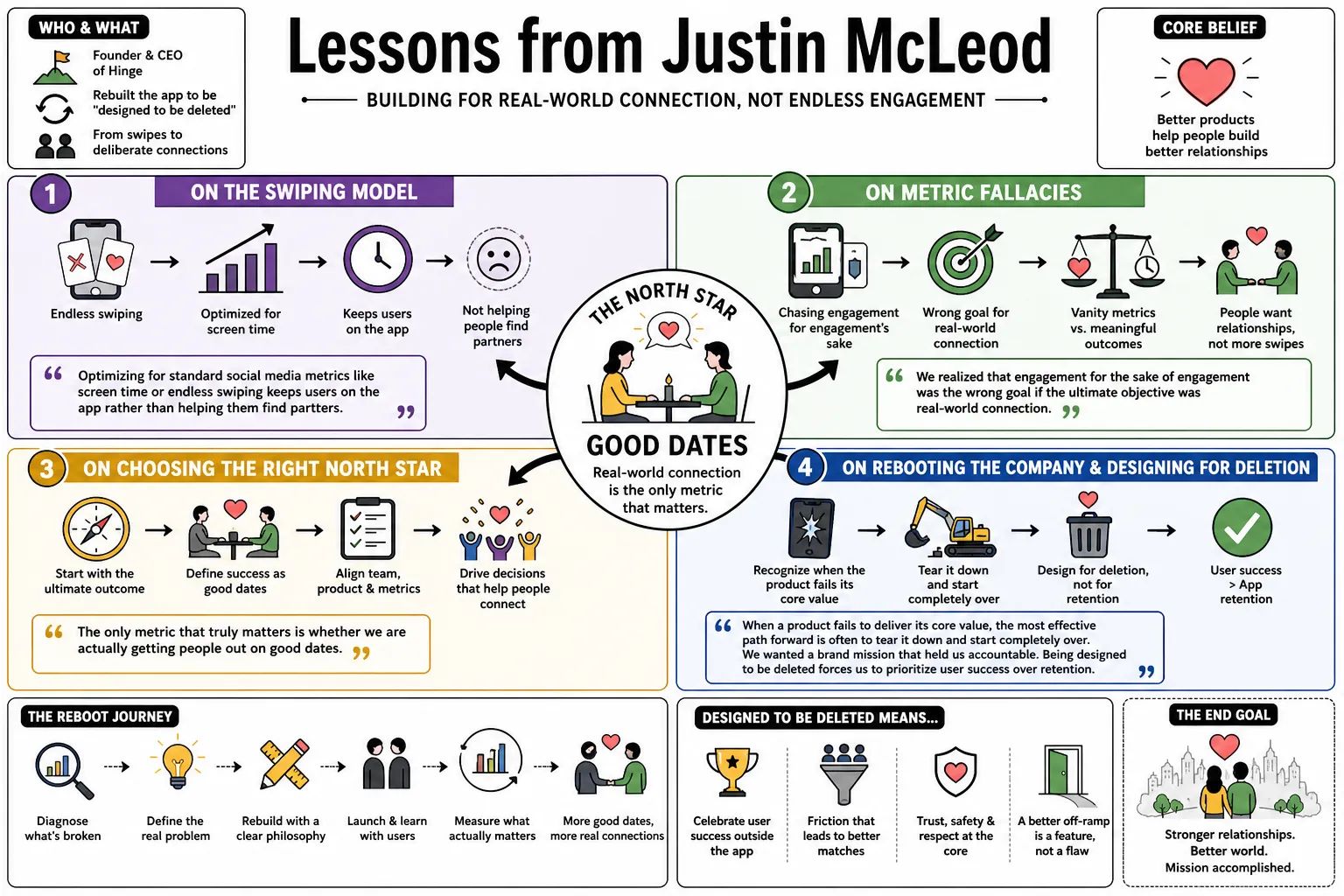
Lessons from Justin McLeod
Justin McLeod is the founder and CEO of Hinge, the dating app he rebuilt to be "designed to be deleted." He ditched standard swiping mechanics to force users into slower, deliberate interactions. This profile covers his approach to building consumer products and the personal history behind his views on human connection.
Part 1: The Reboot and Radical Pivot
- On the Swiping Model: "Optimizing for standard social media metrics like screen time or endless swiping keeps users on the app rather than helping them find partners." — Source: [Fast Company]
- On Metric Fallacies: "We realized that engagement for the sake of engagement was the wrong goal if the ultimate objective was real-world connection." — Source: [Entrepreneur]
- On Choosing the Right North Star: "The only metric that truly matters is whether we are actually getting people out on good dates." — Source: [How I Built This]
- On Rebooting the Company: "When a product fails to deliver its core value, the most effective path forward is often to tear it down and start completely over." — Source: [Masters of Scale]
- On Designing for Deletion: "We wanted a brand mission that held us accountable. Being designed to be deleted forces us to prioritize user success over retention." — Source: [Men's Health]
- On Ignoring the Competition: "Obsessing over what competitors are doing is a distraction. Our success came from focusing on the core human problem of finding love." — Source: [TechCrunch]
- On Long-Term Value: "Sacrificing vanity metrics for quality means you might lose users initially, but you build a much stronger and intentional community in the long run." — Source: [Business Insider]
- On Acknowledging Failure: "The hardest part of the 2015 reboot was admitting that the original version of Hinge, while popular, was failing at its actual purpose." — Source: [Forbes]
- On Corporate Courage: "It takes a specific kind of bravery to look at a functioning, revenue-generating product and decide to shut it down because it misaligns with your values." — Source: [Glory Media]
Part 2: Product Design and Intentional Friction
- On Intentional Friction: "Introducing friction in the onboarding process, even if it means losing twenty percent of new users, ensures that the remaining base is far more serious." — Source: [How I Built This]
- On the End of the Swipe: "We replaced the transactional swipe with features that require users to interact with specific parts of a profile, slowing them down and forcing them to actually read." — Source: [Fast Company]
- On Limiting Daily Actions: "By capping the number of daily likes, we encourage people to be infinitely more thoughtful about who they choose to connect with." — Source: [Men's Health]
- On Prompt Design: "The goal of profile prompts is to act as icebreakers that spark meaningful dialogue instead of passive evaluation." — Source: [Vanity Fair]
- On the 'We Met' Feature: "Data should improve the quality of the experience. We built the 'We Met' survey to train our algorithm on real-world date outcomes rather than merely in-app matches." — Source: [TechCrunch]
- On App Architecture: "Every button and interface choice either pushes users toward superficial judgment or deeper curiosity. We had to redesign everything for the latter." — Source: [Entrepreneur]
- On User Fatigue: "When an app is too easy to use, it paradoxically leads to faster burnout. A little bit of work up front saves users from endless scrolling." — Source: [Business Insider]
- On Shifting Behavior: "You cannot change how people treat each other simply by telling them to behave better. You have to change the mechanics of the environment they are in." — Source: [Masters of Scale]
- On Design Restraint: "Just because you can build a feature to increase time in the app does not mean you should. Product teams need the discipline to say no to addictive mechanics." — Source: [Forbes]
Part 3: Authenticity and Profile Creation
- On Showing the Real You: "Be authentic in your profile to attract the right people, rather than trying to appeal to everyone." — Source: [Men's Health]
- On Photo Variety: "Avoid having the same type of photo six times. Use a variety of contexts to give others a sense of your personality and spark natural conversation." — Source: [Men's Health]
- On Vulnerability in Dating: "Vulnerability is not a weakness in dating. It is the absolute prerequisite for forming a genuine connection." — Source: [Modern Love]
- On Generic Profiles: "When you try to make your profile universally appealing, you end up appealing deeply to absolutely no one." — Source: [Fast Company]
- On Letting Go of Checklists: "Holding onto overly specific criteria can prevent you from seeing the opportunities for connection that are right in front of you." — Source: [How I Built This]
- On Profile Prompts: "Your answers to prompts should be more than clever; they must offer a genuine hook for someone to start a conversation about shared values." — Source: [Vanity Fair]
- On Imperfection: "People connect with flaws and quirks far more than they connect with a highly curated presentation of a life." — Source: [Entrepreneur]
- On the First Message: "The best opening messages reference a specific detail from a profile, showing that you actually took the time to see the person." — Source: [TechCrunch]
- On Self-Awareness: "Creating a good dating profile forces a level of self-reflection about who you actually are versus who you think you are supposed to be." — Source: [Glory Media]
- On Niche Appeal: "It is much better to be an enthusiastic yes for a few people than a maybe for a thousand." — Source: [Business Insider]
Part 4: AI, Data, and the Future of Connection
- On the Role of AI: "AI must stand behind us, not between us. The journey of connection is a human experience that should never be delegated." — Source: [Business Insider]
- On AI Agents: "I reject the idea of AI agents dating on a user's behalf. Removing the human effort removes the foundation of the relationship." — Source: [TechCrunch]
- On Algorithm Goals: "An algorithm should be designed to learn your preferences so quickly that you leave the platform." — Source: [Fast Company]
- On the Limits of Data: "Data can tell us who might be compatible on paper, but it cannot manufacture the in-person chemistry required to sustain a relationship." — Source: [Masters of Scale]
- On Using Machine Learning: "We use machine learning to get better at predicting successful dates, relying heavily on post-date feedback instead of only pre-date matching." — Source: [Forbes]
- On Tech as a Facilitator: "Technology should be the bridge to the real world, rather than a substitute for it." — Source: [Men's Health]
- On Predictive Models: "No predictive model can account for the serendipity and messiness of human interaction, which is why we optimize for the introduction instead of the outcome." — Source: [Entrepreneur]
- On AI Chatbots: "Outsourcing your conversations to a chatbot fundamentally betrays the trust of the person on the other side of the screen." — Source: [Vanity Fair]
- On the Future of Dating Apps: "The most advanced dating apps of the future will be the ones that require the least amount of screen time." — Source: [Glory Media]
Part 5: Entrepreneurship and Leadership
- On Idealism vs. Pragmatism: "Entrepreneurship is the art of being hopelessly idealistic and ruthlessly practical at the exact same time." — Source: [How I Built This]
- On the Value of Ideas: "A good idea is less important than the right team and the right market. The idea is often a starting point." — Source: [Masters of Scale]
- On Execution: "Success comes from the gritty, creative people who help pivot and evolve the strategy along the way." — Source: [Forbes]
- On Hiring for Culture: "When hiring, I focus heavily on finding the right cultural fit. I want a team that is focused on the mission, untouched by our competitors." — Source: [Fast Company]
- On Navigating Crises: "In moments of existential threat to the company, you have to be willing to cut half the product and start from scratch if that is what the mission demands." — Source: [Entrepreneur]
- On Strategy Formulation: "If you have strong players and a winnable game, you will figure out the detailed strategy later." — Source: [Business Insider]
- On Mission Alignment: "Interview questions should test a candidate's alignment with the company’s mission-driven ethos above their technical skills." — Source: [TechCrunch]
- On Leading Through Change: "Telling your team that the product they spent years building is wrong requires immense trust and a very clear articulation of the new vision." — Source: [Glory Media]
- On Defining Success: "Company success should be measured by how effectively you solve the problem you set out to fix." — Source: [Men's Health]
- On Resilience: "Building a startup is less about avoiding failure and more about your capacity to absorb failure and pivot before you run out of capital." — Source: [Vanity Fair]
Part 6: Personal Growth and Overcoming Addiction
- On Hitting Bottom: "You cannot build a healthy company or a healthy relationship until you have confronted the unhealthy patterns in your own life." — Source: [How I Built This]
- On the Parallels of Recovery: "The principles of addiction recovery, like rigorous honesty and taking accountability, are exactly the principles required to be a good CEO." — Source: [Forbes]
- On Self-Deception: "In both addiction and failing startups, the biggest obstacle is the lies we tell ourselves to maintain the status quo." — Source: [Masters of Scale]
- On Radical Honesty: "Getting sober taught me that attempting to manage optics is exhausting. Radical honesty is ultimately the most efficient way to operate." — Source: [Entrepreneur]
- On Empathy: "My own struggles gave me a deeper empathy for the loneliness and disconnection that people feel, which directly informed our mission." — Source: [Fast Company]
- On Rebuilding Trust: "Trust is lost in buckets and gained in drops. Whether in personal recovery or rebranding a company, consistency over time is the only fix." — Source: [Business Insider]
- On Escapism: "Swiping endlessly on a screen can be its own form of numbing and escapism, which is exactly the behavior I wanted to help users break out of." — Source: [TechCrunch]
- On Clarity of Purpose: "Sobriety provided the clarity needed to realize that the original iteration of Hinge was completely out of alignment with my own values." — Source: [Glory Media]
- On the Process of Change: "Personal transformation is rarely a straight line. It requires growth, immense discomfort, and the willingness to risk everything for a better outcome." — Source: [Vanity Fair]
Part 7: The Modern Love Story
- On Second Chances: "Flying across the ocean to interrupt a wedding was more than a dramatic gesture. It was the result of finally being honest with myself about what I wanted." — Source: [Modern Love]
- On Risking Rejection: "The fear of rejection kept me quiet for years. Overcoming that fear was the catalyst for the most important relationship of my life." — Source: [How I Built This]
- On Timing: "Sometimes you have to become the person capable of being in a healthy relationship before the timing can ever be right." — Source: [Vanity Fair]
- On Real-World Romance: "My own experience serves as a cornerstone of my belief in the power of real-world, human-centric love stories over digital approximations." — Source: [Fast Company]
- On the Messiness of Love: "The path to love is characterized by realness and rawness. It is never as polished as a curated dating profile." — Source: [Entrepreneur]
- On Taking Action: "We often wait for a sign or for the universe to align, when in reality, love requires you to take a definitive, terrifying action." — Source: [Men's Health]
- On Regret: "I realized I would rather live with the embarrassment of being told no than the lifelong regret of never having asked." — Source: [Business Insider]
- On Inspiration: "Experiencing a profound connection in my own life made it impossible for me to continue running a company that facilitated superficial flings." — Source: [Masters of Scale]
- On Lasting Narratives: "Our society loves the initial meeting, but the actual story of a relationship is written in the years of difficult conversations that follow." — Source: [Glory Media]
Part 8: The Philosophy of Relationships
- On Creators vs. Consumers: "Users should approach dating as 'creators of relationships' instead of 'consumers of mates.'" — Source: [Men's Health]
- On the Starting Line: "Finding someone nice is really the start of something you have to create. The match is not the finish line." — Source: [How I Built This]
- On Shopping for Partners: "Dating should not be treated like an e-commerce experience where you browse for the perfect person with a checklist of features." — Source: [Fast Company]
- On Intentional Dating: "People have become more intentional about dating. They are treating the process with a rigor similar to finding a career, which requires clarity of purpose." — Source: [TechCrunch]
- On Dating Fatigue: "If the process is exhausting you, it means you are likely focusing on volume. Slow down and engage deeply." — Source: [Forbes]
- On the Illusion of Choice: "Infinite options do not make it easier to choose. They make it harder to commit to the choice you have made." — Source: [Business Insider]
- On Relationship Building: "Compatibility is discovered, but a successful relationship is built through shared effort and mutual compromise." — Source: [Entrepreneur]
- On Communication: "The quality of your relationship is directly proportional to your willingness to have uncomfortable conversations early on." — Source: [Vanity Fair]
- On Expectations: "We expect a partner to be our best friend, therapist, and romantic lead all at once. Lowering the pressure on a single person allows the relationship to breathe." — Source: [Masters of Scale]
- On the Ultimate Goal: "If we do our jobs right, we lose our best customers. That is the fundamental paradox of building a platform meant to foster real love." — Source: [Glory Media]