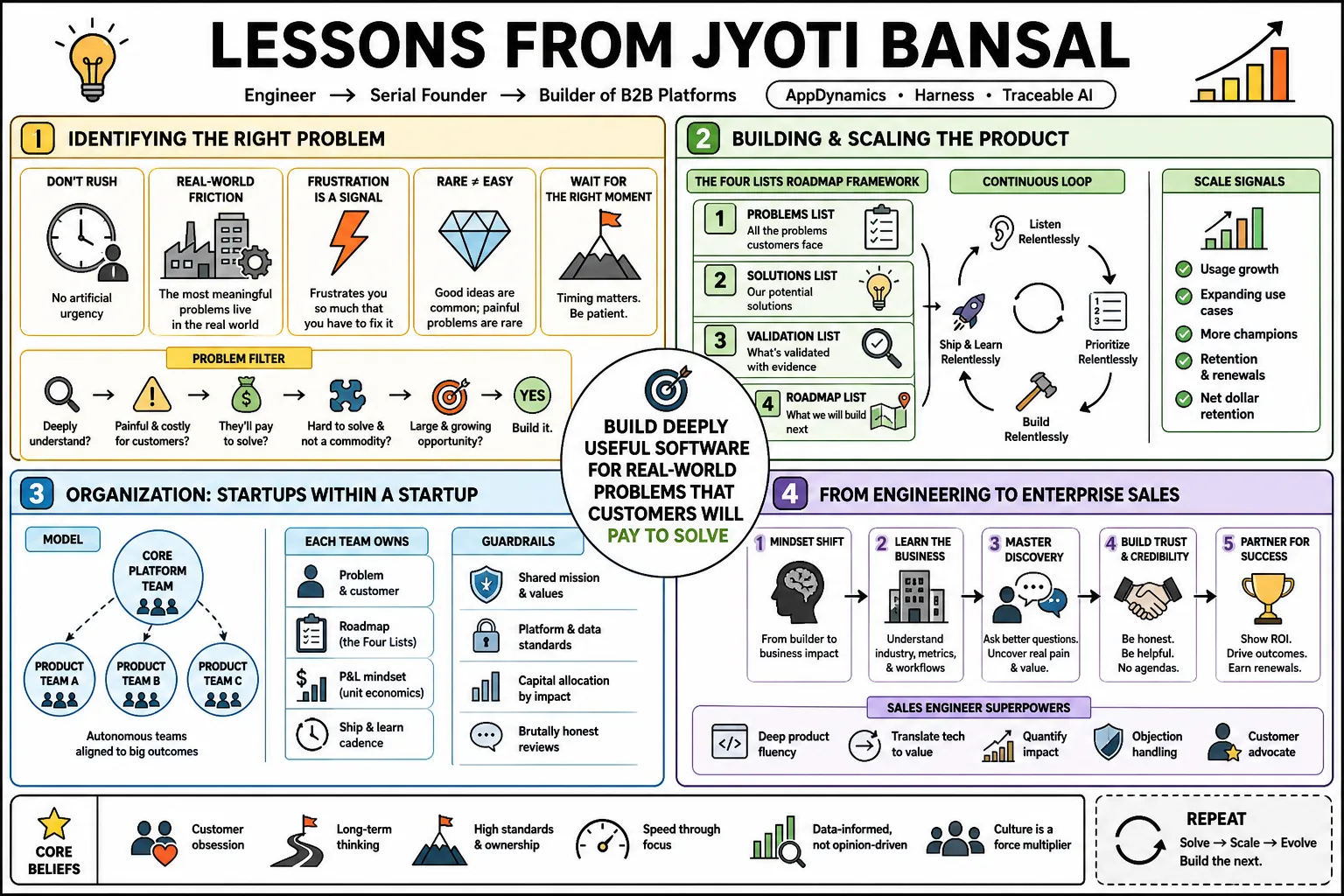
Lessons from Jyoti Bansal
Jyoti Bansal is a software engineer turned serial founder who built AppDynamics, Harness, and Traceable AI. This profile covers his tactics for scaling highly technical B2B products, detailing his "Four Lists" roadmap framework and "startups within a startup" organizational model. It also includes his advice on moving from engineering into enterprise sales.
Part 1: Identifying the Right Problem
- On artificial urgency: "Don't rush into entrepreneurship... If you don't have a problem you're passionate about, go work in industry, experience real problems firsthand, and then build solutions around those." — Source: Reddit Ask Me Anything
- On the catalyst for building: "When something frustrates you so much that you have to fix it — that’s when you build." — Source: Reddit Ask Me Anything
- On classroom versus reality: The most meaningful problems are found in the friction of the real world where businesses operate, rather than in university classrooms. — Source: Unusual Ventures
- On evaluating ideas: A good idea is common, but finding a complex, painful problem that businesses will actively pay to solve is rare. — Source: Business Insider
- On waiting for the right moment: Rushing to start a company just to hold the title of founder often leads to building solutions looking for problems. — Source: SaaStr Podcast
- On building what you know: Your strongest startup ideas will come from experiencing the pain points of a specific industry firsthand. — Source: Behind the Growth Podcast
- On the origin of AppDynamics: The company was born from the direct frustration of dealing with highly complex, distributed software systems that were impossible to debug efficiently. — Source: Forbes
- On deep obsession: If you are not deeply obsessed with the specific problem you are solving, you will burn out before the company reaches scale. — Source: First Round Review
- On ignoring ecosystem trends: Startups should focus on solving urgent customer needs rather than chasing the latest Silicon Valley ecosystem fads. — Source: Business Insider
Part 2: Product-Market-Sales Fit
- On finding early customers: "Start by finding customers for your business. You should be able to find 100 potential customers to talk to. The one mistake most founders make is not talking to customers. It’s not easy to find those people, but it’s 100% worth the effort." — Source: Business Insider
- On getting the first meetings: "To talk to 100 customers, you’ll probably need to contact around 1,000 people. Be scrappy. Find people who can introduce you to them." — Source: Business Insider
- On defining product potential: "The only way to know how much potential there is for a company is if you find people whose problems you’re able to solve effectively." — Source: Business Insider
- On avoiding assumptions: Talk directly to prospects to understand their urgent, undeniable needs instead of building based on internal assumptions. — Source: Unusual Ventures
- On cold conversations: Founders should conduct at least 50 cold, direct interviews with potential customers outside their immediate network to eliminate friendly bias. — Source: Unusual Ventures
- On product-market-sales fit: Building a great product is not enough because you must reach product-market-sales fit by ensuring you understand the business value and can effectively sell it. — Source: a16z Podcast
- On founder-led sales: In First Round's interview, Bansal says technical founders need to own early selling long enough to land the first 20 to 25 customers and build the first 20 to 25 real success stories before trying to scale sales through others. — Reference: First Round interview on founders selling until they have 20 to 25 happy customer stories
- On the binary differentiator: When launching into a crowded market, your product needs a binary differentiator, which is a clear, easily explainable reason to exist that separates it entirely from incumbents. — Source: First Round Review
- On pricing and value: If the business case for your tool is undeniably strong, you are doing a disservice by not aligning your go-to-market and pricing strategies to capture that value. — Source: Future by a16z
- On diagnosing slow growth: Bansal frames early slow selling as a product-maturity test: if you cannot point to even a handful of happy, successful customers, the core problem is still product maturity rather than pure sales execution. — Reference: First Round interview on using happy successful customers to diagnose product maturity versus sales problems
Part 3: The Four Lists Framework
- On balancing roadmap demands: The "Four Lists" process replaces the chaotic product backlog with a transparent system that respects different functional areas. — Source: Medium
- On List One (Customer Success): A dedicated portion of engineering must focus on features requested by existing customers to prevent churn and drive retention. — Source: A Smart Bear
- On List Two (Sales): The roadmap must explicitly include the specific features the sales team identifies as absolute necessities to close key competitive deals. — Source: Medium
- On List Three (Technical Debt): You cannot ignore the engineering work required to maintain system stability and scalability because failing to prioritize technical debt will eventually halt development velocity. — Source: A Smart Bear
- On List Four (Vision): The CEO and product leadership must drive strategic features designed to expand the market and outpace competitors over the long term. — Source: Medium
- On avoiding the loud minority: Forcing requests into separate streams allows leadership to allocate resources strategically rather than reacting to the loudest voices in the room. — Source: A Smart Bear
- On organizational harmony: Acknowledging that Sales, Engineering, and Customer Success all have valid but conflicting goals is the first step to building a functional product roadmap. — Source: Medium
- On survival versus innovation: The four-list methodology ensures a startup balances short-term revenue generation with the long-term viability of the technology. — Source: Medium
- On resource allocation: In the same conversation, Bansal describes new products at Harness as small internal startups, usually five or six people on top of shared platform infrastructure, with additional funding earned only after they prove traction. — Reference: First Round interview on funding new products as small internal startups that earn more resources with traction
Part 4: The Startup Within a Startup Model
- On maintaining agility: To prevent a scaling company from slowing down, Harness is organized into a "startups within a startup" model. — Source: First Round Review
- On modular product structures: Break down a massive platform into distinct product lines, with each operating as a quasi-independent entity. — Source: Boldstart Ventures
- On dedicated team ownership: Give each product module its own dedicated team that operates with the autonomy, risk tolerance, and speed of an early-stage startup. — Source: Boldstart Ventures
- On interoperability: Ensure that while teams operate independently, the resulting modules remain highly interoperable to form a cohesive platform for the customer. — Source: Forbes India
- On launching new products: A multi-startup structure allows a company to launch two or three major new product lines a year without the usual corporate friction. — Source: First Round Review
- On merging companies: Building a modular infrastructure allows for seamless integration of new ventures, such as when API security company Traceable merged into the Harness platform. — Source: Traceable AI
- On solving the founder's itch: Serial entrepreneurs can channel their drive to build new companies internally by creating new startup units within their existing enterprise. — Source: First Round Review
- On minimizing risk: If an internal startup fails, the isolated nature of the module prevents it from bringing down the entire company's core business. — Source: First Round Review
- On engineering productivity: Autonomous modules reduce dependencies and allow engineering teams to ship code faster and with a higher sense of ownership. — Source: Boldstart Ventures
Part 5: Hiring and Talent Density
- On hiring beyond yourself: As a founder, you must actively seek out and hire individuals who are substantially more capable than you in their respective domains. — Source: Inc. Magazine
- On the binary nature of leadership: Evaluate leaders based on their ability to diagnose whether a problem is rooted in product-market fit or distribution, and act decisively on that diagnosis. — Source: First Round Review
- On learning from interviews: "If you interview ten candidates for a vice president in marketing and you ask them the same question... after 10 interviews you will know the answer completely. So interviews are a good place to learn." — Source: FactorDaily
- On global talent: Building a massive tech company requires tapping into global engineering talent and treating teams in regions like India as core drivers of product innovation. — Source: Economic Times
- On people savviness: A founder's growth requires developing people savviness because building and running a company ultimately comes down to managing human dynamics. — Source: SaaStr
- On fostering productive debate: Bansal describes strong leadership conversations as challenge paired with trust: people should question decisions rigorously, but without losing confidence in the operators responsible for execution. — Reference: First Round interview on balancing challenge with trust in leadership and board discussions
- On hiring for the right stage: The sales leader who takes you from $1M to $10M is often fundamentally different from the leader needed to scale from $10M to $100M. — Source: First Round Review
- On avoiding premature scaling: Avoid hiring an expensive enterprise sales team before you have clearly proven that you have repeatable product-market-sales fit. — Source: First Round Review
- On culture as a differentiator: Setting the right culture early on is the primary difference between a startup that stalls and one that scales. — Source: Harness Blog
Part 6: Navigating the Early Days
- On the trap of a great product: Looking back on AppDynamics, Bansal says one early mistake was assuming the best product would naturally win, before he learned that go-to-market execution had to become equally excellent. — Reference: First Round interview on learning that the best product alone does not guarantee market success
- On ignoring investor ecosystems: "It’s really important that you get out of that Silicon Valley ecosystem" and stop relying on investor advice when you should be talking to customers. — Source: Business Insider
- On the reality of being a founder: "There are depression moments, there are moments like when things are very hard, you want people with whom you can talk to, even though it’s a lonely job." — Source: FactorDaily
- On building in a downturn: Economic recessions can actually be the best time to build a company because you are forced to remain scrappy, product-led, and hyper-focused on efficiency. — Source: Entrepreneur
- On initial assumptions: Be prepared for your initial product assumptions to be proven entirely wrong by the market, as success relies on your speed to adapt. — Source: Unusual Ventures
- On the immigrant entrepreneur experience: Dealing with the U.S. green card process as a founder is deeply frustrating because it removes control over a major part of your life and limits early risk-taking. — Source: Forbes
- On execution versus ideation: Great companies are not born from unique ideas. They are built through relentless, day-to-day execution. — Source: Ivy Podcast
- On finding the pain: You must build something that addresses a problem so acute that prospective buyers are willing to take a risk on an unproven startup. — Source: First Round Review
- On bootstrapping validation: Before writing code, use sheer hustle to validate if anyone actually cares about the problem you want to solve. — Source: Business Insider
- On being flexible: Building a startup is not a test of being right from day one. It is a test of how quickly you can pivot based on real-world friction. — Source: Unusual Ventures
Part 7: Transitioning to Enterprise
- On go-to-market execution: Bansal argues that once a company finds real product pull, it still has to build a deliberate go-to-market engine instead of expecting product strength by itself to carry the business to scale. — Reference: First Round interview on building a real go-to-market engine after product pull appears
- On mid-market versus enterprise: What works to acquire mid-market customers rarely works when moving up-market, so your go-to-market strategy must fundamentally evolve. — Source: SaaStr
- On firing customers: Bansal recounts letting Netflix go as a customer when its requests were consuming too much engineering time, a reminder that even marquee accounts can become a bad trade if they distort the roadmap. — Reference: First Round interview on letting Netflix go when customer demands consumed too much engineering time
- On capacity-driven growth: Bansal says a scaled sales organization should think in terms of capacity, not just heroic deal anecdotes, because the planning question becomes how much ramped selling capacity is being added and what bookings that should predictably produce. — Reference: First Round interview on managing scale through sales capacity rather than one-off deals
- On systemic growth: While early days are about product-market fit, scaling a business requires the systematic integration of go-to-market excellence alongside engineering. — Source: First Round Review
- On adopting AI: As the volume of code increases due to AI, scaling enterprise software delivery requires embedding agentic AI to handle bottlenecks in testing and compliance. — Source: WorkOS Podcast
- On repeat founder traps: Bansal warns that repeat founders get into trouble when they assume the same playbook that worked at the first company will transfer cleanly to the second without re-earning product, market, and operating fit. — Reference: First Round interview on the repeat-founder mistake of reusing the first company playbook too literally
- On avoiding custom dev shops: If you build every feature requested by a massive enterprise prospect, you cease to be a product company and become a custom development shop. — Source: Medium
- On the predictability of scale: In Bansal's telling, mature growth becomes more legible when leaders can model revenue against ramped sales capacity instead of retelling every quarter as a collection of special-case wins. — Reference: First Round interview on mature sales becoming predictable through ramped capacity planning
Part 8: The Founder's Journey
- On the four dimensions of growth: "You have to actively work on developing yourself... on four dimensions. One is the technology savvy... Second is the business savvy... The third is people savviness." — Source: SaaStr
- On the fourth dimension: The final dimension of founder growth is personal psychology, which involves managing your own resilience, stress, and ability to handle the continuous emotional rollercoaster. — Source: SaaStr
- On the transition to CEO: Moving from a technical engineer to a CEO requires letting go of the codebase and learning how to build the machine that builds the machine. — Source: Behind the Growth Podcast
- On continuous self-improvement: A founder's primary job is to outpace the growth rate of their own company by constantly absorbing new knowledge. — Source: SaaStr
- On asking for help: Despite the loneliness of the CEO role, the most effective founders are those who actively seek out mentors and are unafraid to admit what they don't know. — Source: FactorDaily
- On measuring time: Leaders should train themselves and their teams to measure their time not by hours worked, but by the tangible impact delivered. — Source: Inc. Magazine
- On maintaining the edge: Even as a successful CEO, you must retain the scrappy, paranoid edge of an early-stage founder to prevent complacency. — Source: First Round Review
- On the joy of building: For true serial entrepreneurs, the motivation isn't the final exit, but the profound enjoyment of the zero-to-one building phase. — Source: First Round Review
- On selling pre-IPO: The decision to sell AppDynamics days before its IPO was not about the money, but a rational assessment of the best long-term outcome for the company's employees and investors. — Source: First Round Review
- On leaving a legacy: Ultimately, a founder's legacy is defined by the resilience of the culture they built and the caliber of the leaders they helped develop. — Source: Harness Blog