Kapil Gupta: Truth, Mind, and Mastery
Kapil Gupta writes and speaks about truth, the mind, performance, and the limits of prescribed methods. The lessons below distinguish his stated philosophy from independently established fact. — Naval interview.
On Truth and Sincerity
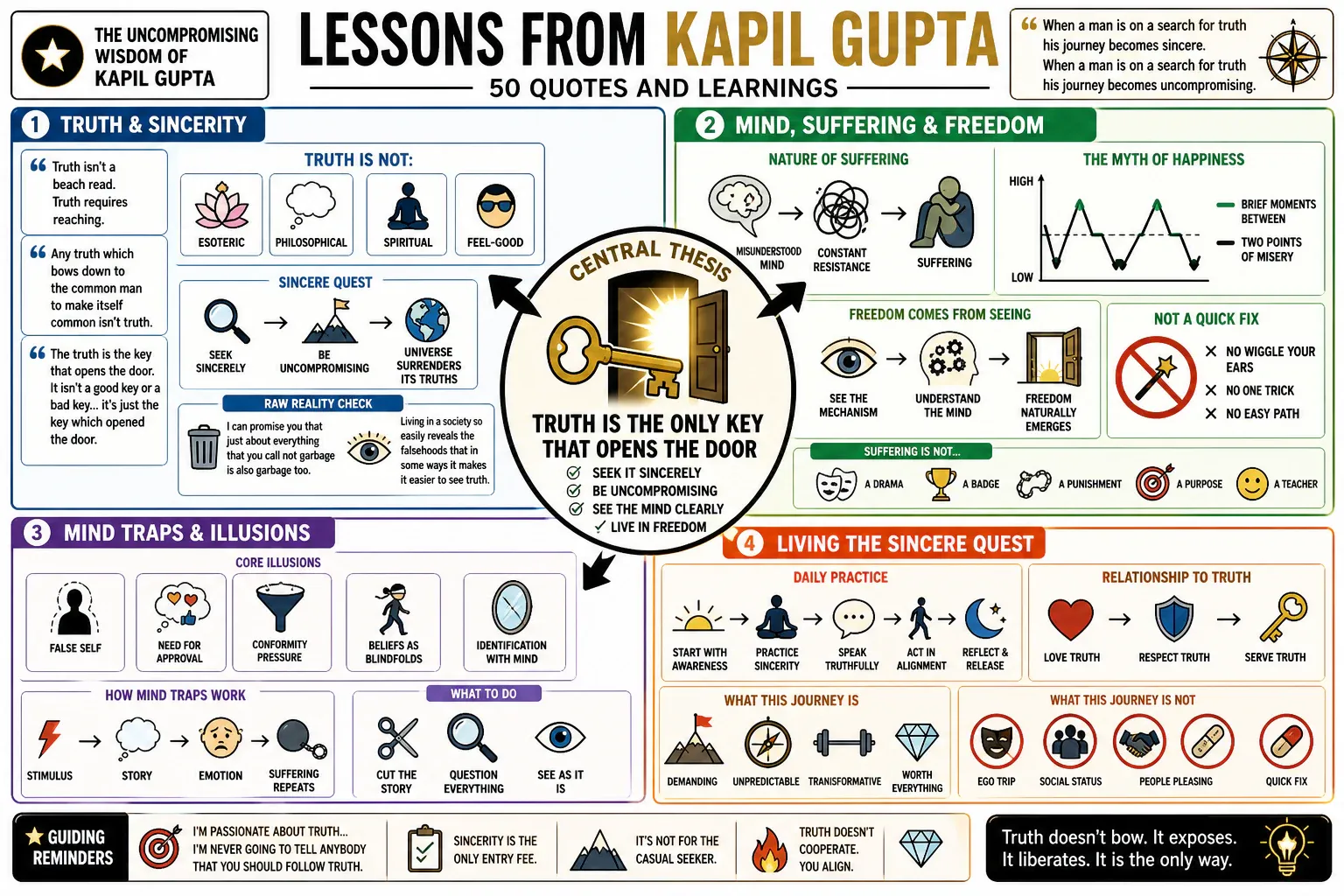
Gupta treats truth as an inquiry into lived problems and regards sincerity as more important than following a formula. — Naval interview.
- Truth is practical: Gupta treats truth as a concrete inquiry into the problems a person actually faces, not merely as an abstract spiritual idea. — Naval interview.
- Sincerity changes the search: In Gupta’s account, a sincere search becomes uncompromising when a person is willing to examine the thing they seek without relying on inherited methods. — On the Buddha’s Enlightenment and Yours.
- Truth requires examination: He argues that the truth about an acute problem requires examining it rather than looking for a quick technique to make discomfort disappear. — Naval interview.
- Truth is not tailored to an audience: Gupta says his aim in conversation is to speak truth rather than make every listener understand it. — Naval interview.
- Truth is not a happiness trick: His approach asks where a problem comes from, rather than offering a ritual or technique that promises immediate relief. — Naval interview.
- Study the source of a problem: Gupta argues that understanding the problem itself can reveal what a conventional search for solutions misses. — Naval interview.
- Do not prescribe a quest for truth: He rejects turning even sincerity or truth seeking into a rule for everyone. — Naval interview.
- Examine inherited notions: Gupta’s signed essay warns that accepting ideas from authorities without examining them can substitute one inherited belief for another. — Learning From Others.
On The Mind, Suffering, and Freedom
Gupta describes freedom in relation to understanding the mind and the origin of internal conflict. These are his philosophical claims, not clinical conclusions. — Naval interview.
- Happiness as a mental idea: Gupta describes happiness as a mental construct people pursue, while leaving open what the felt experience beneath that label might be. — There Is Something Within Us.
- Suffering can prompt inquiry: Gupta starts with a person’s most acute fear, anxiety or conflict and asks what it is and where it comes from. — Naval interview.
- Do not assume fear comes only from circumstance: He argues that attributing fear and anxiety solely to outside circumstances can obscure the role of the mind. — Naval interview.
- The mind can create confinement: Gupta describes internal dialogue, rules and self-conflict as constraints on freedom. — Naval interview.
- Frustrated desires and anger: In a letter about a person facing turmoil, Gupta connects anger with a desired outcome that has not arrived; this is his interpretation of that case, not a universal clinical rule. — A Delicate Solution.
- More freedom is not necessarily freedom: Gupta questions a form of freedom that immediately produces a wish for still more of it. — Naval interview.
- Understanding before suppression: He locates freedom in understanding where a troubling experience comes from rather than consciously trying to end it. — Naval interview.
- Look beneath social scripts: His account of the mind includes culturally learned expectations; he urges examining those assumptions when they cause conflict. — Naval interview.
On Rejecting "How-To's" and Self-Help
Gupta distinguishes mechanical instructions from the prescriptions he rejects for creative work, mastery, and inner life. — Naval interview.
- How-tos have a boundary: Gupta distinguishes useful instructions for mechanical tasks from prescriptions that he thinks cannot produce art, peace or mastery. — Naval interview.
- Even copying yourself can fail: His world-class-performer example says repeating the outward steps of a past success is not the same as recreating its underlying process. — Naval interview.
- Great work can be tacit: Gupta says people may not know how they do their greatest work, limiting what a step-by-step account can teach. — Naval interview.
- Relief is not a generic method: He is skeptical of self-help prescriptions for internal problems and asks people to understand the problem beneath the method. — Naval interview.
- Question borrowed wisdom: In a signed essay, Gupta disputes learning from others when their ideas are simply another form of unexamined conditioning. — Learning From Others.
- A spiritual practice can become an identity: Gupta warns that following a prescribed practice for the image of being a seeker can displace the underlying aim. — Meditation Is Not for the Meditator.
- Do not universalize a prescription: Gupta objects to converting a personal pursuit into a rule that everyone else should follow. — Naval interview.
- Techniques may leave the fear untouched: In Gupta’s discussion of anxiety, repeating a prescribed exercise without examining the anxiety can leave the original problem unaddressed. — Naval interview.
On Society and The Masses
Gupta challenges inherited social assumptions and asks readers to examine whose ideas they have accepted. — Learning From Others.
- Readiness cannot be forced: Gupta writes that he does not shape truth for a mass audience; a reader must be ready to receive it. — On Art and Truth.
- Group identity can obscure the aim: In his critique of meditation groups, Gupta argues that joining the group can become more important than the practice or its purpose. — Meditation Is Not for the Meditator.
- Culture can compound a problem: Gupta argues that searching for an answer only within a culture’s standard prescriptions may add a second problem to the original one. — Lost in the Culture.
- Arrange your environment deliberately: Gupta advises shaping one’s environment around the direction one wants to take, while treating this as his philosophy rather than an empirically guaranteed outcome. — Naval interview.
- Inspect inherited shoulds: His critique of social conditioning invites scrutiny of what one has been told to do rather than reflexively adopting the culture’s answers. — Lost in the Culture.
- Question good-and-bad labels: Gupta resists treating “good” and “bad” as automatic guides to understanding what is true. — Naval interview.
- A different relationship to norms: Gupta says some people feel an immediate mismatch with what society expects; he presents this as a difference in sensibility, not a measurable inborn superpower. — Naval interview.
- Examine the source of authority: Gupta argues that wisdom begins by questioning whether expert and influencer claims are true, not accepting them for their status. — Learning From Others.
On True Performance and Mastery
For Gupta, distinctive work calls for an honestly chosen aim rather than imitation or externally supplied motivation. — Emulate No Man.
- Internal interest versus motivation: Gupta explicitly rejects attempts to motivate someone from outside, favoring quiet examination of what the person actually wants. — Naval interview.
- Understanding can change action: For Gupta, understanding the origin of an internal problem is more important than layering a prescribed action on top of it. — Naval interview.
- Truth before five steps: He argues that naming and understanding a problem is more useful than treating an external solution as separate from it. — Naval interview.
- Devotion without imitation: In Gupta’s account, sincerity toward a personally meaningful aim matters more than copying another seeker’s method. — On the Buddha’s Enlightenment and Yours.
- Progress can become self-image: Gupta cautions that measuring self-improvement can turn into pleasure in the image of being further along. — Naval interview.
- Protect your own path: Gupta argues that another person’s distinctive accomplishment cannot be reproduced by copying outward habits. — Emulate No Man.
- Name the aim honestly: He asks readers to examine what they truly value rather than adopt a goal or route inherited from someone else. — On the Buddha’s Enlightenment and Yours.
Sources