Kara Swisher is a technology journalist who has spent decades covering Silicon Valley’s founders, companies, and cultural shifts. Known for her blunt interviewing style and refusal to coddle executives, she built a career demanding accountability from the world's wealthiest people. This profile examines her observations on the tech industry's power dynamics, the failures of digital media, and the personal philosophy that fueled her career.
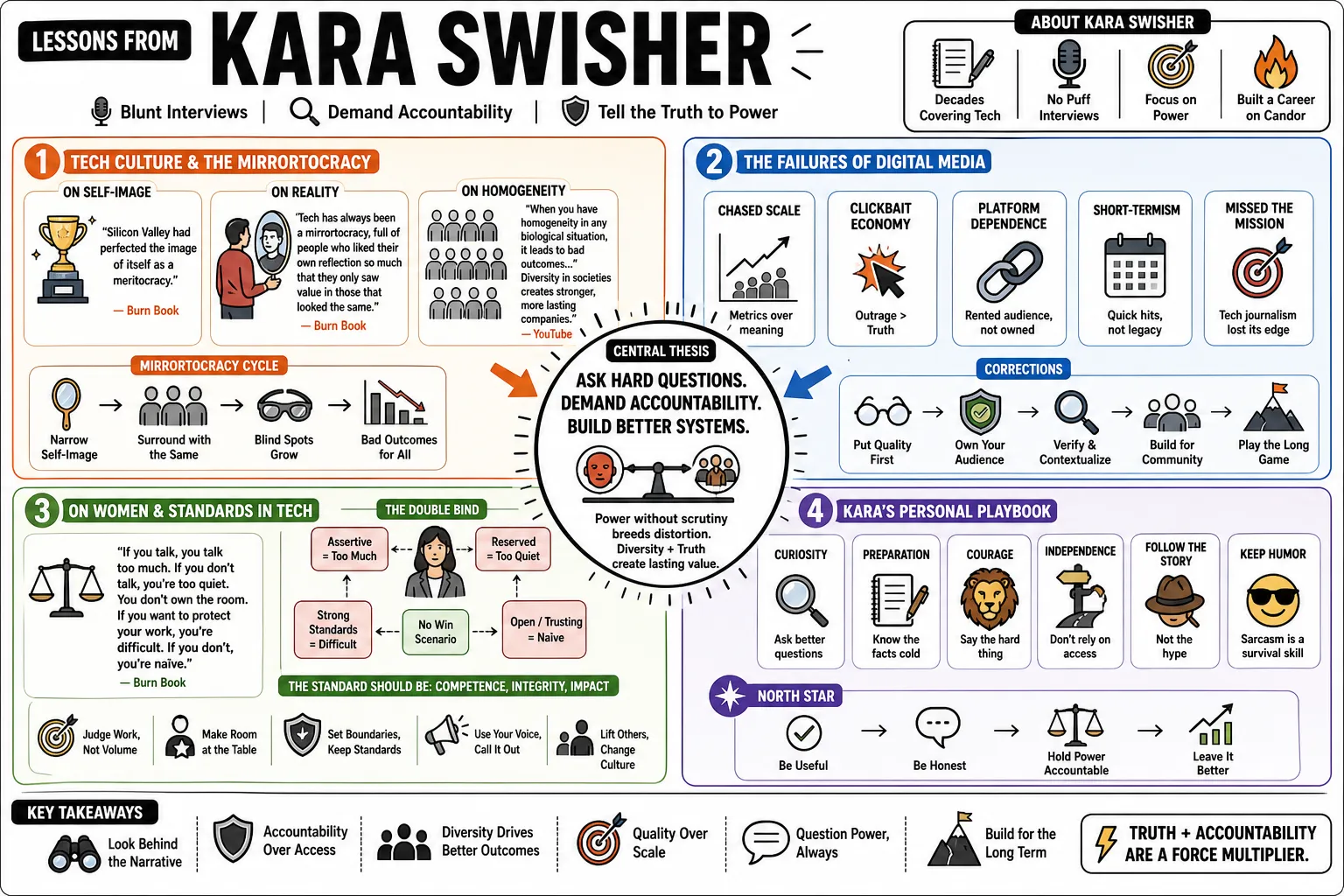
Part 1: Tech Culture and the Mirrortocracy
- On self-image: "Silicon Valley had perfected the image of itself as a meritocracy and touted that as one of its greatest strengths." — Source: Burn Book
- On the reality of the ecosystem: "In fact, tech has always been a mirrortocracy, full of people who liked their own reflection so much that they only saw value in those that looked the same." — Source: Burn Book
- On biological homogeneity: "When you have homogeneity in any biological situation, it leads to bad outcomes... Diversity in societies creates stronger, more lasting companies." — Source: YouTube
- On women's standards in tech: "If you talk, you talk too much. If you don't talk, you're too quiet. You don't own the room. If you want to protect your work, you're not a team player." — Source: Bookey
- On frothy numbers: A key part of the early tech boom involved raising money on inflated metrics just to sugarcoat structural rot. — Source: Podscripts
- On elbows: In tech, if a woman advocates for her work or pushes back, she is routinely told her elbows are too sharp. — Source: GeekWire
- On the billionaire boys club: The tech industry largely functions as an exclusive club where wealthy men insulate each other from consequences. — Source: Stanford GSB
- On manufactured brilliance: Many leaders claim they know better than the public, using their wealth as a shield to paper over their numerous mistakes. — Source: WNYC Studios
- On arrogance: The standard attitude of a Silicon Valley founder is to be frequently wrong, but never in doubt. — Source: Goodreads
- On performative disruption: It is inherently amusing to see the world’s richest men urging people to stick it to the man, when they are, in fact, the man. — Source: Burn Book
Part 2: The Founders and Executive Power
- On unaccountable influence: "We had, in essence, privatized our public discourse and were now allowing billionaires to implement the rules of the road." — Source: Burn Book
- On Travis Kalanick: "Every now and then, when he's spoiling for a fight, Travis Kalanick has a face like a fist." — Source: Washington Post
- On Steve Jobs: Jobs understood the emotional resonance of technology in a way other founders simply did not. — Source: Pivot
- On Mark Zuckerberg: He often operates with the mindset of a nation-state leader but without any democratic accountability. — Source: Sway
- On Elon Musk: "Kara has become so shrill at this point that only dogs can hear her." — Source: The Geyser
- On executive hypocrisy: Tech leaders often demand transparency from their users while keeping their own algorithmic decisions locked in black boxes. — Source: Recode
- On the god complex: Success at a young age in software often deludes founders into thinking they can seamlessly solve complex societal issues. — Source: New York Magazine
- On political meddling: The convergence of political ambition, massive wealth and Silicon Valley influence is an existential threat to humanity. — Source: Calcalistech
- On the fear factor: Many tech executives are simultaneously afraid of tough reporters and deeply desirous of their validation. — Source: The Geyser
- On adult supervision: The myth of the lone genius founder often obscures the army of experienced operators actually keeping the company afloat. — Source: Pivot
Part 3: The Cost of Innovation and Negativity
- On tech's reach: "Tech is like water. It’s going to get in everywhere. It’s going to drip, drip, drip at your population, for good or bad." — Source: Simplecast
- On the ship and the shipwreck: "When you invent the ship, you also invent the shipwreck... Every technology carries its own negativity, which is invented at the same time as technical progress." — Source: Burn Book
- On unintended consequences: Silicon Valley excels at launching products but willfully ignores the downstream societal damage until it becomes a PR crisis. — Source: TED
- On the engagement economy: Platforms built to maximize attention inherently prioritize outrage because anger keeps users scrolling longer than joy. — Source: Pivot
- On prioritizing speed: Moving fast and breaking things works for software updates but it is a disastrous framework for public infrastructure and democracy. — Source: Sway
- On algorithmic bias: Artificial intelligence is often just human prejudice laundered through complex mathematics. — Source: Recode Decode
- On surveillance capitalism: Consumers traded their privacy for convenience, a bargain that tech companies eagerly exploited to build massive advertising empires. — Source: New York Magazine
- On safety blind spots: In ELLE, Swisher argued that many men, especially white men, feel safe all the time and therefore do not understand other people's lack of safety, supporting a narrower lesson that tech leaders often miss guardrail needs because the underlying risks do not feel personal to them. — Reference: ELLE interview with Kara Swisher
- On the burden of proof: The tech industry forces society to prove a product is harmful rather than proving it is safe before launch. — Source: Pivot
Part 4: Journalism, Media, and Generative AI
- On fair use in AI: "Pay me for my stuff! You can’t walk into my store and take all my Snickers bars and say it’s for fair use." — Source: WNYC Studios
- On media economics: "These businesses have economic systems not in line with our costs." — Source: Observer
- On media optimism: "You’d be shocked. I am the hopeful person in media. I’m the one that argues for it." — Source: Possible FM
- On access journalism: Refusing to cozy up to executives means occasionally losing access, but retaining the trust of the audience is far more valuable. — Source: WRAL
- On the decline of print: The failure of traditional media was about a stubborn refusal to adapt to how audiences actually consumed information. — Source: Pivot
- On tough questions: A reporter's job is not to make the subject comfortable but to ask the questions the public needs answered. — Source: New York Magazine
- On indifference to power: A reporter must cultivate an absolute indifference to the wealth and status of the people they cover. — Source: GeekWire
- On the theft of content: Tech companies built massive valuations by scraping the work of creators without offering compensation or credit. — Source: Sway
- On the future of news: Quality journalism will survive by requiring direct relationships with audiences rather than relying on algorithmic distribution. — Source: Pivot
Part 5: Career Philosophy and Taking Risks
- On being unintentional: Careers rarely follow a master plan; success often comes from embracing an unintentional trajectory and acting on instinct. — Source: KKarenism
- On making mistakes: "I don't make mistakes. I just go another way and if that doesn't work then I change it." — Source: KKarenism
- On getting stuck: If you are unhappy in your job, stop complaining and take the risk of trying something completely new. — Source: Inspiring Women
- On self-confidence: When criticized for being too confident, the best response is simply to agree and declare that you are fantastic. — Source: Inspiring Women
- On the good girl trap: Women are conditioned to get along and be pleasant, which often prevents them from speaking their minds and claiming their power. — Source: Stanford GSB
- On risk and value: At Stanford GSB, Swisher argued that the more safe and risk-averse you are, the less successful you are, supporting a cleaner Reference lesson that meaningful work usually requires taking more risk than comfort-minded career planning allows. — Reference: Stanford GSB interview with Kara Swisher
- On leaving toxic environments: Swisher said in ELLE that she always leaves when she is not happy and in the Stanford GSB interview that if you end up in an environment where people bully you or you cannot speak your mind freely, find a way out because it will not improve. — Reference: Stanford GSB interview with Kara Swisher
- On time as a currency: Because time is finite and unpredictable, spending it in a miserable job is a tragic misallocation of resources. — Source: Inspiring Women
- On owning the room: Do not wait for permission to speak or lead; assume you have the right to be there and act accordingly. — Source: Bookey
Part 6: Leadership and Workplace Dynamics
- On the top spot: The most effective way to enact change is to seek the top spot and be the boss of whatever you are doing. — Source: Stanford GSB
- On generous mentorship: True leaders share the spotlight and foster growth in others rather than hoarding opportunities for themselves. — Source: Inspiring Women
- On truth-telling: Radical honesty is a professional asset; the willingness to state obvious truths when others will not sets you apart. — Source: Stanford GSB
- On bullies: If you cannot be the leader, actively seek out environments where you are protected from workplace bullies. — Source: Stanford GSB
- On diversity as a priority: At Stanford GSB, Swisher said companies routinely treat board and leadership diversity as priority 15, 16, or 17 instead of placing it at the top, supporting a narrower Reference lesson that diversity has to be run as a real operating priority rather than a symbolic gesture. — Reference: Stanford GSB interview with Kara Swisher
- On managing upwards: Do not flatter executives since they have enough sycophants; offer them friction and facts. — Source: Pivot
- On recognizing talent: The best managers look for employees who challenge their weaknesses instead of those who mirror their own traits. — Source: Recode
- On firing people: If someone is detrimental to the culture or incapable of the work, dragging out their departure only harms the rest of the team. — Source: Pivot
- On structural rot: No amount of free snacks or office perks can fix a company built on a foundation of unethical leadership. — Source: New York Magazine
Part 7: Navigating Narrative and Influence
- On controlling the story: "Everything is a narrative in life." If you do not write your own story, someone else will write it for you. — Source: AZQuotes
- On public relations: The tech industry uses PR to obscure their actual business models instead of informing the public. — Source: Pivot
- On Twitter: It functions less as a digital town square and more as an unregulated rage machine designed to extract attention. — Source: Sway
- On the illusion of connection: Social media platforms sold the promise of global connection while actively isolating users into hyper partisan filter bubbles. — Source: New York Magazine
- On owning your expertise: When someone questions her qualifications, Swisher often jokes, "I'm good at everything, just so you know." — Source: UC Berkeley
- On interviewing tactics: The most effective interview technique is to ask a direct question and then remain entirely silent while the subject struggles to fill the void. — Source: GeekWire
- On corporate apologies: A tech CEO apology is rarely about contrition; it is almost always about minimizing regulatory blowback. — Source: Recode Decode
- On shifting blame: Platforms often blame their users for toxic content while conveniently ignoring that their algorithms amplified it in the first place. — Source: Pivot
- On the index of a book: "There is no index, people. So, you have to read the whole book all the way through to see if you're in it. I'll be honest—most of you are not." — Source: Burn Book
Part 8: Life, Mortality, and Moving Forward
- On perspective and mortality: "Remembering that you are going to die is the best way I know to avoid the trap of thinking you have something to lose. You are already naked." — Source: Burn Book
- On following your heart: Because time is short and the end is certain, there is absolutely no reason not to pursue what actually matters to you. — Source: Burn Book
- On looking backward: Dwelling on the past is largely unproductive; the focus must remain relentlessly on what happens next. — Source: Elle
- On losing a parent early: Experiencing profound loss at a young age fundamentally alters your relationship with risk and makes career anxieties seem trivial. — Source: Inspiring Women
- On ignoring critics: Wasting energy on people who fundamentally misunderstand you is a distraction from doing actual work. — Source: Pivot
- On the value of bluntness: Life is too brief for polite equivocation when directness can solve the problem in half the time. — Source: Stanford GSB
- On reinvention: If an industry or medium stops working for you, burn the old model down and build a new one. — Source: Pivot
- On aging in tech: The industry worships youth but experience provides the necessary context to see through cyclical hype. — Source: New York Magazine
- On personal agency: You cannot control the macroeconomic shifts or algorithmic changes but you can always control your own labor and reaction. — Source: Sway
- On legacy: A career should be measured by the willingness to hold power accountable instead of proximity to power. — Source: Burn Book