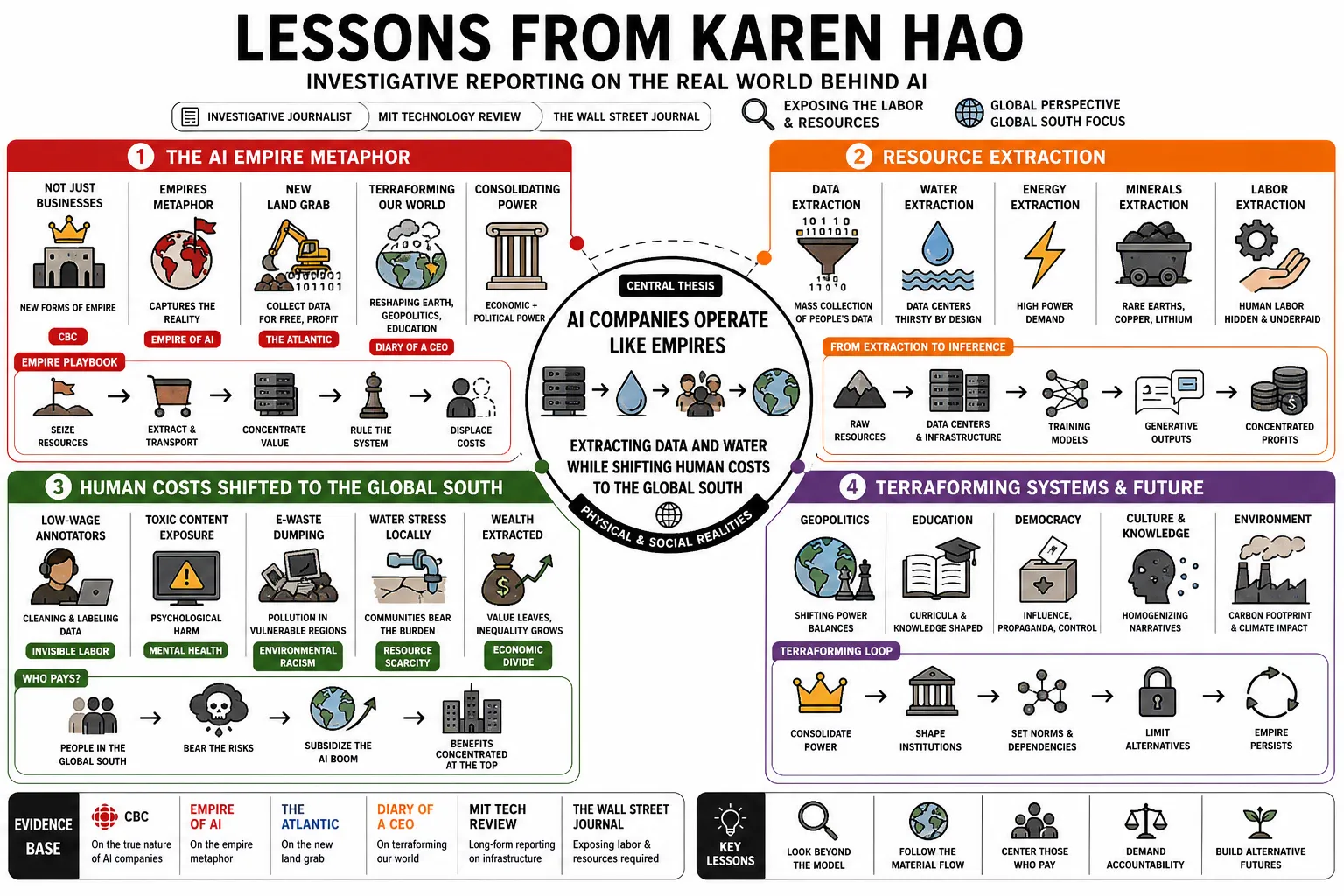
Lessons from Karen Hao
Investigative journalist Karen Hao spent years at MIT Technology Review and The Wall Street Journal exposing the labor and resources required to build artificial intelligence. She argues that modern AI companies operate like empires, extracting data and water while shifting the human cost to the Global South. This profile gathers her reporting to reveal the physical and social realities behind generative models.
Part 1: The AI Empire Metaphor
- On the True Nature of AI Companies: "We need to stop thinking of these companies as merely businesses... These are new forms of empire that are consolidating a historic amount of economic and political power." — Source: The CBC
- On Resource Extraction: "Over the years, I've found only one metaphor that encapsulates the nature of what these AI power players are: empires." — Source: Empire of AI
- On the New Land Grab: "AI is just a land grab all over again. Big Tech likes to collect your data more or less for free... and then turn it around." — Source: The Atlantic
- On Terraforming: "These empires are terraforming our earth, reshaping our geopolitics, and upending our education systems." — Source: The Diary of a CEO
- On the Logic of Scale: "We don't need to accept the logic of unprecedented scale and consumption to achieve advancement." — Source: Empire of AI
- On Centralized Power: "AI development has become a game where only a handful of corporations have the capital to participate, centralizing influence." — Source: TechPolicy Press
- On Separating Technology from Empire: "Fundamentally, we need to separate AI from empire. We want the benefits of AI. We absolutely cannot have it at the cost of our democracy." — Source: The CBC
- On Tech Colonialism: "The playbook of AI expansion mirrors historical colonialism, extracting raw materials from marginalized regions to build wealth elsewhere." — Source: Hidden Forces
- On Fighting for Democracy: "People should fight like hell to make sure that's not taken away by unaccountable algorithms." — Source: The CBC
- On Decolonizing the Future: "Resisting the AI empire requires actively choosing a path that does not depend on exploiting the developing world." — Source: TechPolicy Press
Part 2: OpenAI and the Race for AGI
- On the Singular Obsession: "OpenAI executives had a singular obsession: to be the first to reach artificial general intelligence, to make it in their own image." — Source: Empire of AI
- On the Shift in Mission: "Early visions of building AI for humanity's benefit were quickly overtaken by the mandate to scale at any cost." — Source: MIT Technology Review
- On Strategy: "OpenAI transitioned from a safety-focused nonprofit to a massive powerhouse by changing its internal definitions of success." — Source: TechCrunch Equity
- On the Problem of Alignment: "We cannot create an artificial intelligence more powerful than human beings unless we can solve the problems of control and alignment." — Source: MIT Technology Review
- On the Illusion of Progress: "The pursuit of AGI often ignores whether the interim products are actually safe for immediate public deployment." — Source: The Wall Street Journal
- On Internal Culture: "Disagreements within OpenAI often stemmed from the friction between releasing tools quickly and ensuring they were strictly controlled." — Source: The Diary of a CEO
- On the Definition of AGI: "The goalpost for AGI is frequently moved to justify massive ongoing investments and compute expenditure." — Source: Empire of AI
- On Commercial Pressure: "As the company took on billions in investment, the structural need to generate returns overwhelmed its original open-source ethos." — Source: TechCrunch Equity
- On Playing Catch-Up: "Even the researchers building these systems admit they do not fully understand how their models make decisions, making control nearly impossible." — Source: MIT Technology Review
- On Cultural Bias: "The desire to build an all-knowing machine reflects the specific cultural and ideological biases of a narrow demographic in Silicon Valley." — Source: Empire of AI
Part 3: The Ghost Workers of the Global South
- On Sweatshop Wages: "The AI boom relies on the humans cleaning up that data for sweatshop wages throughout the Global South." — Source: Empire of AI
- On the Reality of Automation: "Behind the magic of machine learning is an army of invisible laborers categorizing images and text." — Source: MIT Technology Review
- On Psychological Trauma: "Workers in Kenya and Colombia are frequently exposed to graphic and violent content so that the AI learns to filter it out for Western users." — Source: The Wall Street Journal
- On Silicon Valley's Justifications: "Tech executives often minimize these harms by claiming the workers are happier because of it and grateful for the employment." — Source: Empire of AI
- On Asymmetric Benefits: "The people doing the grueling work of data labeling are rarely the ones who benefit from the economic upside of the final product." — Source: Jacobin
- On Outdated Labor Laws: "Current global labor frameworks are completely unequipped to protect digital gig workers from exploitation by multinational tech companies." — Source: Data & Society
- On the Illusion of Intelligence: "AI appears intelligent only because human workers are constantly manually correcting its mistakes behind the scenes." — Source: MIT Technology Review
- On Data Labeling Supply Chains: "The supply chain of AI is deliberately opaque, obscuring the human labor required to make generative models function." — Source: Jacobin
- On Language Bias: "Data workers are forced to train models primarily in English, reinforcing a global linguistic hierarchy." — Source: The Atlantic
- On Organizing Labor: "Despite the isolated nature of clickwork, data annotators are beginning to form unions to demand better psychological support and fair pay." — Source: The Wall Street Journal
Part 4: Natural Resources and Hyperscale Computing
- On the Physicality of the Cloud: "Under the hood, generative AI models are monstrosities built from consuming unfathomable amounts of natural resources." — Source: Empire of AI
- On Water Consumption: "Training large language models requires millions of gallons of fresh water to cool data centers, often in drought-prone regions." — Source: The Nation
- On Local Community Impact: "Tech giants build data centers in places like Chile and Uruguay, where they compete directly with local residents for drinking water." — Source: The Atlantic
- On Hidden Carbon Footprints: "The emissions tied to training state-of-the-art models are systematically underreported by the companies building them." — Source: MIT Technology Review
- On Energy Grids: "The massive electricity demands of hyperscale computing are placing unprecedented strain on local energy infrastructures." — Source: The Nation
- On Zero-Sum Resource Allocation: "The resources required to train a single language model could power entire neighborhoods, forcing a societal choice about what we value." — Source: The Atlantic
- On Corporate Sustainability: "Tech companies' promises of carbon neutrality often ignore the immediate, localized environmental degradation caused by data center construction." — Source: The Wall Street Journal
- On Extractivism: "The hardware supply chain for AI mirrors the extractive mining practices of the nineteenth century, just updated for silicon and server racks." — Source: Empire of AI
- On the Cost of a Query: "Generating an image or writing an essay with AI costs significantly more energy than completing the same task using traditional software." — Source: MIT Technology Review
Part 5: Algorithms, Attention, and Facebook
- On the Addiction to Misinformation: "Social media platforms like Facebook built algorithms that became addicted to spreading misinformation because it generated the most engagement." — Source: MIT Technology Review
- On Business Model Alignment: "The harms of recommendation algorithms are not bugs; they are the direct result of a business model that monetizes human attention." — Source: Karen Hao's Website
- On Algorithmic Amplification: "AI models on social networks reliably elevate divisive and extreme content over nuanced discussion." — Source: MIT Technology Review
- On Content Moderation: "Automated moderation systems are consistently outpaced by the sheer volume of inflammatory content the core algorithm promotes." — Source: The Wall Street Journal
- On Internal Warnings: "Whistleblowers and internal researchers frequently warned leadership about algorithmic harms, but were ignored in favor of growth metrics." — Source: MIT Technology Review
- On the Engagement Trap: "Engineering teams are incentivized to optimize for time-on-site, inherently blinding them to the offline consequences of their code." — Source: Karen Hao's Website
- On Filter Bubbles: "AI recommendations fracture shared reality by feeding users increasingly isolated and tailored streams of information." — Source: The Wall Street Journal
- On Political Polarization: "The structural design of newsfeeds accelerates political polarization by rewarding outrage with visibility." — Source: MIT Technology Review
- On Shifting Blame: "Tech companies often blame users for the spread of toxicity, obscuring the role their AI systems play in curating the environment." — Source: Karen Hao's Website
Part 6: Geopolitics and Global AI Development
- On the AI Arms Race: "The framing of an AI arms race is often used by defense contractors and tech executives to secure massive government funding without oversight." — Source: The Atlantic
- On Surveillance Exports: "Both Western and Chinese tech companies actively export AI surveillance technologies to authoritarian regimes worldwide." — Source: MIT Technology Review
- On Global Supply Chains: "The AI industry relies on a deeply entangled global supply chain, making a true decoupling of US and Chinese tech ecosystems nearly impossible." — Source: The Wall Street Journal
- On Nationalism in Tech: "Patriotic rhetoric is frequently deployed to silence critics who question the ethics or safety of domestic AI programs." — Source: The Atlantic
- On the Global South's Exclusion: "Developing nations are treated as data mines and testing grounds, but are rarely invited to the table when global AI policy is written." — Source: TechPolicy Press
- On Facial Recognition Harms: "The deployment of biometric AI systems disproportionately targets marginalized communities across different geopolitical contexts." — Source: MIT Technology Review
- On Open Source Geopolitics: "The debate over open-sourcing AI models is complicated by national security concerns and the fear of proliferating dual-use technology." — Source: The Wall Street Journal
- On Regulatory Arbitrage: "Tech empires move their operations across borders specifically to exploit regions with the weakest data privacy and labor laws." — Source: Empire of AI
- On the Rhetoric of Winning: "The insistence that a country must win the AI race prevents meaningful international cooperation on shared safety standards." — Source: The Atlantic
Part 7: Safety, Alignment, and Silicon Valley Logic
- On the Term 'Alignment': "In Silicon Valley, alignment often means making the AI agree with the corporate values of the company that built it, rather than human values." — Source: MIT Technology Review
- On Existential Risk as a Distraction: "Focusing entirely on hypothetical future threats allows companies to dodge accountability for the immediate harms happening today." — Source: The Atlantic
- On the Tech Savior Complex: "Industry leaders operate under the assumption that they are uniquely qualified to engineer solutions to the very societal problems they created." — Source: Empire of AI
- On Move Fast and Break Things: "The culture of shipping unfinished software is fundamentally incompatible with deploying autonomous systems into critical infrastructure." — Source: TechCrunch Equity
- On the Homogeneity of Builders: "The lack of diversity among AI researchers results in systems that fail to recognize or respect non-Western cultural contexts." — Source: MIT Technology Review
- On Ethical Washing: "Companies frequently establish AI ethics boards only to dismantle or ignore them when their recommendations threaten the bottom line." — Source: The Wall Street Journal
- On Measuring Intelligence: "The industry relies on flawed, gameable benchmarks to claim that their models are achieving human-level reasoning." — Source: Karen Hao's Website
- On the Profit Motive vs. Safety: "When forced to choose between a safer model and a more profitable one, the structural incentives always favor profit." — Source: Hidden Forces
- On Red Teaming Limitations: "Internal safety testing is usually rushed and severely constrained by the pressure to launch ahead of competitors." — Source: MIT Technology Review
Part 8: Journalism, Accountability, and the Future
- On the Role of the Journalist: "Reporters must look past the public relations statements of tech executives and examine the physical supply chains that make AI possible." — Source: Pulitzer Center
- On Resisting the Hype Cycle: "The media frequently fails the public by repeating corporate claims of magic instead of explaining the underlying math and labor." — Source: The Algorithm
- On AI Literacy: "A functioning democracy requires citizens who understand how algorithmic systems are actively shaping their daily choices and opportunities." — Source: Karen Hao's Website
- On Auditing the Algorithms: "We desperately need independent, third-party auditors who have the legal authority to inspect the training data of large models." — Source: MIT Technology Review
- On Demystifying Tech: "Journalists must stop treating artificial intelligence as an inevitable force of nature and start covering it as a series of human decisions." — Source: Pulitzer Center
- On the Value of Local Reporting: "Understanding the true cost of AI requires on-the-ground reporting in the communities where data centers and labor camps are located." — Source: The Atlantic
- On Corporate Secrecy: "Tech firms hide behind trade secrets to avoid explaining how their models arrive at decisions that affect housing, employment, and justice." — Source: The Wall Street Journal
- On Reclaiming Agency: "Society still has the power to reject the premise that massive data extraction is a mandatory requirement for technological progress." — Source: Empire of AI
- On an Alternative Forward: "There is a different way forward. Artificial intelligence doesn't have to be what it is today." — Source: Empire of AI