Karen Karniol-Tambour is the Co-Chief Investment Officer at Bridgewater Associates, where she oversees investment strategy and systemizes macroeconomic research. She is recognized for detailing the shift toward "modern mercantilism" and warning against the risks of under-diversified portfolios in an inflationary world. This profile distills her specific ideas on global markets, physical asset allocation, and leadership mechanics.
Part 1: Macroeconomics and Structural Inflation
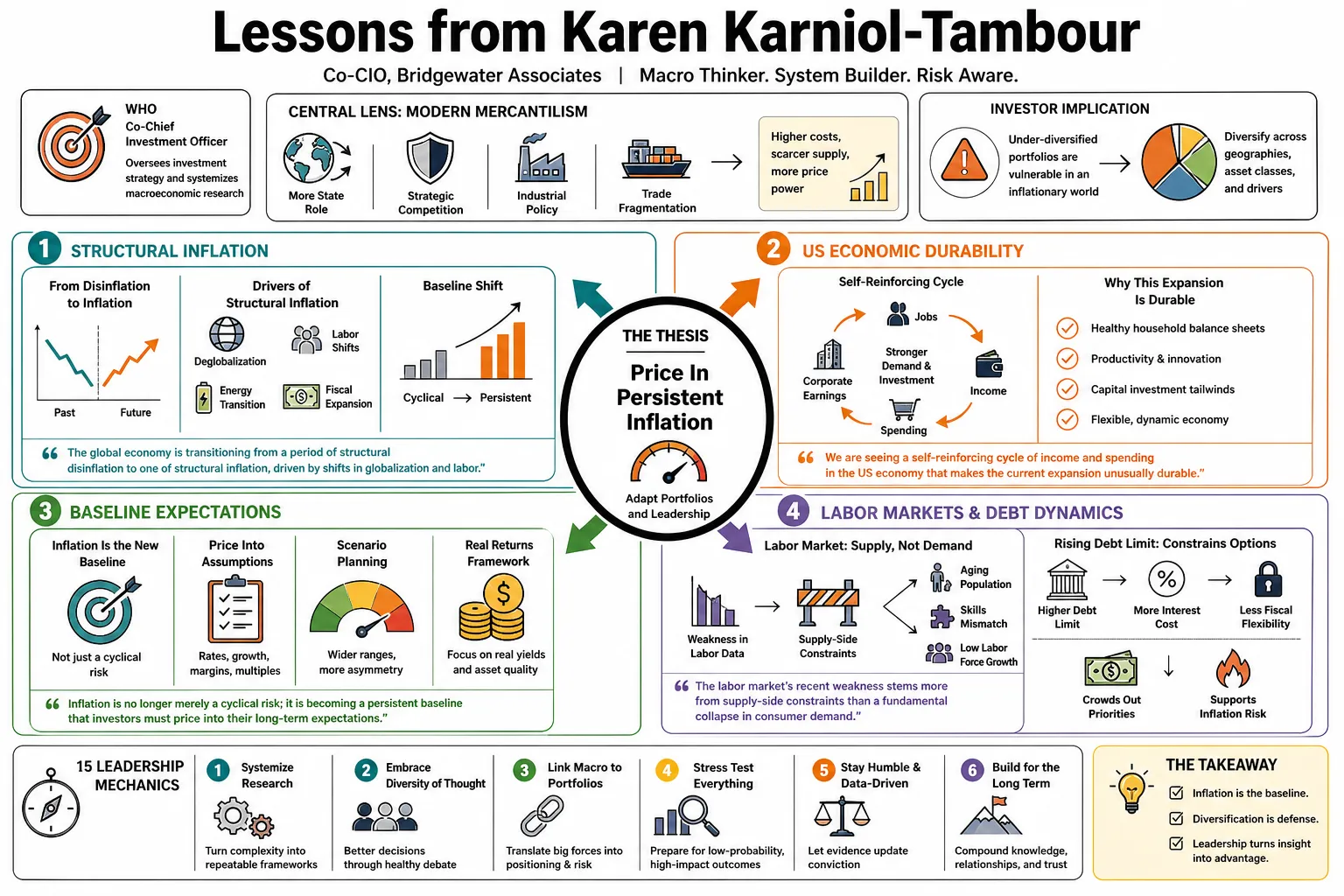
- On Structural Inflation: "The global economy is transitioning from a period of structural disinflation to one of structural inflation, driven by shifts in globalization and labor." — Source: [Bridgewater Daily Observations]
- On US Economic Durability: "We are seeing a self-reinforcing cycle of income and spending in the US economy that makes the current expansion unusually durable." — Source: [Goldman Sachs Interviews]
- On Baseline Expectations: "Inflation is no longer merely a cyclical risk; it is becoming a persistent baseline that investors must price into their long-term expectations." — Source: [Invest Like the Best Podcast]
- On Labor Markets: "The labor market’s recent weakness stems more from supply-side constraints than a fundamental collapse in consumer demand." — Source: [Bloomberg Markets]
- On Rising Debt Limits: "When debt levels rise to historic highs globally, the traditional levers of monetary policy become far more complex to operate." — Source: [Bridgewater Research]
- On Anchoring Bias: "Investors are still anchored to the macroeconomic reality of the 2010s, which leaves them vulnerable to the distinct pressures of the 2020s." — Source: [Sohn Investment Conference]
- On Central Bank Tradeoffs: "Central banks are facing a persistent tradeoff between controlling inflation and maintaining economic growth, a dynamic we haven't seen in decades." — Source: [The Wall Street Skinny]
- On the 60/40 Portfolio: "The traditional 60/40 portfolio was built for a deflationary environment and struggles when both equities and bonds sell off due to inflation shocks." — Source: [Invest Like the Best Podcast]
- On Fiscal Dominance: "Fiscal dominance is returning, meaning government spending patterns will increasingly drive market outcomes regardless of central bank actions." — Source: [Bridgewater Daily Observations]
- On Liquidity Linkages: "Understanding the linkages between fiscal deficits, liquidity, and asset prices is essential for navigating the next decade of macro markets." — Source: [Bloomberg Markets]
Part 2: Modern Mercantilism and Geopolitics
- On Modern Mercantilism: "We have entered an era of 'modern mercantilism,' where countries are prioritizing national security and supply chain resilience over pure economic efficiency." — Source: [Bridgewater Research]
- On Supply Chain Costs: "The push to close vulnerabilities in critical supply chains is a structural force that is inherently inflationary." — Source: [Bridgewater Daily Observations]
- On Economic Ecosystems: "The world is reorganizing into competing economic ecosystems, breaking down the decades-long trend of seamless globalization." — Source: [Invest Like the Best Podcast]
- On Industrial Policy: "Industrial policy has returned as a primary tool for governments seeking to secure access to technology and critical minerals." — Source: [Sohn Investment Conference]
- On Tail Risks: "Geopolitics is no longer merely a tail risk; it is a primary driver of capital flows and asset valuations." — Source: [Bloomberg Markets]
- On Onshoring Dynamics: "As nations onshore production to ensure resilience, the cost of manufacturing and goods fundamentally increases." — Source: [Bridgewater Research]
- On Geographic Diversification: "The decoupling of major global economies forces investors to treat geographic diversification as a necessity rather than an option." — Source: [The Wall Street Skinny]
- On Free-Market Limitations: "National security concerns are overriding free-market principles in sectors ranging from semiconductors to energy infrastructure." — Source: [Goldman Sachs Interviews]
- On Multipolarity: "The transition from a unipolar world to a multipolar world introduces sustained volatility into global supply networks." — Source: [Bridgewater Daily Observations]
- On Capital Allocation: "Capital allocation must now account for the reality that geopolitical alliances can dictate economic access overnight." — Source: [Invest Like the Best Podcast]
Part 3: Portfolio Construction and Concentration Risk
- On Overweighting Equities: "Most institutional portfolios are dangerously concentrated, heavily overweight in US equities and severely underweight in real assets." — Source: [Bridgewater Research]
- On Stress Testing: "The most vital tool for building a resilient portfolio is the discipline to consistently ask what could go wrong." — Source: [The Wall Street Skinny]
- On Outdated Models: "A portfolio built for the last forty years of falling interest rates is poorly equipped for a world of constrained resources and fragmented markets." — Source: [Sohn Investment Conference]
- On True Diversification: "True diversification requires finding assets that behave differently in response to inflation and growth shocks, not simply holding many different stocks." — Source: [Bridgewater Daily Observations]
- On Geographic Illusions: "Many investors mistake geographic concentration for safety, ignoring the systemic risks of relying entirely on one currency and economy." — Source: [Invest Like the Best Podcast]
- On Sizing Positions: "Protecting against extreme unknowns means deliberately sizing positions so that no single macroeconomic event can wipe out your capital." — Source: [Bloomberg Markets]
- On the New World Toolkit: "The 'old world' portfolio relies on equities for growth and bonds for defense; the 'new world' requires a much broader toolkit." — Source: [Goldman Sachs Interviews]
- On Widening the Aperture: "We must widen our aperture as investors to identify patterns and echoes across asset classes that traditional benchmarks miss." — Source: [Bridgewater Research]
- On Historical Bias: "Relying on the recent past as a template for portfolio construction is the greatest risk facing institutional investors today." — Source: [The Wall Street Skinny]
- On Economic Regimes: "Resilience is achieved by balancing exposure across different economic regimes: growth, inflation, deflation, and contraction." — Source: [Bridgewater Daily Observations]
Part 4: Real Assets, Commodities, and Gold
- On the Physical Asset Scramble: "There is a massive scramble for physical assets driven by the dual forces of AI infrastructure buildout and geopolitical resilience." — Source: [Bridgewater Research]
- On Gold as Money: "Gold is currently acting more akin to money than a traditional commodity, serving as a store of value amidst geopolitical and currency uncertainty." — Source: [Bloomberg Markets]
- On Portfolio Deficiencies: "The physical requirements of the coming decade—energy, industrial metals, and rare earths—represent a dangerously small fraction of most financial portfolios." — Source: [Invest Like the Best Podcast]
- On Commodity Themes: "Commodities are a specific thematic trade linked directly to deglobalization and the massive capital expenditure required for the energy transition." — Source: [Bridgewater Daily Observations]
- On Inflation Hedges: "While gold is a proven inflation hedge, other commodities must be evaluated based on the specific economic regime and supply dynamics." — Source: [Sohn Investment Conference]
- On Fiat Currency Pressures: "As fiat currencies face pressure from high debt burdens, gold's historical role as a non-liability asset becomes increasingly relevant." — Source: [Goldman Sachs Interviews]
- On Structural Demand Shocks: "The transition to green energy and independent supply chains guarantees a sustained, structural demand shock for industrial metals." — Source: [Bridgewater Research]
- On Differentiating Commodities: "Investors cannot simply buy a broad commodity index; they must differentiate between assets driven by consumption and those driven by strategic national interest." — Source: [The Wall Street Skinny]
- On Providing Ballast: "Real assets provide the essential ballast for a portfolio when financialized assets suffer from rising interest rates and inflation." — Source: [Bridgewater Daily Observations]
Part 5: Artificial Intelligence and Technology
- On the AI Buildout Phase: "We are currently in the massive infrastructure and buildout phase of the AI boom, which requires enormous physical resources." — Source: [Bridgewater Research]
- On Pricing Capex: "The market is aggressively pricing in the capex associated with AI, but the broader productivity and adoption phases remain highly uncertain." — Source: [Invest Like the Best Podcast]
- On Supply Chain Intersections: "AI's demand for energy and physical infrastructure directly intersects with our constrained global supply chains." — Source: [Bloomberg Markets]
- On Inflationary AI: "While AI promises deflationary productivity gains in the long run, the short-term capital investment required to build it is highly inflationary." — Source: [Bridgewater Daily Observations]
- On Machine Learning: "Systemizing research into trading strategies relies increasingly on machine learning, but it must be guided by fundamental economic logic." — Source: [Sohn Investment Conference]
- On Ultimate Winners: "The companies building AI infrastructure are currently capturing the value, but the ultimate winners will be those who seamlessly integrate it to transform traditional industries." — Source: [Goldman Sachs Interviews]
- On Quantitative Modeling: "Quantitative models can process vast amounts of data, but AI cannot replace the human necessity of asking the right structural questions." — Source: [The Wall Street Skinny]
- On Geopolitics and AI: "The intersection of AI capabilities and geopolitical competition will dictate the industrial policies of the next decade." — Source: [Bridgewater Research]
- On Differentiating Hype: "Investors must distinguish between the hype of AI adoption and the hard, physical reality of the data centers and power grids required to run it." — Source: [Bridgewater Daily Observations]
Part 6: Sustainable Investing and ESG
- On Economic Realities: "Sustainable investing cannot ignore the fundamental laws of macroeconomics; ESG goals must be analyzed through the lens of resource constraints." — Source: [Bridgewater Research]
- On Capital Reallocation: "The energy transition is one of the largest capital reallocation events in history, creating immense implications for inflation and commodity demand." — Source: [Invest Like the Best Podcast]
- On Exclusionary Screens: "Integrating ESG requires moving beyond simple exclusionary screens to deeply understanding the systemic risks posed by climate and governance factors." — Source: [Bloomberg Markets]
- On Transition Tensions: "There is an inherent tension between the speed required for the energy transition and the physical realities of mining and infrastructure development." — Source: [Goldman Sachs Interviews]
- On Environmental Constraints: "Environmental constraints are increasingly translating into hard economic constraints that directly impact corporate profitability and asset pricing." — Source: [Bridgewater Daily Observations]
- On Carbon Risk: "To effectively price carbon risk, investors must look at the entire supply chain, not just the final point of emission." — Source: [Sohn Investment Conference]
- On Corporate Governance: "Governance is often the most overlooked pillar of ESG, yet it serves as the most reliable predictor of long-term corporate resilience." — Source: [The Wall Street Skinny]
- On Transition Volatility: "Sustainable portfolios must be constructed to withstand the volatility of the transition period, which will inevitably involve energy price shocks." — Source: [Bridgewater Research]
- On Public and Private Sectors: "The transition to a sustainable economy is highly capital-intensive and will require unprecedented cooperation between the public and private sectors." — Source: [Invest Like the Best Podcast]
Part 7: Leadership and Decision Making
- On Intellectual Curiosity: "Intellectual curiosity and the willingness to ask tough questions are far more valuable than simply having a high IQ." — Source: [The Wall Street Skinny]
- On Lateral Thinking: "The ability to move fluidly between different areas of expertise allows you to see patterns that specialists often miss." — Source: [Goldman Sachs Interviews]
- On Objective Analysis: "Effective decision-making requires separating what you want to happen from what the data is actually signaling." — Source: [Bridgewater Daily Observations]
- On Crisis Management: "In times of crisis, the most important leadership trait is the discipline to reassess your baseline assumptions objectively." — Source: [Invest Like the Best Podcast]
- On World Mechanics: "Success in investing comes from being relentless in the pursuit of understanding how the world actually works." — Source: [Sohn Investment Conference]
- On Modeling Behavior: "You cannot build reliable models without first understanding the underlying economic and sociological mechanics of human behavior." — Source: [Bridgewater Research]
- On Diversity of Perspective: "Diversity of perspective in a team is a mechanical necessity for uncovering blind spots in complex markets." — Source: [Bloomberg Markets]
- On Questioning Consensus: "The best leaders cultivate an environment where questioning consensus is not only accepted but systematically expected." — Source: [The Wall Street Skinny]
- On Changing Your Mind: "Conviction is important, but the flexibility to change your mind when the structural reality shifts is what ensures survival." — Source: [Bridgewater Daily Observations]
Part 8: Bridgewater Culture and Career Journey
- On Joining Bridgewater: "I joined Bridgewater directly out of Princeton because I was drawn to the firm's relentless, almost obsessive approach to decoding global mechanics." — Source: [The Wall Street Skinny]
- On Her Academic Background: "My background in public and international affairs provided a sociological lens that is essential for understanding macroeconomic shifts." — Source: [Princeton Alumni Weekly]
- On Radical Transparency: "Bridgewater’s culture of radical transparency forces you to constantly pressure-test your ideas against some of the sharpest minds in the industry." — Source: [Invest Like the Best Podcast]
- On Becoming Co-CIO: "Transitioning from Head of Investment Research to Co-CIO required shifting from purely answering questions to deciding which questions mattered most." — Source: [Goldman Sachs Interviews]
- On Systematizing Research: "The firm's systemization of research ensures that individual insights are translated into repeatable, scalable investment logic." — Source: [Bridgewater Research]
- On Entering Finance: "I never intended to enter finance; my passion was understanding how the world worked, and macro investing turned out to be the ultimate expression of that." — Source: [The Wall Street Skinny]
- On Cause and Effect: "Working alongside founders like Ray Dalio teaches you that understanding the historical cause-and-effect of markets is more powerful than forecasting." — Source: [Bloomberg Markets]
- On Daily Observations: "Our daily observations are not merely market commentary; they are a living documentation of our collective attempt to map the global economy." — Source: [Bridgewater Daily Observations]
- On Embracing Discomfort: "The most defining aspect of my career has been learning to embrace the discomfort of being wrong in pursuit of getting to the right answer." — Source: [Sohn Investment Conference]