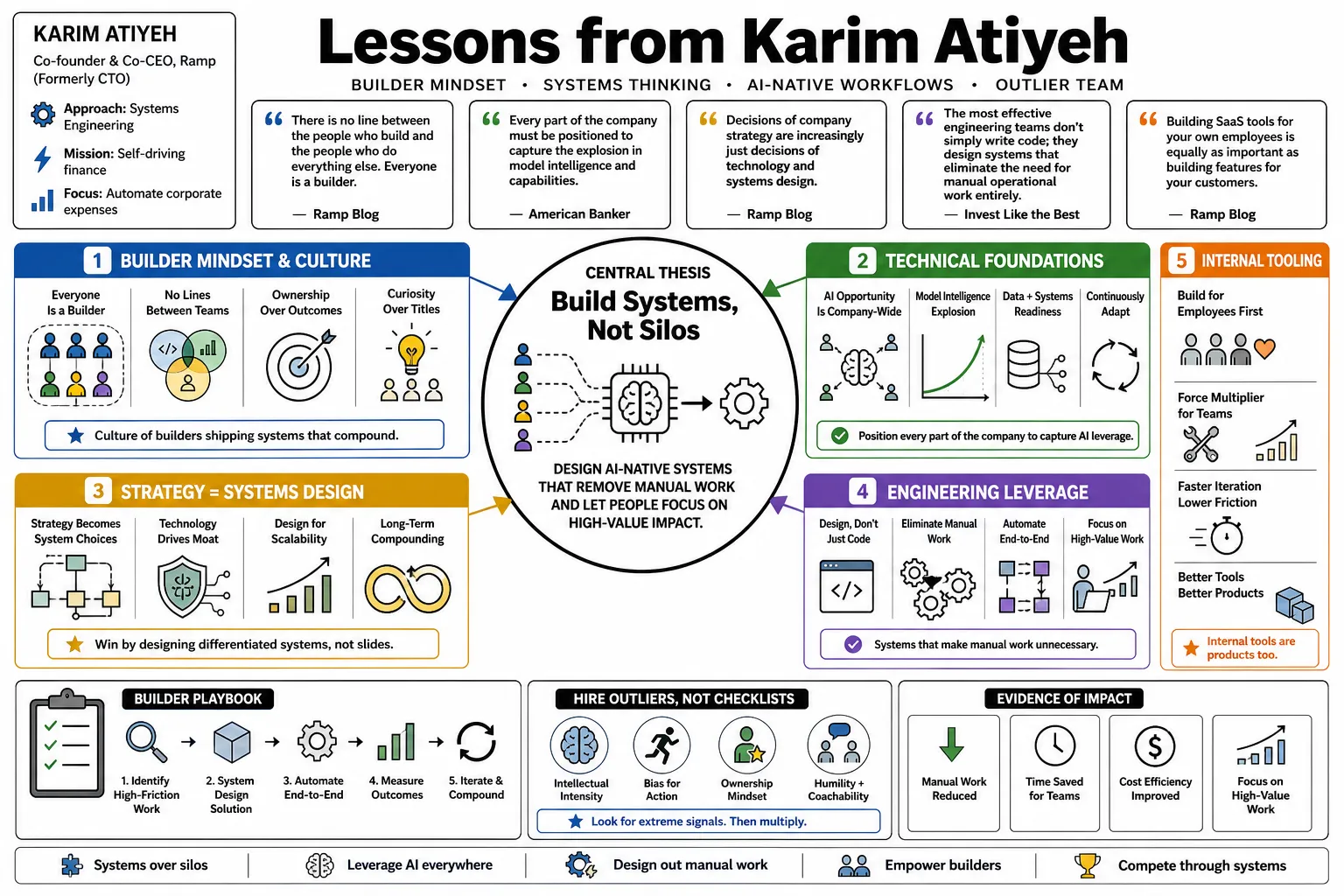
Lessons from Karim Atiyeh
Karim Atiyeh is the co-founder and Co-CEO of Ramp, where he originally served as CTO. He approaches business as a systems engineering problem, leading to Ramp's focus on automating corporate expenses through "self-driving finance." This profile outlines his thinking on asymmetric risk, AI-native workflows, and hiring for outlier traits.
Part 1: The Builder Mindset & Engineering Culture
- On Organizational Silos: "There is no line between the people who build and the people who do everything else. Everyone is a builder." — Source: Ramp Blog
- On Technical Foundations: "Every part of the company must be positioned to capture the explosion in model intelligence and capabilities." — Source: American Banker
- On Strategy vs. Systems: "Decisions of company strategy are increasingly just decisions of technology and systems design." — Source: Ramp Blog
- On Engineering Leverage: "The most effective engineering teams don't simply write code; they design systems that eliminate the need for manual operational work entirely." — Source: Invest Like the Best
- On Internal Tooling: "Building SaaS tools for your own employees is equally as important as building features for your customers." — Source: No Priors Podcast
- On Domain Expertise: "Technical founders have a distinct advantage today because they can bridge the gap between understanding an opaque industry and building the software to disrupt it." — Source: Invest Like the Best
- On the Engineering Mandate: "We view every manual internal process as a bug that engineering needs to fix." — Source: 8VC Fireside Chat
- On Problem Solving: "An engineer's job is not merely to build features, but to figure out the most efficient way to solve the customer's actual underlying problem." — Source: No Priors Podcast
- On Cross-Functional Teams: "We do not believe in having engineering sit separately from business teams; they have to sit together and share the exact same goals." — Source: Invest Like the Best
Part 2: Hiring, "Spikiness," and Team Building
- On Spikiness: "We explicitly hire for spikiness. We want people with extreme, outlier strengths in specific areas rather than well-rounded generalists." — Source: Invest Like the Best
- On Identifying Talent: "The best indicator of a great hire is someone who has demonstrated an obsession with mastering a very specific, difficult domain." — Source: Invest Like the Best
- On Generalists: "Well-rounded often means average at everything. We prefer assembling a team of complementary extremes." — Source: Ramp Blog
- On Interviewing: "When interviewing candidates, we dig relentlessly into their past projects to see if they actually built it or simply managed the people who built it." — Source: No Priors Podcast
- On Early Employees: "Your first twenty hires dictate the culture for the next two thousand. You cannot compromise on their baseline intensity." — Source: 8VC Fireside Chat
- On Performance Management: "High performers want to be surrounded by other high performers. Tolerating low performance is the fastest way to lose your best people." — Source: FII Institute
- On the Builder Trait: "We ask every candidate what they have built outside of their formal job description." — Source: Invest Like the Best
- On Onboarding: "We push new engineers to ship code to production on their first day to set the cadence for their entire tenure." — Source: Ramp Blog
- On Retaining Talent: "The best way to retain elite engineers is to give them hard, consequential problems and remove all administrative friction from their day." — Source: No Priors Podcast
- On Management: "Managers exist to unblock builders, rather than to direct them." — Source: Invest Like the Best
Part 3: Speed, Iteration, and Startup Velocity
- On Speed as Defense: "For a startup competing against incumbents, speed is no mere tactic; it is an existential necessity." — Source: Invest Like the Best
- On Decision Making: "A fast, decent decision is almost always better than a slow, perfect decision." — Source: No Priors Podcast
- On the Cost of Delay: "Every day a feature sits in staging is a day of lost feedback from the market." — Source: 8VC Fireside Chat
- On Iteration: "You have to be comfortable shipping something that embarrasses you slightly, as long as it solves the immediate problem." — Source: Ramp Blog
- On Scaling: "Maintaining a Day One mentality at scale requires actively fighting the natural corporate tendency to add approval layers." — Source: Invest Like the Best
- On Execution: "The gap between a good idea and a shipped product is where most startups die." — Source: FII Institute
- On Prioritization: "If you try to build everything at once, you will build nothing well. Pick one constraint and break it." — Source: No Priors Podcast
- On Feedback Loops: "The tighter you can make the loop between shipping code and hearing from a customer, the faster the company grows." — Source: Invest Like the Best
- On Risk Tolerance: "Move fast and break things, except when it touches money or risk. In those cases, you move deliberately and test exhaustively." — Source: Invest Like the Best
Part 4: Systems Engineering as a Business Model
- On Company Structure: "We treat the entire company, including marketing and sales, as a single systems-engineering problem." — Source: Invest Like the Best
- On Automation: "Any process that requires a human to copy data from one place to another is a failure of systems design." — Source: No Priors Podcast
- On Risk Management: "Risk is a data problem. If you build better data ingestion systems, you can underwrite customers that traditional banks ignore." — Source: Sacra
- On Marketing: "Marketing is a top-of-funnel engineering problem that requires optimization algorithms alongside creative copy." — Source: 8VC Fireside Chat
- On Sales Efficiency: "We instrument our sales team with internal tools so they spend their time talking to customers instead of updating CRMs." — Source: No Priors Podcast
- On Scaling Operations: "You cannot hire your way out of an operational bottleneck; you have to engineer your way out." — Source: Invest Like the Best
- On Data Infrastructure: "The foundation of a good financial product is a pristine, real-time data ledger." — Source: Sacra
- On Product Design: "Good systems design makes the correct user behavior the path of least resistance." — Source: Ramp Blog
- On Technical Debt: "Paying down technical debt is an investment in future velocity." — Source: No Priors Podcast
Part 5: "Self-Driving Finance" and Corporate Spend
- On the End Goal: "Our vision is self-driving finance, where software manages expenses so perfectly that the finance team rarely has to intervene." — Source: Invest Like the Best
- On Corporate Cards: "A corporate card should act as a software enforcement layer for company policy, rather than a simple payment mechanism." — Source: TechCrunch
- On Expense Reports: "Expense reports are an outdated concept. Transactions should be automatically reconciled the moment a card is swiped." — Source: Ramp Blog
- On Receipt Matching: "Forcing employees to manually upload receipts and match them to transactions is a massive waste of human capital." — Source: 8VC Fireside Chat
- On Finance Teams: "Finance professionals should spend their time analyzing capital allocation instead of chasing down ten-dollar coffee receipts." — Source: Invest Like the Best
- On Spend Visibility: "Real-time visibility into company spend fundamentally changes how executives make decisions." — Source: Sacra
- On Saving Money: "Most B2B software extracts money from customers; we built a product designed to actively reduce their expenses." — Source: Ramp Blog
- On Software vs. Banking: "We view ourselves as a software company that issues cards, instead of a bank with a software wrapper." — Source: Invest Like the Best
- On Vendor Management: "Automatically identifying duplicate SaaS subscriptions is low-hanging fruit for saving companies money." — Source: No Priors Podcast
- On the Future of Accounting: "The general ledger will eventually update itself in real-time without human data entry." — Source: 8VC Fireside Chat
Part 6: Integrating AI and Large Language Models
- On AI Agents: "We are deploying AI agents to handle complex multi-step workflows like invoice processing and contract negotiation." — Source: No Priors Podcast
- On Internal AI Use: "We use LLMs to summarize sales calls and automatically generate internal podcasts for our product teams to review." — Source: No Priors Podcast
- On AI Pragmatism: "Do not use AI for the sake of using AI. Use it only when it materially reduces friction for the end user." — Source: 8VC Fireside Chat
- On Unstructured Data: "Language models are incredibly effective at extracting structured accounting data from messy PDF invoices." — Source: Invest Like the Best
- On Copilots: "An AI copilot in finance should execute actions on behalf of the user instead of merely answering questions." — Source: Ramp Blog
- On AI Reliability: "When AI touches money, it cannot hallucinate. We build deterministic guardrails around probabilistic models." — Source: Invest Like the Best
- On Prompt Engineering: "Writing good prompts is becoming a baseline engineering skill, akin to writing good SQL." — Source: No Priors Podcast
- On AI in Customer Support: "LLMs allow us to resolve the majority of customer support tickets instantly and accurately without human intervention." — Source: 8VC Fireside Chat
- On Model Agnosticism: "We design our infrastructure to easily swap out underlying LLMs as new, superior models are released." — Source: No Priors Podcast
- On the AI Advantage: "Startups that natively integrate AI into their core architecture will outmaneuver incumbents trying to bolt it onto legacy systems." — Source: Invest Like the Best
Part 7: Asymmetric Risks and Early Entrepreneurship
- On Consumer Frustration: "I like to think of myself as a smart shopper, but I kept seeing these price fluctuations and I couldn't shake the feeling that I was getting scammed." — Source: Harvard Innovation Labs
- On Founding Paribus: "The initial idea for Paribus came from a simple desire to automate the tedious process of claiming retail price drop refunds." — Source: TechCrunch
- On Asymmetric Risk: "Build your career by taking asymmetric risks where the downside is capped but the upside is virtually limitless." — Source: Ramp Blog
- On College Startups: "Starting a company while in school is the ultimate asymmetric risk because your worst-case scenario is simply graduating with a degree." — Source: Ramp Blog
- On Early Rejection: "You have to get comfortable with smart people telling you your idea will never work." — Source: FII Institute
- On Choosing Co-founders: "Partner with someone who complements your technical skills with equal intensity in sales and operations." — Source: Invest Like the Best
- On First Products: "The first version of your product should be held together by duct tape if it means getting it into users' hands faster." — Source: No Priors Podcast
- On Capital One: "Selling Paribus to Capital One taught us how massive financial institutions operate at scale, which directly informed how we built Ramp." — Source: Invest Like the Best
- On Persistence: "Startups are a test of stamina. The ones who win are usually just the ones who refused to quit when things got hard." — Source: FII Institute
Part 8: Product Strategy and the "Divinely Discontent" Mindset
- On Divinely Discontent: "We operate with a divinely discontent mindset. No matter how good the product gets, we obsess over the remaining flaws." — Source: Invest Like the Best
- On Bifurcated Strategy: "Things that touch money must be built perfectly. Everything else should iterate fast, even if it breaks." — Source: Invest Like the Best
- On Product Interfaces: "The best interface is often no interface at all. The system should just do the work quietly in the background." — Source: Ramp Blog
- On Customer Requests: "Customers will tell you what hurts, but they rarely know the best technical solution to fix it." — Source: No Priors Podcast
- On Feature Bloat: "Adding features is easy, but removing them is hard. We aggressively prune the product to keep it intuitive." — Source: 8VC Fireside Chat
- On B2B Software: "Enterprise tools do not have to be ugly and hard to use. We design them with consumer-grade aesthetics." — Source: Invest Like the Best
- On Pricing Strategy: "If your software actually saves the customer money, the pricing model justifies itself immediately." — Source: Sacra
- On Competitors: "We do not look at competitors to see what to build next. We look at our customers' most manual workflows." — Source: Ramp Blog
- On Long-term Vision: "We are trying to rewrite the operating system for modern businesses, rather than building a marginally better corporate card." — Source: Invest Like the Best