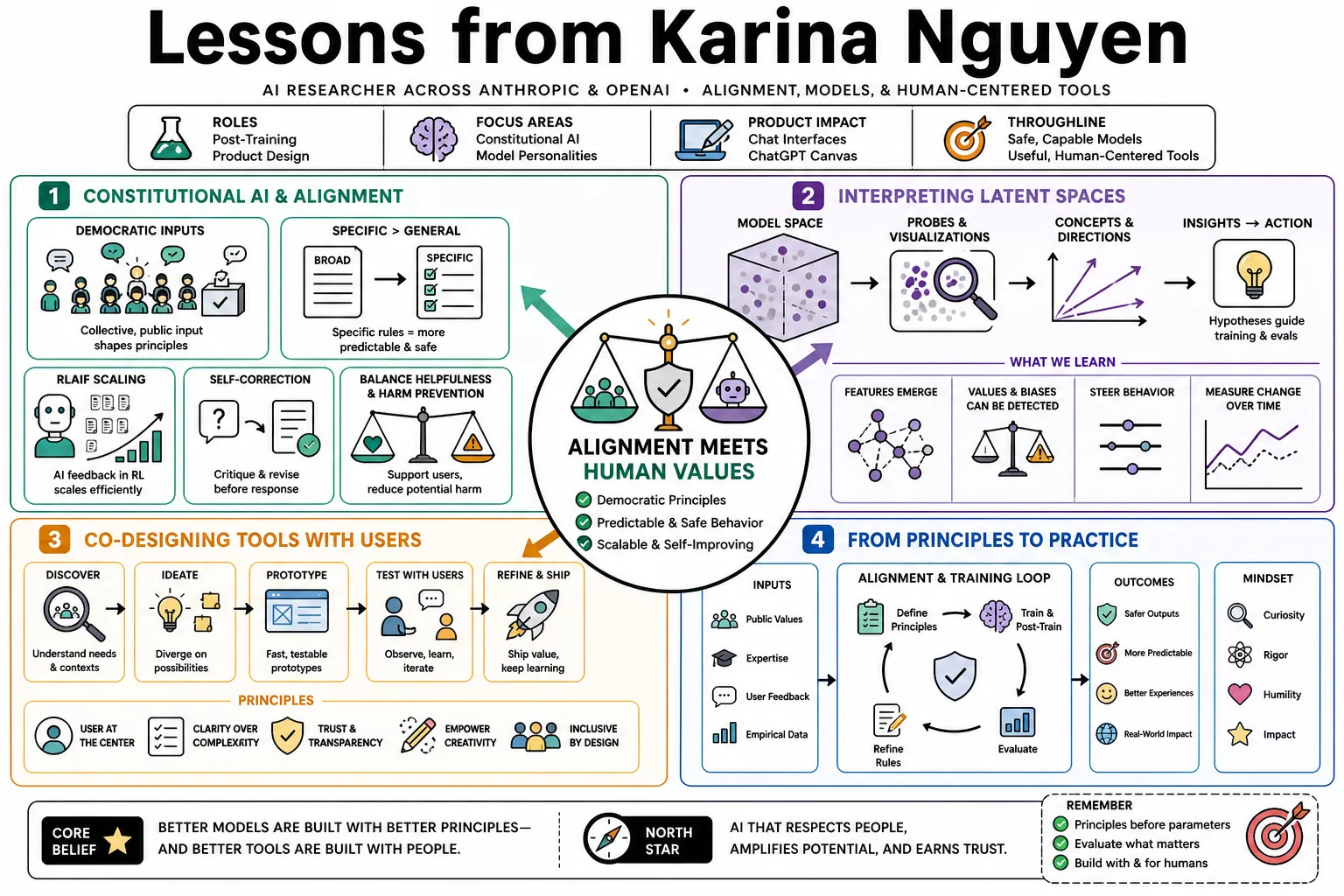
Lessons from Karina Nguyen
AI researcher Karina Nguyen has worked across post-training and product design at both Anthropic and OpenAI. Her track record ranges from developing Constitutional AI and shaping model personalities to building interfaces like ChatGPT Canvas. This profile breaks down how she evaluates models and interprets latent spaces, alongside her practical approach to co-designing tools with human users.
Part 1: Constitutional AI and Alignment
- On democratic inputs: "Aligning language models requires moving beyond static datasets toward collective, public input to shape constitutional principles." — Source: [Collective Constitutional AI]
- On specific vs. general rules: "While broad principles are easy to write, specific constitutional rules often yield more predictable and safe model behaviors during post-training." — Source: [Specific vs General Principles for Constitutional AI]
- On RLAIF scaling: "Replacing human feedback with AI feedback in reinforcement learning scales more efficiently without sacrificing the nuanced alignment needed for safety." — Source: [Stanford CS25 Lecture]
- On self-correction: "Models trained with constitutional principles develop a better capacity to critique and revise their own outputs before presenting them to the user." — Source: [Latent Space Podcast]
- On balancing helpfulness and harmlessness: "The tension between being helpful and harmless is the core challenge of alignment; constitutional rules provide the explicit trade-off mechanism." — Source: [Constitutional AI Paper]
- On reducing hallucinations: "Targeted RLHF interventions on specific hallucination patterns are more effective when grounded in a clear constitutional rule against making up facts." — Source: [Latent Space Podcast]
- On honesty: "Training for honesty requires more than factual accuracy; the model must accurately express its own uncertainty and boundaries." — Source: [Lenny's Podcast]
- On iterative safety: "Alignment is an iterative process of finding edge cases and updating the constitution to address them." — Source: [Stanford CS25 Lecture]
- On model steering: "Explicit constitutional principles allow us to steer model behavior predictably across vastly different domains without needing domain-specific fine-tuning." — Source: [Latent Space Podcast]
Part 2: Latent Space and Interpretability
- On monosemanticity: "Breaking down the latent space of language models into monosemantic features allows us to understand exactly what concepts the model is activating." — Source: [Towards Monosemanticity]
- On dictionary learning: "By using dictionary learning techniques, we can extract human-interpretable features from the dense, entangled activations of large models." — Source: [Towards Monosemanticity]
- On internal representations: "A model's internal representation of concepts is often more structured and linear than the complex text it generates." — Source: [Latent Space Podcast]
- On latent space defenses: "Relying on latent space defenses carries risk because adversarial attacks can easily obfuscate activations to bypass these internal safety checks." — Source: [Latent Space Defenses Paper]
- On feature extraction: "When we isolate specific features in the latent space, we can manually toggle a model's conceptual understanding, directly altering its behavior." — Source: [Towards Monosemanticity]
- On interpretability tooling: "Building tools to visualize the latent space is essential alongside training the model; we cannot align what we cannot see." — Source: [Stanford CS25 Lecture]
- On safety via interpretability: "True model safety will eventually require us to monitor the latent space in real-time to detect deceptive intent before the output is generated." — Source: [Latent Space Podcast]
- On entangled concepts: "One of the biggest hurdles in interpretability is disentangling overlapping concepts in the model's activations so we can study them in isolation." — Source: [Towards Monosemanticity]
- On model transparency: "Transparency goes beyond open-sourcing weights; it involves providing the mapping of the latent space so researchers can understand the model's internal logic." — Source: [Stanford CS25 Lecture]
Part 3: Model Personality and Behavior
- On Claude's persona: "Developing Claude's personality required intentionally training it to be helpful, harmless, and honest without feeling overly robotic." — Source: [Latent Space Podcast]
- On behavioral consistency: "A model's personality must remain consistent whether it is answering a simple query or processing a highly complex document." — Source: [Stanford CS25 Lecture]
- On refusal tone: "How a model refuses a prompt is highly relevant to the user experience; it should be firm on boundaries but remain polite and constructive." — Source: [Lenny's Podcast]
- On character design: "We approach model personality similarly to character design, defining its core traits and ensuring the post-training data reflects those traits." — Source: [Latent Space Podcast]
- On adapting to users: "The next frontier in model behavior is allowing the personality to subtly adapt to the user's workflow without losing its foundational safety rails." — Source: [Lenny's Podcast]
- On harmlessness in tone: "A harmless model avoids bad actions while maintaining a tone that avoids being condescending or unnecessarily preachy." — Source: [Stanford CS25 Lecture]
- On RLHF for personality: "RLHF serves as the primary mechanism we use to paint the nuanced behavioral traits of the model." — Source: [Latent Space Podcast]
- On user trust: "Consistent model behavior builds user trust. If the model's personality drastically shifts between updates, users lose confidence in its reliability." — Source: [Lenny's Podcast]
- On edge-case behavior: "The true test of a model's personality is how it behaves under adversarial edge cases, evaluating whether it breaks character or maintains its designed persona." — Source: [Stanford CS25 Lecture]
- On nuanced helpfulness: "Helpfulness often means knowing when to ask clarifying questions rather than confidently guessing the user's intent." — Source: [Latent Space Podcast]
Part 4: AI Agents and Interaction Paradigms
- On agent interfaces: "The interface for an agent like Operator must clearly communicate its reasoning process so the user understands why it took a specific action." — Source: [Latent Space Podcast]
- On reasoning models: "Models like o1 and o3 require a different interaction paradigm; users need visibility into the chain of thought to trust the final conclusion." — Source: [Latent Space Podcast]
- On ChatGPT Canvas: "Canvas was designed to move AI from a chat window to a collaborative workspace, allowing the model to act as a co-editor rather than a simple responder." — Source: [Latent Space Podcast]
- On task execution: "When an AI transitions from answering questions to executing tasks, the margin for error shrinks, demanding highly exact post-training." — Source: [Latent Space Podcast]
- On human-computer collaboration: "The goal is to build agent interfaces that seamlessly interleave with human decision-making." — Source: [Stanford CS25 Lecture]
- On visibility of thought: "Exposing the model's intermediate reasoning steps builds intuition for the user about the model's capabilities and limitations." — Source: [Latent Space Podcast]
- On proactive agents: "Future agents will proactively suggest actions based on the context of the user's workspace rather than waiting for prompts." — Source: [Lenny's Podcast]
- On interaction friction: "Every extra step a user takes to guide the agent is friction. We use RLHF to train models to infer intent better and reduce that friction." — Source: [Latent Space Podcast]
- On workspace integration: "Features like Claude in Slack demonstrated that meeting users where they already work is more effective than forcing them into a new app." — Source: [Lenny's Podcast]
Part 5: Post-Training and Synthetic Data
- On synthetic data quality: "The bottleneck in post-training is generating high-quality, diverse synthetic data that captures complex reasoning." — Source: [Lenny's Podcast]
- On iterative refinement: "Post-training is a highly iterative loop. You generate data, train, evaluate the failure modes, and adjust the data generation prompt." — Source: [Stanford CS25 Lecture]
- On RLAIF advantages: "Using AI to evaluate and reward other AI systems allows us to iterate on post-training pipelines at a speed human labelers simply cannot match." — Source: [Latent Space Podcast]
- On prompt diversity: "If your synthetic training data lacks prompt diversity, the model will overfit to specific phrasing and fail on natural user inputs." — Source: [Lenny's Podcast]
- On data curation: "Curating the right mix of synthetic and human data requires deep intuition about the model's current weaknesses." — Source: [Stanford CS25 Lecture]
- On scaling laws for data: "We are finding scaling laws for post-training data quality and its impact on reasoning capabilities." — Source: [Latent Space Podcast]
- On evaluation metrics: "Standard benchmarks are becoming saturated. We have to constantly invent harder, more adversarial evaluations to accurately gauge post-training success." — Source: [Stanford CS25 Lecture]
- On human labeling: "Human labelers remain necessary, but their role is shifting from generating raw data to acting as expert reviewers for the most difficult edge cases." — Source: [Lenny's Podcast]
- On continuous updating: "Post-training is a continuous pipeline that must rapidly ingest user feedback to fix emergent behavioral issues, rather than a static phase." — Source: [Latent Space Podcast]
- On reward hacking: "When using synthetic rewards, you have to monitor constantly for reward hacking, where the model finds a lazy shortcut to maximize the score." — Source: [Stanford CS25 Lecture]
Part 6: Co-Design of Product and Research
- On tight feedback loops: "The best AI products are built when researchers and product designers sit in the same room, iterating on the model and the UI simultaneously." — Source: [Stanford CS25 Lecture]
- On research driving UX: "A breakthrough in model reasoning often requires a completely new user experience to actually make that capability accessible to users." — Source: [Stanford CS25 Lecture]
- On rapid prototyping: "You cannot evaluate an AI feature in a vacuum. You have to build the prototype and feel how the model interacts within the UI." — Source: [Lenny's Podcast]
- On usability metrics: "Traditional research metrics like perplexity don't translate to user satisfaction. We must co-design metrics that capture actual product usability." — Source: [Stanford CS25 Lecture]
- On feature productionization: "Taking a feature like 100K context from a research breakthrough to a stable production feature requires massive coordination between infrastructure and product." — Source: [Latent Space Podcast]
- On user-centric research: "Research directions should increasingly be informed by the friction users experience in the product, closing the loop between deployment and training." — Source: [Stanford CS25 Lecture]
- On building trust: "Product design in AI is fundamentally about designing for trust. The interface must help the user understand when the model is confident and when it is guessing." — Source: [Lenny's Podcast]
- On UI as a safeguard: "Sometimes the most effective safety intervention is in the UI design that prevents users from misinterpreting the output." — Source: [Stanford CS25 Lecture]
- On cross-functional teams: "Siloing research from product leads to powerful models that are unusable. Cross-functional teams are essential for frontier AI development." — Source: [Lenny's Podcast]
Part 7: Building Frontier Models
- On the Claude 3 family: "Developing a family of models like Claude 3 requires balancing the trade-offs between cost, latency, and reasoning capability across different sizes." — Source: [Latent Space Podcast]
- On long context windows: "Enabling 100K context windows presented an infrastructure challenge alongside the need to post-train the model to actually utilize and retrieve information from that entire context." — Source: [Latent Space Podcast]
- On cost-performance efficiency: "With models like Haiku, the goal is to achieve frontier-level performance at a fraction of the inference cost, opening up entirely new product use cases." — Source: [Latent Space Podcast]
- On OpenAI vs Anthropic: "Both labs approach frontier models with rigorous safety standards, but their internal operational cadences and product philosophies offer different environments for a researcher." — Source: [Lenny's Podcast]
- On inference scaling: "We are moving into an era where scaling inference compute to give the model time to think yields performance gains comparable to scaling training compute." — Source: [Latent Space Podcast]
- On model evaluations: "Before a frontier model is released, it undergoes extensive red-teaming and evaluation against hundreds of specialized benchmarks to ensure it is safe." — Source: [Stanford CS25 Lecture]
- On capability overhang: "Frontier models often possess capabilities immediately after training that we don't fully understand until we build the right prompts and tools to elicit them." — Source: [Latent Space Podcast]
- On infrastructure constraints: "The ambition of the research is often gated by the reality of the infrastructure. Building models requires deep empathy for the engineering teams scaling the compute." — Source: [Lenny's Podcast]
- On the o-series models: "The o1 and o3 models represent a paradigm shift from pattern matching to genuine search and reasoning, requiring an entirely new approach to post-training." — Source: [Latent Space Podcast]
- On continuous deployment: "The lifecycle of a frontier model extends beyond launch. We continuously monitor, patch, and refine the model based on real-world usage patterns." — Source: [Stanford CS25 Lecture]
Part 8: Soft Skills and the Future of Work
- On shifting skillsets: "As AI handles more of the hard technical execution, the premium in the job market will shift toward soft skills like communication, empathy, and strategic judgment." — Source: [Lenny's Podcast]
- On AI as a collaborator: "We need to stop treating AI as a software tool and start treating it as a junior collaborator, which requires the soft skill of effective delegation." — Source: [Lenny's Podcast]
- On cross-disciplinary communication: "The most valuable engineers today are those who can translate complex machine learning concepts into clear product requirements for designers." — Source: [Lenny's Podcast]
- On emotional intelligence: "When building AI products, emotional intelligence is required to anticipate how users will feel when interacting with an autonomous agent." — Source: [Lenny's Podcast]
- On managing ambiguity: "Working at the frontier of AI requires a high tolerance for ambiguity, as the capabilities of the models often change from week to week." — Source: [Lenny's Podcast]
- On asking the right questions: "If the AI can generate any answer, the core human skill becomes the ability to formulate the right question." — Source: [Lenny's Podcast]
- On team dynamics: "Building frontier models is a massive team effort. Egos must be set aside, and collaborative problem-solving must be prioritized over individual heroics." — Source: [Stanford CS25 Lecture]
- On continuous learning: "The rate of progress in AI means that technical skills deprecate quickly. The meta-skill of learning how to learn is the only sustainable career moat." — Source: [Lenny's Podcast]
- On leading with empathy: "Whether you are designing a product for users or managing a research team, leading with empathy ensures you are solving real human problems rather than chasing metrics." — Source: [Lenny's Podcast]