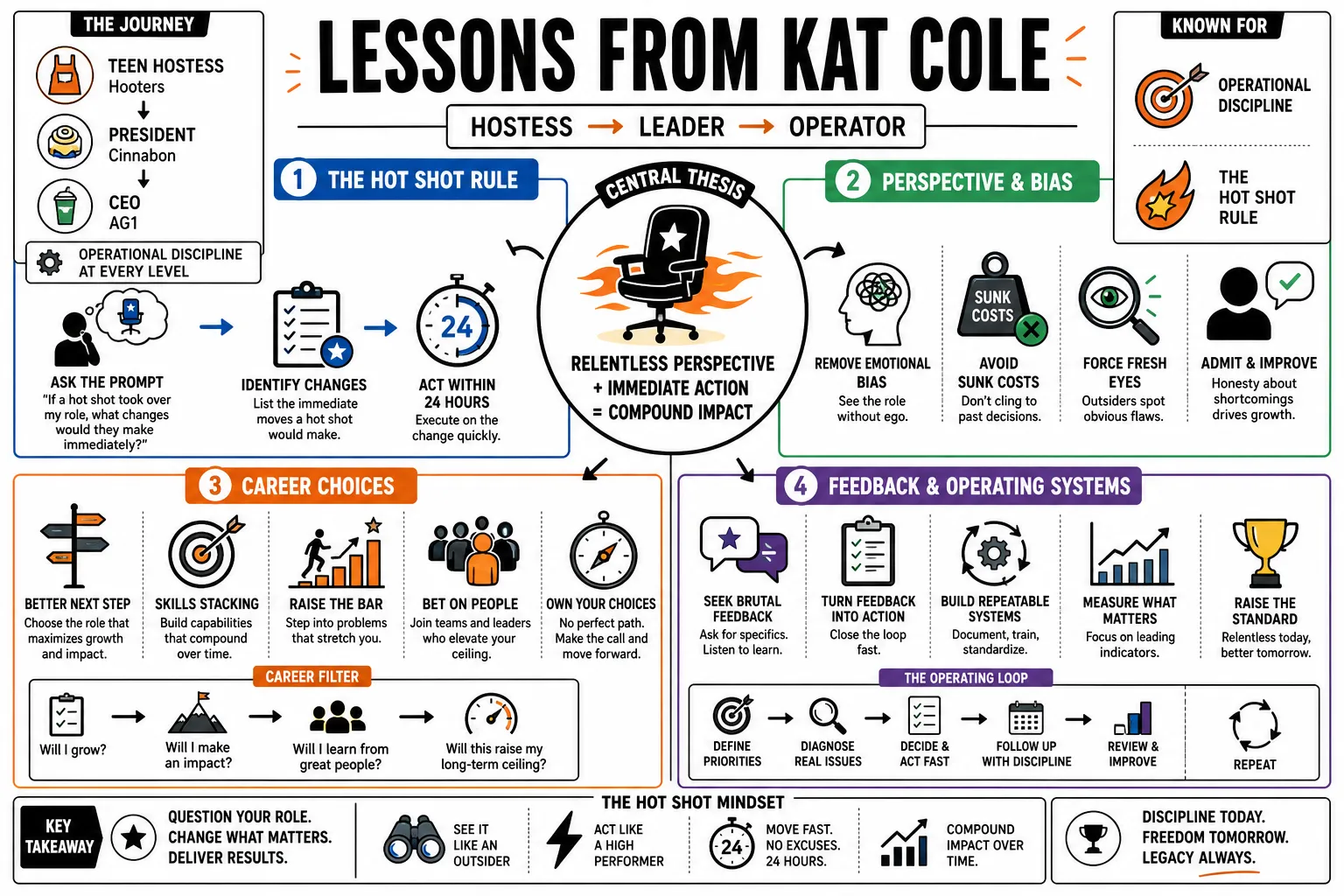
Lessons from Kat Cole
Kat Cole started as a teenage hostess at Hooters and eventually became President of Cinnabon and CEO of AG1. She is known for her operational discipline and the "Hot Shot Rule," a tactic to beat complacency by viewing your job through the eyes of a high-performing replacement. This profile breaks down her practical models for making career choices, handling feedback, and running businesses.
Part 1: The Hot Shot Rule and Perspective
- On the Hot Shot Rule: "If a hot shot took over my role, what changes would they make immediately? Why have I not already made those changes myself?" — Source: [Chief]
- On immediate action: "The power of the Hot Shot Rule is lost without taking action; you must execute on the identified change within twenty-four hours." — Source: [Checking In Substack]
- On overcoming bias: "Envisioning someone else in your seat removes the emotional bias and sunk costs that cloud your decision-making." — Source: [Checking In Substack]
- On fresh eyes: "Proximity to a problem breeds comfort, making it necessary to force an outsider's perspective to see obvious flaws." — Source: [National CIO Review]
- On admitting fault: "Answering the Hot Shot prompt honestly requires admitting that you have been tolerating suboptimal conditions in your own domain." — Source: [Inc]
- On continuous improvement: "Regular reflection prevents the slow creep of complacency that happens when things are going reasonably well." — Source: [Learning Leader]
- On shifting viewpoint: "When you step outside yourself to judge your work, the solutions to your biggest roadblocks often become immediately apparent." — Source: [Checking In Substack]
- On questioning success: "It is equally important to audit your successes as your failures to ensure results are driven by leadership rather than favorable conditions." — Source: [Knowledge Project]
- On self-awareness: "The single biggest hack for getting stronger in business is the simple act of checking in with yourself to audit your own performance." — Source: [Checking In Substack]
Part 2: Humility and Courage
- On productive achievement: "Effective leadership requires balancing two polarities: the courage to make tough calls and the humility to listen to others." — Source: [Business Insider]
- On using your voice: "I've learned to not confuse having a seat at the table with having and using my voice. If I don't question things, who will?" — Source: [Adam Mendler]
- On being a student: "No matter your title, you must remain a student of your customers, your competitors, and your investors." — Source: [Business Insider]
- On the limits of humility: "Humility becomes a liability if it prevents you from exercising the authority and decisiveness your position requires." — Source: [Knowledge Project]
- On questioning the room: "If you are the leader, it is your responsibility to challenge the consensus, even if you are the least experienced person present." — Source: [Knowledge Project]
- On waiting for permission: "If you don't use your voice, there's someone waiting behind you who will." — Source: [The Chief Storyteller]
- On standing your ground: "Courage means ignoring peripheral opinions to focus entirely on what actually moves the needle for the business." — Source: [Learning Leader]
- On humanizing leadership: "For whatever reason, very early on, it felt smart to share something personal so that people could see me as a person instead of just the boss." — Source: [Forbes]
- On maintaining perspective: "True confidence is rarely brash; it is quiet, grounded, and always paired with a deep curiosity about what you might be getting wrong." — Source: [Checking In Substack]
Part 3: Action and Confidence
- On building confidence: "Confidence does not precede action; rather, the capacity to lead is built specifically through taking action." — Source: [National CIO Review]
- On readiness: "I said yes to opportunity long before I was technically ready, but had the hustle muscle to figure things out along the way." — Source: [Adam Mendler]
- On the rep of action: "You do not need to feel ready to start a new role, because taking the first steps will generate the competence you lack." — Source: [Checking In Substack]
- On hustle muscle: "The ability to figure things out on the fly is a far more valuable asset than a perfectly curated resume." — Source: [Adam Mendler]
- On early opportunities: "Volunteering for every available task, even those outside your job description, is the fastest way to build operational knowledge." — Source: [GoRick]
- On hesitation: "Waiting until you feel fully qualified guarantees that you will miss the window of opportunity entirely." — Source: [Inc]
- On momentum: "Action creates a feedback loop; doing the work generates the data you need to correct your course and proceed with certainty." — Source: [Checking In Substack]
- On figuring it out: "Being scrappy and resourceful can compensate for a lack of formal training in almost any business environment." — Source: [Knowledge Project]
- On jumping into the breach: "Filling the organizational gaps that others ignore naturally positions you as an indispensable leader." — Source: [GoRick]
Part 4: Feedback and Criticism
- On assuming correctness: "Anytime you are criticized, assume first it's correct. Just allow yourself to digest that and then respond." — Source: [Knowledge Project]
- On digesting feedback: "Bypassing defensiveness allows you to look objectively at negative feedback and decide if you want to alter your path." — Source: [Knowledge Project]
- On the grain of truth: "Even in the most poorly delivered or unfair criticism, there is usually a small fact that you can use to improve your operation." — Source: [Learning Leader]
- On information vacuums: "In the absence of alternative information, people come to their own conclusions. Fill the information vacuum with perspective and empathetic explanations before they do with inaccurate stories." — Source: [Checking In Substack]
- On taking accountability: "When you let someone down, you should make a bigger deal out of the mistake than they do to prove that you genuinely care." — Source: [Checking In Substack]
- On making amends: "Apologies must be followed by tangible actions that address what is redeemable about the situation." — Source: [Checking In Substack]
- On self-correction: "A leader's job is not to be perfect from the start, but to be the fastest person in the room to recognize and correct a mistake." — Source: [Forbes]
- On external perspectives: "Listening to stakeholders who are angry with you often yields the most accurate roadmap for fixing your product." — Source: [Knowledge Project]
- On customer service judo: "You can take a customer's frustrated energy and play it back to them constructively to build deep loyalty." — Source: [YouTube]
- On removing ego: "Defending your initial position wastes time that could be spent implementing the solution hidden within the critique." — Source: [Learning Leader]
Part 5: Navigating Career Choices
- On the three buckets: "When evaluating career options, judge them against three separate categories: Money, Ego and Optics, and Capabilities." — Source: [Checking In Substack]
- On financial compensation: "You must be honest with yourself about your financial baseline and whether a new role meets your actual economic needs." — Source: [Checking In Substack]
- On ego and optics: "Acknowledge how a job title or company brand appeals to your pride, so you can separate that feeling from the actual work." — Source: [Checking In Substack]
- On capabilities and learning: "The most critical bucket is evaluating what new skills you will learn and what existing strengths you can put to work." — Source: [Checking In Substack]
- On making intentional choices: "Discuss the three buckets in isolation, then blend them together to map out a clear, rational career decision." — Source: [Checking In Substack]
- On non-traditional paths: "Rising from a hostess to an executive proves that non-linear career trajectories can offer distinct advantages over traditional corporate ladders." — Source: [Forbes]
- On doing the unglamorous work: "True professional growth often happens when you take on the tedious, overlooked tasks that keep the business running." — Source: [GoRick]
- On becoming indispensable: "If you consistently solve the problems that others avoid, leadership will eventually have no choice but to promote you." — Source: [GoRick]
- On experience vs resourcefulness: "Companies overvalue prior experience when they should be selecting for a candidate's proven ability to adapt and learn quickly." — Source: [Adam Mendler]
- On outgrowing situations: "If a role no longer offers new capabilities to learn, it may be time to transition, regardless of the money or title." — Source: [Checking In Substack]
Part 6: Building Culture and Teams
- On questions vs answers: "As organizations scale, answers stop being effective; only teaching your team how to ask the right questions will scale properly." — Source: [Masters of Scale]
- On checking in: "Regularly checking in with your team builds the necessary trust to handle future crises without fracturing." — Source: [Checking In Substack]
- On proximity to the frontline: "The best ideas for improving a business always come from the employees who interact directly with the customers." — Source: [Knowledge Project]
- On finding the friction: "A leader must constantly search for areas of resistance within the company and eliminate them to boost overall productivity." — Source: [Checking In Substack]
- On culture as offense: "Company culture is not a soft metric; it is a strategic lever that should be used as both an offensive and defensive tool." — Source: [Checking In Substack]
- On stay interviews: "Instead of waiting for an exit interview, regularly ask your top performers what keeps them at the company and what might cause them to leave." — Source: [Checking In Substack]
- On empowering advice: "Employees will remain highly engaged if they see that their feedback directly influences the direction of the company." — Source: [YouTube]
- On team alignment: "You align a group not by dictating terms, but by ensuring everyone understands the underlying logic of the strategy." — Source: [Checking In Substack]
- On the ask, answer, act formula: "When entering a new role, you must ask the right questions, answer them without bias, and act immediately on the findings." — Source: [Knowledge Project]
Part 7: Brand and Customer Experience
- On the definition of a brand: "A brand is nothing more than a consistent promise delivered over time through actual customer experiences." — Source: [YouTube]
- On the intersection of commerce and community: "Modern businesses only thrive when they build a genuine community around the product they are selling." — Source: [YouTube]
- On fixing unit-level economics: "The business was in such bad shape, all I needed to do was start shining a light in the dark. The product was amazing, the only thing that was wrong was the unit-level economics." — Source: [AirTree]
- On the true truth of a business: "You have to strip away the marketing metrics and corporate spin to understand how the business actually functions at its core." — Source: [Learning Leader]
- On losing trust: "Outside of losing a life or a loved one, there is nothing worse for a company than losing the trust of its customers." — Source: [YouTube]
- On legacy vs innovation: "Great brands know how to honor the history that built their trust while finding the courage to break tradition for future growth." — Source: [YouTube]
- On transparency: "Admitting flaws to your customers builds more long-term brand equity than pretending the product is perfect." — Source: [Forbes]
- On consistent promises: "If a brand scales without maintaining the quality of its core promise, it will eventually collapse under its own weight." — Source: [YouTube]
- On product fundamentals: "A beloved brand cannot survive bad math; you must fix the fundamental economics before you attempt to scale the marketing." — Source: [AirTree]
Part 8: Personal Growth and Resilience
- On the dark side of gratitude: "Gratitude can become a trap if it convinces you to remain in a stagnant situation simply because you feel lucky to be there." — Source: [Knowledge Project]
- On reframing failure: "Treat the word FAIL as an acronym for First Attempt In Learning to permanently remove the fear of making mistakes." — Source: [Checking In Substack]
- On past vs future: "Don't forget where you came from, but don't you dare ever let it solely define you. Your truth is in your roots, but your past is not your anchor." — Source: [Checking In Substack]
- On self-definition: "When we get our sense of self from only one place, when something goes wrong it can crush you. It is important not to believe you are defined by one place." — Source: [AZ Quotes]
- On energy management: "Traditional time management is useless if you do not also manage the physical and mental energy required to execute your schedule." — Source: [The Tim Ferriss Show: Kat Cole]
- On the art of ending things: "Growth often requires the discipline to deliberately end projects, habits, or relationships that no longer serve your goals." — Source: [Checking In Substack]
- On saying no: "Learning how to decline requests gracefully is the only way to protect your time for the work that creates maximum impact." — Source: [Checking In Substack]
- On pragmatic optimism: "True resilience comes from believing that a lot is possible with very little, while remaining deeply grounded in reality." — Source: [Learning Leader]
- On hunger for success: "Success is mostly driven by how badly you want something and how well you partner with other great people. It has to do with how hungry you are." — Source: [AZ Quotes]
- On micro-improvements: "True personal development is not about massive overhauls; it is the result of committing to small, daily actions that compound over time." — Source: [Checking In Substack]