Katalin Karikó is a biochemist who spent decades researching messenger RNA when most of the scientific community considered it a dead end. Her persistence in discovering how to modify mRNA to safely enter human cells laid the direct foundation for the COVID-19 vaccines. This profile collects her reflections on surviving institutional rejection, the mechanics of her collaboration with Drew Weissman, and the unglamorous reality of scientific work.
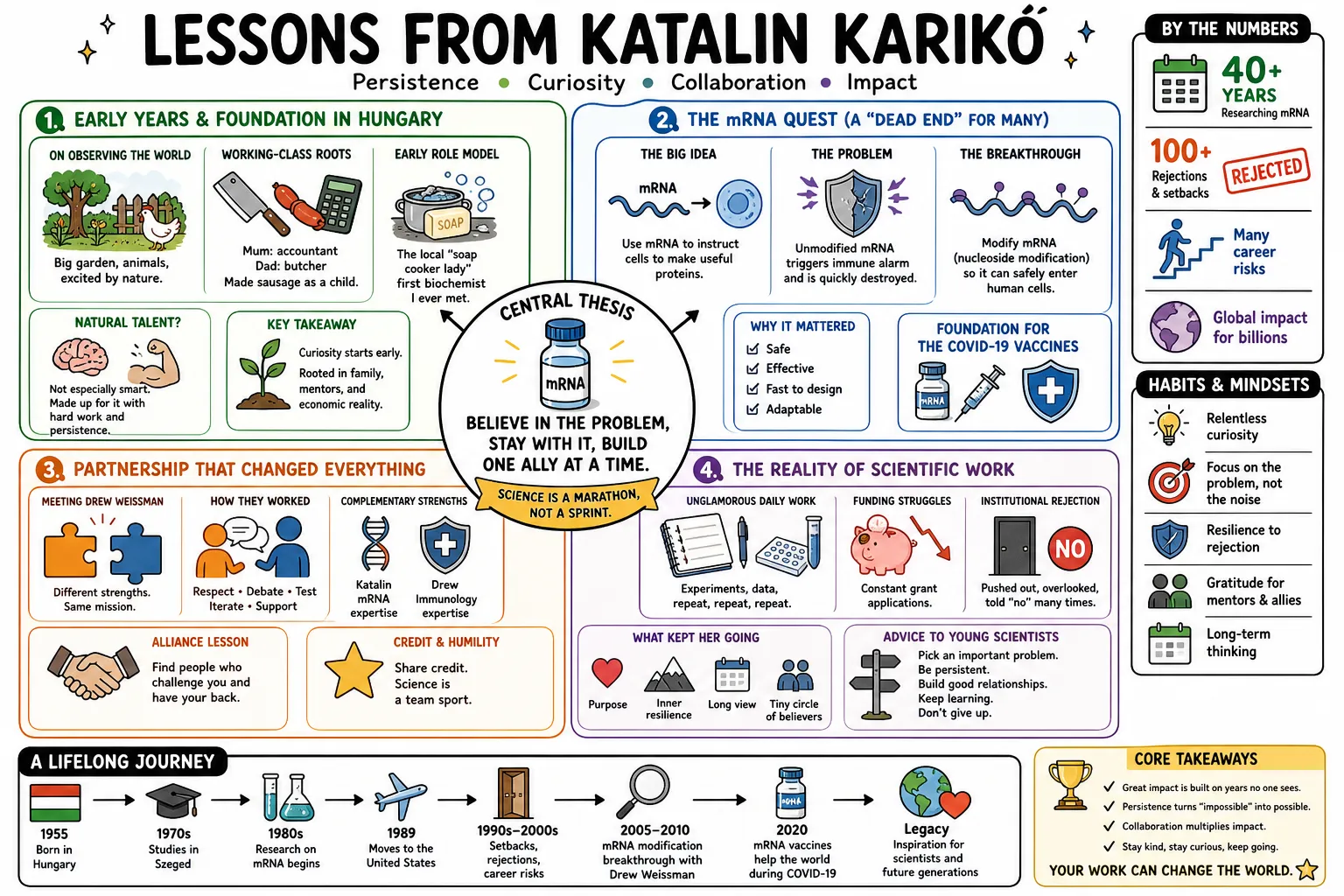
Part 1: Early Years & Foundation in Hungary
- On observing the world: "I have to say that every child is interested in understanding the nature around them and so I was surrounded with nature because we had a big garden, we had animals around and it was an exciting thing." — Source: Substack
- On her working-class roots: "My mum was an accountant, while my father was a butcher, I knew how to make sausage as a child. But I was also very curious and had an amazing teacher who encouraged me a lot." — Source: Hunimed
- On early role models: "I understand now that this local 'soap cooker lady' was the first biochemist I ever met." — Source: LitHub
- On natural talent: "I don't consider myself especially smart, but what I lacked in natural ability, I could make up for in effort." — Source: The Guardian
- On the 'Fizikai' label: The "F" on her Hungarian school transcripts meant physical labor, identifying her lower status, yet she viewed this working-class background as the root of her resilience. — Source: Penguin Random House
- On valuing vaccines: The Nobel Prize facts page frames Kariko's breakthrough in practical public-health terms: her and Drew Weissman's 2005 discovery of RNA base modifications laid the foundation for effective mRNA vaccines against COVID-19, underscoring how she treated vaccines as concrete medical progress rather than an abstract debate. — Reference: Nobel Prize facts page on Kariko
- On her mother's prediction: Her mother used to tell her she would win the Nobel Prize, to which she would reply that she couldn't even get a grant to fund her lab. — Source: NobelPrize.org
- On early schooling: She learned that scientific curiosity begins not in a laboratory, but in simply paying close attention to the mechanics of the natural world outside your front door. — Source: Medium
- On the value of effort: "I have met many people born with what seemed to be a photographic memory, a gift for learning effortlessly. That wasn't me; it has never been me." — Source: GoodReads
- On growing up without amenities: Living in a home without running water in Kisújszállás taught her early on how to operate without expecting comfort or convenience. — Source: Achievement.org
Part 2: Navigating Institutional Rejection
- On being demoted: "Usually, at that point, people just say goodbye and leave because it's so horrible." — Source: Substack
- On getting fired: "Don't focus on what you cannot change. Because you are fired, don't start to feel sorry for yourself. You just have to focus." — Source: Hertelier
- On the nature of academia: Scientific institutions often prioritize funding and publication quantity over risky or long-term foundational research. — Source: The Guardian
- On parting words: Upon being ousted from her lab space at the University of Pennsylvania, she told the manager: "That lab is going to be a museum one day." — Source: The Guardian
- On lacking grants: Her work was repeatedly deemed "not of faculty quality" because it failed to attract the external funding that universities use to measure success. — Source: Forbes
- On compounding adversity: Her 1995 demotion happened simultaneously with a cancer diagnosis and her husband being stuck in Hungary due to visa issues, forcing her to compartmentalize her struggles. — Source: Forbes
- On the freedom of demotion: After accepting a lower position to stay at the university, she ultimately felt liberated to pursue her mRNA research without the pressure of the tenure track. — Source: Hertelier
- On history's pattern: "The history of science it turns out is filled with stories of very smart people laughing at good ideas." — Source: Substack
- On status quo: "A world that's missing an important contribution looks ordinary. It is the definition of status quo." — Source: Reddit
- On ignoring prestige: She realized early on that her progress had to be fueled by a deep passion for discovery rather than a desire for status or institutional validation. — Source: The Guardian
Part 3: The Work Ethic & Persistence
- On working hard: "I could work harder, put in more hours, do more, and do it with greater care." — Source: GoodReads
- On work and play: "And of all my early lessons that prepared me to be a scientist, that one, I think, is the most important of all: that work and play can bleed into each other, become one and the same, until the very idea of their distinction feels meaningless." — Source: GoodReads
- On trusting the work: "Just keep going with your one more thing, and your one more thing, and your one more thing after that." — Source: Medium
- On self-belief: "You must trust what's inside you. Nurture what you find there, especially when no one else does. Keep going. Keep growing. You are the potential." — Source: Medium
- On the brain's capacity: "The brain is malleable. What we practice, we strengthen." — Source: Medium
- On the athlete mindset: She compares scientific practice to an athlete training, noting that consistent effort makes complex tasks become more natural over time. — Source: Medium
- On maintaining physical health: She frequently stresses that mental and physical health are essential for long-term endurance in the lab, noting she exercises every day. — Source: UZH
- On protecting focus: In the Nobel Prize interview transcript, Kariko warns young scientists not to spend their attention comparing themselves with others, arguing instead that they have to focus on what they can do and what their own project requires. — Reference: Nobel Prize interview transcript with Katalin Kariko
- On comparing yourself to others: If you spend your energy looking at what others are doing or getting, you will exhaust the energy needed to actually succeed at your own work. — Source: NobelPrize.org
- On holding grudges: "You don't have to hold a grudge against somebody, because it poisons you and the other person won't even remember." — Source: Hertelier
Part 4: The Core Science (mRNA)
- On the underlying problem: The core challenge of her career was figuring out how to modify synthetic mRNA so that it wouldn't trigger a massive, deadly inflammatory response in the human body. — Source: Lindau Nobel Laureate Meetings
- On what makes research: "Unless you do many different experiments, each time adjusting a little something, you can't possibly know. An individual experiment is not in itself research." — Source: Medium
- On the elegant solution: She and Drew Weissman discovered that swapping out one of the four building blocks of RNA (uridine for pseudouridine) allowed the molecule to sneak past the immune system's defenses. — Source: Penn Medicine
- On mRNA's potential: She believed long before the pandemic that mRNA could be used as a temporary instruction manual to tell the body to create its own medicine, rather than relying on permanent DNA alterations. — Source: Issues in Science and Technology
- On convincing others: For decades, she struggled to explain to grant committees why RNA was a viable platform, as the molecule is inherently fragile and degrades quickly. — Source: Time
- On finding the clue: They noticed that while human cells attacked lab-made RNA, they ignored transfer RNA (tRNA) from the body, leading them to investigate what modifications naturally existed in human cells. — Source: NobelPrize.org
- On the nature of discovery: Breakthroughs rarely look like a sudden lightbulb moment; they are mostly long, tedious series of negative controls and failed assays until one small modification works. — Source: Journal of Clinical Investigation
- On avoiding shortcuts: If a scientist skips the foundational understanding of the underlying biology just to push an application, the application will eventually fail under stress. — Source: Journal of Clinical Investigation
- On the eventual application: Though she worked on mRNA to treat strokes and cancer, the technology's ability to safely express viral proteins made it the perfect, rapid-response tool for the COVID-19 vaccine. — Source: NobelPrize.org
Part 5: Collaboration & The Weissman Partnership
- On meeting Drew Weissman: The two scientists famously met while fighting for time at a University of Pennsylvania photocopier in 1997, striking up a conversation about their respective research. — Source: Penn Medicine
- On mutual education: "We educated and respected each other. You have to be willing to listen to each other. I learned all about immunology from Drew... And he learned about RNA from me." — Source: UZH
- On different thinking styles: "Drew showed me 'You know Kati, from A to B you zigzag, zigzag, zigzag, zigzag! And I am just like, straight.' But I told him that when I zigzag, I learn so much!" — Source: NobelPrize.org
- On energetic debates: "When you would see us looking at the data, we cut each other's words! What it means, you know, we're very 'alive'." — Source: NobelPrize.org
- On complementary skills: While Karikó understood the exact mechanisms of RNA synthesis, Weissman provided the deep knowledge of dendritic cells and the immune system necessary to test it. — Source: NIH
- On working shoulder-to-shoulder: They did not run massive, disconnected labs; for decades, they were directly at the bench analyzing data side-by-side to overcome each specific biological obstacle. — Source: NobelPrize.org
- On shared dedication: Despite their contrasting personalities, they were unified by an obsessive focus on the data itself. — Source: NobelPrize.org
- On surviving isolation: When the broader scientific community dismissed their work, their collaboration provided the internal validation needed to keep moving forward. — Source: Issues in Science and Technology
- On equal contribution: True scientific collaboration requires leaving ego at the door; neither could have solved the problem of mRNA immunogenicity without the exact expertise of the other. — Source: UZH
Part 6: Handling Failure & Perspective
- On dealing with failure: "You have to be a champion of failure." — Source: UZH
- On what failure means: "You learn more from failure—when things are not working well." — Source: Issues in Science and Technology
- On reframing mistakes: When an experiment fails, it simply means you do not yet understand what is happening; this curiosity should drive you to study further rather than quit. — Source: Issues in Science and Technology
- On instant gratification: "Don't focus on success—it's so rare. If you want instant gratification, don't be a scientist." — Source: Issues in Science and Technology
- On inner confidence: "You will fail if you don't believe in yourself." — Source: Lasker Foundation
- On control: If you dwell on the decisions of university administrators, peer reviewers, or grant committees, you surrender control; focus only on the quality of the next experiment. — Source: Hertelier
- On long-term vision: She views scientific progress not as a series of personal victories, but as laying a brick on a wall that someone else will eventually finish. — Source: GoodReads
- On separating self from outcome: A failed hypothesis does not make you a failed scientist; it simply eliminates one incorrect path from the map. — Source: Issues in Science and Technology
- On enduring obscurity: To survive decades of being ignored, a researcher has to find the daily act of pipetting and analyzing data intrinsically rewarding, regardless of who is watching. — Source: The Guardian
Part 7: Transition to BioNTech & Realizing the Vision
- On joining BioNTech: "This was the first time in my life that I didn't have to explain that RNA is good, because all of the people who were there, were believers." — Source: BioNTech
- On shared language: She described the environment at BioNTech—which she joined in 2013 after leaving UPenn—as a place where finally, "all of us... spoke science." — Source: Time
- On industrial vs. academic research: Moving to a company allowed her to focus entirely on turning the modified mRNA platform into actionable therapeutics without the constant distraction of academic grant writing. — Source: BioNTech
- On scaling up: It was one thing to prove the concept in a lab, but BioNTech provided the infrastructure to figure out how to manufacture lipid nanoparticles and mRNA at a clinical scale. — Source: Time
- On the arrival of the pandemic: When the SARS-CoV-2 sequence was published, the decades of foundational work meant they were uniquely positioned to design a vaccine candidate in a matter of days. — Source: NobelPrize.org
- On waiting for results: During the clinical trials for the COVID-19 vaccine, she remained cautiously focused on the data, knowing from experience that biology often behaves unpredictably in humans. — Source: Journal of Clinical Investigation
- On hearing the efficacy data: When she first learned the vaccine was over 90% effective, she allowed herself a brief moment of celebration by eating an entire box of chocolate-covered peanuts. — Source: The Guardian
- On the global impact: Seeing people finally receive the vaccine and knowing the technology worked was the validation of a lifetime's work, far superseding any award. — Source: Time
- On vindication: The success of the BioNTech/Pfizer vaccine proved that her insistence on the viability of mRNA wasn't stubbornness, but a correct reading of the underlying biology. — Source: BioNTech
Part 8: Legacy & Advice for Scientists
- On leaving a mark: "Sometimes, I think, that is the best we can do: to learn from the world we've been handed and then try to leave things a little bit better for the next generation." — Source: GoodReads
- On finding joy: "The most important thing is that they should enjoy what they are doing. Because if you are happy with what you are doing, you will do more and then you become an expert." — Source: UZH
- On women in science: "It is important in science to have women because we are thinking differently. We are multitasking... People have different views, different thinking." — Source: NobelPrize.org
- On mentoring the next generation: She advises young researchers to ignore the modern pressure to immediately publish flashy papers, and instead take the time to do rigorous, reproducible science. — Source: Journal of Clinical Investigation
- On receiving the Nobel Prize: While grateful for the honor, she frequently redirects the attention back to the thousands of unnamed scientists whose incremental discoveries made her work possible. — Source: NobelPrize.org
- On true motivation: If a scientist is driven by the desire to win awards or get rich, the inevitable long stretches of failure will break them; curiosity must be the anchor. — Source: Lasker Foundation
- On reading old papers: She regularly advocates for diving into the archives of scientific literature, as many forgotten or dismissed ideas hold the missing pieces for modern problems. — Source: Issues in Science and Technology
- On staying grounded: Despite global fame, she continues to view herself simply as a bench scientist, happiest when looking at fresh experimental data. — Source: The Guardian
- On the ultimate lesson: "You are the seed. Do not stop. There is so much more to discover." — Source: Medium