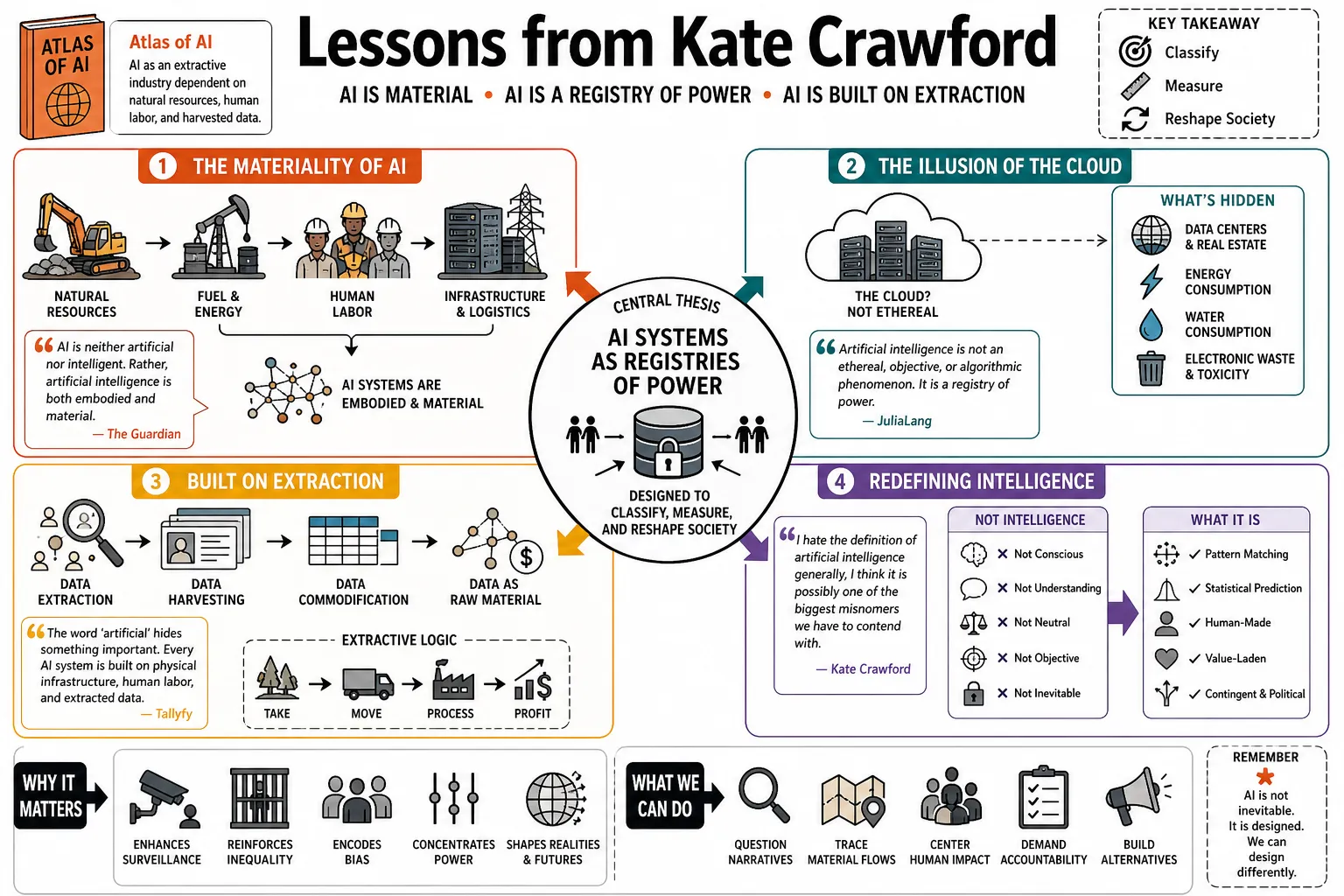
Kate Crawford studies the social and political realities of artificial intelligence. Her book Atlas of AI argues that machine learning is an extractive industry dependent on natural resources, human labor, and harvested data. This compilation traces her case that AI systems act as registries of power designed to classify, measure, and reshape society.
Part 1: The Materiality of Artificial Intelligence
- On the nature of AI: "AI is neither artificial nor intelligent. Rather, artificial intelligence is both embodied and material, made from natural resources, fuel, human labor, infrastructures, logistics, histories, and classifications." — Source: The Guardian
- On the illusion of the cloud: "Artificial intelligence is not an ethereal, objective, or algorithmic phenomenon. It is a registry of power." — Source: JuliaLang
- On physical infrastructure: "The word 'artificial' hides something important. Every AI system is built on physical infrastructure, human labor, and extracted data." — Source: Tallyfy
- On redefining intelligence: "I hate the definition of artificial intelligence generally; I think it is possibly one of the biggest misnomers we have to contend with. It takes us away from the anthropomorphization that we find so frustrating." — Source: Renewable Matter
- On probabilistic statistics: "These systems are just probabilistic statistics at scale. The current wave of generative AI has only increased the amount of mystification and hype." — Source: Renewable Matter
- On magical thinking: "That these systems are seen as both magical and alien and otherworldly is a political choice. And that has political ramifications. It means that we do not look at these wider planetary costs." — Source: CIGI
- On shifting focus: "My hope is that we can shift this conversation about artificial intelligence away from this narrow technical focus to really look at artificial intelligence as deeply interconnected at this planetary level." — Source: CIGI
- On avoiding scrutiny: "The industry mythologizes the internal workings as a way to avoid scrutiny and oversight." — Source: CIGI
- On what makes it run: "AI is the result of extracting human life through data, raw materials, and labor." — Source: Turning Point
- On historical scale: "We have not invested this much money into an infrastructure like this really until you go back to the pyramids." — Source: YouTube
Part 2: The Planetary and Environmental Costs
- On the business of mining: "Since antiquity, the business of mining has only been profitable because it does not have to account for its true costs, including environmental damage, the illness and death of miners, and the loss to the communities it displaces." — Source: Medium
- On deep time: "Each object in the extended network of an AI system, from network routers to batteries to data centers, is built using elements that require billions of years to form inside the earth." — Source: Turning Point
- On the cost of convenience: "We are not used to thinking about these systems in terms of the environmental costs. We forget the deep costs of what is actually being built by these systems for these tiny moments of convenience." — Source: CIGI
- On metabolic media: "Generative AI is fundamentally metabolic media. It has a burn rate that is astronomical and growing." — Source: Monthly Review
- On future energy consumption: "Generative AI is rapidly expanding its footprint, and on its current trajectory, it will be using the same amount of energy as the entire country of India by 2030." — Source: YouTube
- On obsolescence cycles: "The AI industry fuels a rapid obsolescence cycle of hardware, creating massive amounts of electronic waste as companies race for more compute power." — Source: YouTube
- On AI as an extractive industry: "AI must be understood not as software, but as an extractive industry that strips the earth of minerals like lithium and cobalt to sustain its physical backbone." — Source: Turning Point
- On unpriced externalities: "The tech sector avoids paying for the true planetary costs of its operations, treating environmental degradation as an unpriced externality." — Source: Medium
- On resource dependency: "Without continuous extraction of physical resources from the Earth, the entire edifice of artificial intelligence would collapse." — Source: Turning Point
Part 3: The Hidden Labor of Automation
- On the myth of automation: "Workers do the repetitive tasks that backstop claims of AI magic, but they rarely receive credit for making the systems function." — Source: SoBrief
- On crowd-sourced labor: "The technical AI research community relies on cheap, crowd-sourced labor for many tasks that cannot be done by machines." — Source: Medium
- On algorithmic management: "Workers under algorithmic management systems face extreme physical and psychological tolls, often pressured to act like machines to meet automated picking rates." — Source: The Guardian
- On proving our humanity: "In a paradox that many of us have experienced, in order to prove true human identity when reading a website, we are required to convince Google’s reCAPTCHA of our humanity." — Source: Medium
- On ghost work: "Behind every sophisticated AI system is a hidden workforce of human labelers, moderators, and annotators who piece together the logic that the machine mimics." — Source: SoBrief
- On unequal value: "The AI economy systematically devalues the human labor required to train its models, paying pennies for tasks that generate billions in corporate valuation." — Source: Medium
- On structural dependence: "AI is not replacing labor; it is structurally dependent on an increasingly precarious and invisible global workforce." — Source: The Guardian
- On continuous human input: "AI systems do not run themselves once built. They require continuous human input to course-correct, filter toxic content, and label new data." — Source: Medium
- On the illusion of autonomy: "The appearance of a fully autonomous machine is carefully constructed by hiding the vast human infrastructure required to maintain it." — Source: SoBrief
Part 4: Data Extraction and Epistemological Violence
- On the bloodless word: "Data has become a bloodless word; it disguises both its material origins and its ends. If data is seen as abstract and immaterial, then it more easily falls outside of traditional understandings of care, consent, or risk." — Source: Business Insider
- On forcing categories: "What epistemological violence is necessary to make the world readable to a machine learning system?" — Source: Humanities Commons
- On context and place: "While massive datasets may feel abstract, they are intricately linked to physical place and human culture." — Source: CA.gov
- On rapacious harvesting: "There is an unswerving belief that everything is data and is there for the taking. It does not matter where a photograph was taken or whether it reflects a moment of vulnerability or pain." — Source: Goodreads
- On industry normalization: "It has become so normalized across the industry to take and use whatever is available that few stop to question the underlying politics." — Source: Goodreads
- On systematizing the universe: "AI seeks to systematize the unsystematizable, formalize the social, and convert an infinitely complex and changing universe into a Linnaean order of machine-readable tables." — Source: Goodreads
- On raw data as myth: "Data is never a raw, natural resource; it is always actively harvested, selected, and interpreted through human frameworks." — Source: Goethe-Institut
- On erasing context: "When data is ingested by machine learning models, the specific social and historical context in which it was created is routinely erased." — Source: Business Insider
- On non-consensual use: "The foundation of modern AI rests on the non-consensual scraping of human lives, treating personal images and texts as free raw material." — Source: The Guardian
Part 5: Bias and the Politics of Classification
- On the term bias: "Bias is too narrow a term for the sorts of problems we are talking about." — Source: Humanities Commons
- On neutrality: "No algorithm focused on human behavior is neutral. Anything which is trained on historical human behavior embeds and codifies historical and cultural practices." — Source: CA.gov
- On constructing reality: "Machine learning systems are, in a very real way, constructing race and gender. They are defining the world within the terms they have set, and this has long-lasting ramifications for the people who are classified." — Source: Business Insider
- On features versus bugs: "The 'bug' in the system is, more often than not, an integral and self-reinforcing feature of classification that ends up amplifying social inequalities under the guise of technical neutrality." — Source: Humanities Commons
- On the phrenological impulse: "I call this a phrenological impulse, the desire to categorize people’s character based on appearance." — Source: Business Insider
- On biology as destiny: "Systems that claim to read emotions or character from faces are grounded in the flawed premise that biology is destiny, turning our faces into our fate." — Source: Business Insider
- On affective computing: "The attempt to measure internal emotional states through external facial movements commits a deep epistemic error by ignoring cultural context and the complexities of human expression." — Source: Wikipedia
- On historical continuity: "Modern AI classification systems often echo 19th-century scientific practices like craniometry, forcing complex human identities into discrete, quantifiable, and historically prejudiced categories." — Source: Turning Point
- On technical fixes: "Fixing bias is often treated as a mathematical problem, ignoring that the underlying issues are rooted in how systems are fundamentally designed to classify the world." — Source: Socializing AI
- On enforcing social order: "AI does not just hold a mirror to society; it actively enforces outdated or harmful social categories by automating them at scale." — Source: Domino Data Lab
Part 6: Power and AI as a Registry
- On power structures: "AI is about power all the way down." — Source: Public Infrastructure
- On democratizing AI: "To suggest that we democratize AI to reduce asymmetries of power is a little like arguing for democratizing weapons manufacturing in the service of peace." — Source: Goodreads
- On time and control: "Controlling time, whether via the clocks for churches, trains or data centers, has always been a function of controlling the political order." — Source: Goodreads
- On dismantling structures: "As Audre Lorde reminds us, the master’s tools will never dismantle the master’s house." — Source: Goodreads
- On asking the right questions: "These illusions distract from the far more relevant questions: Whom do these systems serve? What are the political economies of their construction? And what are the wider planetary consequences?" — Source: Medium
- On the limits of ethics: "Ethics are necessary, but not sufficient. More helpful are questions such as: Who benefits and who is harmed by this AI system? And does it put power in the hands of the already powerful?" — Source: DIID
- On political products: "AI is politics all the way down. Rather than being inscrutable and alien, these systems are products of larger social and economic structures with profound material consequences." — Source: YouTube
- On billionaires and power: "We are looking at eight billionaires who are having extraordinary power over the lives of 8 billion people. This has to be a public conversation." — Source: YouTube
- On defining knowledge: "By centralizing what is considered valid knowledge, AI measurement systems marginalize local and non-quantifiable forms of understanding, establishing epistemic dominance." — Source: Turning Point
Part 7: The Myths of AI and Ground Truth
- On ground truth: "The concept of ground truth in machine learning is not an objective baseline, but a highly constructed set of political and social assertions." — Source: UChicago
- On scale as authority: "The AI industry relies on the flawed epistemic assumption that scale acts as a proxy for accuracy, that if a dataset is large enough, it becomes a mirror of the world." — Source: UChicago
- On the view from nowhere: "AI systems are often presented as having a view from nowhere, a detached, omniscient perspective that purposefully obscures the human decisions shaping their design." — Source: Medium
- On human labelers: "In practice, the truth an AI learns is merely whatever underpaid human labelers, working quickly and without context, decided to tag a piece of data as." — Source: UChicago
- On measurement as imposition: "AI measurement does not simply observe reality; it imposes a specific order on it, turning past social inequalities into mathematical facts." — Source: Turning Point
- On formal accounts of power: "As a registry of power, AI formally accounts for what dominant institutions deem worthy of being recorded, measured, and controlled." — Source: Humanities Commons
- On universal emotions: "The epistemic foundation of emotion recognition AI relies on contested psychological theories that falsely assume universal human emotions can be read reliably from faces." — Source: Wikipedia
- On automating assumptions: "When we automate decisions at scale, we are merely building complex technical infrastructures around pre-existing human assumptions and biases." — Source: KateCrawford.net
- On epistemic limits: "There is a fundamental limit to what AI can know about human life, because complex lived experiences cannot be perfectly mapped into machine-readable tables." — Source: Goodreads
Part 8: The Future of Model Autophagy
- On the slop tide: "The slop tide will rise. Cursed domains of fake news, psyops imagery, and synthetic influencers will multiply and capture the paid sponsorships that once belonged to humans." — Source: Monthly Review
- On Model Autophagy Disease: "AI systems degenerate when they are fed on too much of their own outputs, a phenomenon researchers call MAD." — Source: Monthly Review
- On the collapse of systems: "In other words, AI will eat itself, then gradually collapse into nonsense and noise." — Source: Monthly Review
- On forensic literacy: "We urgently need more forensic investigation that will reveal the fuller picture of how AI is designed, and the longer implications of these technical infrastructures." — Source: YouTube
- On feedback loops: "As generative AI pollutes the internet with synthetic data, future models trained on this scraped content will inevitably degrade in quality and coherence." — Source: Monthly Review
- On systemic degeneration: "The race to scrape the entire internet means companies are running out of high-quality human data, leading to an epistemic crisis in model training." — Source: Monthly Review
- On moving past hype: "To address the real harms of AI, we must look past the relentless corporate hype cycle and focus on the material extraction taking place right now." — Source: Renewable Matter
- On structural regulation: "Regulatory approaches must move beyond individual data privacy to address the structural environmental and labor monopolies created by tech giants." — Source: Substack
- On revealing the infrastructure: "True forensic literacy requires making visible the global supply chains, data centers, and labor camps that the AI industry fights to keep hidden." — Source: YouTube
- On the path forward: "The solution is not to build a more perfectly fair algorithm, but to ask whether certain systems should be built at all given their profound social and planetary costs." — Source: Socializing AI