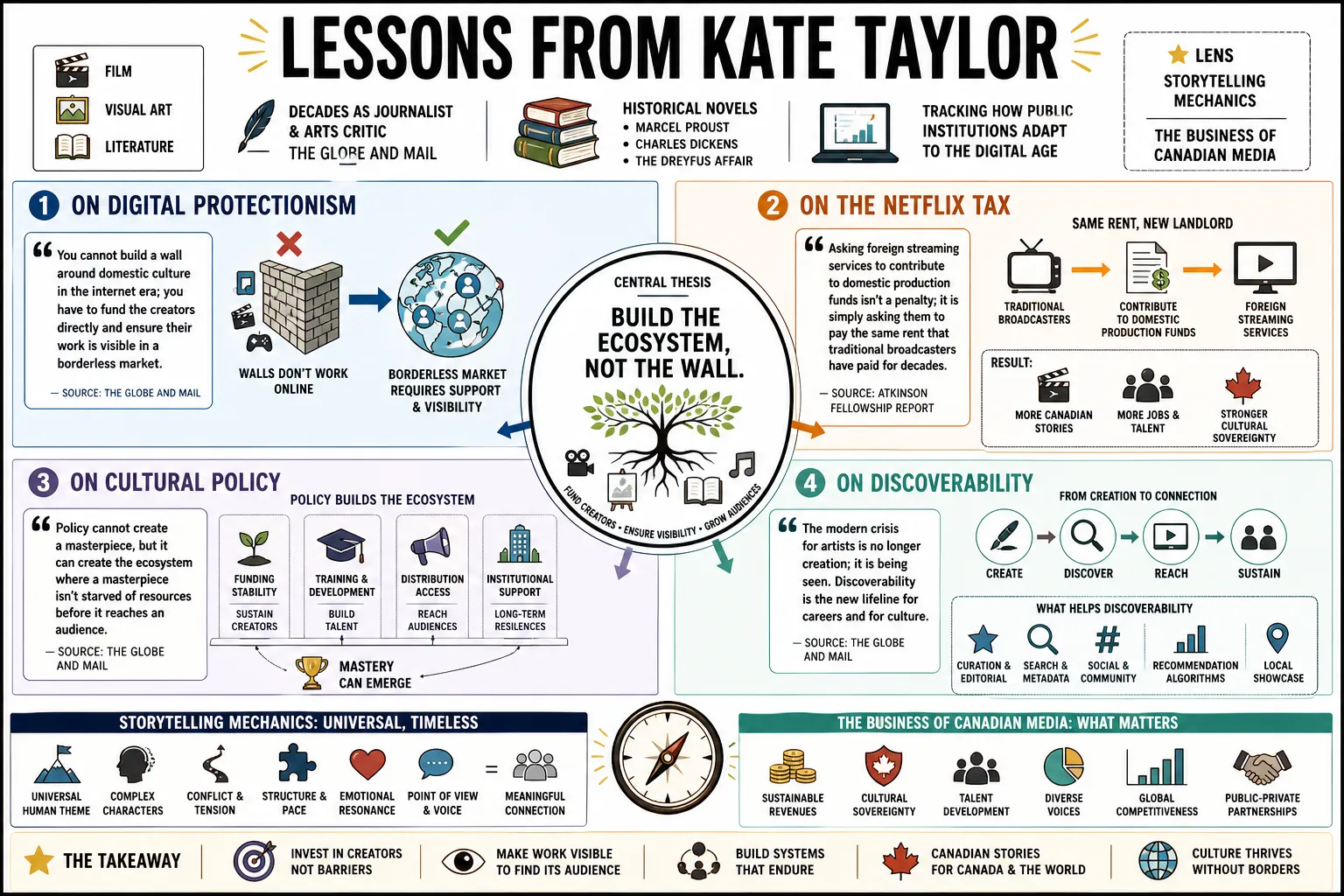
Lessons from Kate Taylor
Kate Taylor has spent decades as a journalist and arts critic for The Globe and Mail, analyzing film, visual art, and literature. Alongside her historical novels about Marcel Proust, Charles Dickens, and the Dreyfus Affair, she regularly tracks how public institutions adapt to the digital age. This profile covers her views on the mechanics of storytelling and the business of Canadian media.
Part 1: On Cultural Sovereignty and the Digital Age
- On Digital Protectionism: "You cannot build a wall around domestic culture in the internet era; you have to fund the creators directly and ensure their work is visible in a borderless market." — Source: The Globe and Mail
- On the Netflix Tax: "Asking foreign streaming services to contribute to domestic production funds isn't a penalty; it is simply asking them to pay the same rent that traditional broadcasters have paid for decades." — Source: Atkinson Fellowship Report
- On Cultural Policy: "Policy cannot create a masterpiece, but it can create the ecosystem where a masterpiece isn't starved of resources before it reaches an audience." — Source: The Globe and Mail
- On Discoverability: "The modern crisis for artists is no longer just funding, but discoverability in algorithms that prioritize global homogeny over local specificity." — Source: Atkinson Fellowship Report
- On Public Broadcasting: "A public broadcaster must justify its mandate not by chasing commercial ratings, but by serving the niches and complex narratives that private networks abandon." — Source: The Globe and Mail
- On Global Tech Giants: "When a tech company controls the distribution pipeline, they eventually control the aesthetic of the art itself." — Source: The Globe and Mail
- On Canadian Content Rules: "Quotas worked for television and radio because the spectrum was finite. In an infinite digital space, quotas are meaningless without aggressive curation." — Source: Atkinson Fellowship Report
- On Artistic Subsidy: "We subsidize culture not because it can't survive on its own, but because a purely commercial culture reflects only the desires of the majority." — Source: The Globe and Mail
- On the Internet's Promise: "The internet promised to democratize art, but in practice, it merely shifted power from studio executives to platform engineers." — Source: The Globe and Mail
Part 2: On the Art and Ethics of Criticism
- On the Critic's Job: "A critic is not a consumer guide assigning star ratings, but an essayist using a piece of art to start an argument about the world." — Source: The Globe and Mail
- On Bad Reviews: "Writing a negative review is only useful if it clarifies why the work failed on its own terms, rather than punishing it for not being something else entirely." — Source: The Globe and Mail
- On Objectivity in Art: "There is no such thing as an objective review. The best a critic can offer is transparency about their own biases and the rigor of their attention." — Source: The Globe and Mail
- On Film Festivals: "Festivals like TIFF are where the hype cycle is born, and the critic's job is often to be the single sober person in a room full of intoxicants." — Source: Toronto International Film Festival Coverage
- On Reviewing Friends: "The cultural scene in Canada is small enough that you will eventually review people you know. The only defense is a strict, almost clinical loyalty to the reader over the artist." — Source: The Globe and Mail
- On Theatre's Ephemerality: "Criticizing theatre requires a specific urgency because you are reviewing an event that disappears the moment the curtain falls." — Source: The Globe and Mail
- On Popular Entertainment: "Dismissing blockbusters as low art ignores the fact that they are the most accurate psychological mirrors of our collective anxieties." — Source: The Globe and Mail
- On Artistic Intent: "It does not matter what the director meant to say. It only matters what is actually on the screen or the canvas." — Source: The Globe and Mail
- On the Death of the Critic: "Social media made everyone a reviewer, but it did not make everyone a critic. A critic provides context; a reviewer provides a verdict." — Source: The Globe and Mail
- On Generosity: "The most difficult skill for a critic to learn is how to be generous to a flawed work that takes genuine risks." — Source: The Globe and Mail
Part 3: On Historical Fiction and Narrative Truth
- On Fiction vs. History: "Historians are bound by what the archives hold. Novelists are tasked with filling the silences between the documents." — Source: A Man in Uniform
- On the Dreyfus Affair: "The Dreyfus Affair was the first modern media circus, a trial where narrative and propaganda became more important than evidence." — Source: A Man in Uniform
- On Research: "Research for a historical novel should be like an iceberg. The reader only sees the ten percent above the water, but they must feel the weight of the ninety percent below." — Source: CBC The Next Chapter
- On Historical Characters: "When writing about real people, you owe them the dignity of their contradictions, letting them exist outside the mythology history settled on." — Source: Serial Monogamy
- On Setting the Scene: "A setting is only successful in fiction if it acts upon the characters. Paris in the 1890s must force the protagonist into corners they wouldn't find in London." — Source: A Man in Uniform
- On Anachronism: "The worst anachronism in historical fiction isn't a misplaced zipper or a wrong carriage; it is giving a 19th-century character a 21st-century conscience." — Source: CBC The Next Chapter
- On Charles Dickens: "Dickens understood better than anyone that public morality and private cruelty can comfortably coexist in the same man." — Source: Serial Monogamy
- On the Past as a Mirror: "We read historical fiction not to escape the present, but to see our current political and social failures dressed in different clothes." — Source: CBC The Next Chapter
- On Multiple Timelines: "Braiding a historical narrative with a modern one is a way of proving that the ghosts of the past are still arguing with us." — Source: Mme Proust and the Kosher Kitchen
Part 4: On Marcel Proust and Memory
- On Proustian Memory: "Proust taught us that memory is not a filing cabinet you open, but a sensory ambush that happens when you least expect it." — Source: Mme Proust and the Kosher Kitchen
- On Jeanne Weil Proust: "The mother of Marcel Proust was the architect of his neuroses, but she was also the fiercely protective editor of his early imagination." — Source: Mme Proust and the Kosher Kitchen
- On Reading In Search of Lost Time: "Reading Proust is less like consuming a novel and more like taking up residence in another person's nervous system." — Source: The Globe and Mail
- On Time: "For Proust, time was the ultimate antagonist. Art was the only weapon capable of delaying its victory." — Source: Mme Proust and the Kosher Kitchen
- On Social Climbing: "The salons of Proust’s Paris were brutal ecosystems where wit was weaponized and social status was entirely transactional." — Source: Mme Proust and the Kosher Kitchen
- On Illness as Metaphor: "Proust’s asthma confined him to a cork-lined room, but that physical restriction is exactly what forced his mind to travel so expansively inward." — Source: Mme Proust and the Kosher Kitchen
- On Jewish Identity: "Jeanne Weil’s refusal to convert to Catholicism anchored Marcel in a complex outsider status that fueled his observational distance." — Source: Mme Proust and the Kosher Kitchen
- On Food and Nostalgia: "The madeleine is famous, but all food in Proust serves as a sudden, involuntary bridge across decades." — Source: Mme Proust and the Kosher Kitchen
- On Jealousy: "Proust understood that romantic jealousy is an act of imagination. We suffer based on the fictions we invent about what our partners might be doing." — Source: The Globe and Mail
Part 5: On Marriage and Monogamy
- On the Institution of Marriage: "Marriage is frequently treated as a fixed destination in fiction, when in reality it is a daily, exhausting negotiation of boundaries." — Source: Serial Monogamy
- On Infidelity: "An affair is rarely about the third person; it is usually a crude, destructive attempt to break a deadlock within the marriage itself." — Source: Serial Monogamy
- On Divorce: "The tragedy of divorce is not that people stop loving each other, but that they have to dismantle a shared history piece by piece." — Source: CBC The Next Chapter
- On Female Independence: "Modern expectations force women to be economically independent, emotionally supportive, and domestically competent, which frequently causes the arrangement to collapse under its own weight." — Source: Serial Monogamy
- On Secrets: "The most durable marriages are not those without secrets, but those where both partners agree on which secrets are allowed to remain unsaid." — Source: Serial Monogamy
- On Aging Together: "Growing old with someone forces you to witness the decay of the person you love, which is the ultimate test of early promises." — Source: Serial Monogamy
- On Dickens' Marriage: "Charles Dickens publicly discarded his wife of twenty-two years with a cruelty that entirely contradicted the deep empathy of his novels." — Source: Serial Monogamy
- On Public vs. Private Selves: "Artists often demand total forgiveness at home for the energy they expend in public. It is a terrible bargain for their spouses." — Source: Serial Monogamy
- On Betrayal: "Betrayal in a long marriage is shocking precisely because it uses the intimate knowledge of the partner as a weapon." — Source: CBC The Next Chapter
- On Forgiveness: "Forgiveness in marriage is not a sudden grace. It is a tedious, repetitive task that you have to choose to do every morning." — Source: Serial Monogamy
Part 6: On the Visual Arts and Public Institutions
- On Museum Funding: "A gallery that relies entirely on wealthy donors will eventually find its exhibition schedule dictated by the tastes of the boardroom rather than the curators." — Source: The Globe and Mail
- On Public Art: "Public art shouldn't just decorate a plaza; it must interrupt the daily commute and force the public to confront an idea they didn't ask to see." — Source: The Globe and Mail
- On Indigenous Art in Galleries: "Institutions moving Indigenous art from anthropology wings into contemporary fine art spaces is a necessary correction, but it does not erase the colonial violence of how those objects were acquired." — Source: The Globe and Mail
- On Architecture: "A museum’s architecture often competes with the art it houses. The best gallery designs surrender their ego at the front door." — Source: The Globe and Mail
- On the Group of Seven: "The Group of Seven branded the Canadian landscape as an empty, pristine wilderness, conveniently ignoring the Indigenous peoples who already lived there." — Source: Art Gallery of Ontario Talk
- On Photography as Art: "We take more photographs in a day than were taken in the entire 19th century, yet we have never been worse at actually looking at an image." — Source: The Globe and Mail
- On Art Market Speculation: "When art is treated primarily as an asset class, the gallery becomes a bank vault and the public is locked out." — Source: The Globe and Mail
- On Curation: "A curator’s job is to create a narrative out of disparate objects, guiding the viewer without suffocating the art's inherent ambiguity." — Source: Art Gallery of Ontario Talk
- On Vandalism as Protest: "Throwing soup at a masterpiece guarantees headlines, but it fundamentally misunderstands the protective role that art plays in a decaying society." — Source: The Globe and Mail
Part 7: On Canadian Identity and Culture
- On the Canadian Complex: "Canada’s cultural insecurity is rooted in proximity. It is difficult to hear your own voice when you are standing next to a stadium amplifier." — Source: The Globe and Mail
- On Regionalism: "There is no single Canadian culture. There is a series of regional cultures loosely held together by a broadcasting act and a highway." — Source: Atkinson Fellowship Report
- On State Support: "Without the Canada Council for the Arts, our literature would simply be a regional branch of the American publishing industry." — Source: The Globe and Mail
- On Toronto: "Toronto spends too much energy trying to be a world-class city, rather than accepting the messy, fractured, and fascinating city it actually is." — Source: The Globe and Mail
- On Multiculturalism in Fiction: "Canadian literature has moved past the immigrant arrival narrative into the much more complicated territory of second-generation inheritance and refusal." — Source: CBC The Next Chapter
- On the Film Industry: "We have built a brilliant infrastructure for shooting American movies in Vancouver and Toronto, but we still struggle to put our own stories on our own screens." — Source: The Globe and Mail
- On CanLit: "The era of Canadian literature functioning as a polite, homogeneous club is dead, and the friction that replaced it has made the writing significantly sharper." — Source: The Globe and Mail
- On Winter: "Our climate enforces an indoor introspection for six months of the year, which is perhaps why we produce more novelists than extroverted showmen." — Source: The Globe and Mail
- On National Myths: "Every country requires a mythology to hold it together, but journalism's job is to continually scrape the paint off that mythology." — Source: Atkinson Fellowship Report
Part 8: On the Craft of Writing and Journalism
- On the Blank Page: "Writing does not get easier with experience. You merely develop a higher tolerance for the initial dread." — Source: CBC The Next Chapter
- On the Newsroom: "The disappearance of the physical newsroom has robbed young journalists of the passive education of overhearing older reporters argue on the phone." — Source: The Globe and Mail
- On Editing: "A good editor does not rewrite your sentence; they ask the precise question that forces you to realize the sentence was incomplete." — Source: The Globe and Mail
- On Print vs. Digital: "Digital journalism demands speed, but print journalism demands a finality that forces the writer to stand behind their argument without the safety net of an update button." — Source: The Globe and Mail
- On Finding the Story: "The real story is rarely what the press release announces. It is usually found in the budget line they refused to comment on." — Source: The Globe and Mail
- On Pacing in Fiction: "Pacing is not about moving fast. It is about controlling the flow of information so the reader feels the suspense of withheld knowledge." — Source: A Man in Uniform
- On Cultural Journalism: "Arts reporting is often dismissed as the toy department of the newspaper, but artists are usually the first to register the cracks in a political system." — Source: The Globe and Mail
- On Dialogue: "Good dialogue is never a direct exchange of information. It is two people talking past each other while trying to protect their own vulnerabilities." — Source: Serial Monogamy
- On Writer's Block: "Writer's block is usually just an act of extreme vanity, driven by the fear that what you are about to draft won't immediately match your own high standards." — Source: CBC The Next Chapter
- On the Future of Print: "Newspapers may abandon paper, but the democratic requirement for an institution that verifies facts and sues for public records will never become obsolete." — Source: The Globe and Mail