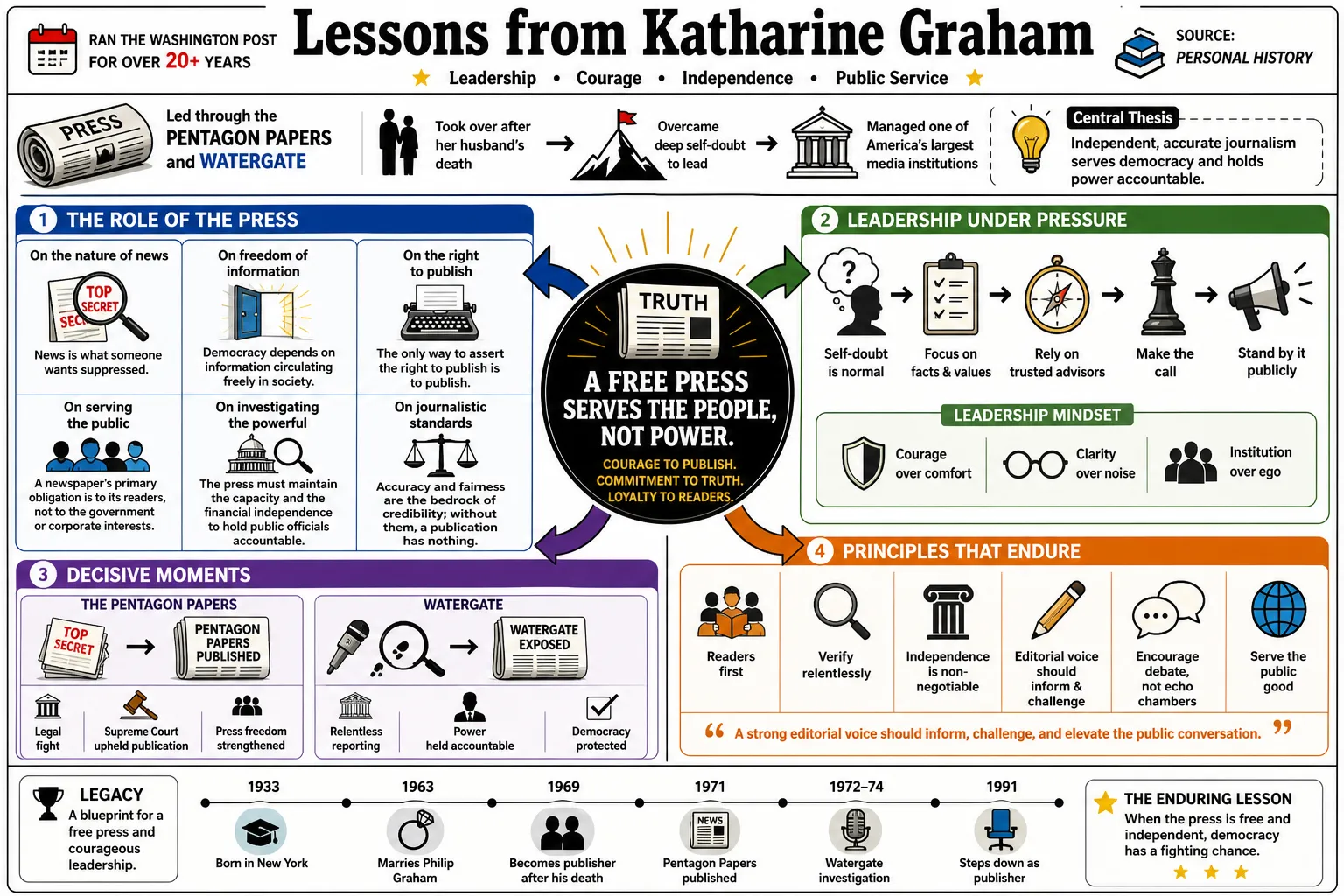
Lessons from Katharine Graham
Katharine Graham ran The Washington Post for over twenty years, leading the paper through the Pentagon Papers and Watergate. Taking over after her husband's death, she pushed past severe self-doubt to manage one of America's largest media institutions. Her memoir, Personal History, details the reality of making high-stakes calls under intense political pressure.
Part 1: The Role of the Press
- On the nature of news: "News is what someone wants suppressed. Everything else is advertising." — Source: [The Washington Post]
- On freedom of information: "Democracy depends on information circulating freely in society." — Source: [Personal History]
- On the right to publish: "The only way to assert the right to publish is to publish." — Source: [Personal History]
- On serving the public: "A newspaper's primary obligation is to its readers, not to the government or corporate interests." — Source: [The Washington Post Archives]
- On investigating the powerful: "The press must maintain the capacity and the financial independence to hold public officials accountable." — Source: [Personal History]
- On journalistic standards: "Accuracy and fairness are the bedrock of credibility; without them, a publication has nothing." — Source: [The Washington Post]
- On the editorial page: "A strong editorial voice should provide clear, reasoned opinions without dictating the news coverage." — Source: [Personal History]
- On protecting sources: "Journalists must be willing to defend their sources at all costs to ensure the continuous flow of critical information." — Source: [Watergate Hearings]
- On truth over comfort: "A publisher must be willing to print the truth even when it makes their friends and social circle uncomfortable." — Source: [Personal History]
- On long-term value: "Investing in the newsroom and high-quality reporting is the only reliable way to build a profitable media business over time." — Source: [The Washington Post]
Part 2: Leadership and Wielding Power
- On taking charge: "I had very little idea of what I was supposed to be doing, so I set out to learn. What I essentially did was to put one foot in front of the other, shut my eyes, and step off the edge." — Source: [Personal History]
- On wielding power: "I don't flinch at [power] the way I used to. If power is there to be used, it is used whether you abdicate it or whether you use it. You have to remember that you can do as much damage by abdicating it as by using it in the wisest way you know." — Source: [W Magazine Interview]
- On gender and authority: "Once, power was considered a masculine attribute. In fact, power has no sex." — Source: [Personal History]
- On making decisions: "You cannot wait for absolute certainty before making a difficult choice; you must gather the best advice and then decide." — Source: [Personal History]
- On independent thought: "No human being can blindly accept authority in one area of life and become self-reliant in day-to-day decisions in the field of morals, politics and economics." — Source: [Personal History]
- On the illusion of security: "It's a pretty hairy existence, and nobody ever has it made. The minute you think you do – you don't." — Source: [Personal History]
- On trusting experts: "A leader's job is not to know everything, but to hire exceptional people and trust their expertise." — Source: [The Washington Post Archives]
- On isolation: "The position of a chief executive is inherently lonely, especially when the stakes are existential." — Source: [Personal History]
- On setting the tone: "The ethical standards of an organization are established directly by the behavior of its leadership." — Source: [Personal History]
- On adapting to pressure: "Leadership requires learning to function normally even when under immense external stress." — Source: [Charlie Rose Interview]
Part 3: The Pentagon Papers Decision
- On assessing risk: "The decision to publish was made despite lawyers warning that the paper could face criminal charges and lose its television licenses." — Source: [Personal History]
- On the final call: "Go ahead, go ahead, go ahead. Let's go. Let's publish." — Source: [Personal History]
- On solidarity with the Times: "Once the New York Times was enjoined from publishing, the responsibility fell to the Post to continue bringing the documents to light." — Source: [The Washington Post Archives]
- On legal threats: "The threat of the Espionage Act was real, but the threat to the paper's soul if it backed down was greater." — Source: [Personal History]
- On editor-publisher relations: "Ben Bradlee's relentless push to publish tested their relationship but forged a lasting editorial partnership." — Source: [Personal History]
- On financial timing: "The crisis arrived exactly as the Washington Post was preparing to go public, forcing a choice between financial safety and journalistic duty." — Source: [Personal History]
- On the First Amendment: "The case cemented the principle that prior restraint by the government against the press is almost never constitutional." — Source: [New York Times Co. v. United States]
- On acting quickly: "The timeline for the decision was compressed into hours, proving that critical choices often allow no time for leisurely debate." — Source: [Personal History]
- On the public's right to know: "The government's desire to avoid embarrassment is not a valid reason to classify historical information." — Source: [The Washington Post]
- On the aftermath: "Surviving the Pentagon Papers ordeal gave the paper the institutional confidence needed to tackle Watergate the following year." — Source: [Personal History]
Part 4: Watergate and Facing Threats
- On intimidation: "When John Mitchell threatened that she would get her tit caught in a big fat wringer, she refused to let the crude intimidation stop the reporting." — Source: [All the President's Men]
- On standing alone: "For months, the Post was the only major news organization aggressively pursuing the Watergate story, causing immense anxiety in the newsroom." — Source: [Personal History]
- On backing reporters: "She stood firmly behind Bob Woodward and Carl Bernstein, shielding them from the intense political heat directed at the publisher's office." — Source: [Personal History]
- On government retaliation: "The Nixon administration systematically attempted to damage the company by challenging its Florida television licenses." — Source: [The Washington Post Archives]
- On enduring the marathon: "Watergate was not a quick victory but a slow, grinding process of incremental reporting over two years." — Source: [Personal History]
- On minimizing personal bias: "She insisted that the coverage remain strictly factual and devoid of vindictiveness toward the Nixon administration." — Source: [Personal History]
- On the stakes: "If the reporting had been fundamentally wrong, the newspaper would have likely been destroyed by the administration." — Source: [Personal History]
- On vindication: "The resignation of the president was a solemn moment for the country, not a cause for celebration at the newspaper." — Source: [The Washington Post Archives]
- On maintaining perspective: "Even at the height of the scandal, she reminded her team that they were simply doing their jobs as journalists." — Source: [Personal History]
Part 5: Overcoming Self-Doubt and Gender
- On minority psychology: "She observed that women often share the conviction of the majority: that one is less able, less intelligent, less educable, less worthy of responsibility." — Source: [Personal History]
- On internalized sexism: "Early in her life, she believed that men were inherently more capable of running a business than women." — Source: [Personal History]
- On finding her voice: "It took years for her to stop deferring automatically to the male executives who surrounded her." — Source: [Personal History]
- On surviving tragedy: "Taking over the company after her husband's suicide forced her to suppress her grief in order to stabilize the business." — Source: [Personal History]
- On the impostor syndrome: "She frequently described feeling like she was simply holding the seat warm for the next generation, rather than owning the role herself." — Source: [Charlie Rose Interview]
- On gaining confidence: "Competence and confidence are built sequentially through the simple act of doing the work every day." — Source: [Personal History]
- On female friendships: "She eventually found strength and perspective in her friendships with other trailblazing women, such as Gloria Steinem." — Source: [Personal History]
- On being the only woman: "Walking into boardrooms where she was the sole female participant was a recurring, intimidating experience that she had to normalize for herself." — Source: [Personal History]
- On legacy over gender: "Ultimately, she wanted to be judged by the quality of the newspaper she produced, not by the novelty of her gender in the role." — Source: [The Washington Post Archives]
Part 6: Business, Management, and Quality
- On corporate strategy: "A media company cannot produce great journalism if it is not financially secure and profitable." — Source: [Personal History]
- On investing in talent: "Warren Buffett taught her that hiring exceptional managers and giving them autonomy is the key to business growth." — Source: [Warren Buffett Partnership Letters]
- On learning business: "She had to teach herself how to read financial statements and understand the mechanics of a publicly traded company mid-career." — Source: [Personal History]
- On labor relations: "The 1975 pressmen's strike was one of the most painful episodes of her career, forcing her to choose between union demands and the survival of the paper." — Source: [Personal History]
- On product quality: "The best defense against competitors is to simply produce a superior, indispensable product every single day." — Source: [The Washington Post]
- On shareholder value: "While acknowledging shareholders, she believed that a newspaper's civic mission could not be entirely subjugated to quarter-by-quarter earnings." — Source: [Personal History]
- On making changes: "Firing people or making drastic changes in leadership is agonizing but sometimes absolutely necessary for the health of the organization." — Source: [Personal History]
- On building an institution: "A successful tenure is measured by whether the institution is stronger and more resilient when you leave than when you arrived." — Source: [The Washington Post Archives]
- On handling criticism: "You must be willing to accept criticism from both the public and your own employees without becoming defensive." — Source: [Personal History]
Part 7: Resilience and Personal Growth
- On mistakes: "A mistake is simply another way of doing things." — Source: [Personal History]
- On anger: "The longer I live, the more I observe that carrying around anger is the most debilitating to the person who bears it." — Source: [Personal History]
- On courage: "Courage applies when one has a choice." — Source: [Personal History]
- On loving your work: "To love what you do and feel that it matters — how could anything be more fun?" — Source: [Personal History]
- On childhood environment: "The more subtle inheritance of my strange childhood was the feeling, which we all shared to some extent, of believing we were never quite going about things correctly." — Source: [Personal History]
- On evolving: "Personal growth doesn't stop in middle age; some of the most significant transformations happen late in life out of sheer necessity." — Source: [Personal History]
- On self-awareness: "Recognizing your own limitations and blind spots is the first step toward overcoming them." — Source: [Charlie Rose Interview]
- On endurance: "Sometimes the only strategy available is to simply endure a crisis day by day until it breaks." — Source: [Personal History]
- On moving forward: "Dwelling on past tragedies or business failures prevents you from addressing the immediate challenges in front of you." — Source: [Personal History]
Part 8: Ethics, Responsibility, and Freedom
- On societal progress: "I believe...that education is not only the most important societal problem but the most interesting." — Source: [Personal History]
- On freedom of expression: "People perform best when they have the freedom to be themselves." — Source: [Personal History]
- On public service: "Ownership of a major newspaper is essentially a public trust rather than a standard commercial enterprise." — Source: [The Washington Post Archives]
- On independence: "A publisher must maintain distance from the politicians they cover, even if they share the same social circles in Washington." — Source: [Personal History]
- On admitting fault: "When the paper made errors, she believed in correcting them promptly and transparently to maintain reader trust." — Source: [The Washington Post Archives]
- On the burden of legacy: "Inheriting a family business comes with the profound responsibility of not ruining the work of previous generations." — Source: [Personal History]
- On civic duty: "The press serves as an unofficial fourth branch of government, checking the power of the other three." — Source: [Watergate Hearings]
- On moral clarity: "During crises of national importance, legal considerations must sometimes take a backseat to ethical imperatives." — Source: [Personal History]
- On enduring principles: "The fundamental values of truth-telling and accountability remain constant regardless of changes in technology or the media landscape." — Source: [Personal History]