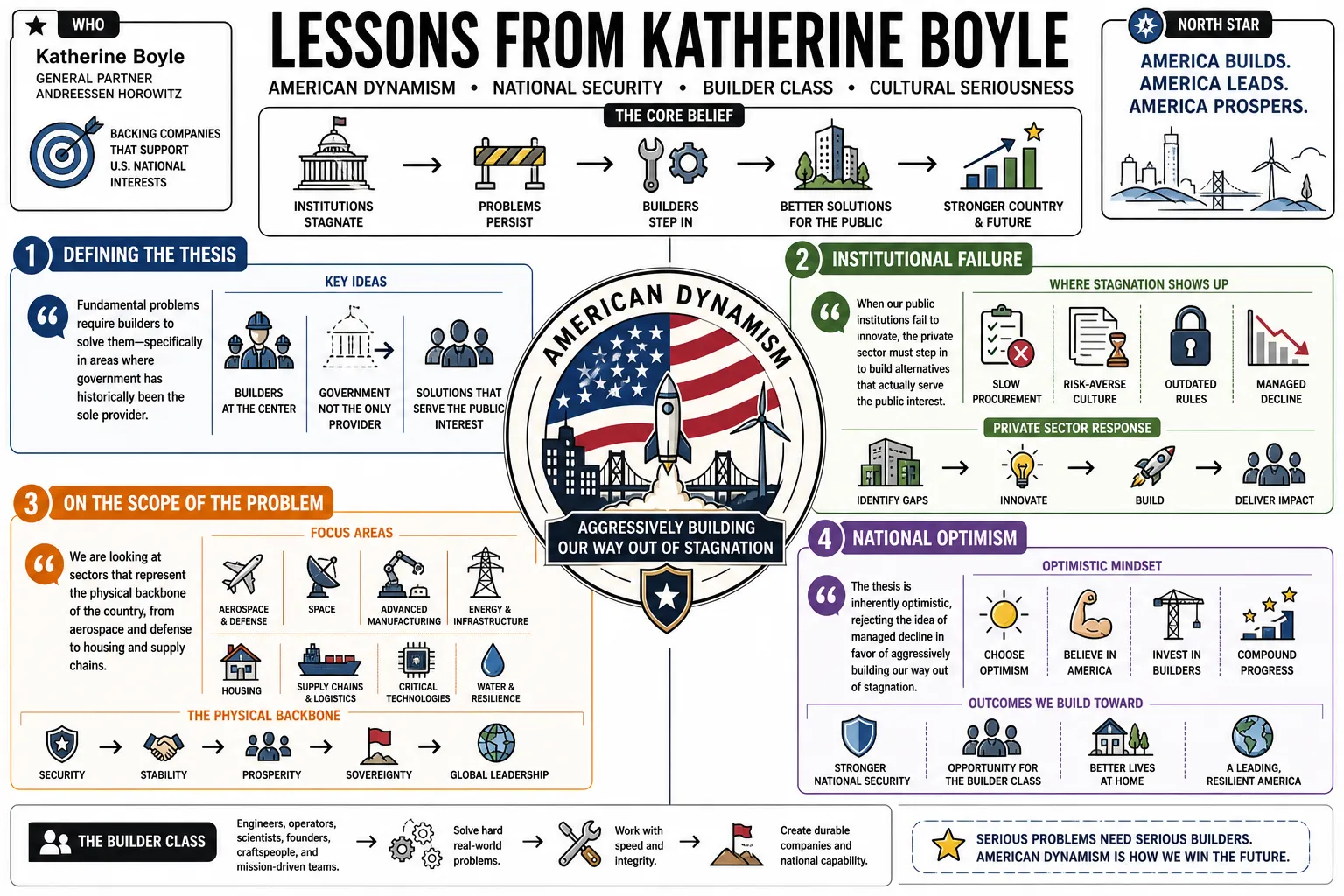
Lessons from Katherine Boyle
Katherine Boyle is an Andreessen Horowitz general partner who launched the "American Dynamism" thesis to back companies that support U.S. national interests. She argues that reversing institutional stagnation requires Silicon Valley to modernize defense and rebuild the physical world. This collection outlines her views on national security, the builder class, and the cultural need for seriousness.
Part 1: American Dynamism
- On Defining the Thesis: "American Dynamism is the recognition that the fundamental problems of our time require builders to solve them, specifically in areas where government has historically been the sole provider." — Source: [Andreessen Horowitz]
- On the Scope of the Problem: "We are looking at sectors that represent the physical backbone of the country, from aerospace and defense to housing and supply chains." — Source: [Acquired Podcast]
- On Institutional Failure: "When our public institutions fail to innovate, the private sector must step in to build alternatives that actually serve the public interest." — Source: [Andreessen Horowitz]
- On National Optimism: "The thesis is inherently optimistic, rejecting the idea of managed decline in favor of aggressively building our way out of stagnation." — Source: [Invest Like the Best]
- On the Role of Technology: "Technology is not a sector; it is the fundamental tool for modernizing the slow, heavily regulated industries that govern daily life." — Source: [Noahpinion]
- On Civic Responsibility: "Founders in this space are motivated by a sense of civic duty, recognizing that software alone cannot fix crumbling infrastructure." — Source: [Acquired Podcast]
- On the Shift from Consumer Apps: "We spent a decade optimizing digital conveniences, but the next generation of founders wants to tackle the difficult realities of the physical world." — Source: [Andreessen Horowitz]
- On Bridging Public and Private: "The most successful companies in this category will learn how to navigate regulatory environments while moving at the speed of a startup." — Source: [Invest Like the Best]
- On Economic Resiliency: "True national security requires economic resiliency, which means investing heavily in our own domestic capabilities and supply chains." — Source: [Noahpinion]
Part 2: The Builder Class and Talent Allocation
- On the Builder Class: "There is an emerging group of engineers and entrepreneurs who refuse to accept institutional decay and are choosing instead to build new foundations." — Source: [The Free Press]
- On Talent Migration: "The smartest young engineers are increasingly walking away from traditional tech jobs to work on hard tech and defense problems." — Source: [The Shawn Ryan Show]
- On Purposeful Work: "Top tier talent is seeking mission alignment. They want to know that their daily work contributes to the safety and prosperity of the country." — Source: [Invest Like the Best]
- On Overcoming Bureaucracy: "The builder class is defined by its willingness to run straight into regulatory roadblocks and figure out how to dismantle them." — Source: [Andreessen Horowitz]
- On Hardware Talent: "We are seeing a renaissance in hardware engineering, driven by people who want to see the tangible physical results of their labor." — Source: [Acquired Podcast]
- On Founder Motivations: "The founders building in this space are not looking for a quick exit; they are motivated by a deep frustration with the status quo." — Source: [Noahpinion]
- On the Decline of Cynicism: "The new generation of founders rejects the cynicism that permeated previous eras; they actually believe things can be fixed." — Source: [The Free Press]
- On Elite Divergence: "There is a growing split between the credentialed elite who manage existing systems and the builder elite who want to create entirely new ones." — Source: [Invest Like the Best]
- On Youth and Ambition: "We must empower young people who grew up coding to apply those skills to our most pressing national challenges." — Source: [The Free Press]
Part 3: Defense Technology and Modern Security
- On the Urgency of Defense Tech: "Progress in defense is not optional; it is a basic requirement for maintaining global stability and democratic values." — Source: [Andreessen Horowitz]
- On Silicon Valley's Patriotism: "The narrative that Silicon Valley is anti-defense is outdated. Founders are now highly motivated to work with the Department of Defense." — Source: [The Shawn Ryan Show]
- On Software in Warfare: "Modern conflicts will be decided by software and autonomy, areas where the private sector currently holds a massive advantage over the government." — Source: [Acquisition Talk]
- On Asymmetric Advantages: "We must use our asymmetric advantage in commercial technology to offset the numerical superiority of our adversaries." — Source: [Noahpinion]
- On Prime Contractors: "The traditional defense primes are optimized for hardware platforms from the last century, leaving a massive gap for agile software companies to fill." — Source: [The Shawn Ryan Show]
- On the SpaceX Effect: "SpaceX proved that a privately funded startup could completely disrupt a government monopoly in aerospace, creating a blueprint for other defense sectors." — Source: [Invest Like the Best]
- On Capitalizing Defense: "Venture capital is now willing to fund defense startups, but the government must prove it can actually buy from them to sustain this ecosystem." — Source: [Acquisition Talk]
- On Geopolitical Reality: "The return of great power competition has clarified the stakes for founders, making defense technology a moral imperative rather than a taboo." — Source: [Andreessen Horowitz]
- On Speed as Security: "In the current geopolitical environment, the speed of innovation and deployment is our most important national security asset." — Source: [Acquisition Talk]
Part 4: Reindustrialization and The Physical World
- On the Decline of Manufacturing: "We hollowed out our industrial base for decades under the assumption that global supply chains would always remain stable and friendly." — Source: [Noahpinion]
- On Bringing Production Home: "Reindustrialization is no longer a political talking point; it is an economic and security necessity that startups are rushing to solve." — Source: [Invest Like the Best]
- On Advanced Manufacturing: "The future of American manufacturing relies on automation and robotics, allowing us to build locally without relying on cheap overseas labor." — Source: [Acquired Podcast]
- On Physical Infrastructure: "Software has eaten the world, but we still need better roads, faster planes, and resilient power grids to support that software." — Source: [Andreessen Horowitz]
- On the Energy Transition: "Abundant energy is the prerequisite for all other physical progress, making nuclear and next-generation energy startups vital." — Source: [Noahpinion]
- On Space as Infrastructure: "The commercialization of space is fundamentally about building new infrastructure that will dictate the rules of the next century." — Source: [Invest Like the Best]
- On Housing Scarcity: "Housing is a structural problem that limits economic mobility, and it requires builders willing to challenge archaic zoning and construction methods." — Source: [Andreessen Horowitz]
- On Supply Chain Resilience: "The disruptions of the past few years proved that efficiency cannot be our only metric; we must design supply chains for resilience and redundancy." — Source: [Noahpinion]
- On Hard Tech: "Investors used to avoid hard tech because of the high capital requirements, but the strategic necessity of these technologies has completely changed the math." — Source: [Acquired Podcast]
- On Domestic Production: "Bringing manufacturing back to American shores is a fundamental requirement for securing our future economic independence." — Source: [Noahpinion]
Part 5: Silicon Valley versus Washington D.C.
- On Cultural Divides: "Silicon Valley moves fast and breaks things, while Washington is designed to move slowly and preserve the status quo." — Source: [The Shawn Ryan Show]
- On Viewing Adversaries: "When Washington looks at China, they see a strategic adversary. Historically, when Silicon Valley looked at China, they saw a massive customer base." — Source: [Acquisition Talk]
- On Bridging the Gap: "To solve our biggest problems, we need technologists who understand policy and policymakers who understand modern software." — Source: [Andreessen Horowitz]
- On Government Friction: "Founders entering the government space must be prepared for extreme friction, treating procurement strategy as seriously as product development." — Source: [Invest Like the Best]
- On the Need for Translation: "There is a massive translation problem between the Pentagon and venture-backed startups; fixing that communication gap is half the battle." — Source: [Acquisition Talk]
- On Risk Tolerance: "The public sector operates on risk elimination, while the venture capital model relies entirely on taking aggressive, calculated risks." — Source: [The Shawn Ryan Show]
- On D.C.'s Learning Curve: "Washington is finally waking up to the fact that they cannot build modern technology in-house and must rely on the commercial sector." — Source: [Noahpinion]
- On Regulatory Capture: "Many heavily regulated industries are protected by incumbents who use lobbying to prevent startups from competing on merit." — Source: [Invest Like the Best]
- On the Power of Outsiders: "Real change in government capabilities almost never comes from within; it requires outsiders who refuse to accept 'that is how it is done' as an answer." — Source: [Andreessen Horowitz]
- On Shared Goals: "Despite their differences, both Silicon Valley and Washington ultimately share a reliance on American stability and prosperity to function." — Source: [The Shawn Ryan Show]
Part 6: The Case for Seriousness and Culture
- On the Loss of Focus: "American culture has drifted away from seriousness, prioritizing irony and cynicism over the difficult work of building lasting institutions." — Source: [The Free Press]
- On the Definition of Seriousness: "Seriousness is a fire in the eyes, a ferocity of action, and the deep belief that your work has direct consequences for the future." — Source: [The Free Press]
- On Cynicism as a Trap: "Cynicism is the ultimate luxury of a society that has forgotten how hard it is to maintain civilization." — Source: [The Free Press]
- On the Pandemic's Reality Check: "The global pandemic was a brutal reminder of the physical world's importance, shattering the illusion that we could exist purely in digital spaces." — Source: [Andreessen Horowitz]
- On Cultural Exhaustion: "We are currently fighting through a period of cultural exhaustion, but historically, these periods are followed by massive waves of pragmatic building." — Source: [Noahpinion]
- On Choosing Hard Paths: "A serious culture celebrates those who choose the difficult, necessary problems over the easy, highly profitable distractions." — Source: [The Free Press]
- On Institutional Decay: "Institutions do not decline overnight; they erode slowly as the people inside them lose their sense of seriousness and purpose." — Source: [The Free Press]
- On Restoring Optimism: "True optimism requires looking directly at the broken parts of our society and believing we possess the capability to fix them." — Source: [Invest Like the Best]
- On Media Narratives: "The prevalent media narrative focuses exclusively on decline, which ignores the quiet, intense work being done by builders across the country." — Source: [Noahpinion]
Part 7: Government Bureaucracy and Procurement
- On the Death Valley of Contracts: "Startups often die waiting for government contracts to materialize, trapped in a procurement process designed for decades-long timelines." — Source: [Acquisition Talk]
- On Software Procurement: "The Department of Defense still struggles to buy software because its entire acquisition framework was built to buy ships and tanks." — Source: [The Shawn Ryan Show]
- On the Danger of Delays: "After years of the Pentagon stating they want to work with startups, we are running out of time before founders lose faith and private capital dries up." — Source: [Acquisition Talk]
- On Need for Speed: "If the government wants access to the best technology, it has to learn how to sign contracts and deploy capital in months, not years." — Source: [The Shawn Ryan Show]
- On Incumbent Advantage: "The current procurement system heavily favors incumbent primes who employ armies of compliance officers, locking out innovative small businesses." — Source: [Invest Like the Best]
- On Production Contracts: "Pilots and research grants are helpful, but the only signal that matters to the venture ecosystem is a recurring, scaled production contract." — Source: [Acquisition Talk]
- On Budget Flexibility: "The rigid color of money in government budgets makes it incredibly difficult to shift funding toward emerging technologies that appear mid-cycle." — Source: [Acquisition Talk]
- On Misaligned Incentives: "Program managers in government are rarely rewarded for taking a risk on a new technology, but they are severely punished if a new technology fails." — Source: [Noahpinion]
- On Commercial Dual-Use: "To survive the government sales cycle, defense startups must often build dual-use technologies that can simultaneously sell to enterprise customers." — Source: [Acquired Podcast]
Part 8: Venture Capital and Funding the Future
- On Capital Allocation: "Venture capital has a responsibility to direct resources toward companies that solve foundational problems rather than solely chasing incremental software improvements." — Source: [Acquired Podcast]
- On the Role of the Investor: "We are not just passive allocators; we must act as partners to founders navigating the massive regulatory hurdles of building in the physical world." — Source: [Invest Like the Best]
- On Thesis Investing: "American Dynamism is an acknowledgment that the broader macroeconomic and geopolitical environment must dictate where we invest for the next twenty years." — Source: [Andreessen Horowitz]
- On Patience in Capital: "Investing in hard tech and defense requires a different fund structure and a tolerance for long periods of research and development." — Source: [Acquired Podcast]
- On Evaluating Founders: "In this category, we look for founders who possess an almost irrational determination to brute-force their way through systemic inertia." — Source: [Noahpinion]
- On Valuing Patriotism: "There is a tangible market value to patriotism today; employees want to work for mission-driven companies, and that drives competitive advantage." — Source: [The Shawn Ryan Show]
- On Market Size: "The total addressable market for modernizing the U.S. government and its physical infrastructure is effectively limitless." — Source: [Invest Like the Best]
- On Systemic Risk: "Venture capitalists are realizing that ignoring national security and industrial policy creates a systemic risk to the rest of their portfolios." — Source: [Acquisition Talk]
- On the Future of Innovation: "The most important companies of the next decade will not look like the software giants of the past; they will be industrial powerhouses built by software engineers." — Source: [Andreessen Horowitz]
- On Funding the Physical World: "Venture capital must return to its roots of funding monumental physical advancements instead of marginal digital conveniences." — Source: [Invest Like the Best]