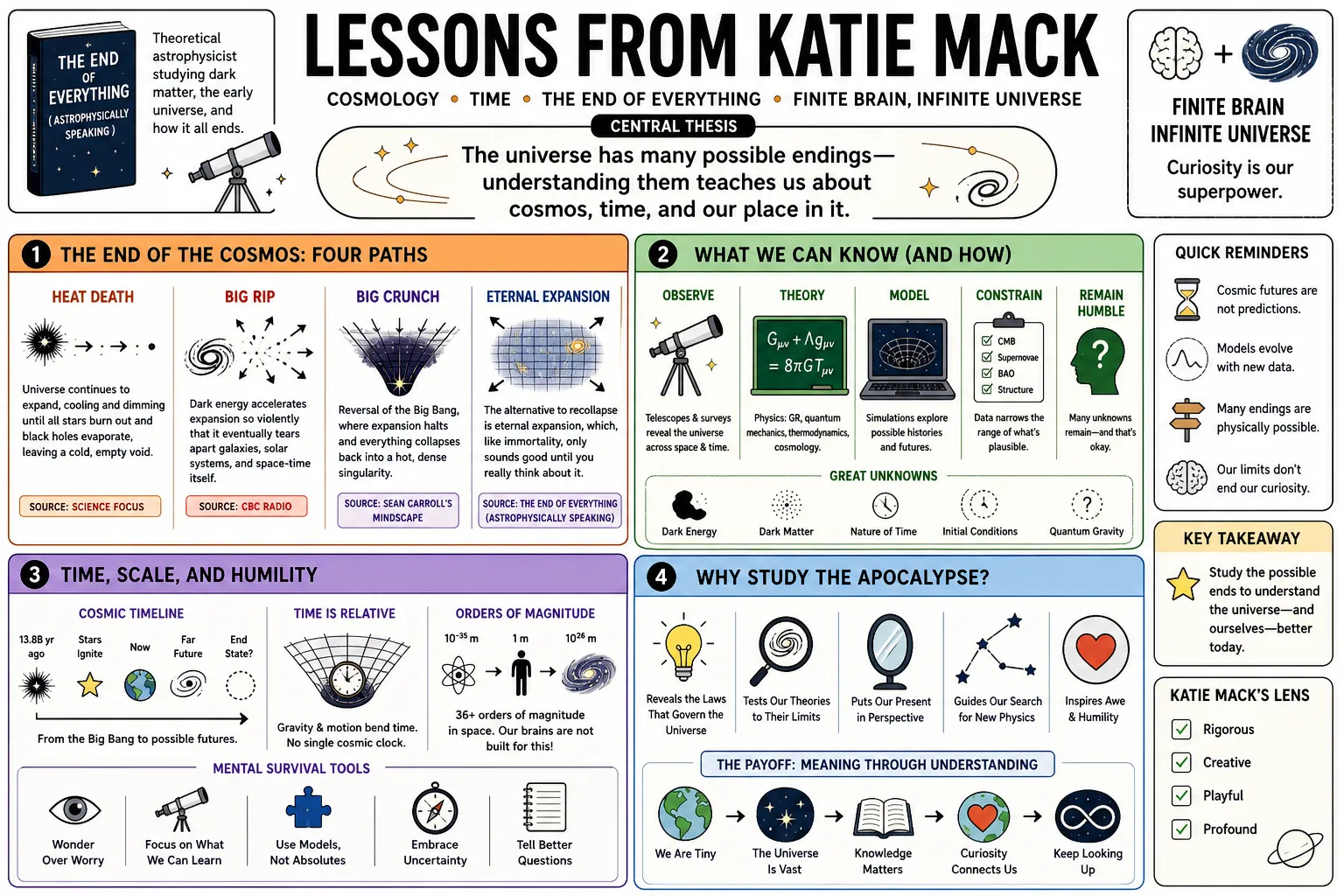
Lessons from Katie Mack
Theoretical astrophysicist Katie Mack studies dark matter, the early universe, and how it all ends. Her book The End of Everything (Astrophysically Speaking) breaks down the physics of our eventual cosmic demise. This profile covers her views on cosmology, time, and what it means to study an infinite universe with a finite brain.
Part 1: The End of the Cosmos
- On Heat Death: "The universe will continue to expand, cooling and dimming until all stars burn out and black holes evaporate, leaving a cold, empty void." — Source: Science Focus
- On the Big Rip: "In a Big Rip scenario, dark energy accelerates expansion so violently that it eventually tears apart galaxies, solar systems, and space-time itself." — Source: CBC Radio
- On the Big Crunch: "The Big Crunch theorizes a reversal of the Big Bang, where expansion halts and everything collapses back into a hot, dense singularity." — Source: Sean Carroll's Mindscape
- On eternal expansion: "The alternative to recollapse is eternal expansion, which, like immortality, only sounds good until you really think about it." — Source: The End of Everything (Astrophysically Speaking)
- On studying the apocalypse: "Understanding how the universe ends is fundamentally about understanding the physical laws that govern how it operates right now." — Source: Perimeter Institute
- On cosmic longevity: "The universe has already been around for 13.8 billion years, and in most scenarios, it has trillions of years left before any final ending." — Source: National Geographic
- On the appeal of endings: "There is a strange comfort in knowing that the universe has a lifecycle, that it isn't a static, unchanging background." — Source: CBC Radio
- On the breakdown of matter: "In a sufficiently long timeline, even protons themselves might decay, erasing the basic building blocks of matter." — Source: Science Focus
- On the emptiness of the future: "Eventually, the expansion of space will carry other galaxies so far away that their light can no longer reach us, leaving an observer with an entirely dark sky." — Source: The End of Everything (Astrophysically Speaking)
- On the final state: "The ultimate end state of the universe is likely a state of maximum entropy, where no more work can be done and nothing new can ever happen." — Source: Sean Carroll's Mindscape
Part 2: The Big Bang and Origins
- On human composition: "You hold within you the dust of ancient generations of stars. But you are also, to a very large fraction, built out of by-products of the actual Big Bang." — Source: The End of Everything (Astrophysically Speaking)
- On cosmic inflation: "The theory of inflation suggests the universe expanded exponentially in a fraction of a second, smoothing out irregularities and setting the stage for galaxy formation." — Source: Perimeter Institute
- On the Cosmic Microwave Background: "The CMB is the afterglow of the Big Bang, a snapshot of the universe when it first became cool enough for light to travel freely." — Source: Quanta Magazine
- On the singularity: "The singularity at the beginning of the universe represents a breakdown in our current laws of physics, a point of infinite density and temperature." — Source: Sean Carroll's Mindscape
- On the early universe: "In its earliest moments, the universe was a chaotic, dense plasma where particles and antiparticles constantly annihilated each other." — Source: Science Focus
- On looking backward: "When astrophysicists study the distant universe, we are literally looking back in time, studying conditions that existed billions of years ago." — Source: CBC Radio
- On the asymmetry of matter: "One of the great mysteries of the Big Bang is why there was slightly more matter than antimatter, allowing anything to exist at all." — Source: National Geographic
- On the first stars: "The earliest stars were massive, bright, and short-lived, forging the heavier elements necessary for rocky planets and life." — Source: Perimeter Institute
- On cosmic evolution: "The history of the universe is a story of decreasing temperature and increasing complexity, from a hot plasma to complex biological organisms." — Source: The End of Everything (Astrophysically Speaking)
Part 3: Vacuum Decay and Quantum Shifts
- On the mechanics of Vacuum Decay: "Vacuum decay is a quantum shift in the laws of physics that would propagate outward at the speed of light, altering reality completely." — Source: Science Focus
- On the suddenness of the event: "Because vacuum decay travels at the speed of light, you wouldn't see it coming. The universe would simply end before the visual information reached your eyes." — Source: CBC Radio
- On true versus false vacuums: "The concept relies on the idea that our universe might be sitting in a 'false vacuum' state, and could spontaneously drop into a lower-energy 'true vacuum'." — Source: Sean Carroll's Mindscape
- On the role of the Higgs boson: "The mass of the Higgs boson suggests that our universe's vacuum state might be metastable, making vacuum decay theoretically possible." — Source: Quanta Magazine
- On survivability: "Vacuum decay is entirely un-survivable. It rewrites the rules of physics, meaning molecules, atoms, and chemistry as we know them could no longer exist." — Source: National Geographic
- On the probability: "While vacuum decay could technically happen at any moment, the mathematics suggest it is unlikely to occur for another $10^{100}$ years." — Source: Science Focus
- On existential dread: "People often fixate on vacuum decay because it is sudden and unpredictable, unlike the slow, grinding death of maximum entropy." — Source: The End of Everything (Astrophysically Speaking)
- On the bubble of destruction: "The decay would manifest as a bubble of new physics expanding through the cosmos, destroying everything it touches." — Source: Perimeter Institute
- On accepting the theory: "If vacuum decay is possible, it is a reminder that the stability we perceive in the universe is an illusion at the quantum level." — Source: Sean Carroll's Mindscape
Part 4: Dark Matter and Invisible Forces
- On the dominance of dark matter: "Dark matter makes up roughly 25% of the universe, massively outweighing the visible matter we interact with daily." — Source: Quanta Magazine
- On holding galaxies together: "Without dark matter providing a gravitational scaffold, galaxies would spin apart; there isn't enough visible mass to hold them together." — Source: Perimeter Institute
- On the frustrating invisibility: "Dark matter does not interact with light or electromagnetism, making it completely invisible and incredibly difficult to study directly." — Source: Science Focus
- On theoretical particle models: "Theorists have proposed many candidates for dark matter, from Weakly Interacting Massive Particles to axions, but none have been directly detected." — Source: Sean Carroll's Mindscape
- On the cosmic web: "Dark matter forms a massive web across the universe, dictating where galaxies form and how clusters of galaxies group together over time." — Source: National Geographic
- On dark energy versus dark matter: "While dark matter acts as the gravitational glue pulling the universe together, dark energy acts as a repelling force pushing it apart." — Source: CBC Radio
- On the nature of dark energy: "Dark energy is an intrinsic property of space itself, causing the expansion of the universe to accelerate rather than slow down." — Source: The End of Everything (Astrophysically Speaking)
- On our ignorance: "The fact that 95% of the universe consists of dark matter and dark energy means we are ignorant of what most of reality actually is." — Source: Perimeter Institute
- On the necessity of dark matter: "Without the gravitational influence of dark matter in the early universe, structures like our Milky Way would never have had the chance to form." — Source: Quanta Magazine
Part 5: Time, Entropy, and Observation
- On seeing the past: "Everything you see is in the past, as far as you're concerned. If you look up at the Moon, you're seeing a little over a second ago." — Source: The End of Everything (Astrophysically Speaking)
- On the delay of sunlight: "The Sun is more than eight minutes in the past. And the stars you see in the night sky are deep in the past, from just a few years to millennia." — Source: The End of Everything (Astrophysically Speaking)
- On the law of entropy: "In fact, it's possible that the only reason we can remember the past and not the future is that 'things can only get worse' is a truth so universal that it shapes reality as we know it." — Source: The End of Everything (Astrophysically Speaking)
- On the arrow of time: "Entropy provides the universe with an arrow of time, a distinct direction moving from order and structure toward chaos and equilibrium." — Source: Sean Carroll's Mindscape
- On the cost of action: "Every attempt to bend some part of the world to our will creates disorder somewhere else, often in the form of heat." — Source: The End of Everything (Astrophysically Speaking)
- On deep time: "Thinking in cosmic timescales requires abandoning human intuitions about duration, scaling up to billions and trillions of years." — Source: Science Focus
- On theoretical recurrences: "And from time to time, the fluctuation doesn't produce a Big Bang, it just re-creates last Tuesday... And every other moment of your life." — Source: The End of Everything (Astrophysically Speaking)
- On the limits of observation: "Because light takes time to travel, there is a hard horizon on the observable universe beyond which we can never see." — Source: CBC Radio
- On memory and physics: "The way our brains record memories is fundamentally tied to the physical process of entropy increasing in our immediate environment." — Source: Sean Carroll's Mindscape
- On the persistence of information: "Whether information is truly lost when a black hole evaporates remains one of the central conflicts between quantum mechanics and general relativity." — Source: Quanta Magazine
Part 6: Human Insignificance and Awe
- On finite comprehension: "There is simply no easy way to hold infinite space in a finite brain." — Source: The End of Everything (Astrophysically Speaking)
- On cosmic self-awareness: "You are a way for the universe to be in awe of itself." — Source: Perimeter Institute
- On our dual nature: "We are a species poised between an awareness of our ultimate insignificance and an ability to reach far beyond our mundane lives, into the void, to solve the most fundamental mysteries of the cosmos." — Source: The End of Everything (Astrophysically Speaking)
- On existential perspective: "Studying the end of the universe can induce dread, but it also provides a perspective that makes everyday anxieties feel remarkably small." — Source: CBC Radio
- On the absurdity of physics: "It's not that it can't be true, but that if it is, nothing makes sense, and we might as well give up on trying to understand the universe at all." — Source: The End of Everything (Astrophysically Speaking)
- On temporary existence: "The fact that the universe will eventually end does not rob our current existence of meaning; it highlights the rarity of our consciousness." — Source: Sean Carroll's Mindscape
- On humanity's reach: "With mathematics and telescopes, a small species on a rocky planet has managed to decode the history of billions of lightyears of space." — Source: National Geographic
- On embracing the void: "Rather than fearing the vast emptiness of space, we should appreciate the unique physical conditions that allow us to observe it." — Source: Science Focus
- On poetic science: "Cosmology inherently borders on philosophy and poetry because it forces us to confront questions about origins, endings, and purpose." — Source: Perimeter Institute
- On the beauty of the cosmos: "The universe is fundamentally violent and hostile to life, yet its mechanics produce structures of profound and undeniable beauty." — Source: Quanta Magazine
Part 7: The Life of a Theoretical Astrophysicist
- On the theorist's laboratory: "As a theoretical astrophysicist, my lab isn't a telescope dome; it is a computer where I write code and manipulate equations." — Source: Science Focus
- On the reality of the work: "Much of theoretical physics involves long periods of being stuck on a math problem, hunting for bugs in code, or reading papers by colleagues." — Source: CBC Radio
- On the pursuit of answers: "Theoretical physics is driven by the compulsion to ask 'why' long after it is practical to do so." — Source: Sean Carroll's Mindscape
- On relying on observers: "Theorists build models of how the universe might work, but we rely entirely on observational astronomers to look at the sky and tell us if we are right." — Source: Perimeter Institute
- On mathematical elegance: "There is a profound satisfaction in finding an elegant mathematical solution, even if it takes years to determine if it describes reality." — Source: Quanta Magazine
- On dealing with failure: "In theoretical physics, most of your ideas will be wrong. Learning to accept that and move to the next hypothesis is a core part of the job." — Source: National Geographic
- On interdisciplinary physics: "Modern cosmology requires a synthesis of general relativity on a massive scale and quantum mechanics at the subatomic level." — Source: Science Focus
- On the pace of discovery: "Breakthroughs in physics are rarely 'eureka' moments; they are usually the result of slow, collective work by hundreds of researchers." — Source: Sean Carroll's Mindscape
- On academic collaboration: "Physics is a conversation. You test your ideas by arguing with colleagues, presenting at conferences, and submitting to peer review." — Source: Perimeter Institute
Part 8: Science Communication and Fiction
- On accessible science: "Translating complex mathematical concepts into language the public can understand is a necessary challenge for modern physics." — Source: Perimeter Institute
- On using social media: "Platforms like Twitter allow scientists to bypass traditional media filters and speak directly to people curious about the cosmos." — Source: CBC Radio
- On science fiction as an outlet: "Reading and engaging with science fiction provides a form of escapism that still wrestles with the rules and possibilities of physics." — Source: Sean Carroll's Mindscape
- On the poetry of space: "Projects like 'Disorientation' merge the rigor of cosmology with the emotional resonance of poetry, reflecting how space actually feels." — Source: Science Focus
- On debunking misconceptions: "A significant part of public science communication is simply clarifying what we actually know versus what is speculative or misrepresented in pop culture." — Source: National Geographic
- On the narrative of the universe: "When writing about the end of the universe, the goal is to tell a compelling story where the main character is space-time itself." — Source: Quanta Magazine
- On inspiring the public: "The best outcome of science communication is not just imparting facts, but conveying the thrill of discovery and the scale of the unknown." — Source: Perimeter Institute
- On the limits of metaphor: "Analogies are essential for explaining physics to a general audience, but they always break down if you push them too far." — Source: Sean Carroll's Mindscape
- On the scientist's duty: "Researchers have a responsibility to share what they learn; the universe belongs to everyone, and its mechanics should be public knowledge." — Source: Science Focus