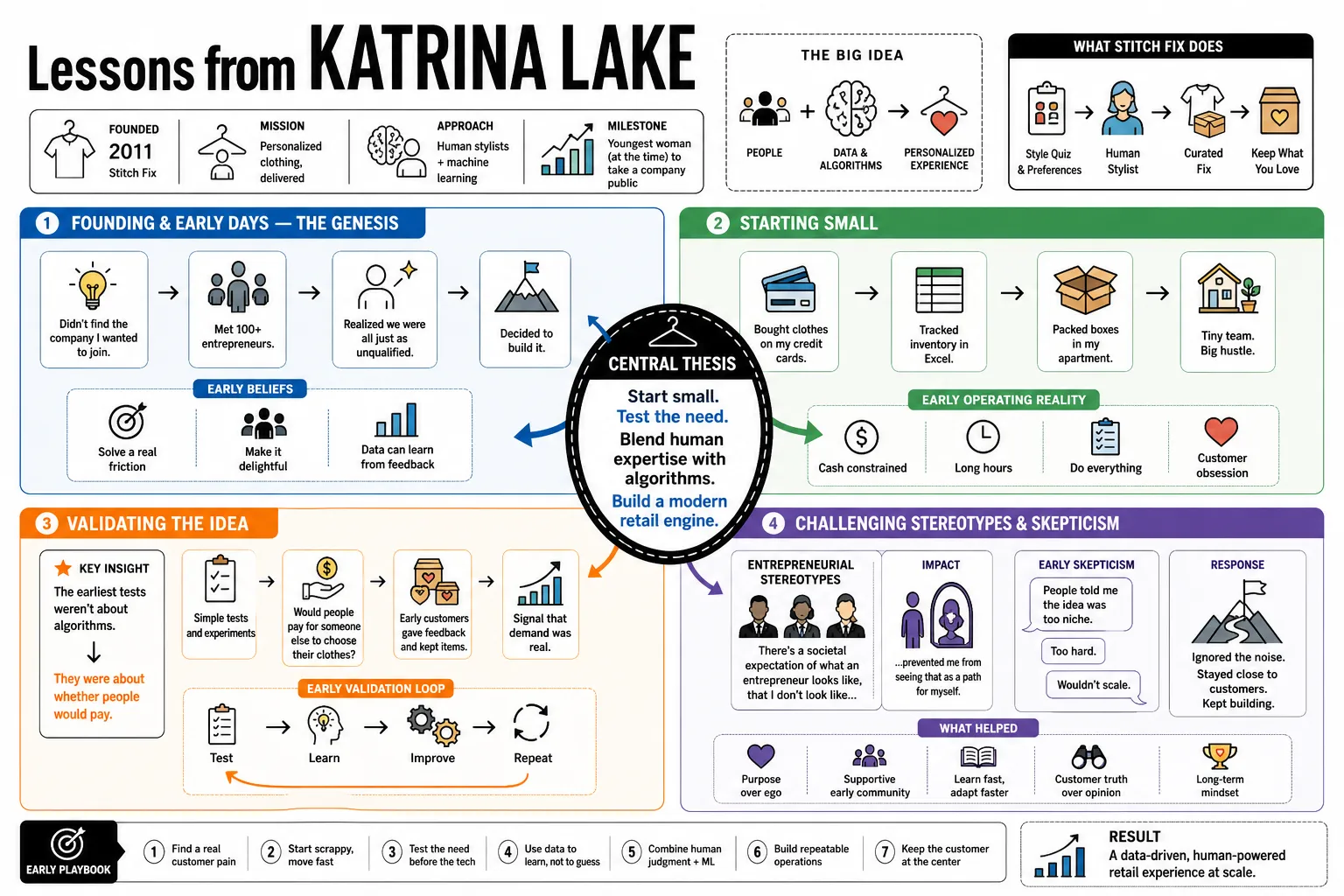
Lessons from Katrina Lake
Katrina Lake founded Stitch Fix in 2011 for people who wanted clothes that fit their style but hated shopping. She grew the business by pairing human stylists with machine learning, eventually becoming the youngest woman at the time to take a company public. This collection covers her approach to unit economics, applied algorithms, and running a modern retail operation.
Part 1: Founding and Early Days
- On the Genesis: "I didn't quite find the company I wanted to join, but I met more than 100 entrepreneurs and realized that all these entrepreneurs were just as unqualified as I was." — Source: [What Should I Read Next?]
- On Starting Small: "We started by buying clothes on my credit cards, tracking inventory in an Excel spreadsheet, and packing boxes in my apartment." — Source: [NPR's How I Built This]
- On Validating the Idea: "The earliest tests weren't about building algorithms; they were about seeing if people would actually pay for someone else to choose their clothes." — Source: [Fast Company]
- On Entrepreneurial Stereotypes: "There’s a societal expectation of what an entrepreneur looks like, that I don’t look like... prevented me from seeing that as a path for myself." — Source: [Forbes]
- On Early Skepticism: "People told me the idea was too inventory-heavy and that apparel was a terrible category for a startup." — Source: [Inc.]
- On Finding Co-Founders: "I was looking for people who were as passionate about the problem we were solving as I was, not just someone with a certain resume." — Source: [First Round Review]
- On the Target Audience: "We thought our core customer would be a busy executive, but we quickly found it was actually women everywhere who just wanted a better way to shop." — Source: [Time]
- On the Value of Ignorance: "Sometimes not knowing how hard something is going to be is the exact advantage you need to actually start." — Source: [Business Insider]
- On Being Unqualified: "If I wanted to join the retailer of the future, I could just start it myself, even if I didn't feel perfectly ready." — Source: [Fortune]
- On Early Hustle: "I used to stand at train stations handing out flyers to get our first few hundred customers to try the service." — Source: [Harvard Business School]
Part 2: Fundraising and Constraints
- On Limited Capital: "If I had been handed $100 million, I don't know that I would have understood the business as well as I did." — Source: [Forbes]
- On Profitability: "It forced us to think about profitability really early so that we weren’t dependent on venture capitalists." — Source: [Forbes]
- On Being Underestimated: "The adage that what doesn’t kill you makes you stronger could not have been more true for us." — Source: [Forbes]
- On Pitching VCs: "I had to explain the problem of shopping to rooms full of men who mostly wore the exact same fleece every day." — Source: [CNBC]
- On Capital Efficiency: "We raised just $42 million before going public, which is incredibly lean for an e-commerce company of our scale." — Source: [TechCrunch]
- On Constraint as an Advantage: "Having less money meant we couldn't paper over our mistakes with customer acquisition spend. We had to fix the actual product." — Source: [20VC Podcast]
- On Board Dynamics: "I looked for investors who asked the right questions rather than those who claimed to have all the answers." — Source: [StrictlyVC]
- On Raising Money as a Woman: "You realize quickly that the questions you get asked are often about risk mitigation, whereas male founders get asked about upside and vision." — Source: [Recode]
- On Sustainable Growth: "We never wanted to buy our growth. We wanted to build a business that functioned on its own merits." — Source: [The Wall Street Journal]
- On Valuation: "A high valuation is not a measure of success; building a durable, profitable company is the real measure." — Source: [Bloomberg]
Part 3: Data Science and Personalization
- On Algorithms vs. Humans: "We've never sent a fix where a human didn't choose it. The human touch is super important." — Source: [Time]
- On the Role of Tech: "What makes this company special is undoubtedly technology. But I just don’t believe in the tech tag... we are a retail company." — Source: [Time]
- On Chief Algorithm Officers: "Bringing Eric Colson on board early was a signal that data science wasn't just a function, it was our core strategy." — Source: [Harvard Business Review]
- On Personalization at Scale: "The goal is to make a mass-market service feel completely bespoke to every single individual." — Source: [Wired]
- On Feedback Loops: "Every item a customer keeps or returns makes our algorithms smarter for their next box and for everyone else's." — Source: [MIT Technology Review]
- On Data as a Differentiator: "Traditional retail buys inventory based on intuition; we buy inventory based on billions of data points of direct customer feedback." — Source: [Fast Company]
- On Human Intuition: "A machine can tell you what fits, but a human stylist understands that a customer wants a dress to wear to her ex-boyfriend's wedding." — Source: [The New York Times]
- On Inventory Efficiency: "Because we know our customers so well, we can turn our inventory far faster than a traditional department store." — Source: [Vogue Business]
- On Data Privacy: "Customers are willing to share incredibly personal data with us because we give them direct value in return." — Source: [Invest Like the Best]
- On Building a Data Culture: "Data shouldn't just live in the engineering department; it has to be accessible to the buyers, the stylists, and the marketers." — Source: [McKinsey]
Part 4: Leadership and Culture
- On Language and Authority: "Saying 'like' doesn't make me a worse leader. I need to keep saying it so young women don't think they need to pretend to be old and experienced to start companies." — Source: [Medium]
- On Authentic Leadership: "You don't have to adopt an aggressive, masculine style to be a highly effective CEO." — Source: [Inflection Point Podcast]
- On Building for the Long Term: "I wanted to build a company culture that I would be proud to have my own children work in one day." — Source: [MaxiTech]
- On Parental Leave: "By taking a full maternity leave as CEO, I wanted to show our employees that they shouldn't have to choose between their family and their career." — Source: [Glamour]
- On Hiring: "We look for people who are highly capable but also possess deep empathy, because our whole business is built on understanding others." — Source: [LinkedIn]
- On Missionaries vs. Mercenaries: "Founders should be driven by a genuine passion to solve a customer problem, not by money or the desire to be in a hot sector." — Source: [25iq]
- On Vulnerability: "Admitting what you don't know is the fastest way to build trust with your executive team." — Source: [Inc.]
- On Decision Making: "The best decisions are often the ones that feel a little uncomfortable at the time, because they require you to challenge the status quo." — Source: [Forbes]
- On Employee Retention: "People stay when they feel their work has a direct impact on the customer's happiness." — Source: [Harvard Business Review]
Part 5: Retail and Customer Experience
- On the Problem with Shopping: "Spending a day at the mall or devoting hours of time to sifting through millions of products online is time consuming, overwhelming, and neither effective nor enjoyable." — Source: [What Should I Read Next?]
- On the Retail Landscape: "The future of retail isn't about giving people more choices; it's about giving them the right choices." — Source: [Business of Fashion]
- On Customer Trust: "We are asking customers to pay for a box of clothes they haven't seen. That requires a tremendous amount of earned trust." — Source: [CNBC]
- On Sizing and Fit: "Fit is the hardest problem in apparel, and it's something that can't be solved by standard sizing charts alone." — Source: [Vogue]
- On E-commerce vs. Brick and Mortar: "The internet made it easy to buy things, but it actually made it harder to discover things. We wanted to solve discovery." — Source: [TechCrunch]
- On the Joy of Unboxing: "We wanted the experience of receiving a Fix to feel like getting a gift from a friend who knows your taste perfectly." — Source: [Fast Company]
- On Brand Agnosticism: "Customers don't always care about the label; they care about how the garment makes them feel and how it fits their body." — Source: [WWD]
- On Customer Empathy: "You have to truly care about the anxiety a woman feels when she's standing in front of her closet in the morning." — Source: [Time]
- On Expanding Categories: "Whether it's men's, plus size, or kids, the core problem remains the same: finding things you love without the hassle." — Source: [Bloomberg]
Part 6: Female Founders and Diversity
- On Changing Perceptions: "It’s really, really important that we start to change that perception and evolve what my kids... are going to look at and think about as career opportunities." — Source: [Medium]
- On Progress: "Where we are today is not where we want to be. But there are a lot of positive signals of change to come." — Source: [Forbes]
- On Being the Youngest Female Founder to IPO: "I hope that title is taken away from me very quickly, because it means more women are breaking through." — Source: [Fortune]
- On the Funding Gap: "The fact that female founders receive a tiny fraction of venture capital is a massive missed opportunity for investors." — Source: [PitchBook]
- On Board Diversity: "If your customer base is predominantly women, it makes zero business sense to have a board composed entirely of men." — Source: [The Wall Street Journal]
- On Mentorship: "I feel a deep responsibility to advise and invest in the next generation of female entrepreneurs." — Source: [Forbes]
- On Systemic Barriers: "We don't just need to encourage more women to start companies; we need to change the structures that evaluate and fund them." — Source: [TechCrunch]
- On Representation: "Seeing someone who looks like you doing the job you want makes it infinitely more attainable in your own mind." — Source: [Inc.]
- On Redefining Success: "Success for women in business shouldn't mean having to operate exactly like the men who came before us." — Source: [Fast Company]
Part 7: Scaling and Public Markets
- On the IPO Process: "Taking a company public is a milestone, not a destination. It's just a different way to finance the business." — Source: [CNBC]
- On Ringing the Bell: "Holding my young son while ringing the Nasdaq bell was a deliberate choice to show that motherhood and executive leadership can coexist." — Source: [The New York Times]
- On Public Markets: "The scrutiny of the public market forces a level of discipline that ultimately makes you a better company." — Source: [Bloomberg]
- On Managing Growth: "The hardest part of scaling is ensuring that the customer experience at one million users is just as good as it was at ten thousand." — Source: [Harvard Business Review]
- On Evolving the Team: "The people who get you to $10 million in revenue might not be the same people who can get you to $1 billion, and that's okay." — Source: [First Round Review]
- On Maintaining Culture at Scale: "Culture isn't a ping pong table; it's how your team makes decisions when you aren't in the room." — Source: [Forbes]
- On Quarterly Pressures: "You have to balance delivering short-term results with investing in the long-term infrastructure that will sustain the business." — Source: [The Wall Street Journal]
- On International Expansion: "Entering a new market isn't just about translating a website; it requires a deep understanding of local nuances in fashion and behavior." — Source: [Vogue Business]
- On Operational Complexity: "Scaling a business that deals with physical inventory and complex logistics is exponentially harder than scaling pure software." — Source: [Wired]
Part 8: Career Transitions and The Future
- On Stepping Down as CEO: "Knowing when to pass the baton is one of the most critical decisions a founder can make." — Source: [Stitch Fix Newsroom]
- On Identifying Successors: "I wanted to find leadership that could take the company into its next chapter and do things that I couldn't." — Source: [Forbes]
- On the Founder's Role Post-CEO: "As Executive Chairperson, my job shifted from running the day-to-day to protecting the long-term vision and supporting the new CEO." — Source: [Fortune]
- On Re-engaging: "Sometimes stepping away gives you the exact perspective you need to come back and see the business with fresh eyes." — Source: [Business Insider]
- On the Future of E-commerce: "We are still in the early innings of figuring out how algorithms and human expertise can work together to solve complex consumer problems." — Source: [Invest Like the Best]
- On Personal Growth: "Your identity shouldn't be entirely tied up in the company you founded; you have to evolve as an individual as well." — Source: [Inflection Point Podcast]
- On the Next Generation: "I am most excited about companies that are using technology to solve deeply human, emotional problems, rather than just optimizing for clicks." — Source: [TechCrunch]
- On Legacy: "I hope my legacy is that I built a company that made people feel good about themselves and proved that a different kind of leader can succeed." — Source: [Time]
- On Embracing Change: "The retail landscape will always shift. The companies that survive are the ones that fall in love with the customer's problem, not their own solution." — Source: [Fast Company]