Kayvon Beykpour is a software developer and product executive who co-founded the live-streaming app Periscope and later served as Twitter's Head of Consumer Product. He is known for pushing established companies to test their ingrained assumptions, which he calls "sacred cows," to revive stagnant product cultures. This profile collects his tactical advice on building consumer apps, managing engineering teams, and using AI to reduce software development overhead.
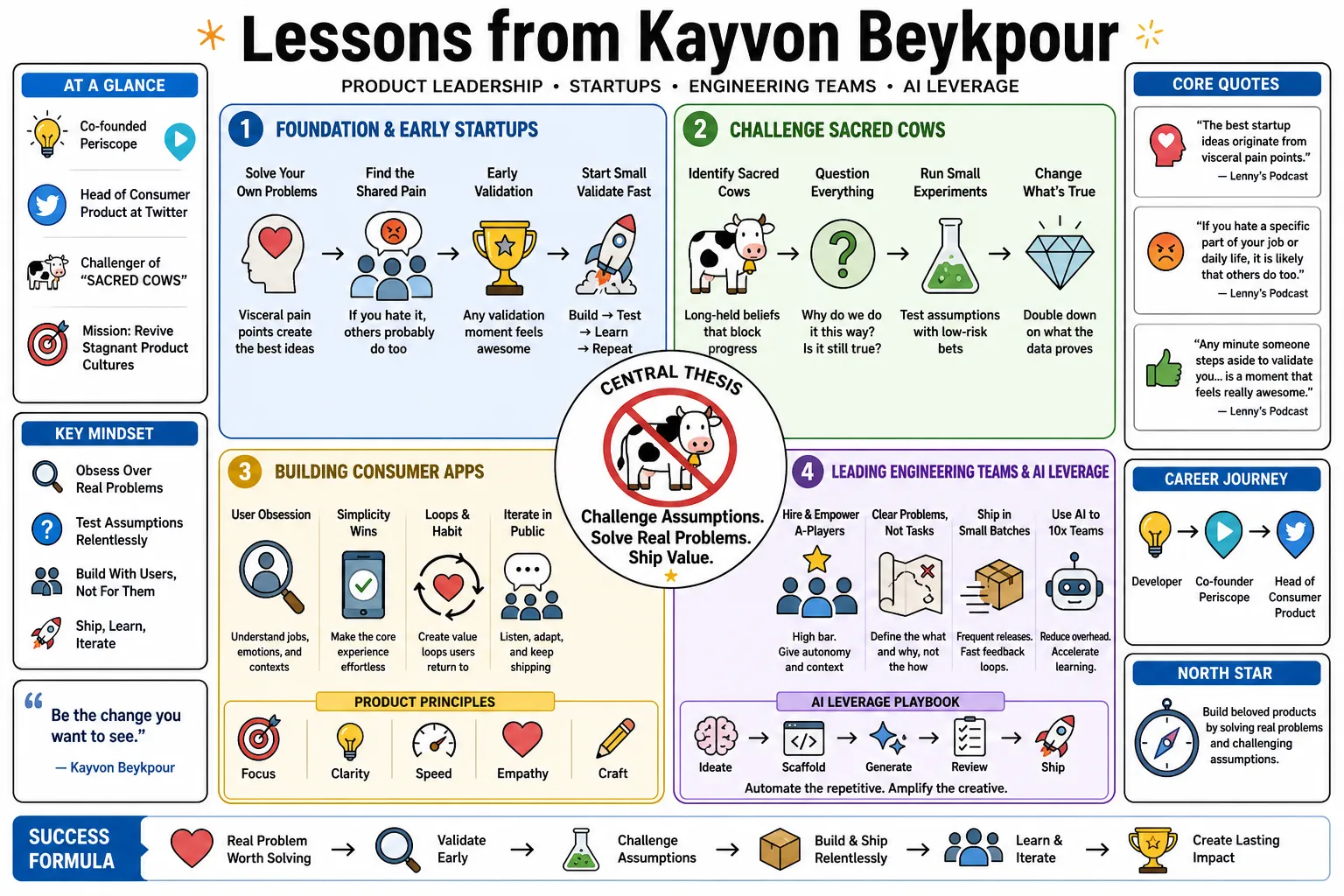
Part 1: The Foundation and Early Startups
- On solving your own problems: "The best startup ideas originate from visceral pain points. Look for problems you experience personally—tasks that feel inefficient or areas where existing tools fail to solve a specific, nagging frustration." — Source: Lenny's Podcast
- On finding opportunity: "If you hate a specific part of your job or daily life, it is likely that others do too, creating an opportunity to be the change you want to see." — Source: Lenny's Podcast
- On early validation: "It can be hard and terrifying to build a startup and anytime there's a minute where someone steps aside to validate you — whether it's friends, parents or an acquirer, it's a moment that feels really awesome." — Source: Business Insider
- On intuition: "Product-market fit is not a static destination, but a byproduct of deep customer understanding and consistent execution guided by intuition." — Source: Between Two Founders
- On starting young: "We built TerriblyClever because we were students who just wanted a better way to interact with our university's services." — Source: Bessemer Venture Partners
- On building for utility: "Our early work on mobile campus applications proved that taking existing, clunky web services and making them native to mobile could unlock massive engagement." — Source: Bessemer Venture Partners
- On the founder journey: "The path to building something meaningful is rarely a straight line; it requires an iterative approach and a willingness to follow your instincts." — Source: Between Two Founders
- On early team dynamics: "Working with people you trust implicitly, like co-founders from your university days, allows you to move faster and argue more productively." — Source: Between Two Founders
- On early acquisitions: "Selling TerriblyClever to Blackboard was a lesson in how large organizations view innovation, and it gave me my first real taste of operating within a bigger corporate structure." — Source: Bessemer Venture Partners
Part 2: Building Periscope and Mobile Teleportation
- On the core idea: "Periscope was like a mobile teleportation service. It let users livestream whatever was happening around them for anyone who wanted to watch." — Source: Business Insider
- On inspiration: "We conceived the idea after being unable to view live footage of protests in Istanbul's Taksim Square." — Source: Medium
- On passive vs active media: "Instead of Youtube, where a viewing experience was passive, Periscope was active. Viewers could comment, ask questions, and heart broadcasts in real time." — Source: Business Insider
- On breaking the fourth wall: "We were really interested in breaking that fourth wall of, 'I know something's happening right now, but what if I could participate in that experience?'" — Source: Menlo Ventures
- On interactive media: "What if I could actually effect the experience and make something else happen by actually interacting with that creator?" — Source: Menlo Ventures
- On empathy: "The emotional and human impact of technology is far more important than just its functional utility." — Source: LinkHumans
- On competition: "Build a product people love to use. Competition is good, but we don't let it distract us." — Source: ABC 10
- On reacting to rivals: "You don't want to get into a mode where your product development is based on them." — Source: ABC 10
- On rumors of shutting down: "It's funny that people keep saying that. Everything we've done demonstrates that we're doubling down on the platform." — Source: Mashable
- On live video's impact: Sciences Po introduced Beykpour's keynote by describing Periscope as a live-video platform with more than 10 million accounts broadcasting through Periscope and Twitter, which supports the more conservative takeaway that he saw live streaming as a way to bring unfolding events directly to viewers instead of relying only on traditional broadcast filters. — Reference: Sciences Po event page for Beykpour's Periscope keynote
Part 3: Navigating the Acquisition
- On selling pre-launch: "It was an incredibly fortunate situation." — Source: Business Insider
- On external validation: "Anytime there's a minute where someone steps aside to validate you... it's a moment that feels really awesome." — Source: Business Insider
- On alignment: "You cannot successfully execute on product or culture without alignment among leadership. If the leadership team is not aligned, it creates friction." — Source: Tiny Stakeholders
- On integration: "Merging a fast-moving startup into a larger public company requires a deliberate effort to protect the startup's core culture while leveraging the parent company's distribution." — Source: TechCrunch
- On retaining talent: "The key to a successful acquisition is making sure the founders and early team members still feel a sense of ownership over the product's destiny." — Source: Between Two Founders
- On M&A strategy: "Acquisitions should ideally bring in not just technology, but entrepreneurial energy that can infect the rest of the organization." — Source: Lenny's Podcast
- On operating independently: "For a time, keeping Periscope as a standalone app allowed us to iterate rapidly without being bogged down by the core platform's constraints." — Source: Mashable
- On the emotional toll: "Selling a company is an emotional rollercoaster; you are giving up total control of something you birthed in exchange for scale." — Source: Business Insider
- On integration timing: "Eventually, the right move was to integrate the core live video experience directly into the main app to reduce friction for the end user." — Source: The Vergecast
Part 4: Rethinking Product Frameworks
- On Jobs to Be Done: "Rigid product frameworks like 'Jobs to Be Done' have limitations. Sometimes they are taken too far, replacing actual user empathy with mechanical processes." — Source: Lenny's Podcast
- On being a user: "You must be a voracious user of the products you build. Direct experience hones your taste far better than any framework." — Source: Lenny's Podcast
- On challenging assumptions: "Look for the 'sacred cows'—the deeply ingrained, often unspoken assumptions about what cannot be changed in a product." — Source: Lenny's Podcast
- On roadmaps: "Those sacred cows are actually a built-in roadmap of innovations that are worth challenging and testing." — Source: Lenny's Podcast
- On focus: "You have to be hyper-focused on doing very, very few things to drive meaningful results." — Source: Medium
- On iteration vs pivoting: "Establish rigorous processes for product reviews. Setting clear agendas and consistently reviewing data helps objectively determine if a product is worth further iteration or if it is time to move on." — Source: 20VC
- On letting go: "One of the most difficult decisions for a product leader is knowing when to kill a feature that you spent months building but isn't resonating." — Source: 20VC
- On building vs buying: "Sometimes the fastest way to solve a product gap is not to build it internally, but to find a team externally that has already obsessed over the problem." — Source: Lenny's Podcast
- On product mechanics: "Process is as important as vision. How you structure reviews and communicate with your team are the mechanics that determine success." — Source: 20VC
Part 5: Product Team Culture and Hiring
- On the first hire: "Founders often struggle with when to hand off product decisions. Look for specific traits and characteristics in early hires rather than just 'experience.'" — Source: 20VC
- On interviews: "Use case studies and actual product demos during the hiring process to see how candidates think through problems in real-time, rather than relying solely on interviews." — Source: 20VC
- On autonomy: "The best leaders provide a lot of trust and autonomy to their leadership team, allowing them to make critical decisions even if the leader themselves might hold a different opinion." — Source: Medium
- On acquihires: "To shift stagnant cultures, bring in ambitious, entrepreneurial founders who are given significant responsibility and autonomy to lead new bets." — Source: Lenny's Podcast
- On driving change: "Driving change at scale requires leadership to be 'on the wagon,' repeatedly telling a compelling vision and strategy story to ensure the entire organization is aligned." — Source: Lenny's Podcast
- On executive roles: "Being at the helm provides 'real talk'—exposure to intimate, complex problems that you do not see until you are at the top of the organization." — Source: Podscripts
- On team structure: "Organize product reviews so that they are focused on unblocking the team rather than just serving as a status update for management." — Source: 20VC
- On maintaining speed: In Lenny Rachitsky's interview, Beykpour describes trying to change Twitter's stagnant product culture and admits the company was not swift enough on some organizational changes, supporting the lesson that large teams have to fight the slowdown that comes with scale instead of accepting it as inevitable. — Reference: Lenny's interview with Kayvon Beykpour on changing Twitter's stagnant culture
- On rewarding risk: "If you want a culture that ships, you have to celebrate the teams that take big swings, even if the feature ultimately fails." — Source: Lenny's Podcast
- On the product manager role: "A good PM acts as the connective tissue between engineering, design, and the user, not just a project manager checking off a list." — Source: Intro
Part 6: Leading Product at Twitter
- On Super Follows: "You're super following them for the things that they don't tweet. Which I think is so spot on." — Source: Medium
- On Community Notes: Twitter's launch post for Birdwatch says people valued notes written in the community's voice and useful context over top-down true-or-false labels, which fits the broader product direction Beykpour was helping drive toward community-assisted moderation. — Reference: Twitter/X Birdwatch launch post on community-based misinformation notes
- On scaling moderation: At Code Conference, Beykpour said Twitter had to translate the goal of healthier public conversation into product strategy that makes people feel comfortable participating in public, reinforcing the point that moderation at scale has to be built into product design and user controls rather than handled only as policy enforcement. — Reference: Vox transcript of Kayvon Beykpour at Code Conference on healthier public conversation
- On long-term strategy: "Our initiatives were not reactive—like waiting for an election to pass—but were part of a long-term strategy to innovate." — Source: Medium
- On creator tools: "Providing new ways for creators and users to interact was essential to revitalizing the platform's stagnant product culture." — Source: The Information
- On legacy codebases: "Rebuilding the core engine of a platform like Twitter takes time, but it's a prerequisite for shipping features at the pace users expect." — Source: The Vergecast
- On audio formats: "Spaces was our bet that live audio could capture the spontaneous, conversational magic of the timeline, but with the nuance of human voice." — Source: Big Technology
- On pacing: "We went from shipping almost nothing to shipping multiple major features in a single quarter by completely rethinking how we evaluated risk." — Source: Lenny's Podcast
- On public feedback: "Building a product that millions of people use every day means you get immediate, visceral feedback. You have to learn how to filter the noise from the signal." — Source: Lenny's Podcast
- On the 140-character limit: "Challenging the fundamental constraints of the platform was necessary to see if we were holding ourselves back out of nostalgia rather than utility." — Source: Lenny's Podcast
Part 7: The Musk Transition and Leaving Twitter
- On the initial meeting: "Musk asked, 'Do you want to just like come — You seem like you care about the product and you don't have dumb ideas. Do you want to come hang out?'" — Source: Business Today
- On the Tinder metaphor: "He said, 'We don't have to make this a thing. Just like do you want to hang out and work on the product with us? ... Swipe right on whether you want to be here.'" — Source: Business Insider
- On the interaction: "It was a hilarious interaction, and he was very cool about it during our two-hour meeting covering the history and future of the platform." — Source: Business Today
- On leaving: "Being let go while on paternity leave was abrupt, but it clarified the reality of organizational change at that scale." — Source: Lenny's Podcast
- On the platform's future: "I remain proud to see projects like Community Notes, Spaces, and creator-focused programs continue to grow and be given more oxygen under new leadership." — Source: Lenny's Podcast
- On transitioning out: "Leaving a product you poured seven years into is jarring, but it immediately forces you to look at the market with fresh eyes." — Source: Lenny's Podcast
- On organizational disruption: In Lenny Rachitsky's interview, Beykpour says changing Twitter required repeatedly challenging “sacred cows,” aligning leaders, and moving faster on organizational change, which supports the more defensible lesson that stagnant teams sometimes need a deliberate jolt rather than another round of incremental tweaks. — Reference: Lenny's interview on challenging sacred cows and changing Twitter's culture
- On comfort: Beykpour tells Lenny Rachitsky that entrenched assumptions are often a “built-in roadmap” of innovations worth testing, supporting the lesson that teams get into trouble when they become too attached to legacy constraints instead of questioning them. — Reference: Lenny's interview on sacred cows as a roadmap for innovation
- On legacy: "Your legacy as a product leader isn't just the features you shipped, but the culture of shipping you leave behind for the teams that remain." — Source: Lenny's Podcast
Part 8: Macroscope and AI in Engineering
- On the need for visibility: "As Twitter's head of product, I often found myself just trying to understand the state of things. Despite important tasks and skilled engineers, there was little visibility into how work was moving forward." — Source: Insights Success
- On meeting culture: "If managers still need meetings to check progress, we've failed." — Source: Insights Success
- On the work about the work: "Engineering teams often resort to a soul-crushing mix of endless meetings and scattered tools, leading to bureaucratic process hell—draining, demoralizing, slow." — Source: Macroscope
- On model costs: "$15-25 per review is well over an order of magnitude more expensive than Macroscope. Not because we want to subsidize model costs, but because architecturally our agent can use..." — Source: Techmeme
- On AI speed: "Delightful demo moment that would have been inconceivable a year or two ago... End to end the fix was merged, tested and deployed to prod within 20min-- before the meeting was even over." — Source: TWStalker
- On agentic code: The Apple Podcasts description for Beykpour's Generative Now episode says he is reimagining how teams manage both human and agentic workforces, which supports the conservative takeaway that he sees agentic coding systems as an organizational shift large engineering teams need to learn how to manage directly. — Reference: Apple Podcasts description for Kayvon Beykpour's Generative Now episode
- On turbocharging engineers: CNBC's description of Beykpour's Closing Bell appearance says he discussed how coding is being transformed by AI and why that creates new challenges for teams, supporting the broader lesson that AI is amplifying individual engineers while forcing managers to rethink how they evaluate software work. — Reference: CNBC video description for Beykpour's Macroscope interview
- On token efficiency: The MTS episode description says Beykpour joined to discuss token efficiency in engineering organizations, AI-powered code review systems, and code-based understanding at scale, which is strong enough support for the narrower lesson that efficient token use matters when teams operationalize AI review across large codebases. — Reference: Apple Podcasts listing for Kayvon Beykpour's MTS appearance
- On the future of development: "We are moving away from manual status updates toward AI-powered understanding engines that give real-time visibility into complex codebases." — Source: Yutori