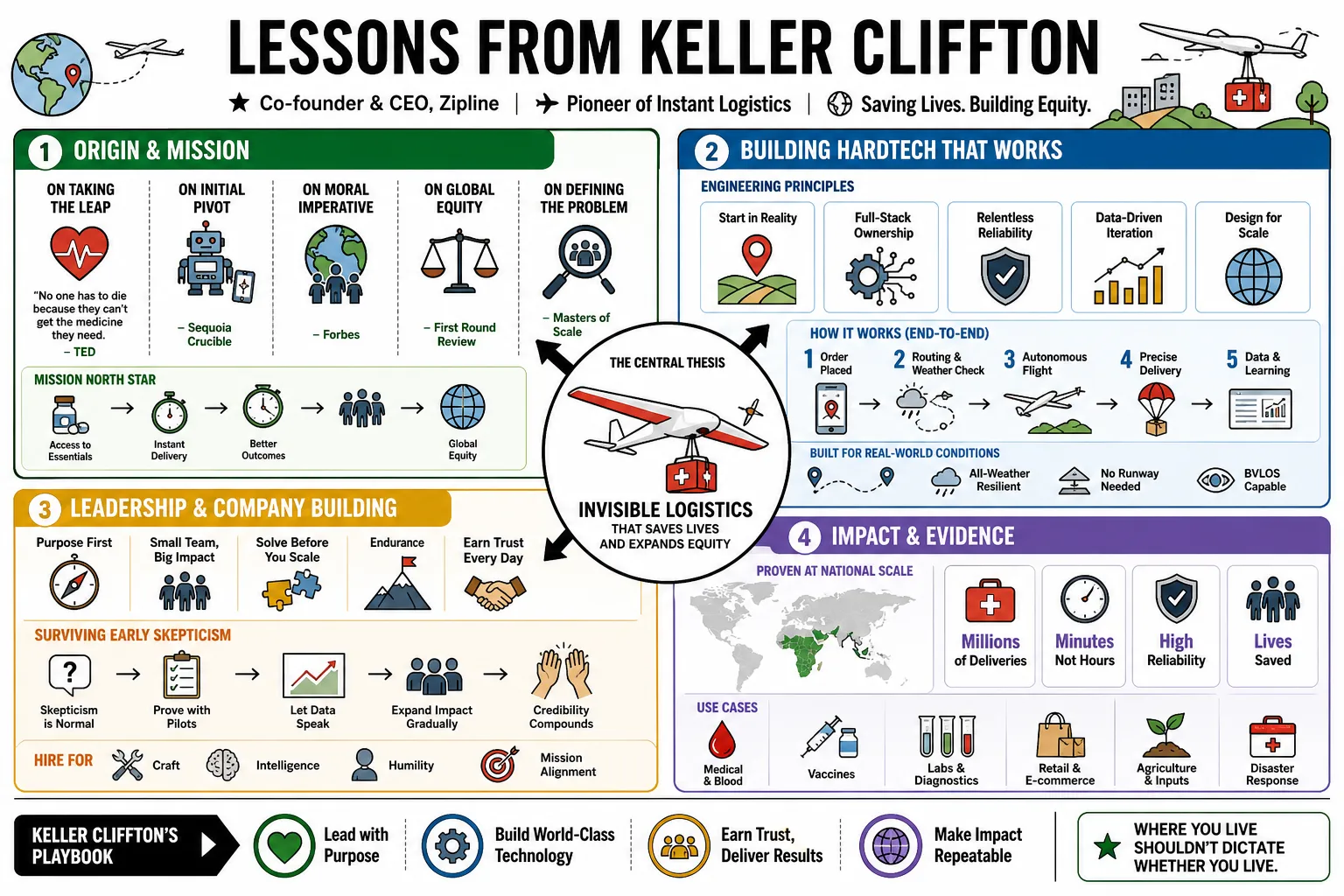
Lessons from Keller Cliffton
Keller Cliffton, co-founder and CEO of Zipline, proved that drone logistics can work at a national scale. From early medical deliveries in Rwanda to global retail, he has turned complex engineering into an invisible utility. This profile collects his practical advice on building hardtech and surviving early skepticism.
Part 1: The Origin and Mission
- On taking the leap: "We started with a simple idea: build a logistics system so fast and reliable that no one has to die because they can't get the medicine they need." — Source: TED
- On the initial pivot: Zipline began when Cliffton shut down the robotic-toy direction and redirected the team toward autonomous delivery for lifesaving medical supplies. — Reference: Sequoia Crucible episode on Zipline pivot
- On moral imperative: "There is a growing feeling around the world that technology is not benefiting the vast majority of people. We wanted to build a company that proves otherwise." — Source: Forbes
- On global equity: Cliffton frames Zipline as a logistics system meant to serve people equally, especially where access to basic medical products has historically failed. — Reference: Goldman Sachs Talks on Zipline mission
- On defining the problem: Zipline narrowed its broad health-system vision into a concrete first wedge: blood delivery, where matching the right product to the right hospital is a logistical nightmare. — Reference: Harvard International Review interview on starting with blood
- On mission-driven work: "The best engineers want to work on problems that matter. If you give them a chance to save lives instead of optimizing ad clicks, they will move mountains." — Source: Fast Company
- On setting constraints: "If you want to solve global logistics, you can't build a system that only works in wealthy suburbs. It has to work in places with no roads and extreme weather." — Source: Business Insider
- On early motivations: "I spent time in Tanzania and saw a text-message database of thousands of stock-outs at clinics. We knew the data was there, the only thing missing was the physical delivery mechanism." — Source: Satoshi Blog
- On long-term focus: Cliffton’s Zipline story is built around a long time horizon: take a big swing on a problem that matters, then keep going when the company is written off. — Reference: Sequoia Crucible key lesson on taking a big swing
- On solving the right equation: "We realized that sending a 3,000-pound gas-combustion vehicle to deliver a two-pound package of medicine didn't make economic or environmental sense." — Source: WSJ Bold Names
Part 2: Overcoming Early Skepticism
- On early feedback: "The overwhelming advice we got was, this is not technologically possible. Even if it were, it wouldn't work reliably." — Source: Satoshi Blog
- On ignoring the naysayers: Early skepticism was rational on paper: the team lacked obvious drone, healthcare, and logistics expertise, but they kept learning in the real world. — Reference: Sequoia Crucible account of investor skepticism
- On the lack of precedent: The absence of a precedent became part of the work: Zipline had to survive being written off while proving the logistics system could actually operate. — Reference: Sequoia Crucible transcript on being written off
- On fundraising struggles: Cliffton warns that hardtech companies face brutal capital reality: physical products often cost far more than early-stage founders or investors expect. — Reference: First Round interview on the 10x hardware cost rule
- On proving the model: "The only way to answer extreme skepticism is with extreme execution. We didn't debate the feasibility; we just launched the service." — Source: Fast Company
- On assumed lack of demand: Demand proved itself in usage: Rwanda expanded Zipline from an initial 21-hospital blood contract into national healthcare infrastructure serving hundreds of facilities. — Reference: Harvard interview on Rwanda expansion
- On regulatory doubts: "People assumed aviation authorities would never let autonomous drones fly beyond visual line of sight. But governments are surprisingly open when you offer them a way to save their citizens' lives." — Source: TED
- On hardware bias: Cliffton argues Zipline is not just an aircraft company; the harder moat is the full logistics system around the drone. — Reference: First Round interview on aircraft being 15 percent of system complexity
- On redefining the impossible: "When people say something is impossible, they usually just mean it hasn't been done yet by a sufficiently motivated team." — Source: WSJ Bold Names
Part 3: Hardtech and Engineering Culture
- On extreme ownership: "There are no handoffs or buffers at Zipline. The engineer who writes the flight code is often the same person out in the field testing the recovery system." — Source: Substack
- On generalist engineers: Zipline hires for practical problem-solvers and fast learners because hardtech roles change quickly and the work crosses hardware, software, and operations. — Reference: First Round interview on Zipline hiring traits
- On relentless testing: "We maintain an obsessive culture of testing. We operate in crazy weather every single day to ensure the system never fails." — Source: Business Insider
- On hiring criteria: "We actively look for a pioneering spirit. We prefer scrappy problem solvers over people who just have traditional academic credentials." — Source: Forbes
- On the reality of hardware: In the physical world, a demo is not enough; the hard part is making the system reliable and useful for customers every day. — Reference: First Round interview on robotics reliability
- On building from first principles: Cliffton favors the fastest workable solution over ornamental engineering; if a simple component works, the team should learn from it before overbuilding. — Reference: Sequoia Crucible key lesson on minimum viable solutions
- On learning from failure: Cliffton treats repeated failure as the price of hard engineering: the process has to teach the team faster than the failures can discourage it. — Reference: Goldman Sachs Talks on being comfortable with failure
- On passion for the mission: "We want people who eat, breathe, and sleep the problem. When lives depend on your code, everyone takes it very seriously." — Source: Tiger Feathers
- On integration: Zipline is full-stack by necessity: the useful system combines software, hardware, operations, and customer delivery into one working product. — Reference: No Priors episode page on full-stack software, hardware, and operations
- On speed of iteration: "The hardware cycle is traditionally slow. We brought the software mindset of rapid iteration into physical engineering, building and testing new airframes in weeks instead of years." — Source: Fast Company
Part 4: Autonomous Logistics and Reliability
- On the goal of invisibility: "Our aim is to create an automated logistics system so predictable and reliable that it ultimately becomes boring." — Source: eScholarship
- On user experience: "Although we are taking advantage of a lot of complex technology on the backend, the experience for the user is really simple: push a button, get what you need." — Source: Leipzig University
- On acoustic systems: Zipline’s autonomy work includes AI acoustic detect-and-avoid, part of making drones safe enough to operate in real airspace. — Reference: No Priors episode page on acoustic detect-and-avoid
- On weather resilience: "A logistics network that shuts down when it rains is useless. We designed our vehicles to fly through high winds and monsoons because that's when people need medicine the most." — Source: Business Insider
- On true autonomy: "These are not remote-controlled planes. They are fully autonomous robots that make their own navigation and safety decisions in real-time." — Source: TED
- On precision delivery: "Dropping a package via parachute into a space the size of a few parking spots requires incredibly precise calculations of wind speed and vehicle trajectory." — Source: Fast Company
- On systemic redundancy: Cliffton’s reliability bar is daily usefulness, not one-off spectacle; autonomous logistics has to keep working in the real world, not just in demos. — Reference: First Round interview on reliable real-world operation
- On scale and uptime: Zipline’s reliability bar is public-infrastructure level: the system now serves thousands of hospitals, so the operation has to work every day, not merely impress in pilots. — Reference: First Round interview on Zipline scale and reliability
- On continuous improvement: "With millions of commercial flights completed, our neural networks are constantly learning. Every flight makes the entire fleet smarter and safer." — Source: WSJ Bold Names
Part 5: Impact on Healthcare in Africa
- On starting in Rwanda: "Rwanda is a country of visionary leadership. They didn't see themselves as a testbed; they saw an opportunity to leapfrog Western infrastructure." — Source: TED
- On reducing maternal mortality: "One of our most profound impacts has been delivering blood for postpartum hemorrhaging. Getting blood to a rural clinic in fifteen minutes instead of four hours is the difference between life and death." — Source: Forbes
- On cold-chain logistics: "Keeping vaccines cold on dirt roads is nearly impossible. By flying over the roads, we preserve the cold chain perfectly from the central warehouse to the patient's arm." — Source: Gavi
- On waste reduction: "Before instant delivery, hospitals had to stockpile blood, leading to massive spoilage rates. We centralized the supply, bringing waste down to virtually zero." — Source: Fast Company
- On national scale: Rwanda moved Zipline beyond a pilot: the service expanded from 21 hospitals to hundreds of facilities and became core infrastructure for the health system. — Reference: Harvard interview on Rwanda national healthcare infrastructure
- On expanding to Ghana: "Scaling into Ghana meant operating in one of the most populous countries in West Africa, proving that the model works across entirely different geographies and health systems." — Source: Satoshi Blog
- On routine healthcare: Zipline’s role broadened from emergency blood into routine medical logistics, including vaccines, cancer therapies, malnutrition treatment, and other public-health supplies. — Reference: Harvard interview on expanded medical delivery categories
- On empowering doctors: "When you remove the supply chain bottleneck, doctors and nurses in rural areas can practice medicine the way they were trained to, without constantly worrying about stock-outs." — Source: Leipzig University
- On reverse innovation: "People assumed this technology would start in the US and trickle down to the developing world. Instead, it started in Africa and is now being exported to the West." — Source: TED
- On the value of speed: "In healthcare, time is the most expensive commodity. We turned a three-day supply chain into a thirty-minute on-demand service." — Source: Gavi
Part 6: Global Expansion and Commercial Markets
- On entering the US: "Bringing our operations to the US isn't about proving the technology; it's about navigating a vastly more complex airspace and regulatory environment." — Source: WSJ Bold Names
- On commercial logistics: "We built this first as a real business, not merely a social good. We are aiming to compete with major logistics players like UPS and FedEx." — Source: Virtual Agile Coach
- On retail partnerships: "Partnering with Walmart and Chipotle shows that instant logistics isn't just for healthcare. It's for anything that people need immediately." — Source: Fast Company
- On the Platform 2 system: Platform 2 takes Zipline from medical logistics into doorstep delivery, including US household-item delivery for partners such as Walmart and Chipotle. — Reference: Sequoia Crucible episode on Platform 2
- On consumer expectations: Cliffton’s consumer promise is speed, cost, and emissions: delivery should become much faster, cheaper, and cleaner than traditional logistics. — Reference: Goldman Sachs Talks on faster, cheaper, zero-emission logistics
- On out-competing ground transport: "Ground delivery is reaching its physical limits in terms of traffic and speed. The sky is a massive, underutilized three-dimensional highway." — Source: Forbes
- On the scale of the market: "It's very obvious that whoever succeeds in this space will be one of the largest companies on Earth—bigger than UPS and FedEx combined." — Source: Q Research
- On environmental impact: Zipline’s environmental case comes from using small, light, electric autonomous vehicles instead of heavier ground-transport defaults. — Reference: Goldman Sachs Talks on electric zero-emission delivery
- On unit economics: Cliffton’s economic target is not novelty; Zipline has to beat traditional logistics on speed and cost while operating with a lighter electric system. — Reference: Goldman Sachs Talks on speed and cost goals
Part 7: Regulation and Government Partnerships
- On working with the FAA: "The FAA's mandate is safety, and rightfully so. Our job is to provide them with the empirical data proving that our autonomous systems are as safe, or safer, than traditional aviation." — Source: WSJ Bold Names
- On regulatory pacing: "Regulation often moves slower than technology. We found success by finding governments that were willing to take calculated risks to solve urgent crises." — Source: Fast Company
- On beyond visual line of sight: BVLOS approval matters because it moves drone delivery from constrained demonstrations toward autonomous logistics that can operate across real routes. — Reference: Sequoia Crucible key lesson on FAA BVLOS approval
- On government as a customer: "When we entered Rwanda, the Ministry of Health wasn't just a regulator; they were our first paying customer. That alignment of incentives is crucial." — Source: TED
- On the complexity of airspace: Airspace is part of the product: Zipline had to solve weather, regulations, and FAA approval alongside the aircraft itself. — Reference: Sequoia Crucible episode on weather, regulation, and FAA approval
- On building trust: Zipline built regulatory trust by leaning in: treat regulators as partners, work through the evidence, and make safety review part of the operating system. — Reference: Sequoia Crucible key lesson on working with regulators
- On global standards: "As we operate across Africa, Asia, and North America, we are helping to shape the global regulatory standards for what autonomous aviation should look like." — Source: Satoshi Blog
- On safety culture: "We treat every flight with the same safety rigor as a commercial airline. If there is a 0.01% chance of a safety issue, the fleet gets grounded until we solve it." — Source: Business Insider
- On mutual benefit: Cliffton’s regulatory posture is collaborative: regulators and builders both need a system that proves safety as it scales. — Reference: Sequoia Crucible key lesson on regulatory partnership
Part 8: The Future of Global Infrastructure
- On the teleporter analogy: Cliffton describes Zipline as a logistics system that approximates teleportation: move physical goods quickly, lightly, autonomously, and with far less friction. — Reference: Goldman Sachs Talks on the teleportation logistics analogy
- On leapfrogging infrastructure: "Just as cell phones allowed developing nations to skip building landlines, autonomous drones allow them to bypass the need for massive paved road networks." — Source: TED
- On democratizing access: "Logistics is the invisible barrier to equality. By making delivery instant and nearly free, we can democratize access to healthcare, food, and basic goods on a global scale." — Source: Forbes
- On shifting consumption: "When delivery becomes instant, people will stop hoarding supplies at home. The supply chain becomes a continuous, just-in-time flow directly to the consumer." — Source: Fast Company
- On the end of the combustion engine: Zipline’s local-delivery thesis replaces heavy default transport with small, light, electric autonomous vehicles built for the package, not the road. — Reference: Goldman Sachs Talks on small electric autonomous vehicles
- On the broader robotics revolution: Cliffton is betting on software reaching the physical world: the hard work is making atoms move reliably, not just making digital systems smarter. — Reference: First Round interview on atoms and real-world logistics
- On designing for scale: "To touch the lives of a billion people, you can't just have clever technology. You need an operational machine that scales flawlessly across completely different cultures and climates." — Source: WSJ Bold Names
- On the ultimate vision: Zipline’s end state is logistics that fades into daily life: autonomous delivery becomes normal infrastructure rather than a futuristic spectacle. — Reference: Sequoia Crucible episode on transformational logistics
- On measuring success: "We don't measure our success by valuation or hype. We measure it by how many lives we've saved and how much of the world has access to this new infrastructure." — Source: Gavi