Lessons from Kelly Johnson
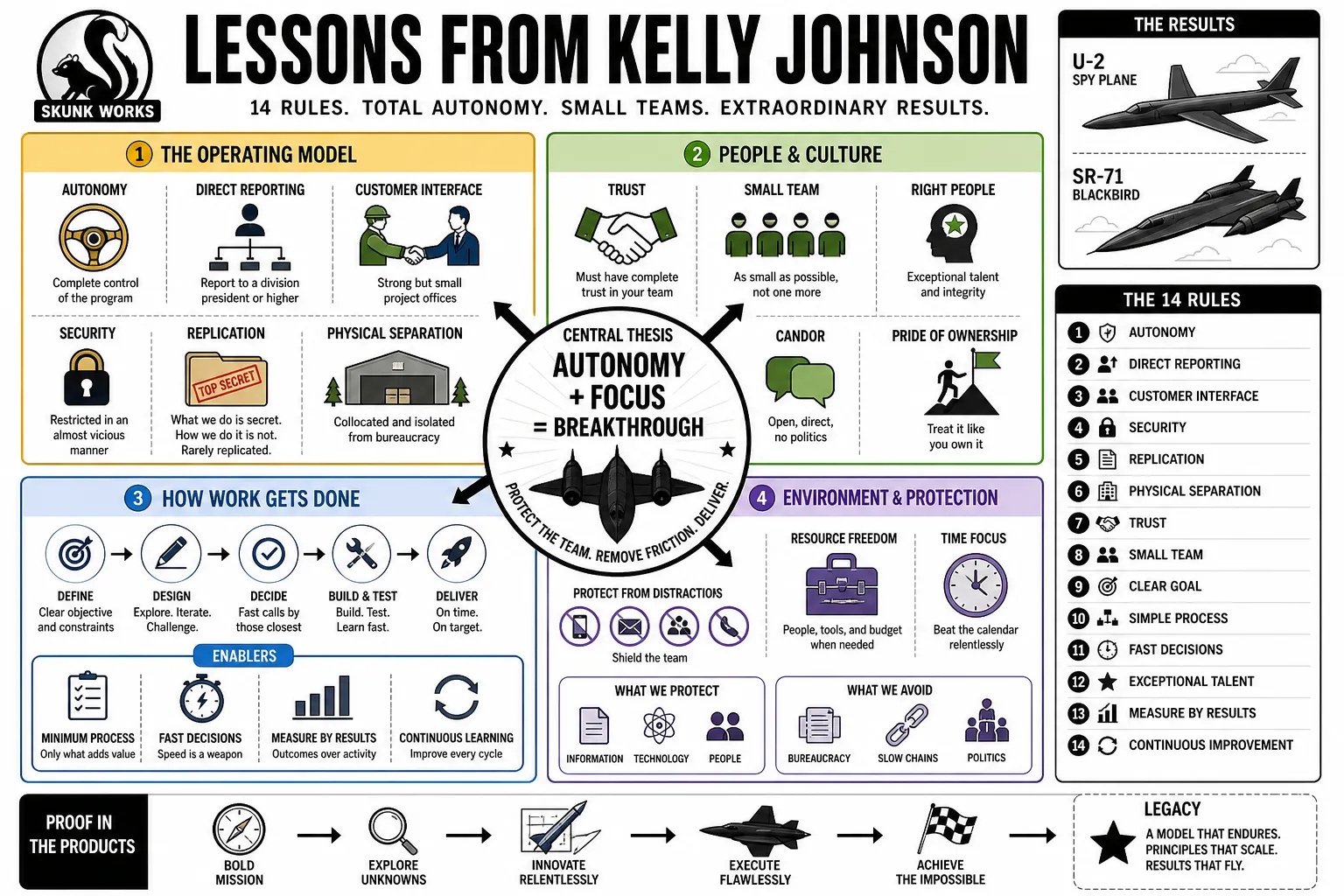
Aerospace engineer Clarence "Kelly" Johnson founded Lockheed's Skunk Works, directing the design of the U-2 spy plane and the SR-71 Blackbird. He ran his projects using 14 management rules that demanded strict autonomy and unusually small teams. This collection outlines his engineering principles and daily practices, providing a practical record of how he built aircraft under tight deadlines.
Part 1: The Skunk Works Operating Model
- On Autonomy: "The Skunk Works manager must be delegated practically complete control of his program in all aspects." — Source: [Kelly's 14 Rules]
- On Direct Reporting: "He should report to a division president or higher." — Source: [Kelly's 14 Rules]
- On Customer Interface: "Strong but small project offices must be provided both by the military and industry." — Source: [Kelly's 14 Rules]
- On Security: "Access to the project must be restricted in an almost vicious manner." — Source: [Kelly's 14 Rules]
- On Replication: "What the Skunk Works does is secret. How it does it is not... Very seldom has the formula been followed." — Source: [More Than My Share of It All]
- On Physical Separation: The team must be collocated and physically isolated from standard corporate bureaucracy to maintain absolute focus. — Source: [Skunk Works: A Personal Memoir]
- On Trust: "There must be mutual trust between the military project organization and the contractor." — Source: [Kelly's 14 Rules]
- On Funding: "Timely funding must be provided so that the contractor doesn't have to keep running to the bank." — Source: [Kelly's 14 Rules]
- On Transparency: "Hardware specifications must be agreed upon well in advance... stating which military specifications will not be complied with and why." — Source: [Kelly's 14 Rules]
- On Program Control: The contractor must maintain absolute authority over the design process without customer interference until the product is ready. — Source: [Kelly's 14 Rules]
Part 2: The KISS Principle and Design
- On Simplicity: "Keep it simple, stupid." — Source: [The KISS Principle]
- On Field Repairs: Aircraft must be designed so they can be repaired in the field with basic tools under combat conditions. — Source: [The KISS Principle]
- On Engineering Delight: "I think most good designers want to keep things simple, but sometimes, for the sheer engineering delight of creating, things become unnecessarily complex and cumbersome." — Source: [More Than My Share of It All]
- On Flexible Tools: "A very simple drawing and drawing release system with great flexibility for making changes must be provided." — Source: [Kelly's 14 Rules]
- On the Six-Tool Rule: When designing a helicopter, he insisted it must be serviceable using only six simple hand tools. — Source: [More Than My Share of It All]
- On Over-Engineering: If a mechanic cannot quickly fix a system using basic equipment, the engineer has failed the design. — Source: [The KISS Principle]
- On Form and Function: "In design, you are forced to develop unusual solutions to unusual problems." — Source: [More Than My Share of It All]
- On Aerodynamic Purity: When transitioning from propeller to jet aircraft, the focus had to shift entirely to drag reduction and cleaner shapes. — Source: [More Than My Share of It All]
- On Trade-Offs: Every ounce of weight or added complexity must rigorously justify its presence on the airframe. — Source: [Skunk Works: A Personal Memoir]
- On Functional Elegance: True engineering genius is found not in adding components, but in stripping them away until only the essential remains. — Source: [The KISS Principle]
Part 3: Execution and Speed
- On Pace: "Be quick, be quiet, and be on time." — Source: [Skunk Works Philosophy]
- On Decisiveness: "Even a timely wrong decision is better than no decision." — Source: [Skunk Works: A Personal Memoir]
- On Killing Problems: "Don't half-heartedly wound problems - kill them dead." — Source: [Skunk Works: A Personal Memoir]
- On the XP-80 Timeline: The first American operational jet fighter was designed, built, and delivered in just 143 days under Johnson's intense timeline. — Source: [Lockheed Martin History]
- On Urgency: Schedules must be aggressively compressed to prevent feature creep and maintain absolute team focus. — Source: [Skunk Works: A Personal Memoir]
- On Quick Changes: The drawing release system must allow engineers to fix mistakes and issue new plans immediately, bypassing standard approval chains. — Source: [Kelly's 14 Rules]
- On Bureaucratic Delays: Standard military contracting procedures are fundamentally incompatible with rapid technological breakthroughs. — Source: [Skunk Works: A Personal Memoir]
- On Brainpower vs. Manpower: "If you can't do it with brainpower, you can't do it with manpower—overtime." — Source: [More Than My Share of It All]
- On Focus: The urgency of a project is best preserved by keeping the team entirely isolated from the rest of the corporation. — Source: [Skunk Works: A Personal Memoir]
Part 4: Small Teams and Elite Talent
- On Team Size: "The number of people having any connection with the project must be restricted in an almost vicious manner." — Source: [Kelly's 14 Rules]
- On Scaling: "Use a small number of good people (10% to 25% compared to the so-called normal systems)." — Source: [Kelly's 14 Rules]
- On Capability: "We became the most successful advanced projects company in the world by hiring talented people, paying them top dollar, and motivating them..." — Source: [Skunk Works: A Personal Memoir]
- On Bureaucratic Headcount: "Hell, in the main plant, they give raises on the basis of the more people being supervised [but here we value results]." — Source: [Skunk Works: A Personal Memoir]
- On Listening: "Listen; you'll never learn anything by talking." — Source: [More Than My Share of It All]
- On Cross-Training: Engineers must sit directly next to the shop floor and understand manufacturing just as well as aerodynamics. — Source: [Skunk Works: A Personal Memoir]
- On Motivation: Small teams can produce miracles when they believe they are building something a generation ahead of everyone else. — Source: [Skunk Works: A Personal Memoir]
- On Intellectual Flexibility: "The measure of an intelligent person is the ability to change his mind." — Source: [More Than My Share of It All]
- On Elite Standards: Only top-tier engineers should be brought onto black projects; average performers inevitably slow down the entire operation. — Source: [Skunk Works: A Personal Memoir]
Part 5: Minimizing Bureaucracy and Cost
- On Reports: "There must be a minimum number of reports required, but important work must be recorded thoroughly." — Source: [Kelly's 14 Rules]
- On Cost Tracking: "There must be a monthly cost review covering not only what has been spent and committed but also projected costs to conclusion." — Source: [Kelly's 14 Rules]
- On Surprises: "Don't have the books ninety days late and don't surprise the customer with sudden overruns." — Source: [Kelly's 14 Rules]
- On Inspections: "The contractor must be delegated and must assume more than normal responsibility to get good vendor bids." — Source: [Kelly's 14 Rules]
- On Military Procedures: Commercial procurement procedures are overwhelmingly faster and cheaper than standard military purchasing rules. — Source: [Kelly's 14 Rules]
- On Duplication: "The inspection system as currently used by the Skunk Works... meets the intent of existing military requirements, but eliminates much of the duplication." — Source: [Kelly's 14 Rules]
- On Pushback: The contractor must have the authority to push inspection responsibilities directly back to subcontractors to save time. — Source: [Kelly's 14 Rules]
- On Data Management: Never let the customer dictate the internal data management systems, as that inevitably invites unnecessary corporate oversight. — Source: [Skunk Works: A Personal Memoir]
- On Corporate Oversight: A specialized advanced projects unit must be fiercely protected from its own company's administrative and financial departments. — Source: [Skunk Works: A Personal Memoir]
- On Value: A small, highly skilled engineering unit is inherently more cost-effective than a massive, heavily managed workforce. — Source: [Skunk Works: A Personal Memoir]
Part 6: Materials and Extreme Engineering
- On the Mach 3 Leap: "Everything about the airplane had to be invented. Everything." — Source: [More Than My Share of It All]
- On the Thermal Thicket: When designing the SR-71, the friction generated at Mach 3 meant aluminum would melt, forcing an abrupt transition to entirely new materials. — Source: [Lockheed Martin History]
- On Sourcing Titanium: "The basic materials for the later Blackbirds came also from Russia... We discontinued those purchases, however... because we did not want to help Russia develop this industry." — Source: [More Than My Share of It All]
- On Tooling: Because titanium was so brittle and difficult to work with, the Skunk Works had to design entirely new tools and manufacturing techniques just to build the aircraft. — Source: [Lockheed Martin History]
- On Fuel as Coolant: To survive extreme temperatures, the SR-71 used its own specialized jet fuel as a heat sink to physically cool the airframe. — Source: [Lockheed Martin History]
- On Expanding Metal: The SR-71's panels were deliberately built with gaps because the airframe expanded by several inches in flight due to extreme thermal friction. — Source: [Lockheed Martin History]
- On Fluid Leaks: Because the panels were intentionally loose on the ground, the SR-71 famously leaked fuel on the tarmac before taking off and sealing itself at high speeds. — Source: [Lockheed Martin History]
- On Jet Propulsion: "It became obvious that we would have to design better wings and tails, but that if we wanted higher performance we would have to get rid of the propeller." — Source: [More Than My Share of It All]
- On the U-2 Glider: The U-2 spy plane was fundamentally designed as a jet-powered glider to reach extreme altitudes with maximum fuel efficiency. — Source: [Lockheed Martin History]
Part 7: Flight Testing and Accountability
- On Flight Test Authority: "The contractor must be delegated the authority to test his final product in flight." — Source: [Kelly's 14 Rules]
- On Skin in the Game: "I have a philosophy that those who design aircraft also should fly them—to keep a proper perspective." — Source: [More Than My Share of It All]
- On Fear and Respect: "I figured I needed to have hell scared out of me once a year in order to keep a proper balance and viewpoint on designing new aircraft." — Source: [More Than My Share of It All]
- On Early Validation: Testing in the real world must happen as soon as possible, as flight conditions frequently reveal flaws that wind tunnels miss entirely. — Source: [Skunk Works: A Personal Memoir]
- On Responsibility: The engineers who draft the system must be physically present on the flight line when the test pilots risk their lives flying it. — Source: [Skunk Works: A Personal Memoir]
- On the Initial Flight: The true test of a flying machine is not the theoretical blueprint, but how it handles the unforgiving aerodynamic realities of the sky. — Source: [Skunk Works: A Personal Memoir]
- On Customer Pilots: Test the aircraft yourself first; never hand over an unproven, dangerous prototype to the military for initial flight testing. — Source: [Kelly's 14 Rules]
- On Honesty in Testing: If a flight test fails, admit it immediately to the customer without attempting to spin the results. — Source: [Skunk Works: A Personal Memoir]
- On Compressibility: When the P-38 encountered extreme drag and control loss in dives, Johnson personally participated in high-speed flight tests to diagnose the aerodynamic crisis. — Source: [Lockheed Martin History]
Part 8: Leadership and Vision
- On Purpose: "My whole life from that time was aimed at preparing for that goal [of being an aircraft designer]." — Source: [More Than My Share of It All]
- On the Process: "We are defined not by the technologies we create but the process in which we create them." — Source: [Skunk Works Philosophy]
- On Inspiration: Johnson credited his lifelong drive to build revolutionary machines directly to the science fiction novels he read during his youth. — Source: [More Than My Share of It All]
- On Uncompromising Standards: If a customer requests a change that compromises the fundamental safety or structural integrity of the aircraft, the engineer must refuse. — Source: [Skunk Works: A Personal Memoir]
- On Protection: The role of the Skunk Works leader is to act as an unyielding shield, protecting the engineers from outside interference and corporate politics. — Source: [Skunk Works: A Personal Memoir]
- On Results Over Process: Ultimately, the customer cares about the machine functioning perfectly, not the mountain of paperwork proving how it was built. — Source: [Skunk Works: A Personal Memoir]
- On the First Step: You cannot build generational leaps in technology if you start by assuming the traditional rules of physics and bureaucracy cannot be bent. — Source: [Skunk Works: A Personal Memoir]
- On Trusting Talent: Once you hire the smartest people and assign them an impossible task, get completely out of their way and let them work. — Source: [Skunk Works: A Personal Memoir]
- On Legacy: The greatest machines are built by individuals who are explicitly given the freedom to fail quickly and fix their mistakes quietly. — Source: [Skunk Works Philosophy]