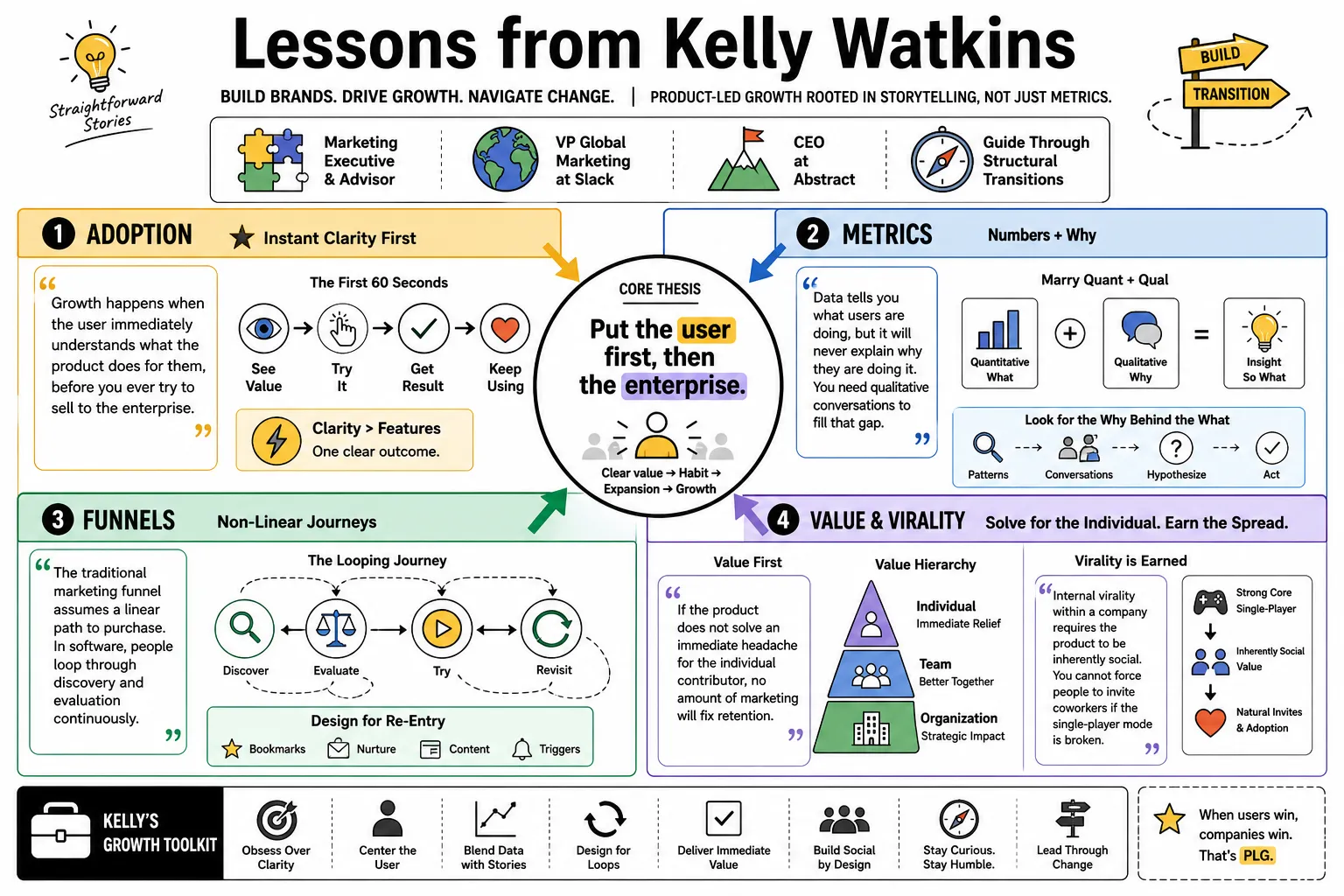
Lessons from Kelly Watkins
Kelly Watkins is a marketing executive and advisor who served as VP of Global Marketing at Slack and CEO of Abstract. She grounds product-led growth in straightforward storytelling instead of relying purely on metrics. This collection breaks down her approach to building brands and steering companies through structural transitions.
Part 1: Product-Led Growth
- On Adoption: "Growth happens when the user immediately understands what the product does for them, before you ever try to sell to the enterprise." — Source: [OpenView Partners]
- On Metrics: "Data tells you what users are doing, but it will never explain why they are doing it. You need qualitative conversations to fill that gap." — Source: [First Round Review]
- On Funnels: "The traditional marketing funnel assumes a linear path to purchase. In software, people loop through discovery and evaluation continuously." — Source: [OpenView Partners]
- On Value: "If the product does not solve an immediate headache for the individual contributor, no amount of marketing will fix retention." — Source: [B2B Marketing Leaders]
- On Virality: "Internal virality within a company requires the product to be inherently social. You cannot force people to invite coworkers if the single-player mode is broken." — Source: [First Round Review]
- On Playbooks: "There is no magic formula to replicate another company's growth. Copying tactics without understanding your own context is a waste of time." — Source: [B2B Marketing Leaders]
- On Friction: "Look at every step a user takes to sign up. Remove everything that does not actively pull them closer to their first success." — Source: [OpenView Partners]
- On Pricing: "Transparent pricing builds trust. When users have to guess what something costs, they assume it is too expensive and leave." — Source: [MarTech]
- On Enterprise Sales: "The transition to enterprise sales in a product-led company requires marketing to connect the bottom-up usage story with top-down business goals." — Source: [First Round Review]
- On Feedback: "Users will tell you exactly what is wrong with the product if you make it easy for them to contact you directly." — Source: [GitHub Blog]
Part 2: Brand Strategy
- On Identity: "A brand is the sum of every interaction a person has with your company, starting from the very first advertisement." — Source: [Forbes]
- On Messaging: "Stop talking about features. Talk about the better version of the user that your product enables." — Source: [The Bigger Narrative]
- On Differentiation: "If you remove your logo from your website and it looks exactly like your competitor's, you do not have a brand." — Source: [B2B Marketing Leaders]
- On Campaigns: "The 'Where Work Happens' campaign worked because it reflected the actual reality of our users rather than an idealized fantasy." — Source: [First Round Review]
- On Consistency: "Brand consistency means your support tickets sound like your marketing emails. The voice has to match across the entire surface area." — Source: [Forbes]
- On Risk: "Bland marketing is the highest risk you can take. If no one remembers what you said, you have wasted your budget." — Source: [Medium]
- On Emotion: "B2B software purchases are driven by emotion and justified by logic. People want to feel safe and competent." — Source: [The Bigger Narrative]
- On Simplicity: "Avoid jargon at all costs. Write the way you would speak to a friend who does not work in your industry." — Source: [Forbes]
- On Trust: "You build trust by admitting what your product cannot do, rather than pretending it is a perfect solution for every problem." — Source: [MarTech]
- On Visuals: "Design is not a coat of paint you add at the end. It is a core part of how the message is delivered and understood." — Source: [First Round Review]
Part 3: Marketing Leadership
- On Roadblocks: "I think the role of any leader, whether in marketing or another function, is to keep the path ahead clear of roadblocks for their team." — Source: [Medium]
- On Hiring: "Look for curiosity over a specific pedigree. The best marketers are the ones who want to figure out how things work." — Source: [First Round Review]
- On Alignment: "Marketing cannot operate in a silo. If you are not in constant contact with product and sales, you are failing the business." — Source: [MarTech]
- On Goals: "Set clear, measurable goals, but give your team the autonomy to decide how to achieve them." — Source: [Forbes]
- On Failure: "Celebrate the experiments that do not work as long as the team learned something valuable that can be applied to the next attempt." — Source: [B2B Marketing Leaders]
- On Focus: "You have to say no to good ideas so you can execute the great ones perfectly." — Source: [Medium]
- On Meetings: "Cancel any meeting that does not have a clear agenda and a specific decision that needs to be made." — Source: [Watkins Advisory]
- On Metrics Review: "Do not simply report the numbers. Tell the story of why the numbers look the way they do and what you are doing about it." — Source: [First Round Review]
- On Empathy: "Leading a team requires understanding what motivates each individual person. A blanket approach to management never works." — Source: [Forbes]
- On Budgets: "Treat the marketing budget like it is your own money. Ask whether each expense is actually driving the business forward." — Source: [OpenView Partners]
Part 4: The CEO Transition
- On Scope: "Moving from marketing to CEO means you suddenly own the things you used to complain about. You have to fix the problems yourself." — Source: [First Round Review]
- On Perspective: "A CEO must look at the company as a whole system, balancing the tension between engineering speed and sales revenue." — Source: [Watkins Advisory]
- On Isolation: "The CEO role is lonely because every conversation has stakes. Finding external peers to talk to is a requirement for survival." — Source: [First Round Review]
- On Decision Making: "You will never have absolute certainty. You have to get comfortable making calls with partial information." — Source: [Watkins Advisory]
- On Communication: "As CEO, you have to repeat the vision and strategy until you are sick of hearing it, because that is when the team finally absorbs it." — Source: [Medium]
- On Investors: "Manage your board actively. Bring them solutions and specific asks rather than presenting unresolved issues." — Source: [First Round Review]
- On Self-Care: "Burnout trickles down. If the CEO is exhausted and reactive, the entire organization will adopt that same anxious energy." — Source: [Watkins Advisory]
- On Delegation: "You cannot do the work anymore. Your job is to build the machine that does the work." — Source: [B2B Marketing Leaders]
- On Reality: "The hardest part of being CEO is seeing the gap between where the company is and where it needs to be, and managing your own patience." — Source: [First Round Review]
Part 5: Team Building
- On Culture: "Culture is defined by who you hire, who you fire, and who you promote. It is not what you write on the wall." — Source: [Forbes]
- On Diversity: "Building a diverse team requires active effort at the top of the funnel. If you only rely on referrals, you will build a homogenous group." — Source: [First Round Review]
- On Onboarding: "The first thirty days determine an employee's trajectory. Give them a quick win so they feel competent immediately." — Source: [Watkins Advisory]
- On Feedback: "Feedback must be direct and timely. Waiting for a quarterly review to correct a behavior is unfair to the employee." — Source: [Medium]
- On Trusting Teams: "If you hire smart people, you have to let them do their jobs. Micromanagement destroys initiative." — Source: [Forbes]
- On Transitions: "When a team member outgrows their role, help them find their next opportunity, even if it is at another company." — Source: [Watkins Advisory]
- On Conflict: "Healthy conflict leads to better ideas. You want a team that will debate the work respectfully rather than agreeing to avoid tension." — Source: [First Round Review]
- On Transparency: "Share as much context as legally and reasonably possible. Teams make better choices when they understand the financial health of the business." — Source: [Medium]
- On Recognition: "Public praise and private criticism is a baseline rule. Acknowledge hard work openly and often." — Source: [MarTech]
Part 6: Narrative and Storytelling
- On Sense-Making: "Humans are creatures who make sense of the world through stories. A product without a story is a list of features." — Source: [The Bigger Narrative]
- On The Hero: "The customer is always the hero of your story. Your product is merely the tool they use to defeat their monster." — Source: [The Bigger Narrative]
- On Stakes: "A good narrative establishes what the user stands to lose if they do not change their current behavior." — Source: [First Round Review]
- On The Enemy: "Name the old way of doing things as the enemy. Frame your product as the natural evolution of work." — Source: [OpenView Partners]
- On Internal Narrative: "The story you tell internally to the team must match the story you tell externally to the market." — Source: [The Bigger Narrative]
- On Proof: "Claims require evidence. Use customer testimonials and hard data to back up the emotional appeal of your story." — Source: [B2B Marketing Leaders]
- On Formats: "The core story remains the same whether it is a tweet, a whitepaper, or a presentation. Only the delivery changes." — Source: [MarTech]
- On Attention: "You are competing for attention with everything else on the internet. Your story has to be instantly compelling." — Source: [Forbes]
- On Revisions: "Narratives evolve as the company grows. You have to update the story when you move into new markets." — Source: [First Round Review]
Part 7: Scaling Organizations
- On Process: "Add process only when the lack of process is causing active pain. Premature optimization slows down execution." — Source: [Watkins Advisory]
- On Org Charts: "Restructuring the team is a tool. Changing reporting lines will not fix an underlying lack of strategy." — Source: [First Round Review]
- On Generalists: "Early stage companies need generalists who can do a little bit of everything. Scaling companies need specialists who can master one channel." — Source: [OpenView Partners]
- On Communication Debt: "As you grow, information stops flowing naturally. You have to build intentional systems for internal communication." — Source: [Medium]
- On Trade-offs: "Scaling means accepting that things will break. You have to decide which systems are allowed to fail while you focus on growth." — Source: [Watkins Advisory]
- On Agencies: "Use external agencies for execution and specialized skills, but keep the core brand strategy and messaging in-house." — Source: [B2B Marketing Leaders]
- On Speed: "The advantage of a startup is speed. As you scale, you have to fight actively against bureaucracy to maintain that velocity." — Source: [First Round Review]
- On Data Infrastructure: "Invest in data analytics early. Trying to untangle a messy data setup at scale is expensive and painful." — Source: [MarTech]
- On Evolution: "The skills that got the company to ten million in revenue are completely different from the skills needed to reach one hundred million." — Source: [First Round Review]
Part 8: The Marketer's Mindset
- On Curiosity: "The best marketing comes from a genuine desire to understand how other people work and what they care about." — Source: [Forbes]
- On The Curse of Knowledge: "You spend all day thinking about your product. The customer spends five seconds. You have to unlearn what you know to communicate effectively." — Source: [Forbes]
- On Agility: "Marketing plans are educated guesses. Be prepared to throw out the plan when the market shows you a different reality." — Source: [OpenView Partners]
- On Craftsmanship: "Great marketing requires a deep respect for the craft of writing and design. There are no shortcuts to good taste." — Source: [Forbes]
- On Resilience: "You will launch campaigns that completely flop. You have to detach your personal worth from the performance of the work." — Source: [Medium]
- On Continuous Learning: "The platforms and tactics change every year. You have to commit to being a student of the industry permanently." — Source: [First Round Review]
- On Perspective: "Step away from the screen. Some of the best ideas come when you are not actively trying to solve the problem." — Source: [Watkins Advisory]
- On Empathy: "If you do not genuinely respect the people you are selling to, it will show in the work. Empathy cannot be faked." — Source: [B2B Marketing Leaders]
- On Impact: "At its best, marketing connects people with tools that give them their time back. That is work worth doing." — Source: [First Round Review]