Ken Carter’s 1999 academic lockout at Richmond High School inspired the 2005 film Coach Carter. His coaching approach placed classroom commitments, accountability and care for students ahead of an unbeaten basketball record. — George Fox — From Lockout to Open Doors.
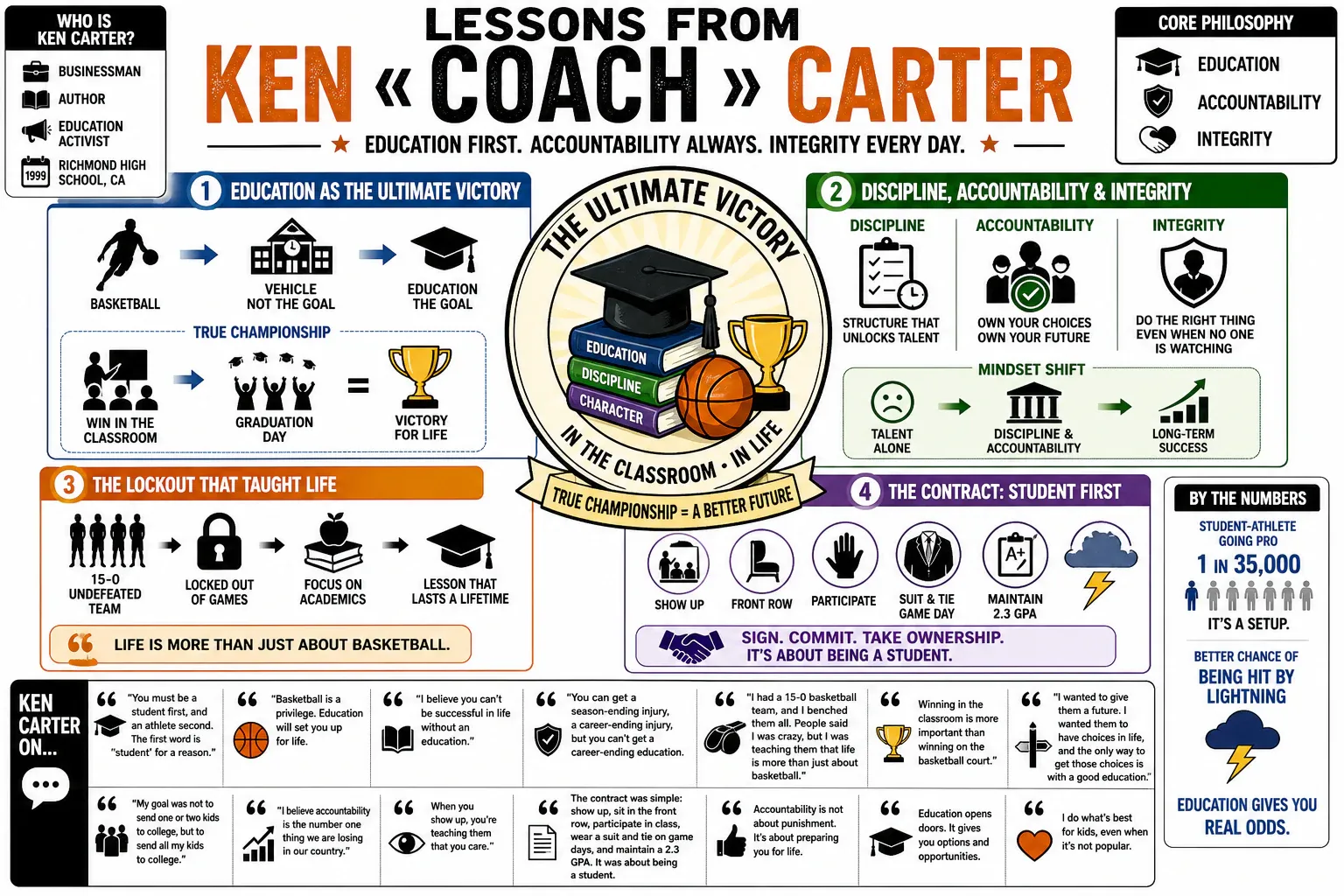
On Education as the Ultimate Victory
Learnings: Carter used basketball to engage students in education, treating their futures beyond the court as the purpose of coaching. — Just Call Him “Sir”.
Lessons:
- Put student responsibilities before athletic participation. Carter treats education as the first obligation of a student-athlete. — In Conversation with Ken Carter.
- Carter suspended a team that was 13–0 when players missed academic requirements, making clear that an unbeaten record did not override classroom responsibilities. — George Fox — From Lockout to Open Doors.
- Prepare students for opportunities beyond professional sport. Carter used education and college visits to widen the futures they could imagine. — The Coast — Q&A with Coach Carter.
- Treat college as an ambition for the students being coached, not merely a reward for a few talented athletes. Carter wanted their education to benefit their communities too. — Just Call Him “Sir”.
- Make participation conditions explicit. Carter’s contract required class attendance, front-row seating, appropriate game-day dress and a 2.3 GPA. — George Fox — From Lockout to Open Doors.
- Turn Knowledge into Visible Choices: Make education tangible. Carter’s banknote exercise illustrated how additional knowledge can reveal options a student did not initially recognize. — Lehigh — Coach Carter Leads by Example.
- Expand Horizons Through Direct Exposure: Take students into unfamiliar professional settings so opportunities beyond their neighborhood become concrete. — George Fox — From Lockout to Open Doors.
- Teach Independence Through Real Responsibility: Pair academics with practical responsibility. Carter’s academy included chores such as cooking and laundry, giving students practice in everyday self-reliance. — Coach Carter Returns to Richmond High.
On Discipline, Accountability, and Integrity
Learnings: Carter’s contract made expectations explicit for players and the adults around them. He joined accountability with a relationship built on mutual respect. — The Coast — Q&A with Coach Carter.
Lessons:
- Accept responsibility for your conduct; accountability depends on consistent action. — Yes Ma’am, No Sir.
- Keep commitments: integrity requires your actions to match your word. — Yes Ma’am, No Sir.
- Practice self-discipline consistently, rather than waiting for external enforcement. — Yes Ma’am, No Sir.
- Use shared academic work to change team habits. Carter wanted stronger students to tutor teammates and make the library a place they valued. — Just Call Him “Sir”.
- Distinguish lasting discipline from temporary punishment. Carter describes his aim as developing habits that remain useful beyond the immediate exercise or consequence. — CNN — Ken Carter Interview.
- Challenge students to improve rather than accept average performance as the final standard. This is Carter’s expectation, not a guarantee of exceptional results. — In Conversation with Ken Carter.
- Make Accountability Collective: Treat missed standards as a shared program problem, rather than publicly identifying individual players as scapegoats. — George Fox — From Lockout to Open Doors.
- Build Advantage from What You Can Control: Build preparation around what can be controlled. Carter emphasized conditioning even when players could not control officiating, coaching decisions or playing time. — Ken Carter on Coach Carter.
On Leadership and Vision
Learnings: Carter defended academic expectations despite pressure to let the team play. His account includes doubt and outside encouragement, not effortless certainty. — Just Call Him “Sir”.
Lessons:
- Help students picture a different future. Carter connected his vision for them with experiences outside their immediate community. — CNN — Ken Carter Interview.
- Be prepared for opposition when enforcing a serious commitment. Carter describes maintaining the academic lockout despite local criticism and doubts of his own. — Just Call Him “Sir”.
- Look beyond individual achievement. Carter hoped students would return with the character and education to contribute to their community. — Just Call Him “Sir”.
- Express belief in students before they can fully imagine their own possibilities, and support that encouragement with experiences that broaden their outlook. — The Coast — Q&A with Coach Carter.
- Build credibility through care. Carter argues that students are more receptive to a message when they trust the person delivering it. — Just Call Him “Sir”.
- Do not confuse coaching with seeking a teenager’s friendship. Carter describes his role as setting expectations and helping students work within them. — CNN — Ken Carter Interview.
- Learn to Follow Before You Lead: Practice listening and following before expecting to lead others. Carter uses his own family experience to make that point. — Lehigh — Coach Carter Leads by Example.
- Join Leadership with Knowledge and Accountability: Combine leadership with knowledge and accountability; articulating a direction does not remove the need to understand it and take responsibility. — Lehigh — Coach Carter Leads by Example.
- Build Relationships Before Demanding Results: When taking over an inexperienced team, build relationships alongside the work of improving its performance. — Coach Carter Returns to Richmond High.
On Overcoming Adversity and Raising Expectations
Learnings: Carter encouraged students not to accept other people’s low expectations as their future. This is encouragement to act, not proof that circumstances cease to matter. — CNN — Ken Carter Interview.
Lessons:
- Challenge a culture that makes academic effort embarrassing. Carter wanted being a serious student to become compatible with belonging to the team. — CNN — Ken Carter Interview.
- Do not let another person’s low opinion become the definition of a student’s future. Encourage effort without pretending external difficulties do not exist. — CNN — Ken Carter Interview.
- Learn from past difficulties without making them the whole focus of your future. — Yes Ma’am, No Sir.
- Prepare and persist when setbacks interrupt progress; talent alone does not remove obstacles. — Yes Ma’am, No Sir.
- Replace excuses with inquiry: admit what you do not know and seek answers. — Yes Ma’am, No Sir.
- Measure Progress from the Real Starting Point: Judge improvement against the team’s actual starting point. Carter describes early progress while rebuilding a group with little organized-basketball experience. — Coach Carter Returns to Richmond High.
On Life, Respect, and Building Men
Learnings: Carter describes coaching as a relationship in which respectful conduct is expected from both coach and players, rather than demanded only from young people. — The Coast — Q&A with Coach Carter.
Lessons:
- Use coaching to serve students’ lives beyond the game. Carter describes basketball as a way to engage young people in education, rather than the final goal. — Just Call Him “Sir”.
- Model responsible conduct: young people learn from the adults they observe. — Yes Ma’am, No Sir.
- Make respect reciprocal. Carter describes addressing his players courteously as well as expecting courteous address from them. — The Coast — Q&A with Coach Carter.
- Use dress to establish professional standards, not to promise better performance in every area. — Yes Ma’am, No Sir.
- Give mentoring time and attention; Carter recalls learning through his brother’s patient involvement. — Yes Ma’am, No Sir.
- Look for a workable response instead of remaining with complaint. — Yes Ma’am, No Sir.
- Measure success partly through work, family responsibilities and helping others, not visible possessions alone. — Yes Ma’am, No Sir.
- Cultivate a constructive outlook that supports effort; attitude alone does not guarantee outcomes. — Yes Ma’am, No Sir.
- Practice composure under criticism rather than letting frustration dictate your response. — Yes Ma’am, No Sir.
- Combine Structure, Knowledge, and Care: Combine concrete commitments, knowledge and care. Carter used the hand, head and heart to explain these complementary parts of his approach. — George Fox — From Lockout to Open Doors.
- Let Service Change the Leader Too: Let service change the leader too. Carter says working with the students changed him, rather than treating the relationship as one-way instruction. — The Coast — Q&A with Coach Carter.
Sources:
Additional direct interviews: — The Coast: Q&A with Coach Carter. — One Guy’s Opinion: Ken Carter on Coach Carter. — Winnipeg Free Press: In Conversation with Ken Carter. — Christianity Today: Just Call Him “Sir”.
- Yes Ma’am, No Sir: The 12 Essential Steps for Success in Life: Direct source. — Yes Ma’am, No Sir.
- Coach Ken Carter: From Lockout to Open Doors: Direct source. — George Fox — From Lockout to Open Doors.
- Real-life Coach Carter Leads by Example: Direct source. — Lehigh — Coach Carter Leads by Example.
- CNN Newsroom: Interview with Ken Carter, October 30, 2009: Direct source. — CNN — Ken Carter Interview.
- Coach Carter Returns to Lead Richmond High After More Than 20 Years: Direct source. — Coach Carter Returns to Richmond High.