Lessons from Ken Norton
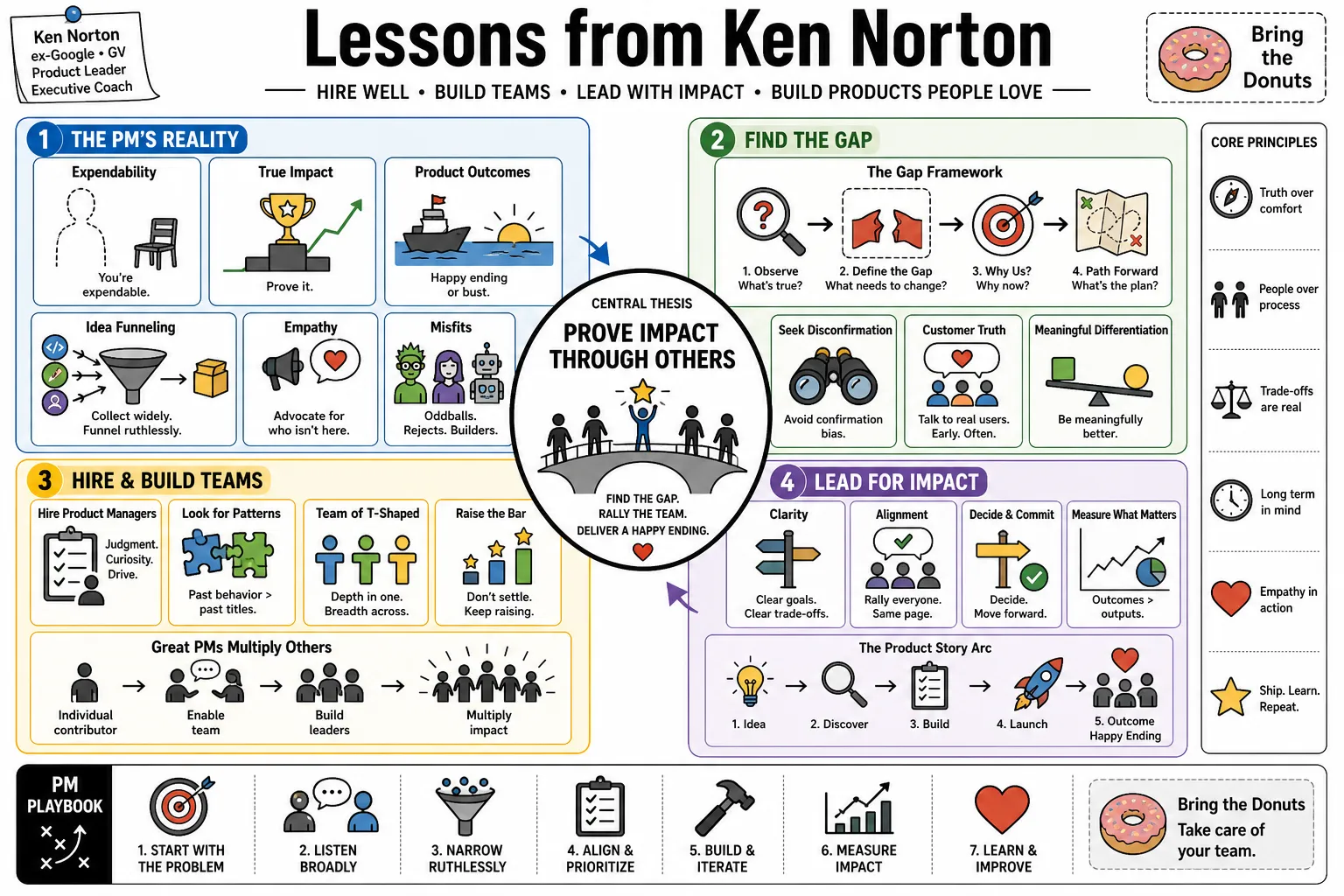
Ken Norton is a former Google and GV product leader turned executive coach. He is best known for his widely read essays on product management, including "How to Hire a Product Manager" and "Bring the Donuts." This collection distills his writing on hiring, teams, and leadership into concrete rules for building software.
Part 1: The Product Manager's Reality
- On Expendability: "Product management may be the one job that the organization would get along fine without... as a PM, you're expendable." — Source: [How to Hire a Product Manager]
- On True Impact: "In the long run, great product management usually makes the difference between winning and losing, but you have to prove it." — Source: [How to Hire a Product Manager]
- On Product Outcomes: "Every product has a story. The PM's job is to make sure it has a happy ending." — Source: [Bring the Donuts]
- On Idea Funneling: "Your job is to get the best ideas from your engineers, designers, and others and funnel them into a product." — Source: [Bring the Donuts]
- On Empathy: "Your job is to be the advocate for whoever isn't currently in the room." — Source: [Bring the Donuts]
- On Misfits: "Product management is a weird discipline full of oddballs and rejects that never quite fit in anywhere else." — Source: [Bring the Donuts]
- On Finding the Gap: "A great product manager acts as a gap filler, recognizing where the team is struggling in execution or communication and immediately stepping in to solve it." — Source: [How to Hire a Product Manager]
- On Listening vs. Solving: "I spent my career relying on my ability to solve problems, but I eventually learned that my most powerful tool was simply listening." — Source: [Bring the Donuts]
- On Influence: "Product managers do not succeed through authority. They must earn leadership through credibility, trust, and a track record of good decisions." — Source: [How to Hire a Product Manager]
Part 2: Hiring and Building Teams
- On Raw Intelligence: "I'll take a wickedly smart, inexperienced PM over one of average intellect and years of experience any day." — Source: [How to Hire a Product Manager]
- On Technical Background: "Hiring PMs with strong technical foundations ensures they can effectively communicate with engineers and earn their respect." — Source: [How to Hire a Product Manager]
- On Product Instincts: "Look for candidates with product spidey-sense, which is an intuitive understanding of user needs and creative product instinct." — Source: [How to Hire a Product Manager]
- On Scaling Teams: "You really can’t solve organizational problems by hiring more people." — Source: [The Product Experience]
- On Over-Hiring PMs: "Adding too many product managers to a team often slows down decision-making rather than accelerating execution." — Source: [The Product Experience]
- On Assessing Talent: "When interviewing product managers, probe how they handled failure and whether they take accountability for missteps." — Source: [How to Hire a Product Manager]
- On Domain Experience: "Avoid overvaluing domain expertise during the hiring process; a sharp, adaptable product manager will learn the industry quickly." — Source: [How to Hire a Product Manager]
- On Interview Assignments: "Take-home exercises or hypothetical product challenges reveal more about a candidate's thought process than standard behavioral questions." — Source: [How to Hire a Product Manager]
- On Background Diversity: "Great PMs often come from non-traditional backgrounds, bringing fresh perspectives that a homogenous team would miss." — Source: [Bring the Donuts]
- On Reference Checks: "The best way to evaluate a product manager candidate is to ask engineers and designers if they would want to work with them again." — Source: [How to Hire a Product Manager]
Part 3: Doing the Work
- On Servant Leadership: "PMs put their teams first, they do what needs to be done, and they demonstrate that every day." — Source: [Bring the Donuts]
- On Unglamorous Work: "If a product manager is unwilling to handle the grimy, behind-the-scenes tasks, no one else will step up to do them." — Source: [Bring the Donuts]
- On Launch Day: "If PMs don't bring donuts for the team on launch day, who else will?" — Source: [Bring the Donuts]
- On the CEO Myth: "Product managers are not the CEOs of the product. They are team-first contributors who facilitate success rather than dictating it." — Source: [Bring the Donuts]
- On Removing Roadblocks: "The daily goal of a PM should be identifying what is slowing the engineering team down and systematically eliminating those hurdles." — Source: [Bring the Donuts]
- On Accountability: "When things go wrong, the PM takes the blame. When things go right, the team gets the credit." — Source: [Bring the Donuts]
- On Managing Bugs: "Sweeping the bug queue and writing clear documentation are just as essential to product success as defining high-level strategy." — Source: [Bring the Donuts]
- On Team Morale: "Paying attention to the emotional state of the team and acting to boost morale is a core part of the PM job description." — Source: [Bring the Donuts]
- On Being Indispensable: "Prove your worth by making the jobs of engineers and designers noticeably easier when you are around." — Source: [Bring the Donuts]
Part 4: Ambition and Vision
- On Incrementalism: "Aiming for small, 10 percent improvements often carries the same amount of effort and risk as shooting for a massive, 10x breakthrough." — Source: [10x Not 10%]
- On Audacity: "What would be possible if you stopped playing small?" — Source: [10x Not 10%]
- On Product Roadmaps: "A roadmap filled exclusively with minor optimizations guarantees a product will eventually be overtaken by bolder competitors." — Source: [10x Not 10%]
- On Future Vision: "Product leaders must constantly challenge their teams to envision how the product could fundamentally alter the market landscape." — Source: [10x Not 10%]
- On Comfort Zones: "Staying within the realm of predictable, safe features is a faster path to irrelevance than attempting an ambitious failure." — Source: [10x Not 10%]
- On Prioritization: "Having the discipline to say no to decent ideas is the only way to leave space for transformative ones." — Source: [Bring the Donuts]
- On User Requests: "Users will often ask for small tweaks; it is the PM's job to dig into the underlying problem and deliver a 10x solution." — Source: [Bring the Donuts]
- On Defending Big Ideas: "Radical ideas will face intense internal skepticism. Product managers must protect and nurture these concepts until they can be tested." — Source: [10x Not 10%]
- On Goal Setting: "Set targets that are impossible to hit by simply working harder, forcing the team to work completely differently." — Source: [10x Not 10%]
Part 5: Organizational Design
- On Conway's Law: "Don't ship the org chart. Do not let internal team structures dictate the user experience." — Source: [Don't Ship the Org Chart]
- On Technical Silos: "Splitting teams purely by technical infrastructure, like front-end versus back-end, creates a disjointed product for the end user." — Source: [Don't Ship the Org Chart]
- On Organizing by Use Case: "Structure product teams around specific customer problems and user journeys rather than engineering disciplines." — Source: [Don't Ship the Org Chart]
- On Cross-Functional Autonomy: "Teams aligned by customer experience develop deeper product intuition and can operate with more autonomy." — Source: [Don't Ship the Org Chart]
- On Shared Infrastructure: "While use-case teams should drive the product, shared infrastructure teams remain necessary to support common technical needs like storage and UI libraries." — Source: [Don't Ship the Org Chart]
- On Reorganization: "Before changing the product, sometimes you have to change the team structure to enable the right kind of collaboration." — Source: [Don't Ship the Org Chart]
- On Customer Perspective: "If a user has to understand your company's internal reporting lines to navigate your software, you have failed the design test." — Source: [Don't Ship the Org Chart]
- On Reporting Lines: "Product managers and engineers must share common goals, even if they report up entirely different management chains." — Source: [Don't Ship the Org Chart]
- On Intentional Structure: "Because organizational design inevitably influences product design, leaders should intentionally structure teams to mirror the desired product outcomes." — Source: [Don't Ship the Org Chart]
Part 6: Risk and Failure
- On Celebrating Failure: "People always talk about failure in tech as if it's a badge of honor, but it's terrible. It's not like I celebrate when I crash my bike." — Source: [Bring the Donuts]
- On The Value of Failure: "Failure is a natural thing we do when building products. Every time we fail, we have new data." — Source: [Bring the Donuts]
- On Improvisation: "Building products is akin to playing jazz; it requires improvisation, listening, and a willingness to step into the unknown." — Source: [Please Make Yourself Uncomfortable]
- On Discomfort: "Please make yourself uncomfortable. Growth and innovation only happen outside the boundaries of predictability." — Source: [Please Make Yourself Uncomfortable]
- On Psychological Safety: "Teams must feel safe taking big swings. If they fear punishment for missing the mark, they will only propose guaranteed, minor updates." — Source: [Please Make Yourself Uncomfortable]
- On Second Product Syndrome: "Many successful startups fail because they are unable to translate the magic of their first hit product into a second one." — Source: [Bring the Donuts]
- On Adapting to Reality: "When the market rejects your product, the worst response is trying to force the market to change; the product must adapt." — Source: [Bring the Donuts]
- On Perfectionism: "Waiting until a product feels completely ready means you have launched too late to learn anything useful." — Source: [Please Make Yourself Uncomfortable]
- On Honest Assessments: "PMs must rigorously separate their hopes for a feature from the actual telemetry and user feedback indicating its failure." — Source: [Bring the Donuts]
- On Resilience: "The best product managers do not avoid failure; they reduce the cost of failing and increase the speed of recovery." — Source: [Bring the Donuts]
Part 7: Communication and Collaboration
- On Status Meetings: "Weekly status update meetings are generally a waste of time and should be replaced by asynchronous messaging or emails." — Source: [Bring the Donuts]
- On 1:1 Meetings: "One-on-one meetings are the most important events on a manager's calendar and should be treated as immovable objects." — Source: [Bring the Donuts]
- On Meeting Ownership: "If a meeting does not have a clearly identified owner responsible for the agenda and outcomes, it should be canceled." — Source: [Bring the Donuts]
- On Walking Meetings: "Taking one-on-ones outside for a walk often leads to more genuine conversations and relieves the pressure of a ticking clock." — Source: [Bring the Donuts]
- On Human Skills: "Technical skills get a PM in the door, but human skills like communication and empathy determine their ultimate success." — Source: [Bring the Donuts]
- On Productive Friction: "A former colleague once told me I was a pain in the ass, but I was worth it, highlighting the friction sometimes required to ship great work." — Source: [Lenny's Podcast]
- On User Manuals: "Creating personal user manuals that outline your communication style and feedback preferences can significantly accelerate team trust." — Source: [Bring the Donuts]
- On Listening to Users: "Customers rarely describe the problem accurately; they describe their desired solution. The PM must communicate to uncover the root cause." — Source: [Bring the Donuts]
- On Managing Up: "Establishing a regular cadence with the CEO to share unformed ideas is critical for a senior product leader's alignment and survival." — Source: [Bring the Donuts]
- On Saying No: "The most important communication skill for a PM is delivering a firm, context-rich no to stakeholders without burning bridges." — Source: [Bring the Donuts]
Part 8: Leadership and Growth
- On Career Ladders: "Companies must create a dual career track so exceptional product managers can advance without being forced to become people managers." — Source: [Bring the Donuts]
- On Reactive vs. Creative Leadership: "Transitioning from a reactive problem-solver to a creative, proactive leader is the hardest leap in a PM's career." — Source: [Lenny's Podcast]
- On Executive Coaching: "Coaching is a creative partnership focused entirely on helping leaders unlock their potential, not a remediation program." — Source: [Lenny's Podcast]
- On Isolation: "Senior product leadership is inherently lonely; navigating ambiguity requires building an external support system or finding a coach." — Source: [Bring the Donuts]
- On Defining Success: "A PM's long-term career trajectory should be dictated by where they generate the most impact, not just by ascending a management ladder." — Source: [Bring the Donuts]
- On Managing PMs: "Leading a team of product managers requires stepping back and letting them make their own mistakes, rather than jumping in to fix the product." — Source: [Bring the Donuts]
- On Continuous Learning: "The best PMs constantly seek out feedback, viewing every interaction as an opportunity to refine their craft." — Source: [Bring the Donuts]
- On Trusting the Team: "If you hire smart people, your primary job as a leader is to provide context and get out of their way." — Source: [Bring the Donuts]
- On Legacy: "The mark of a truly great product leader is that the team and the product continue to thrive long after they have moved on to their next role." — Source: [How to Hire a Product Manager]