Lessons from Kenneth Rogoff
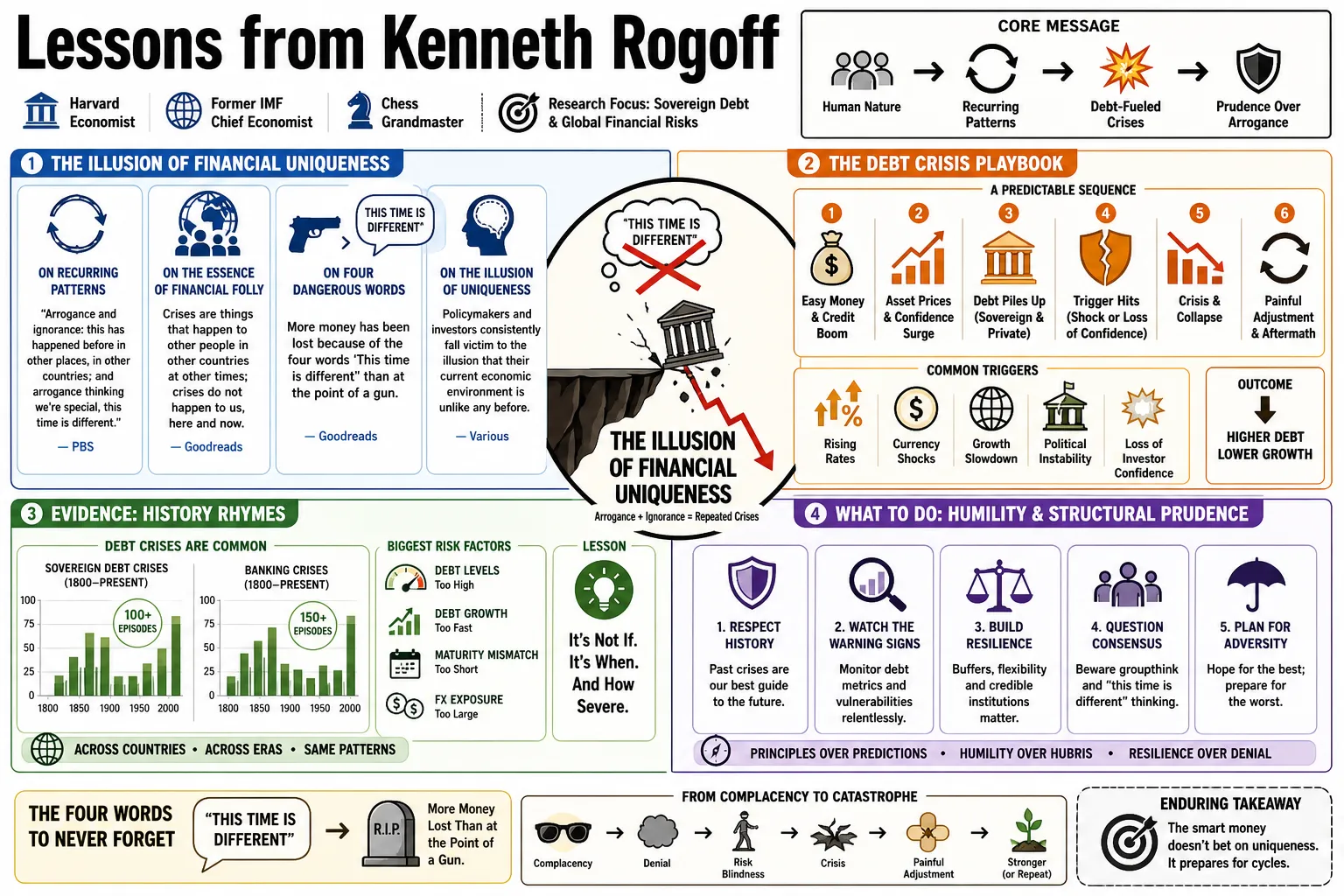
Kenneth Rogoff is a Harvard economist, former IMF chief economist, and chess grandmaster. His empirical work with Carmen Reinhart showed that debt-fueled economic collapses follow predictable patterns. This compilation covers his research on sovereign debt and the structural risks of the global financial system.
Part 1: The Illusion of Financial Uniqueness
- On recurring patterns: "The recurring theme is arrogance and ignorance: ignorance that this has happened before in other places, in other countries; and arrogance thinking we're special, this time is different." — Source: PBS
- On the essence of financial folly: "The essence of the this-time-is-different syndrome is simple. It is rooted in the firmly held belief that financial crises are things that happen to other people in other countries at other times; crises do not happen to us, here and now." — Source: Goodreads
- On four dangerous words: "More money has been lost because of the four words 'This time is different' than at the point of a gun." — Source: Goodreads
- On the illusion of uniqueness: "Policymakers and investors consistently fall victim to the illusion that their current economic environment is entirely unique, ignoring eight centuries of financial data that proves otherwise." — Source: NBER
- On banking panics: "Sovereign debt crises are often preceded by massive private debt surges, making banking crises reliable precursors to broader government defaults." — Source: Harvard University
- On false confidence: "Economies can appear to be merrily rolling along for extended periods until a sudden, precipitous collapse in confidence triggers a severe crisis." — Source: AZ Quotes
- On the aftermath of crises: "The wake of a severe financial crisis is typically defined by prolonged downturns in housing and equity prices, inevitably followed by an explosion in government debt." — Source: ResearchGate
- On debt accumulation: "Across eight centuries, excessive debt accumulation by governments, banks, corporations, or consumers is the single most common precursor to financial catastrophe." — Source: Mauldin Economics
- On declining tax revenues: "The surge in public debt post-crisis is driven more than by bank bailouts, but by the devastating collapse of tax revenues during the resulting economic contraction." — Source: Wise Words Blog
- On historical precedents: "Understanding the long sweep of history is the only reliable method for gauging what economic disasters might come next." — Source: UCLA
Part 2: The Curse of Cash and Underground Economies
- On the world's cash supply: "The world is drowning in cash, and it is making us poorer and less safe." — Source: Harvard University
- On the true use of paper money: "A large part is feeding tax evasion, corruption, terrorism, the drug trade, human trafficking, and the rest of a massive global underground economy." — Source: Goodreads
- On currency supremacy: "A determined government is always going to win the battle for currency supremacy, at least in the long run. Other transaction media may thrive, but the government currency will be at the center." — Source: Goodreads
- On alternative transaction media: "One should have little doubt that governments have all the tools necessary to prevent any alternative transaction media from deeply infiltrating the legal economy on a sustained basis." — Source: Project Syndicate
- On paralyzing monetary policy: "The existence of large-denomination cash constrains central banks from cutting interest rates significantly below zero, for fear investors will abandon treasury bills to stockpile paper currency." — Source: RePEc
- On phasing out large bills: "The optimal approach to currency reform involves very gradually phasing out large notes while leaving small bills in circulation indefinitely for everyday transactions." — Source: World Economic Forum
- On financial inclusion: "A move away from cash must be paired with offering low-income households free debit accounts, which could also streamline government transfer payments." — Source: World Economic Forum
- On the illusion of privacy: "While one of currency's advantages for the user is privacy, the widespread use of large-denomination notes primarily protects the underground economy rather than law-abiding citizens." — Source: Econlib
- On coined liberty: "While central bankers often quote Dostoevsky's 'Money is coined liberty' to defend cash, they forget the phrase originated from his observations of life in a czarist prison, not a modern liberal state." — Source: The Guardian
- On tax evasion costs: "Physical cash is deeply implicated in tax evasion, which costs the federal government hundreds of billions of dollars a year in lost revenue." — Source: Forbes
Part 3: Central Bank Independence and Policy Evolution
- On institutional innovation: "Central Bank Independence has been the most important institutional innovation in macroeconomic policy over the past forty years, and far more important than the choice of monetary rule." — Source: Paris School of Economics
- On the conservative central banker: "The optimal solution to the inflationary bias of discretionary monetary policy is to appoint a conservative central banker who places a higher weight on fighting inflation than the general public does." — Source: Federal Reserve
- On the credibility trade-off: "Appointing a hawkish central banker achieves lower inflation, but the inherent cost is increased volatility in output and employment due to their reluctance to accommodate short-term economic shocks." — Source: Chicago Fed
- On welfare improvement: "Delegating policy to an independent, conservative agent achieves a welfare-improving point on the credibility and flexibility frontier, outperforming both completely rigid rules and total discretion." — Source: Bank of England
- On Central Bank Independence 2.0: "Any strong policy framework needs to account for issues of credibility and political economy which have been far too ignored in recent academic analyses of macroeconomic policy." — Source: Harvard University
- On mandate creep: "Central banks are increasingly expected to address environmental and social policies where they have neither the political legitimacy nor the toolkit to adequately address the issues." — Source: Banco Central de Chile
- On emerging market resilience: "The single biggest factor behind emerging markets' resilience has been the increased focus on central bank independence." — Source: The Guardian
- On political interference: "Maintaining the autonomy of central banks is a critical bulwark against the rising political pressure to monetize sovereign debt." — Source: Harvard Magazine
- On the time-consistency problem: "Effective monetary policy requires shifting the focus from rigid mathematical rules to the institutional characteristics and commitments of the policymakers themselves." — Source: Wikipedia
- On policy minutiae: "Board members happily devote endless hours to discussing the minutiae of interest rate policy, and how it will affect inflation and unemployment." — Source: Goodreads
Part 4: Debt, Deficits, and the Specter of Inflation
- On the nature of debt: "Debt is inherently inflationary." — Source: Business Insider
- On stealthy defaults: "Inflation functions as a form of partial default, a stealthy mechanism governments inevitably use to reduce the real value of their overwhelming obligations." — Source: Substack
- On unchecked borrowing: "If rapidly rising debt is left unchecked, and there seems to be little political appetite to rein in massive deficits, the United States and the entire world is in for a substantial period of global financial volatility marked by higher average real interest rates and inflation." — Reference: Apple Podcasts Booknotes+ page quoting Rogoff on debt, volatility, higher real rates, and inflation
- On unsustainable paths: "Looking way forward, I would just say we are on an unsustainable path. We will continue to have our debt balloon. Eventually I think we are going to have another big inflation soon." — Source: Conversable Economist
- On the threshold of growth: "When public debt exceeds 90 percent of GDP, historical data suggests that economic growth tends to face significant structural headwinds." — Source: NBER
- On ignoring valuation rules: "Financial experts throughout history have dangerously used the phrase 'this time is different' to argue that the old rules of debt valuation no longer apply to their era." — Source: RePEc
- On the illusion of a free lunch: "While advanced economies often act as if debt carries no cost, developing nations have never bought into the notion that deficit spending is a free lunch." — Source: The Guardian
- On high interest rates: Rogoff argues that the low-rate "free lunch" view of government debt is no longer tenable: even as inflation retreats, high debt, deglobalization, and populist pressure can keep real and nominal rates above the post-2008 norm. — Reference: Project Syndicate essay on higher interest rates and the end of cost-free debt thinking
- On the limits of state control: "Even in state-controlled systems where the government owns the banks, the ability to perpetually manage debt-fueled growth without a crisis goes only to a point." — Source: Business Insider
- On progressive consumption taxes: "A progressive consumption tax is relatively efficient and does not distort savings decisions as much as today’s income taxes do, offering a better way to manage fiscal shortfalls." — Source: Iowa State University
Part 5: The U.S. Dollar and Global Hegemony
- On the Dollar's problem: "The system where the U.S. dollar is the primary reserve currency provides immense advantages to America while systematically exporting economic volatility to the rest of the world." — Source: Conversations with Tyler
- On a middle-aged currency: "The U.S. dollar is effectively middle-aged; while it remains central to global finance, its absolute peak in dominance likely passed a decade ago." — Source: IMF
- On debt fatigue: "The United States' historical ability to simply borrow its way out of trouble through massive deficits faces an increasing, undeniable risk of global debt fatigue." — Source: Marginal Revolution
- On global responsibility: "It is incredibly narrow-minded and short-sighted of Americans to think they should not care much about how the rest of the world is faring." — Source: AZ Quotes
- On self-interest: "Engaging with and stabilizing the global economy is more than philanthropy; it is very much in the long-run macroeconomic self-interest of the United States." — Source: QuoteFancy
- On cryptocurrency as a challenger: "While initially dismissive of crypto, its continued usage as a medium of exchange in gray markets poses a legitimate, albeit unconventional, challenge to U.S. dollar hegemony." — Source: CNBC
- On sanction overreach: "Weaponizing the U.S. dollar too frequently through global sanctions accelerates the incentive for competing nations to develop alternative financial payment systems." — Source: Norges Bank
- On capital account liberalization: "Despite the explosion of financial globalization, there remains surprisingly little strong evidence of the direct growth benefits of broad capital account liberalization for developing nations." — Source: Brookings Institution
- On institutional benefits: "The primary advantages of integrating into the global dollar system often come indirectly, through forced improvements to domestic financial institutions and stability, rather than direct capital accumulation." — Source: Harvard University
Part 6: Globalization and Emerging Markets
- On the threat of deglobalization: "A deglobalization overshoot risks hurting far more people than it helps. The risk today of a debilitating 1930s-style overshoot in deglobalization is massive." — Source: ING Think
- On chaotic retreats: "It is folly to think that a chaotic, crisis-driven retreat from globalization will not introduce more, and vastly more serious, problems." — Source: Project Syndicate
- On globalization and inflation: "The increased level of competitiveness resulting from globalization and deregulation has been a primary driver in reducing the pricing power of monopolies and curbing global inflation." — Source: IMF
- On the myth of universal benefits: "The assertion that everyone benefits simultaneously from free trade is simply incorrect." — Source: QuoteFancy
- On emerging market vulnerability: "Developing economies are just an accident waiting to happen, particularly when advanced economies aggressively hike interest rates." — Source: Harvard University
- On clockwork crises: "For the past four centuries, emerging market debt crises have broken out like clockwork." — Source: Cato Institute
- On the dark side of private capital: "Private debt flows to emerging markets are remarkable for their unpleasant side effects: wild booms, spectacular crashes, overindebtedness, and excessive reliance on short-term debt." — Source: IMF
- On fiscal space: "For emerging markets, fiscal space is a very real, hard constraint that can evaporate suddenly due to rising world interest rates or commodity fluctuations." — Source: American Economic Association
- On external debt thresholds: "Developing nations face much lower, more punishing thresholds for external debt, often around 60 percent of GDP, because their obligations are usually denominated in foreign currencies." — Source: NBER
Part 7: China’s Debt-Fueled Trajectory
- On ground zero for debt: "If you want to look at a part of the world that has a debt problem, look at China." — Source: Business Insider
- On systemic vulnerability: "If there is a country in the world which is really going to affect everyone else and which is vulnerable, it has got to be China today." — Source: Harvard University
- On exporting recession: "The soaring debt levels in the Chinese economy are a grave global concern because the fallout of any domestic crisis would inevitably export a recession to the rest of the world." — Source: Harvard University
- On real estate saturation: "China's housing stock in many tier-three cities rivals that of much wealthier, advanced economies, creating a massive overhang and diminishing returns on infrastructure investment." — Source: Economic Policy
- On unsustainable models: "They have seen credit-fueled growth, and these things do not go on forever." — Source: Business Insider
- On structural traps: On Dwarkesh Patel's podcast, Rogoff frames China as caught in a crisis response that keeps leaning on financial repression and state-directed investment, while overbuilt housing and infrastructure leave growth harder to restart. — Reference: Dwarkesh transcript on China, financial repression, state-directed investment, and stagnation risk
- On productivity slowdowns: "The current economic malaise in China is more than a lack of consumer demand, but a deep structural slowdown in baseline productivity." — Source: Harvard University
- On local government burdens: "The overreliance on real estate development has created a uniquely difficult policy challenge regarding massive, opaque local government debt structures." — Source: Brookings Institution
- On the myth of state immunity: "The assumption that China's state-owned banking system makes it immune to a classic financial crisis ignores the historical limits of state control over massive credit bubbles." — Source: Business Insider
Part 8: Chess, Strategy, and the Technological Frontier
- On game theory in economics: "Economic analysis and forecasting draw heavily on game theory, which requires looking for structural patterns similar to analyzing a complex position on a chessboard." — Source: Substack
- On disciplined decision-making: "The rigors of professional chess teach the vital importance of slowing down and radically re-evaluating a decision before fully committing to a move." — Source: Business Insider
- On bucking the consensus: "Just as a chess grandmaster must find non-obvious moves to defeat an opponent versed in standard theory, an economist must frequently position their arguments against the prevailing market consensus." — Source: Institute for New Economic Thinking
- On globalization's impact on talent: "The Indians and Chinese have become brilliant chess professionals. Nowadays, the best chess player in Argentina can no longer make a living playing chess." — Source: QuoteFancy
- On the AI productivity dilemma: "The advent of artificial intelligence presents a deep dilemma: it possesses the potential to lift stagnant economic growth, but carries an equally dark risk of exacerbating severe wealth inequality." — Source: Harvard University
- On the threat of a permanent underclass: "The AI boom could create a permanent underclass if societies fail to distribute the economic benefits of automation more broadly across the labor market." — Source: The Guardian
- On the lag of innovation: "Historically, there is often a massive lag, sometimes an entire generation, between the invention of a technology and its visible impact on aggregate macroeconomic productivity." — Source: Washington Center for Equitable Growth
- On managing technological transitions: "The state remains a mandatory, central player in maintaining social order and building safety nets to mitigate the severe job displacement caused by disruptive technologies." — Source: Goodreads