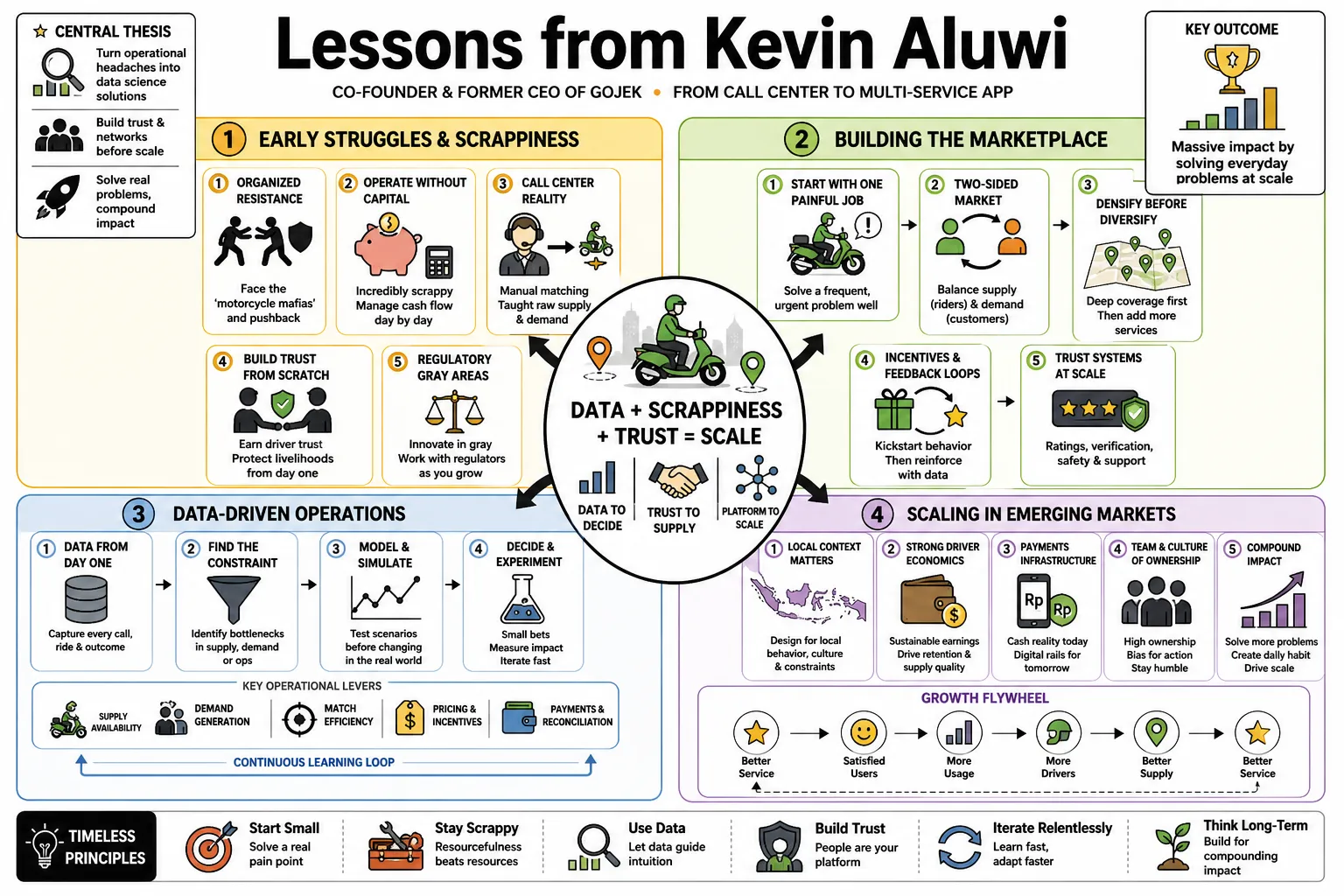
Lessons from Kevin Aluwi
Kevin Aluwi is the co-founder and former CEO of Gojek, where he helped turn a motorcycle taxi call center into an Indonesian multi-service app. He managed the company's early growth and payment infrastructure by treating operational headaches as data science problems. This collection covers his practical advice on building marketplaces and scaling operations in emerging markets.
Part 1: The Early Struggles and Scrappiness
- On facing organized resistance: "When you disrupt an established industry, you have to be prepared to face the 'motorcycle mafias' and physical pushback on the ground." — Source: [Lenny's Podcast]
- On operating without capital: "In the beginning, we didn't have massive funding; we survived by being incredibly scrappy and managing cash flow day by day." — Source: [Lenny's Podcast]
- On the reality of early operations: "Before the app, Gojek was essentially a call center manually matching riders with customers, teaching us the raw mechanics of supply and demand." — Source: [Founders Unfiltered]
- On building trust from scratch: "You can't just build an app; you have to build trust with drivers who are putting their livelihood in your hands for the first time." — Source: [Startup Studio Indonesia]
- On regulatory gray areas: "Innovation in emerging markets often means operating before the regulations are fully written, requiring constant dialogue with the government." — Source: [CNBC Disruptor 50]
- On physical cash management: "Dealing with unbanked drivers meant we had to physically manage cash vaults before we could scale digital payments." — Source: [Lenny's Podcast]
- On the necessity of speed: "When cash is tight and competition is fierce, speed of execution becomes your only defensible moat." — Source: [Founders Unfiltered]
- On embracing unglamorous work: "Building a startup isn't just writing code; it's going into the streets and talking to drivers to understand their daily friction." — Source: [Startup Studio Indonesia]
- On surviving near-death experiences: "We had moments where making payroll seemed impossible, which forces a level of discipline that well-funded startups often lack." — Source: [Lenny's Podcast]
- On defining the early culture: "The early days defined our culture of resilience; if you can survive the taxi mafias, you can survive corporate competition." — Source: [Founders Unfiltered]
Part 2: Data, Intelligence, and Optimization
- On data-driven decision making: "Coming from a business intelligence background, I saw that applying data to optimize pricing and incentives was the key to unlocking scale." — Source: [Data Science Weekend 2018]
- On the limits of intuition: "Gut feeling gets you started, but at a certain scale, you need rigorous data science to balance a two-sided marketplace efficiently." — Source: [CWG Speakers]
- On driver incentives: "You can't just throw money at drivers; incentives have to be mathematically modeled to ensure long-term platform sustainability." — Source: [Lenny's Podcast]
- On algorithmic matching: "The core of our efficiency was building algorithms that could predict demand spikes and position supply before the user even opened the app." — Source: [Data Science Weekend 2018]
- On measuring the right metrics: "Vanity metrics look good on a pitch deck, but unit economics and retention are what actually keep the business alive." — Source: [Startup Studio Indonesia]
- On data democratization: "Data shouldn't just sit with the analytics team; it needs to be accessible to product managers so they can make real-time decisions." — Source: [Data Science Weekend 2018]
- On the value of experimentation: "We built a culture where running A/B tests on pricing and features was the default, not the exception." — Source: [CWG Speakers]
- On balancing data and empathy: "Data tells you what is happening, but you still need empathy for the consumer to understand why it is happening." — Source: [Startup Studio Indonesia]
- On the future of AI: "The biggest bottleneck for tech in Southeast Asia is not compute infrastructure, but the actual adoption of AI-native products by businesses." — Source: [Tech in Asia]
Part 3: Managing Hyper-Growth
- On scaling fast: "Growing 100% month-over-month for a year breaks every system you have; your only job is to rebuild them faster than they collapse." — Source: [Lenny's Podcast]
- On infrastructure debt: "When you scale that quickly, technical debt is inevitable; the skill is knowing which debt to pay down and which to live with." — Source: [Founders Unfiltered]
- On the chaos of success: "Gojek's trajectory was truly one of the most amazing growth stories in the history of technology, and with that came unprecedented operational chaos." — Source: [Life at Gojek]
- On organizational design: "The org chart you have at 100 people will actively harm you at 1,000 people; you must constantly restructure for the next phase." — Source: [Startup Studio Indonesia]
- On maintaining focus: "Hyper-growth brings endless opportunities; the hardest part as a founder is saying no to the distractions and focusing on the core engine." — Source: [Lenny's Podcast]
- On hiring ahead of the curve: "You have to hire leaders not for the company you are today, but for the company you will be in six months." — Source: [Founders Unfiltered]
- On process vs. agility: "Adding process is necessary as you grow, but you have to fight to ensure that process doesn't kill the speed that made you successful." — Source: [CWG Speakers]
- On managing investor expectations: "When growth is a rocketship, investors expect it to never slow down, requiring careful management of expectations and unit economics." — Source: [Lenny's Podcast]
- On the physical toll of scale: "The sheer physical and mental endurance required to manage a hyper-growth company is something no book can prepare you for." — Source: [Founders Unfiltered]
Part 4: The Super App Strategy and Product Focus
- On shifting focus from subsidies: "Our industry focused a lot on promo, promo and promo, but improvements in our services are not yet proportional with our business growth." — Source: [Oxford Business Group]
- On the Super App thesis: "The concept of a Super App wasn't just about doing everything; it was about leveraging a shared logistics network and payment infrastructure across multiple verticals." — Source: [CNBC Disruptor 50]
- On user retention: "Moving beyond burning cash means we must focus entirely on improving the user experience for services like GoFood and GoPay to achieve sustainable success." — Source: [Oxford Business Group]
- On the food delivery market: "The South-east Asian online food delivery market has immense potential, accelerated heavily by the shifts in consumer behavior during the pandemic." — Source: [Oxford Business Group]
- On ecosystem lock-in: "When a user relies on you for transport, food, and payments, the friction to leave the ecosystem becomes much higher than a standalone app." — Source: [CNBC Disruptor 50]
- On prioritizing features: "You can't build every service at once; you have to sequence product rollouts based on what drives daily active usage." — Source: [Startup Studio Indonesia]
- On payment as the foundation: "GoPay was the critical layer; once you control the digital wallet, you reduce friction for every other transaction on the platform." — Source: [Oxford Business Group]
- On offline-to-online transitions: "We weren't just building software; we were actively bringing offline merchants into the digital economy for the first time." — Source: [Founders Unfiltered]
- On adapting to local needs: "A copy-paste strategy from Silicon Valley fails in Southeast Asia; you must build products that respect the nuances of local infrastructure." — Source: [CNBC Disruptor 50]
- On continuous improvement: "A product is never finished; as soon as you launch a new service, you have to look at the data and figure out why people are dropping off." — Source: [Startup Studio Indonesia]
Part 5: Leadership, Culture, and Talent
- On unearthing great people: "We try to avoid rigid formulas in hiring because we believe that talent that is extraordinary can emerge from anywhere." — Source: [Life at Gojek]
- On founder transitions: "When Nadiem left for the government, his achievement became an inspiration for everyone; he left the company while it was at its top." — Source: [Tempo]
- On co-founder dynamics: "A successful partnership requires immense trust and the ability to have brutal, honest disagreements behind closed doors." — Source: [Founders Unfiltered]
- On building culture: "Culture isn't what you write on the wall; it's how your team behaves when the servers go down and customers are angry." — Source: [Startup Studio Indonesia]
- On the transition to CEO: "Stepping into the CEO role means shifting your focus from solving problems yourself to building the team that can solve the problems." — Source: [CWG Speakers]
- On managing egos: "As a company grows, you have to manage the egos of brilliant people and ensure everyone is aligned toward the company's mission, not personal glory." — Source: [Startup Studio Indonesia]
- On radical transparency: "Sharing the hard truths with your team builds trust; people can handle bad news, but they cannot handle being kept in the dark." — Source: [Lenny's Podcast]
- On delegating power: "You have to hire people who are better than you in specific areas and then actually let them do their jobs without micromanaging." — Source: [Founders Unfiltered]
- On preserving agility: "The biggest risk of scaling is becoming a slow bureaucracy; leadership's job is to continually cut red tape." — Source: [CWG Speakers]
Part 6: Personal Journey and Risk-Taking
- On family pressure: "My parents were pressuring me a lot. 'Get an MBA,' they said. 'Why don't you just work in finance or consulting?'" — Source: [Squarespace]
- On leaving finance: "Leaving a stable career in investment banking to build a startup in Indonesia was a calculated risk that required ignoring conventional wisdom." — Source: [Founders Unfiltered]
- On the Zalora experience: "My time at Zalora taught me the mechanics of e-commerce and operations, which was invaluable preparation for the complexity of Gojek." — Source: [Founders Unfiltered]
- On defying expectations: "Sometimes the best career decisions are the ones that make your family the most nervous." — Source: [USC Marshall Speech]
- On learning through failure: "You learn more from the launches that completely flop than from the ones that succeed immediately." — Source: [Startup Studio Indonesia]
- On the burden of responsibility: "When thousands of drivers rely on your platform to feed their families, the weight of leadership becomes profoundly real." — Source: [USC Marshall Speech]
- On continuous learning: "The founder you are at the seed stage is not the founder needed at the IPO stage; you have to aggressively upgrade your own skills." — Source: [Founders Unfiltered]
- On dealing with imposter syndrome: "Every founder feels in over their head at some point; the trick is to keep executing while you figure it out." — Source: [Lenny's Podcast]
- On long-term commitment: "Building a generational company is a decade-long commitment that requires you to sacrifice a lot of your personal life." — Source: [Founders Unfiltered]
Part 7: Southeast Asia and the Tech Ecosystem
- On regional potential: "Southeast Asia is not a monolith; each country has distinct consumer behaviors, regulations, and infrastructure challenges." — Source: [Tech in Asia]
- On the mobile-first economy: "We didn't have to transition users from desktop to mobile; we built for a population that experienced the internet natively on smartphones." — Source: [CNBC Disruptor 50]
- On bypassing legacy systems: "In emerging markets, you aren't just disrupting legacy industries; you are often building the foundational infrastructure from scratch." — Source: [Oxford Business Group]
- On local vs. global competition: "Multinational competitors have deep pockets, but local players win by having a deeper, more nuanced understanding of the on-the-ground reality." — Source: [Lenny's Podcast]
- On the talent ecosystem: "The success of early startups created a mafia of talent that is now seeding the next generation of founders in Indonesia." — Source: [Tech in Asia]
- On regulatory collaboration: "You have to view the government as a partner, not an adversary, especially when your platform impacts national employment metrics." — Source: [CWG Speakers]
- On the impact of COVID-19: "The pandemic compressed five years of digital adoption into a few months, permanently altering consumer expectations for delivery and digital services." — Source: [Oxford Business Group]
- On capital efficiency: "The era of unlimited capital is over; startups in Southeast Asia must now prove a clear path to profitability earlier in their lifecycle." — Source: [Tech in Asia]
- On the future of venture capital: "As a venture partner, I look for founders who understand that solving unglamorous, hard operational problems is where the real value lies." — Source: [Tech in Asia]
Part 8: Resilience and Long-Term Vision
- On surviving crises: "Resilience is not about avoiding mistakes; it's about the speed at which your organization can recover and adapt to them." — Source: [USC Marshall Speech]
- On social impact: "We proved that a business can be highly profitable while simultaneously pulling millions of people out of the informal economy." — Source: [Data Science Weekend 2018]
- On defining success: "Success isn't just a valuation; it's walking down the street in Jakarta and seeing a sea of green jackets knowing you created those jobs." — Source: [Founders Unfiltered]
- On the importance of stamina: "Entrepreneurship is a marathon of sprints; you have to pace yourself or you will burn out before you see the compound returns." — Source: [USC Marshall Speech]
- On navigating uncertainty: "When the future is completely opaque, as it was during the pandemic, you have to communicate clearly and decisively, even if you are unsure yourself." — Source: [USC Marshall Speech]
- On empowering lives: "Technology is useless unless it is applied to solve real human problems; our mission was always about empowering the daily lives of Indonesians." — Source: [Data Science Weekend 2018]
- On legacy: "The ultimate test of a founder is whether the company can thrive and continue to grow after they have stepped away from the CEO role." — Source: [Tempo]
- On the value of conviction: "When everyone tells you an idea won't work in your market, you need the stubborn conviction to prove them wrong through execution." — Source: [Lenny's Podcast]
- On balancing ambition and reality: "You need a grand vision to attract talent and capital, but you need ruthless pragmatism to survive the next thirty days." — Source: [Startup Studio Indonesia]
- On the entrepreneurial spirit: "The most important trait for a founder is an unreasonable optimism that you can bend reality to your will, combined with the work ethic to make it happen." — Source: [USC Marshall Speech]